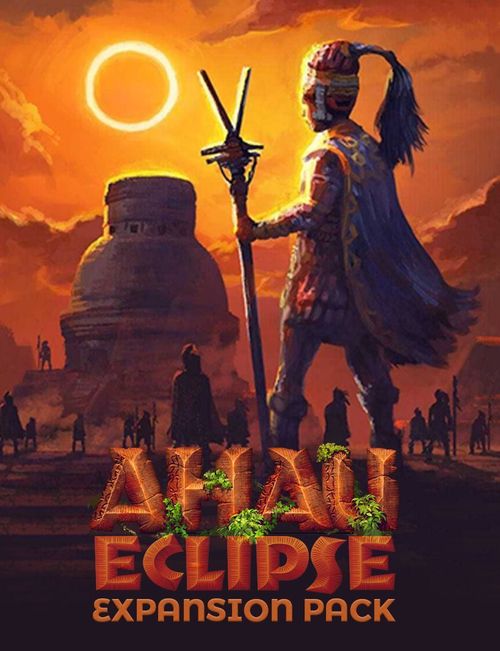
Ahau: Eclipse
Ahau: Eclipse Rulebook
Table of Contents
Table of Contents
Components
The Eclipse expansion adds the following extra components to the base game:
- 5 Building Tiles
- 6 Role cards
- 14 Event Cards
- 6 Personality Cards for the Solo Game
- 15 Special Pyramid Tiles
Transcriber's note: the sheet's component list shows 6 Personality Cards for the Solo Game, but the sheet prints no rules text for them. The solo-game effects for King Pakal that the sheet does print are given under Event Cards, Extra Role Cards, and the Special Pyramid tiles sections below.
This expansion may be played with the Shadow Player Mode or the Solo Game, but is not compatible with Ahau Family.
Setup
To play with the Eclipse expansion, set up and play as for a normal game, with the following changes:
- Step 4: add the 15 Special Pyramid tiles from this expansion to the bag along with those from the base game.
- Step 5: include the 5 Building tiles from this expansion along with those from the base game.
- Step 10: use the 6 Role cards from this expansion instead of the base game ones (return those to the box).
At the end of setup, shuffle the Event cards to form a face-down deck next to the board. Then, flip the top card face up and place it back on top of the deck. This card is called the 'Future Event'.
Gameplay
Event Cards
The Event cards represent Events that may take place over the course of the game. With the exception of the first round, every round of the game will be affected by an Event, with each one being foreshadowed by the Future Event (the face-up card on top of the Event deck, which always depicts the Event that will happen in the next round), giving players some time to prepare for it.
Therefore, the Future Event revealed during setup will take effect in the second round of the game: at the end of the first round, place this Future Event to the left of the deck to become the 'Current Event' for the second round, and flip the next card in the deck face up as the new Future Event.
Continue in the same way: at the end of each subsequent round, discard the Current Event card into a face-up discard pile and replace it with the Future Event card. Then, flip the top card of the deck face up. Should the Event deck become depleted after revealing a new card as a Future Event, shuffle the discarded cards and form a new face-down deck underneath the Future Event.
During the second and each subsequent round, apply the effects of the Current Event card. See the Event card effects below for details of all Event card effects.
Role Cards and Building Tiles
The Role cards and Building tiles from this expansion work in the same way as in the base game. See the Extra Role Cards and Extra Building Tiles sections below for their abilities and effects.
Special Pyramid Tiles
This expansion introduces three new types of Pyramid tile. These cannot be used to summon Gods (since they do not show God symbols), and instead have the following effects:
Tiles showing 4 Fame each: When built, each tile awards 4 Fame, in addition to any adjacency bonuses. The "4 Fame" symbol is considered its own type of symbol for the purposes of scoring adjacency bonuses.
Tiles showing an arrow only: When you build one of these tiles, place it in your Pyramid with its arrow pointing either left or right: it is now considered to have the same colour and symbol as the tile its arrow is pointing to (including when scoring adjacency bonuses). While it is pointing to an empty space (or if it is pointing out of one side of your Pyramid), it retains its original colour, and for these cases the arrow is considered its own type of symbol for the purposes of scoring adjacency bonuses.
Note: It is not permitted to build one of these tiles with its arrow pointing to another arrow tile.
Tiles showing a Resource only: Each of these tiles may be discarded from your reserve in exchange for a resource of a matching colour. When built, the diamond symbol on these tiles is considered its own type of symbol for the purposes of scoring adjacency bonuses.
Special Pyramid Tiles and the Shadow Player Mode
When the Shadow Player moves its Ruler after losing a Conflict or it is its turn to take a Pyramid tile in the Movement Phase, it will prioritise Special Pyramid tiles ahead of those showing Gods, in the order of preference from top to bottom as listed above (i.e., 4 Fame > arrow > Resource).
Special Pyramid Tiles in the Solo Game
(Solo: King Pakal) When it is King Pakal's turn to take a Pyramid tile in the Movement Phase, or when he builds a Pyramid tile and there is more than one tile that would gain him the most Fame, he will prioritise some Special Pyramid tiles ahead of those showing Gods, with the following order of preference: 4 Fame > arrow > God > Resource.
(Solo: King Pakal) When King Pakal gains a Special Pyramid tile showing a Resource in any way, he immediately discards the tile and gains 1 Resource.
(Solo: King Pakal) When King Pakal builds a Special Pyramid tile the effects are as described above, with the addition that when he builds a tile showing an arrow, he builds it with the arrow pointing to the left (unless he builds it in the first space on a Pyramid level or immediately to the right of another arrow tile, in which cases he points the arrow to the right).
Event Cards
Note: When playing with the Shadow Player Mode, the Shadow Player is not affected by, and does not benefit from, any Events.
Note: Effects for King Pakal in the Solo Game are marked (Solo: King Pakal) (printed in red in the original).
1. Ritual
When summoning a God, you may place a Player marker at the corresponding Temple even if you summon using only discarded tiles (you may still have at most 1 marker in each Temple).
(Solo: King Pakal) At the start of the round, place one of King Pakal's Player markers on a Temple where he does not yet have one and that would currently gain him the most Fame in a K'atun Celebration scoring (but do not award that Fame now). If tied, select the tied Temple corresponding to his least-preferred God. Award him the Fame shown on the space where his marker is placed. If King Pakal already has markers at all Temples, do nothing instead.
Transcriber's note: the sheet prints "K'atun CelerbartionCelebration" here, a typo for "K'atun Celebration", which is what is transcribed.
2. Fertile Lands
After placing a Worker in your Action Phase, you may spend 1 Corn to lay down one of your Workers in any City.
(Solo: King Pakal) At the end of his "Place a Worker" step, if possible, King Pakal spends 1 Resource to lay down the Worker he placed this turn.
3. Drink of the Gods
When summoning a God, you may spend 1 Cacao to gain +2 Action Strength.
(Solo: King Pakal) When summoning a God, if possible, King Pakal spends 1 Resource to gain +2 Action Strength.
4. Plentiful Harvest
If you produce in your "Produce or Build" step, you may spend 1 Water to produce again, depleting a second Production Site and gaining Resources as per the normal rules.
(Solo: King Pakal) At the start of the round, King Pakal gains 1 Resource.
5. Flourishing Cities
After placing a Worker in your Action Phase, if you have more Workers in that City than any other player, you may lay that Worker down.
(Solo: King Pakal) At the start of the round, lay down one of King Pakal's Workers in a City, selected in the following order of preference:
i. A City in which doing so would win him majority.
ii. Otherwise, a City where he has at least 1 Worker.
In each case, break ties in favour of tied Cities matching King Pakal's least-preferred God. If still tied, select the tied City that is closer to the top of the board.
6. Limestone Deposits
At the end of your "Produce or Build" step, you may spend 1 Limestone to build 1 additional tile, irrespective of whether you chose to produce or build (you must still spend the Resources required to build the additional tile).
(Solo: King Pakal) At the end of his "Produce or Build" step, if he has enough Resources to do so, King Pakal spends 1 Resource to build 1 additional tile (he must still spend the Resources required to build the additional tile).
7. The Might of Teotihuacan
If, at the end of your "Summon a God" step, you have more than 1 Worker in the City where you placed a Worker this round, you must skip your "Produce or Build" step.
(Solo: King Pakal) When selecting a City in which to place a Worker this round, King Pakal will prioritise Cities where he does not have any Workers over those where he has at least 1 Worker. He carries out his "Produce or Build" step as normal, irrespective of how many Workers he has in the City where he placed a Worker this round.
8. Conquest
If you participated in a Conflict this round, at the start of your Action Phase (and before placing a Worker this round), you may lay down one of your Workers in any City.
(Solo: King Pakal) After placing a Worker this turn, King Pakal lays down that Worker (he does so whether or not he participated in a Conflict).
9. Inland Rains
If you produce in your "Produce or Build" step by depleting an inland Production Site, gain 2 additional Resources of the corresponding type.
(Solo: King Pakal) At the start of the round, King Pakal produces at an inland Production Site (following the normal rules) and gains 2 additional Resources. This is in addition to his normal "Produce or Build" step.
Note: Inland Production Sites are those located on roads (represented by solid white lines between Cities). Production Sites on water routes (dotted white lines) are on the coast and are not inland.
10. Obsidian Deposits
During your Action Phase, the first time you gain Obsidian (in any way), gain 1 Weapon too.
(Solo: King Pakal) At the start of his Action Phase, if possible, King Pakal spends 1 Resource to gain 1 Weapon.
11. Military Might
In a Conflict, your Military Strength is determined by the number of Workers you have adjacent to the contested Region (ignore the value of your right-hand card and your Weapons).
(Solo: King Pakal) In a Conflict, King Pakal's Military Strength is determined by the number of Workers he has adjacent to the contested Region (ignore the value of his right-hand card and his Weapons).
12. Dominion
In the "Select Regions" step, do not play any cards. Instead, each Ruler remains in the same Region as the previous round.
(Solo: King Pakal) In the "Select Regions" step, King Pakal does not play any cards and instead leaves his Ruler in the same Region as the previous round.
13. Volcano Eruption
At the end of the Movement Phase, if your Ruler is in Region 4, you must move it to an adjacent unoccupied Region, or if there are none, to any unoccupied Region.
If you produce in your "Produce or Build" step by depleting a Production Site adjacent to Region 4, gain 1 additional Resource of the corresponding type.
(Solo: King Pakal) At the start of the round, if possible King Pakal depletes a Production Site adjacent to Region 4 to gain 1 Resource. Select the Production Site according to the normal rules for King Pakal's produce actions.
14. Desolation
When summoning a God, do not place a Player marker at the corresponding Temple, even if you summon using at least 1 tile from your Pyramid.
(Solo: King Pakal) When summoning a God, King Pakal does not place a Player marker at the corresponding Temple.
Extra Role Cards
Note: Abilities for King Pakal in the Solo Game are marked (Solo: King Pakal) (printed in red in the original).
Weaver
At the end of your Action Phase this round, gain 1 Fame for each of your built-in Pyramid tiles matching the colour of any Production Sites on the Calendar track.
(Solo: King Pakal) At the end of King Pakal's Action Phase this round, he gains 1 Fame for each of his built-in Pyramid tiles matching the colour of any Production Sites on the calendar track.
Ballgame Player
Immediately before resolving Conflicts this round, you may move any other player's Ruler from an adjacent Region to the Region occupied by your Ruler.
(Solo: King Pakal) In the Movement Phase this round, if your Ruler is in an adjacent Region to King Pakal's Ruler and he would win a Conflict against you, King Pakal will move your Ruler into the Region containing his Ruler.
Astronomer
After revealing cards in the Movement Phase this round, you may take 1 discarded Event card and place it next to your Player board. Its Event will apply to you (and only to you) for this round, in addition to the Current Event. At the end of this round, return it face down to the bottom of the Event deck before the new Future Event is revealed.
(Solo: King Pakal) At the start of King Pakal's Action Phase this round, take the lowest-numbered Event card (if any) from the discard pile and place it next to his Player board. Its Event will apply to him (and only to him) for this round, in addition to the Current Event. At the end of this round, return it face down to the bottom of the Event deck before the new Future Event is revealed.
Farmer
At the start of your Action Phase this round, you may remove a Production Site tile from the Calendar track and place it on any empty Production Site space on the board to gain 1 matching Resource for each of your Workers adjacent to it. Then, slide back any other Production Site tiles on the Calendar track to fill any gap.
(Solo: King Pakal) At the start of King Pakal's Action Phase this round, remove the first Production Site tile from the Calendar track and place it on the empty Production Site space that is adjacent to the highest number of his Workers (if tied, select the tied space closest to the top of the board). King Pakal gains 1 Resource for each of his adjacent Workers. Then, slide back any other Production Site tiles on the Calendar track to fill any gap.
Scribe
When summoning a God in your Action Phase this round, you may use matching Pyramid tiles in your reserve without discarding them.
(Solo: King Pakal) When summoning a God in his Action Phase this round, if King Pakal summons a God that matches any number of tiles in his reserve, he gains +1 Action Strength for each matching tile (before and in addition to any Action Strength he may gain from discarding any tiles under the normal rules).
Sajal
This round, each time another player places or moves their Worker into a City adjacent to the Region occupied by your Ruler, you gain 1 Resource of your choice.
(Solo: King Pakal) This round, if you place or move a Worker into a City adjacent to the Region occupied by King Pakal's Ruler, King Pakal gains 1 Resource.
Extra Building Tiles
Barracks
Before resolving a Conflict you are involved in, you may spend 1 Obsidian to automatically win the Conflict.
Great Ball Court
Once per round, you may gain +1 Action Strength when summoning.
Great Plaza
Once per round, you may use the effect of another Building tile from the offer. If you do, discard that Building from the offer.
Observatory
Once per round, during your turn you may look at the top two face-down cards in the Event deck and, optionally, move one of those cards to the bottom of the deck.
Sweatbath
Once per round, you may spend 1 Water to lay down 1 of your Workers in any City.
Laid-Down Workers
Transcriber's note: the sheet prints this general note in the same column as the Sweatbath tile, with no heading of its own. It is a general rule, not part of the Sweatbath tile's effect.
Unless otherwise stated, a Worker that is lying down counts as 2 Workers for all game purposes. Should you need to remove one of your Workers for any reason you may instead stand one of your laid-down Workers back up, making it a single Worker again.