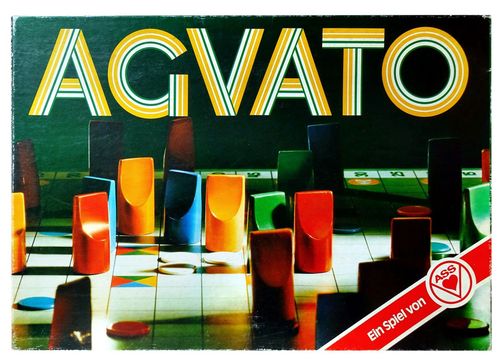
Agvato
Agvato Rulebook
Table of Contents
Table of Contents
Components
- 1 game board
- 20 chips in five colours
- 36 playing pieces in four colours
- 60 move cards
- 4 colour-value sheets
- 2 to 4 players
Goal of the Game
Each player has nine playing pieces of one colour. The move is predetermined by the move card. Players decide for themselves with which of their nine pieces to carry out the move.
The aim is to collect as many of the chips lying on the board as possible, which gives the most points. The combinations of chips in different colours are decisive (see the colour-value table).
Hitting an opponent weakens them and gains further points. At the end of the game, the position of each player's own pieces on the board is scored. Pieces should be placed as close as possible to the goal line lying opposite the player's start line, which can gain further points.
Translator's note: the printed sheet reads "nahe 6er gegenüberliegenden Ziellinie". The "6er" appears to be a misprint or OCR error for "der" and is transcribed here as "the opposite goal line".
Important: During the game, keep track of which of your pieces can score the most points.
Setup
The move cards are shuffled and placed face down on the table as a stack.
Each player receives nine playing pieces of one colour. They place them on the marked points (marked with a © symbol) of their start line. Then the chips are placed on the matching coloured spaces of the board. Finally, each player receives a value table. From it, the point values of the various chip combinations can be read.
Translator's note: the printed sheet has the symbol "©" at the marked points, read here as a marker symbol. The value table referred to here is not part of this sheet.
Turn Sequence
One player takes a move card from the stack and carries out the move drawn on it with one of their pieces. Whoever draws a card marked "Extra" may draw two more cards, which they place face down in front of themselves. The first card is turned face up and the move it shows is carried out. Only then is the second card turned face up and its move carried out. Play goes on around the table in this way, in turn.
When the stack of cards is used up, the cards are shuffled and cut again before new play begins.
Movement
The move cards show the path for the players' pieces. The moves are numbered. In the order of the numbers, the player moves any one of their pieces from space to space. The black circle marks the current position of the piece. The red circle marks the space on which a player can collect the chip or capture the opposing piece.
If a player cannot carry out the prescribed move, or can only carry out part of it, they receive 25 penalty points.
If a player moves one of their pieces onto a four-coloured space in the middle of the board, they must set that piece back onto the four-coloured space in front of their own start line.
A piece that reaches the goal line can no longer move. It stays where it is.
Capturing Chips and Pieces
A player's move brings a piece onto the space of a chip or of an opposing piece. The space is marked with a red circle on the move card. This means that capture takes place on that space. The player receives the chip or the piece. A captured piece is credited to them immediately. The points depend on the position of the captured piece (see Scoring).
Capture is not allowed on the start line or the goal line.
Regaining a Lost Piece
When a player's piece reaches the goal line, they may claim back a lost piece. They first ask their left-hand neighbour, then the other players in turn. The returned piece is placed on one of the two square black spaces in front of the player's own start line.
Translator's note: the printed sheet ends this sentence with "dann reihum" and gives no further detail. The text is transcribed as printed.
End of Game
The last chip has been captured. The players may also continue playing until all pieces have reached the goal line. The game is then over.
The winner of this unusual tactical game is the player with the most points.
Scoring
Points are of two kinds:
- Points that are noted during play, immediately.
- Points that are determined after the end of the game.
Points Noted During Play
Points for captured pieces. A player captures an opposing piece during play and immediately receives the points that correspond to the position of that piece. The number of points comes from the side number scale in the colour of the player whose piece was captured.
Examples:
- Yellow captures a Blue piece six spaces in front of the Blue start line. The blue side number scale shows 35 at the same height. Yellow receives +35.
- Yellow captures a Green piece twelve spaces in front of the Green start line. Yellow receives +65.
Penalty points. A move prescribed on a move card that cannot be carried out earns 25 penalty points.
Example: Yellow has all of its pieces on the start line and draws a move card. That card prescribes a backward sequence of moves. This move is not possible, because it would lead off the board. Yellow receives 25 penalty points.
Points Determined After the Game
Captured pieces. Each captured piece that a player still holds at the end of the game counts 50 points.
Example: Yellow holds three playing pieces at the end of the game. 3 x 50 = +150.
Position of one's own pieces. The number of points comes from the side number scale in the player's colour.
Example: Yellow has four yellow pieces. They stand on the 10th, 11th, 13th and 14th spaces in front of the start line. This gives 55 + 60 and 70 + 75, so +260.
Colour combinations of captured chips. The combinations and their corresponding point values are read from the value table.
Example: Yellow has 2 yellow chips, 1 blue chip, 2 green chips and 3 white chips. According to the value table, this gives the combinations 2 green chips and 3 white chips, which score +2000, and 2 yellow chips and 1 blue chip, which score +130.
Translator's note: the value table is not part of the printed sheet. The point values of +2000 and +130 are transcribed from the example as printed.
Final Result
The plus points of the players are added together. The penalty points are subtracted from the total.
Example, Yellow: the printed total for Yellow is +2640. Penalty points of 25 are subtracted, giving a final result of +2615.
Tip
Before the game begins, draw up a score list. In it you can enter the points of each player and easily determine the winner.
The printed score list has columns for players A, B, C and D, and the following lines:
- During play: capture points
- Penalty points (25)
- After the end of the game: captured pieces (50)
- Position
- Colour combinations
- Result