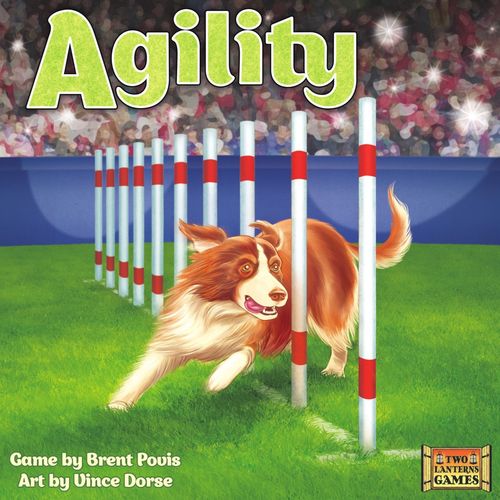
Agility
Agility Rulebook
Table of Contents
Table of Contents
Objective
Agility is a game for 2 players. You are training a team of dogs to compete on obstacle courses. The first player to adopt three dogs and lead all three of them completely through their courses to the Finish Line wins the game.
Components
- Dog Display – Five dog cards are available for adoption at any time. Whenever a dog is adopted, the display immediately refills back up to five.
- Courses – Six courses are in play each game, chosen from a total of sixteen printed across eight double-sided course boards. Each course is a line of obstacles running from a Paw Prints starting space to a Finish Line. A base course has five obstacles, one of which is always a Pause Box (a special obstacle); the rest are drawn from Weave Poles, A-Frames, Tunnels, Hurdles, and Open Ground. A course can only be claimed by a player once one of that player's adopted dogs is placed on it.
- Action Board – A rondel of nine action tiles, chosen from a pool of thirteen possible tiles (see Action Tiles), arranged around a track. A Counting Marker moves along this track over the course of the game.
- Training Cards – Each Training Card shows a large number (used to move the Counting Marker on the Action Board) and a choice of two training-resource rewards, each in its own color and quantity. Players begin with a hand of three Training Cards, refilled from a shared deck and display of face-up cards.
- Training Cubes – Five colors of training resource: Yellow (Agility), Red (Trust), Blue (Jump), Green, and Black.
- Tokens – Flex Tokens and Exchange Tokens (see Tokens).
- Tiebreak Marker – Awarded as an in-game prize; see End of the Game.
Setup
- Lay out six courses (from the sixteen available) between the two players.
- Build the Action Board rondel using nine of the thirteen action tiles. The four "Clear" tiles (Clear Weave Poles, Clear A-Frames, Clear Tunnels, Clear Hurdles) are normally all included; the four extra tiles — Slip, Intimidation, Inspiration, and Rush — may be swapped in and out of the other tile slots however the group likes, and it is even possible to play without some of the Clear tiles for a different feel. Place the Counting Marker on the Action Board's starting space.
- Reveal five dog cards to form the Dog Display.
- Shuffle the Training Card deck. Deal each player a starting hand of three cards, and turn over cards to form a face-up Training Card display alongside the deck.
- Give each player their pawns and place the Supply of Training Cubes, Flex Tokens, and Exchange Tokens within reach of both players.
Players then take turns, starting with whichever player is chosen to go first.
Your Turn
Every turn is broken into the same steps:
- Play a Training Card.
- Take an Action on the Action Board.
- Adopt a dog (optional).
- Move dogs (optional).
- Refill your hand back to three Training Cards, normally from the face-up display.
1. Play a Training Card
Play one Training Card from your hand face-up to your personal discard pile. Every Training Card shows two possible training rewards — for example, a card might read "three Yellow" on one side of the card and "three Red" on the other. Choose one of the two rewards and collect that many Training Cubes of the indicated color. Which reward you should take depends on the obstacles your dogs are currently facing and the training costs of the dogs currently available for adoption.
The large number printed on the card is used in the next step.
2. Take an Action
Move the Counting Marker forward around the Action Board rondel by the number of spaces shown on the Training Card you just played, then resolve whatever action tile the Counting Marker lands on. See Action Tiles for the full list of what each tile does.
3. Adopt a Dog (optional)
You may adopt one dog from the Dog Display by paying its unique training cost in Training Cubes. Choose a dog whose cost and discounts suit the courses that are still available — see Feature Obstacles below.
To adopt a dog:
- Pay its training cost to the supply.
- Place a pawn for that dog on the Paw Prints (starting space) of any course that has not yet been claimed by an opponent's dog, facing its first obstacle.
- If the dog has a training discount on a particular obstacle type (a "feature obstacle" for that dog), mark any matching obstacles on its course with a discount marker.
- Immediately refill the Dog Display back up to five cards.
A dog cannot be adopted until you have paid its full training cost; there is no adopting "on credit."
4. Move Dogs (optional)
After collecting resources, taking your action, and optionally adopting a dog, you may move your dogs forward along their courses. There are three ways a dog can clear an obstacle and advance:
- Pay the full training cost. Pay the training cost shown for the obstacle your dog is currently facing (discounted if it is a feature obstacle for that dog) to clear it and advance that one dog to the next obstacle.
- Use a matching "Clear" action. If the Counting Marker lands on a Clear Weave Poles, Clear A-Frames, Clear Tunnels, or Clear Hurdles tile, every one of your dogs currently facing that type of obstacle clears it and advances, all at once, for free. Because of this, part of the strategy of Agility is trying to sync up multiple dogs on the same obstacle type so that a single Clear action advances them together.
- Clear a Pause Box. The Pause Box is a special obstacle costing four Red Training Cubes to clear. Clearing a Pause Box immediately triggers a bonus Mini-Turn — see below.
The Pause Box and Mini-Turns
The Pause Box is the one obstacle every course has exactly one of, and it is deliberately the hardest to clear: it costs four Red Training Cubes, so you have to plan ahead for it, either by saving up Red cubes or by using Exchange Tokens to convert other colors into Red when you need them.
Clearing a Pause Box is thematic — your dog pauses there, obediently waiting for its handler's cue — and it rewards you with a Mini-Turn:
- Choose one card remaining in your hand (you do not refill your hand before choosing).
- Play that card face-down to your discard pile, then use its number to move the Counting Marker and resolve a bonus action, exactly as in step 2 of a normal turn.
- A Mini-Turn only grants an action. You may not adopt a dog or pay Training Cubes to move a dog during a Mini-Turn.
Action Tiles
Nine of the following thirteen action tiles are used in the Action Board rondel each game (see Setup). Whichever tile the Counting Marker lands on (or, on a Mini-Turn, whichever tile the played card's number points to) is resolved immediately.
The four Clear tiles and five other core tiles:
- Sweep! Collect the training resource you did not choose when you played your Training Card this turn, in the quantity now indicated.
- Clear Hurdles. All of your dogs currently facing a Hurdles obstacle clear it and advance, for free.
- Acquire a Flex Token. Take a Flex Token.
- Clear Tunnels. All of your dogs currently facing a Tunnel obstacle clear it and advance, for free.
- Acquire an Exchange Token. Take an Exchange Token.
- "Break." Lose (discard) one or two Training Cubes to trash one or two Training Cards from your hand. Refill your hand from the deck and/or the display. This is the only time in the game you may refill your hand from the deck rather than only the face-up display.
- "Boost." Draw a card. Either use its raw printed number for an action (ignore where the Counting Marker actually sits and just match the number to a tile), or receive one Training Cube of a color pictured on the card. You get one or the other, not both. The drawn card goes straight to the discard pile.
- Clear A-Frames. All of your dogs currently facing an A-Frame obstacle clear it and advance, for free.
- "Distraction." Place a "+1" marker matching a specific color on an opponent's obstacle (this cannot target a Pause Box). This raises the cost of that obstacle by one cube of the chosen color for whoever must clear it, stacking on top of any feature-obstacle discount that already applies there.
- Clear Weave Poles. All of your dogs currently facing a Weave Poles obstacle clear it and advance, for free.
Four additional tiles that can be freely mixed into the Action Board in place of any of the above, for a different game each time:
- "Slip." Place an Open Ground tile on an opponent's course. It may not be placed before the first obstacle or after the last obstacle on that course — it must go between two existing obstacles. This effectively adds an extra (non-feature) obstacle to that course, for example turning a five-obstacle course into a six-obstacle one.
- "Intimidation." Your opponent must either accept a Flex Token and reduce their hand to two Training Cards, or (if their hand is already reduced) return to a three-card hand. If cards must be discarded to reach the new hand size, your opponent chooses which to keep and discards the rest face-down, so you do not see what was discarded.
- "Inspiration." Before the game, arrange one Training Cube of each of the five colors in a fixed order. When this tile is used, take the next remaining cube in that order. If all five have already been taken, this action has no effect for the rest of the game.
- "Rush." Place a Rush marker on an opponent's dog. That dog's owner must clear the obstacle the marked dog is currently facing before they may move or adopt any other dog.
Tokens
- Flex Token. Spend one (or more) Flex Tokens to shift the space you resolve on the Action Board one space up or down from wherever the Counting Marker lands, without moving the Counting Marker itself. Spending multiple Flex Tokens at once can shift the resolved space by multiple spaces in either direction.
- Exchange Token. Spend one to exchange all of your Training Cubes of one color for an equal number of cubes of another color. There are no partial exchanges — you must convert every cube of the chosen color.
Feature Obstacles
Every dog card lists a training cost, and most dogs also have one or more "feature obstacles" — an obstacle type that dog is especially good at, shown with a reduced cost or no cost at all for that dog to clear. For example, one dog might clear Open Ground and Tunnels for free and pay one cube less than usual on Hurdles, while the top competitor in the game clears Open Ground for free and pays one cube less than usual on every obstacle type.
When choosing which dog to adopt, weigh its training cost and feature obstacles against the courses that are still unclaimed — a dog whose feature obstacles match its course can save a great deal of training over the course of the game.
End of the Game
The first player to adopt three dogs and lead all three of them all the way through their courses — clearing every obstacle, including the Pause Box, and reaching the Finish Line — wins the game immediately.
In-game prizes. There are exactly two prizes available during the game, and it is rare for the same player to win both:
- The first player to have adopted all three of their dogs receives a prize: choose either a Flex Token or an Exchange Token.
- The first player to finish (fully clear) a course with a dog receives a prize: choose either a Flex Token or an Exchange Token. If you choose the Exchange Token here, you also take the Tiebreak Marker.
Equal turns and ties. Agility is designed so that both players get an equal number of turns. The one situation this affects is the Tiebreak Marker: if the player holding the Tiebreak Marker finishes all three of their courses, they win outright, even if — on what would otherwise be the very next turn — their opponent would also have completed all three of their courses. Holding the Tiebreak Marker breaks a tie in its holder's favor.