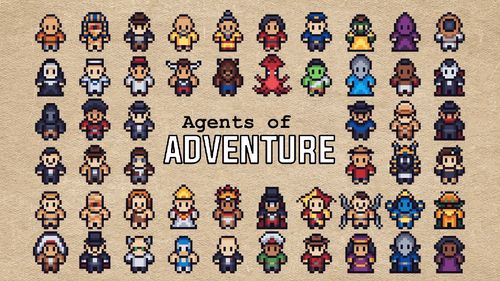
Agents of Adventure
Agents of Adventure Rulebook
Table of Contents
Table of Contents
Input and Output Randomness
Randomness in most board games is output randomness. You make a decision and then roll dice to determine the outcome of your decision. Output randomness leaves you at the mercy of luck and can penalise good play.
Output Randomness: Player Choice > Randomness > Outcome
Agents of Adventure favours input randomness. Through card draws and dice rolls, you are presented with a set of randomised circumstances. You have to decide the best way to deal with those circumstances, but there is little randomness in the outcome of your choices. Input randomness rewards good play.
Input Randomness: Randomness > Player Choice > Outcome
Components
Base Game Cards
- 8 hero cards
- 20 motivation cards
- 6 masterminds
- 6 encounter sets (each of 8 cards)
- 6 missions
- 1 time tracker
- 1 player reference card
Haunted, Noir and Temporal Expansion Cards
- 6 hero cards
- 3 masterminds
- 3 encounter sets (each of 8 cards)
- 3 missions
Other Components
You will also need to supply the following components.
- 24 6-sided dice (12mm work best)
- 24 red health counters (red dice also work)
- 12 green poison counters (green dice also work)
- 1 time counter
Setup
- Choose 1 mission.
- Choose any 1 mission from your collection.
- Choose 1 mastermind.
- Choose any 1 mastermind from your collection and set it aside, out of play.
- Form the encounter deck.
- The encounter deck of 24 cards is made by combining three encounter sets of 8 cards.
- 1 of the encounter sets must share a set icon with the mastermind.
- The other 2 encounter sets can be chosen or selected randomly.
- Shuffle the encounter deck and place it face-down in your play area.
- Choose 3 heroes.
- Choose any 3 heroes from your collection to form your team.
- It is generally best to choose a balanced team with at least one hero who is good at dealing damage, one who can absorb a lot of damage and one who rolls a lot of dice.
- Advanced players may wish to draft their team of heroes instead. To do this, draw 2 random heroes, keep 1 and shuffle the other back into your collection. Repeat until you have a team of 3 heroes.
- Place the motivation deck.
- Shuffle the motivation deck and place it face-down in your play area.
Your First Game
For your first game, use the following setup.
- Heroes: Lord Hawthorne, Wyoming Ross, Sister Judith
- Mission: Search for the Grail
- Mastermind: Mecha-Hitler
- Encounter Deck: Triads, Ocean, Nazis
The Game Round
The game round is made up of 7 phases.
- Draw.
- Draw encounter cards equal to the draw value of the mission and place them face-down.
- Reveal the face-down cards one at a time, resolving any effects immediately.
- Villains and permanents are placed in the staging area (unless card instructions tell you to do otherwise).
- Instants are discarded, once resolved.
- Start of the round.
- Resolve any start of the round effects on cards in play.
- If there are multiple start of the round effects, you can decide which order to resolve them.
- Engage.
- Engage every villain in the staging area with a hero.
- Heroes may have a maximum of 3 villains engaged with them (see Engagement).
- Incapacitated heroes cannot have villains engaged with them.
- Hero turns (x3).
- Activate each hero once.
- You may activate your heroes in any order. The order can change each round.
- See Hero Turns.
- End of the round.
- Resolve any end of the round effects on cards in play.
Hero Turns
The hero turn is made up of 3 steps.
- Resolve poison.
- Deal true damage to each character in the engagement equal to the number of poison counters on them.
- Remove 1 poison counter from each character that is poisoned.
- Roll.
- Roll dice equal to the dice stat of the active hero and add them to that hero's dice pool.
- Place dice and resolve mandatory actions.
- Place dice from the active hero's dice pool and resolve mandatory actions in the engagement in speed order, from 0 to 6. Dice are resolved as soon as they are placed.
- If two actions have the same speed, you can decide in which order they trigger.
- Dice can be placed to trigger basic and dice actions in the engagement or staging area.
- If, for some reason, a dice cannot be placed, it is lost. This may happen if a dice is added to the dice pool with a faster speed than an action or dice which has already triggered.
Mandatory Actions
Mandatory actions are circular. They are always triggered and do not need a dice to be placed on them in order to trigger. The speed of the action is equal to the number in the circle.
Dice Actions
Dice actions are square. A dice must be placed on the dice action in order to trigger it. The dice must have a value greater than or equal to the number in the square. The speed of the action is equal to the value of the dice.
Once a dice action has a dice on it, you cannot place another dice on that action. That means that most dice actions can only be taken once per round. One exception is if the dice is removed in some way, for example it is converted into a token.
Heroes can place dice on dice actions on any cards in their engagement. This includes:
- Dice actions on their hero card.
- Dice actions on villains.
- The "Motivated" dice action on incomplete motivations.
- Dice actions on any cards attached to the hero.
In addition, heroes can place dice on dice actions on the mission or permanents in the staging area.
Heroes cannot place dice on dice actions in other engagements or villains in the staging area.
Basic Actions
There are two basic actions: attack and rest. To use an attack or rest action, place a dice next to a hero's attack or health stat respectively. The speed of the action is equal to the value of the dice.
Basic actions may be taken multiple times per turn/round by each hero.
See Attack and Rest in the Game Concepts section.
Hero Turn Example
Wyoming Ross is engaged with a Nazi Soldier and a Mad Scientist.
- Resolve poison. No characters are poisoned, so nothing happens during this step.
- Roll. I roll 2 dice and get a 1 and a 4. I add these to Wyoming Ross's dice pool.
- Place dice and resolve mandatory actions.
- Inspiration: The fastest action is Wyoming Ross's roll of 1. I take the 1 from Ross's dice pool and place it on his Inspiration skill, which adds a dice with a value of 6 to Ross's dice pool.
- Weird Invention: Mad Scientist's Weird Invention triggers. The player draws an encounter card (another Nazi Soldier) and adds it to the staging area.
- Basic Attack: Next, we have a tie between Ross's dice with a value of 4 and Mad Scientist's Ejector Seat. I choose to trigger Ross's dice first and make a basic attack against Nazi Soldier. I take the 4 from Ross's dice pool and place it next to his basic attack. This basic attack deals 2-1=1 damage.
- Ejector Seat: Mad Scientist's Ejector Seat triggers. Mad Scientist retreats back to the staging area. As Mad Scientist is no longer in the engagement, he can no longer be targeted by attacks and if he had any more actions, they would not trigger.
- Pistol Shot: The Nazi Soldier's Pistol Shot triggers. He attacks Ross, dealing 2-0=2 damage.
- Second Wind: Finally, Ross can use the 6 he added to his dice pool earlier (due to his Inspiration skill). He triggers Second Wind and makes 2 attacks against Nazi Soldier. I take the 6 from Ross's dice pool and place it on Second Wind. Each attack deals 2-1=1 damage, for a total of 2 damage, killing Nazi Soldier. Ross recovers 1 health.
Card Anatomy
Cards show: Name, Stats, Image, Type | Trait 1 | Trait 2 …, Abilities, and Set. Mission cards also show Stage, Time, Draw and Difficulty.
Game Concepts
Action
There are three types of action in Agents of Adventure which take place within a hero's turn: mandatory actions, dice actions and basic actions. See Mandatory Actions, Dice Actions and Basic Actions in the Hero Turns section.
Some actions can take place outside of a hero's turn, including start of the round, end of the round, instant (see Exclamation Mark), when defeated and when incapacitated (see RIP) actions.
Attack
A character can attack other characters who are engaged with them. An attack can be triggered by a basic attack action, a mandatory action or a dice action.
Defender's health reduction = Attacker's attack – Defender's defence
Some actions may allow a hero to attack "any character in play". These attacks can target characters engaged with them, engaged with other heroes or in the staging area.
Some actions may cause attacks to deal "true damage". These attacks ignore the defender's defence when calculating damage (see Damage and True Damage).
Heroes can only make a basic attack if there is a valid target for that attack.
Attack (Stat)
Attack represents a character's strength in combat and ability to damage other characters (see Attack (Action)).
Attachment
Some cards can become attached to heroes. They give heroes boosts to their stats and/or extra abilities. Once attached, these cards become attachments in addition to their primary card type.
To attach a card to a hero, tuck it under the hero so that only the attachment portion of the card is visible. The attachment portion is everything below the thick black line.
When unattached, the attachment portion of the card has no effect. Actions on the attachment portion cannot be triggered and stat boosts are not applied.
Motivation cards are attached to a hero during the motivation step if they have at least 3 motivation tokens on them (see Motivation).
Cards cannot be attached to incapacitated heroes. Any attachments heroes have when they become incapacitated remain attached to them.
Defeat, Destroy and Discard
Cards can be discarded for a number of reasons, including when they are defeated or destroyed. When a card is discarded, move it to the discard pile.
Characters are defeated when they are reduced to 0 or less health. Cards can be destroyed by effects within the game.
When a hero is defeated or destroyed, they become incapacitated (see Incapacitation).
When the mastermind is defeated, they are removed from play. The mastermind cannot be destroyed. When a minion is defeated or destroyed, discard it.
When any non-character encounter card is destroyed, discard it. Non-character cards cannot be defeated as they do not have health.
A defeated card is not destroyed and vice versa.
Defence (Stat)
Defence represents a character's hardiness and ability to avoid taking damage. Reduce damage a character takes by their defence stat.
Defence has no effect on true damage (see Damage and True Damage).
Dice Pool
A character's dice pool contains all of their dice rolled, but not yet placed this round. During the roll step of a hero's turn, roll dice equal to their dice stat and add them to the hero's dice pool.
Dice (Stat)
A character's dice stat shows how many dice they roll each turn. It represents their speed and mental capacity.
Drafting
When drafting cards, look at the top two cards in the relevant deck. Choose one and shuffle the other back into the deck.
Damage and True Damage
When a character takes damage, either from an attack or from some other effect, subtract their defence from the amount of damage they would take.
Health reduction = Damage – Defence
True damage ignores the target character's defence.
Health reduction = True damage
Encounter
The encounter deck consists of 24 cards taken from 3 different encounter sets. There are three types of cards in the encounter deck: minions, permanents and instants (see Minion, Permanent and Instant).
If you run out of cards in the encounter deck and need to draw a further encounter card, you don't draw. Do not shuffle the encounter discard pile back into the encounter deck unless told to do so by a card effect.
Engagement
An Engagement consists of a hero, their attachments, motivations and all the villains engaged with them.
A hero may not be engaged with more than 3 villains. When a hero is engaged with 3 villains, they are fully engaged.
When you would engage a villain with a fully engaged hero, deal 1 true damage to that hero and return the villain to the staging area instead.
You may not choose to engage a villain with a fully engaged hero if there is another valid hero target who is not fully engaged.
When a hero would become engaged with a villain they are already engaged with, that villain does not move but any other effects triggered by villain engagement still happen.
Exclamation Mark
An action with an exclamation mark is triggered as soon as the card the action is on enters play.
Health (Stat)
Health represents a character's vitality. A character's maximum health is listed on their card next to the heart symbol.
As a character takes damage, their current health is reduced below the maximum. This is represented by placing damage tokens on them.
If a villain is reduced to 0 or less health, they are defeated (see Defeat).
If a hero is reduced to 0 or less health, they are incapacitated (see Incapacitation).
Some actions allow characters to recover health. This is represented by removing damage tokens from them. A character can never recover above their maximum health. If an action would recover a character to above their maximum health, they recover to their maximum instead.
Hero
Heroes are characters that you control. At the start of the game, you choose (or draft) 3 heroes to form your team.
Incapacitation
A hero is incapacitated if they are reduced to 0 or less health.
When a hero is incapacitated, immediately remove all dice and counters from them, their attachments and motivations, but leave any tokens. Return all villains engaged with them to the staging area. Flip their hero card to the "incapacitated" side.
Incapacitated heroes still have an influence on their team. Maybe they are too injured to fight but they are giving advice from afar or perhaps they are unconscious, but their presence still inspires their teammates. This is represented by an incapacitated action.
Instant
An instant is an encounter card which has one or more immediate effects. Once all the effects on an instant card have been resolved, discard it.
Mastermind
The mastermind is the ultimate bad guy in your game of Agents of Adventure.
The mastermind is a villain (see Villain).
The mastermind starts the mission out of play.
When the mastermind is spawned by a game effect, they are added to the staging area.
If the mastermind is defeated, they are removed from play again. The mastermind never enters the discard pile.
The mastermind cannot be destroyed.
Minion
A minion is a low-level bad guy that you will find in the encounter deck.
Minions are villains (see Villain).
When a minion is reduced to 0 or less health, they are defeated. Defeated minions are sent to the discard pile.
Motivation
A motivation card represents a hero's personal goals. For example, a hero could be motivated by the search for love or by greed.
Heroes put 3 motivation tokens on their motivations to complete them. This represents them taking time away from the main mission to pursue their own goals.
Once a motivation is completed, it becomes an attachment which provides a stat boost and an additional ability. This represents a hero's personal growth.
Heroes can only benefit from the stat boost and additional ability (everything below the thick black line on the motivation card) once the motivation is completed and attached to them.
On
A dice is considered to be "on" a character if it is placed on a dice action or basic action on that character's card or attachments.
Unspent dice in a character's dice pool are not on that character.
Tokens, such as motivation tokens, are not on that character and are not considered to be dice.
Permanent
A permanent is an encounter card which stays in play indefinitely. Permanent cards are placed in the staging area. Heroes can interact with and place dice on permanent cards in the staging area.
Poison
Some effects cause poison counters to be placed on characters.
During the resolve poison step of each hero turn, deal true damage to each character in the engagement equal to the number of poison counters on them. Then, remove 1 poison counter from every poisoned character in the engagement. This is not an action.
Rest
Rest is a basic action. When a hero rests, they recover 1 health (see Health (Stat)).
Some abilities may cause heroes to recover more than 1 health when resting.
Heroes can rest when on full health. They will not recover any further health, but effects which trigger when a hero rests still happen.
Retreat
When a villain retreats, they immediately move to the staging area. They are no longer considered to be engaged with a hero and no more of their actions activate this round.
If a villain already in the staging area retreats, they do not move but any effects triggered by a villain retreating still happen.
RIP
The RIP icon appears next to actions which are triggered when a character is defeated, destroyed or discarded.
Scenario
The mission is the objective you are trying to achieve. Scenarios have two stages, A and B.
Set
Encounter cards are all in sets of eight cards. These are identified by sharing a common set icon in the top right of the card.
When forming the encounter deck, you choose three of these sets (to a total of 24 cards). One of the chosen sets must share a set icon with the mastermind.
Stun
When a character is stunned, they cannot take actions for the rest of the round.
Any passive abilities they have are still in effect.
Time
When you set up a mission stage, gain time equal to the time number of that mission stage.
Unless otherwise stated, you lose the game if you run out of time.
Some mission stages are not timed. This will be indicated by a "-" as the time number of that mission stage.
Token
Some actions cause a dice to be converted into a token. In these cases, put the dice on the card image, retaining its value. That dice becomes a token and is no longer considered to be a dice.
As tokens are no longer dice, they are not removed during the clean-up phase.
When dice placed on dice actions are converted into tokens, there ceases to be a dice blocking that dice action. That means that dice action can be used multiple times per round.
Trait
Traits are informational attributes on heroes, masterminds and encounter cards. Traits do nothing on their own but are often referred to by other abilities.
Villain
Both masterminds and minions are villains (see Mastermind and Minion).
Frequently Asked Questions
Bill Thunderhawk's "Spirit Friend" ability: Thunderhawk can negate the next action that would happen this round. That means the next action does not occur. That next action could be a hero or villain action or an action on an instant, permanent or mission card. This ability can negate any kind of action (see Action). The effect expires at the end of the round, so cannot negate actions that happen next round.
El Huracan's "Luchador" ability: When a hero is incapacitated, the following happens in order:
- Remove all dice and counters from them, their attachments and motivations, but leave any tokens.
- Return all villains engaged with them to the staging area.
- Flip their hero card to the "incapacitated" side.
That means "Luchador" deals 2 true damage to every villain that was engaged with him, as they are moved to the staging area in step 2 and the damage is dealt in step 3.
Evelyn's "Hanky Panky" ability: Evelyn can copy another hero's dice action. Replace all references to that hero's name in the ability text with "Evelyn". Evelyn can copy dice actions on completed motivations and other attachments. Evelyn cannot copy basic actions, mandatory actions or passive abilities. Evelyn uses her own stats when calculating damage etc… from the copied action.
Redemption: The RIP effect triggers after defeat, so effects which trigger upon defeat are triggered. Villains retreat. Hero dice pool is emptied.