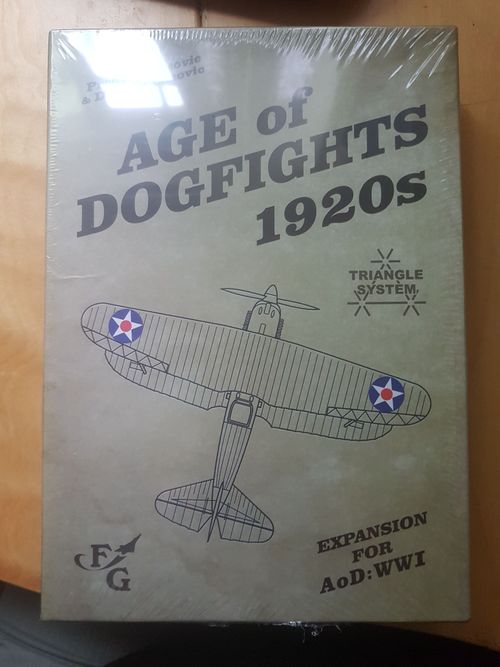
Age of Dogfights: 1920s
Official rulebook: Forsage Games · PDF
Age of Dogfights: 1920s Rulebook
Table of Contents
Table of Contents
Aircraft
This expansion includes 42 types of aircraft (two tokens each) from 11 countries.
Germany, following its defeat in WWI, was banned from operating an air force. Nevertheless, designers and factories continued to produce aircraft, primarily for the civilian market and foreign clients. This expansion includes two types of German planes that were part of the Soviet Air Force.
In the communist Soviet Union (USSR), aircraft production was given priority. Teams were formed around prominent constructors who created some of the most advanced designs of the period. This expansion includes four types, emphasizing the monoplane Tupolev TB-1 bomber, which was a hint of new trends in construction.
The USA, which mainly produced aircraft under foreign license during the war, soon became the leading industrial power in aviation. The army and navy independently developed aircraft for their specific needs. This set includes nine types of American aircraft.
Japan, which had ambitions to dominate the Pacific during the period, also developed and produced many aircraft types for its army and navy. There are five Japanese aircraft types in this set.
Six aircraft types each from the United Kingdom and France are also included. New constructors and manufacturers appeared (Dewoitine, Potez, Lioré et Olivier, Gloster, Hawker, etc.), whose planes proved superior to those from the existing factories (Nieuport, Sopwith, etc.)
Many advanced designs were developed in Italy, but their industry was in stagnation during the 1920s, so few aircraft were produced, of which two types are included in this set.
Many German aces became famous in aircraft designed and manufactured by the Dutch Fokker. After the war, production of several successful aircraft continued, primarily fighter planes, though in much smaller quantities. Although the aircraft were mostly sold to other countries, the three Fokker types in this set have all been given Dutch insignia.
Czechoslovakia had several important aircraft manufacturers in the period, and three types are included in this set. For completeness, the expansion also contains fighters from Norway and Switzerland.
Four Machine Guns
Two aircraft types in this expansion (Curtiss Falcon A3B and Dewoitine D.21) have four fixed machine guns, and one (Tupolev TB-1) has four dorsal machine guns. When firing, add 3 to the total of the red dice.
Alliance Markers
In Age of Dogfights: WWI and all other expansions, aircraft tokens are either black (for Central Powers) or white (for Entente). In the 1920s, the geopolitical situation changed, whereby former opponents became allies and vice versa. There were no major wars during the decade and hence no fixed alliances, so all aircraft tokens here use transparent plastic.
The scenarios in this expansion (or those devised by players themselves) can use any combination of opponents and allies to create exciting gameplay. To identify the two opposing sides in each scenario, every aircraft for one of the two opposing forces should have a colored Alliance marker attached to its current altitude stand.
Additional Altitude Stands
In this expansion, many aircraft have L6 and L7 service ceilings, so the set includes 26 extra altitude stands (16× L7, 5× L6, 5× L5).
Scenarios
The game rules allow for countless initial settings and scenarios. Six scenarios are provided here, using only aircraft from the 1920s, but planes from other expansions and the basic game may also be combined to add further variety.
The scenarios have no historical context due to the lack of significant conflicts in the period, but allow different types of aircraft to be 'tested in combat', though they never were in reality.
The examples in this booklet serve as a guide for players to create their own initial settings and scenarios.
1. 'Military Exercise'
The general staff of France, Switzerland, Italy, Czechoslovakia and Norway have decided to conduct a joint exercise between their air forces. In this exercise, alliances were made between the Central European states of France and Switzerland, against the states surrounding them on three sides: Czechoslovakia, Norway and Italy. The exercise comprises fighter and reconnaissance planes.
This is a modified 'Flying High' scenario (page 14 in the basic rulebook). The distribution of aircraft is French and Swiss on the west side, Norwegian and Czechoslovakian on the northeast and Italian on the southeast.
The battle includes all six French fighters and four scouts from this expansion, together with the two Swiss fighters, for a total of eight fighters and four scouts on the French/Swiss side. The opposing coalition uses all the Czechoslovakian, Italian and Norwegian planes, also totalling eight fighters and four scouts.
Initial aircraft placements and layout of Task Zones are shown in the diagram below. The zones must be photographed from L5 altitude or higher. The winner is determined by counting points, as described under the Reconnaissance section on page 14 of the basic rulebook.
2. 'Partisans in Action'
This scenario takes place during World War II. The Kingdom of Yugoslavia was formed after WWI by merging Serbia and Montenegro with parts of the defeated Austro-Hungarian territories. Initially, the Yugoslav Air Force consisted of French and inherited Austro-Hungarian aircraft, but in the period between the wars, planes were also purchased from Italy, the United Kingdom, Czechoslovakia and Germany. Some aircraft types were manufactured under license (Potez 25, Bréguet 19, Avia BH-33, Hurricane, Do-17, Blenheim, etc.), together with some domestic designs (SIM-XIV, IK-2, IK-3, etc.)
On April 6, 1941, Germany, along with Italy, Hungary, Romania, and Bulgaria, invaded Yugoslavia. The defending aircraft offered significant resistance, but not enough to avoid a general breakdown and capitulation (as early as April 17).
Many working Yugoslav planes were captured, of which newer aircraft types were bought by Romania and Finland, and obsolete aircraft were sold by the Germans to the newly-formed Independent State of Croatia.
Among the pilots in the new state, there were sympathizers of the communist resistance movement led by Marshal Tito (partisans). On May 21, 1942, two planes (Potez 25 and Bréguet 19) fled to the territory controlled by the partisans, creating the first partisan squadron. They went on to fly several missions, bombing enemy troops and dropping leaflets. Although their combat effectiveness was negligible, they had a considerable effect on the morale of the partisans and the people. Both planes were soon destroyed, but the partisans acquired several more, either through defection or capture. Towards the end of the war, with the help of the Allies, Yugoslavia created a strong air force that included Spitfires, Hurricanes, Jak-3, Il-2, etc.
In this scenario, we assume that the partisans have two Potez 25s and two Bréguet 19s at their disposal (with French markings in this set). The Potezs, protected by Bréguet 19s (flying without bombs), have the task of bombing enemy troops in the A and B zones. Four fighters (two BH-21s and Letov Š-20s*) from the Independent State of Croatia are flying to meet them. The game is played on a two-segment board, with initial aircraft placements as shown in the diagram below.
If the partisans drop at least one bomb in each zone, they win. If they hit only one zone, the result is a draw. In all other cases, Croatia wins. The number of destroyed and damaged planes does not affect the result.
*The Croats used Avia BH-33 planes, which are not included in this set. The most similar types included here are the Avia BH-21 (with the only difference being the type of engine) and Letov Š-20. These planes have Czechoslovak insignia.
3. 'Former Enemies'
The British factories that produced the most fighters during WWI (Sopwith, Airco, Royal Aircraft Factory) were left without orders in the post-WWI period, as aircraft from other manufacturers proved superior.
During WWI, the primary opponents of British fighters were Fokkers, which maintained excellent designs during the interwar period. In this scenario, we give 1920s Fokkers the opportunity to engage in dogfights with the latest British fighters.
All six Fokkers take part in the game, fighting against the British Gloster Grebe, Armstrong Whitworth Siskin and Fairey Fox fighters. The Fokker C.V and Fairey Fox both take fighter roles, without bombs. Dogfight mode is used, where every destruction and damage counts. The board consists of two segments, with the British on the northwest side and the Dutch Fokkers on the southeast.
4. 'Future Enemies'
In this scenario, aircraft from the countries that fought epic battles across the Pacific during WWII have the opportunity to engage in combat.
On the Japanese side, all 10 planes from this expansion are participating. Two Mitsubishi B1Ms have the task of torpedoing American ships A and B. All other aircraft fly without bombs.
Two American Douglas T2Ds carry torpedoes, and the other eight fighters (or scouts in fighter role) from this expansion can be chosen by the player.
Symmetrical Bombing mode is used, a variant of 'Zone bombing' from page 15 in the basic rulebook. Instead of land zones, the ship silhouettes (A and B) need to be torpedoed. Initial positions are shown in the diagram below.
The winner is determined according to page 15 of the basic rulebook: each torpedo hit scores 5 points, each destroyed plane scores 1, and each damaged plane scores 0.5.
5. 'Never Enemies'
Although they have been on constant alert for decades, the two militarily strongest countries in the world have never been at war with each other.
In this scenario, it is assumed that, about a hundred years ago, there was an armed incident between the USA and the USSR in the Bering Strait, adjoining the two countries.
Two board extensions are placed on the eastern edge (USA) and the western edge (USSR). All 12 soviet planes from this expansion participate, while on the American side, use all eight planes that can carry a bomb or a torpedo (numbers 19–26), plus four more fighters of the player's choice.
Bombing mode – 'bomber breakthrough' is used (page 15 in the basic rulebook). The main task is to bring the planes carrying the bombs to the opposite side of the board (into enemy territory). Both sides can carry a total of eight bombs, with the Soviets having two planes carrying three and two carrying one bomb each, while eight American planes carry one bomb each. Due to this asymmetry, it is necessary to adjust the scoring criteria. Page 15 of the basic rulebook states that a scout or light bomber carrying one bomb for a successfully completed task (breakthrough to the opposite side) gains 3 points. For this scenario, the Soviet bomber (Tupolev TB-1) carrying three bombs for a successfully completed task scores 9 points. Points are also scored for destroyed (1 point) and damaged aircraft (0.5 points).
6. 'Islanders vs Continentals'
For this scenario, we have created military alliances that would probably never have been possible: the United Kingdom and Japan against the USSR and France!
Classic Dogfight mode is used, where the main goal is to shoot down as many enemy planes as possible. Our suggestion is to play on a double board comprising five bi-fold segments, though it can also be played on a standard board. The game can be played with four players, with each one choosing aircraft from a single country. Each player counts their own points, but may only attack planes from the opposing alliance.
The layout of the board extensions (aircraft starting positions) can be placed as suggested in the diagram below.
The round sequence is clockwise (UK – USSR – Japan – France).
Each player chooses six fighters (or scouts).
The winner is determined by counting destroyed (1 point) and damaged aircraft (0.5 points).