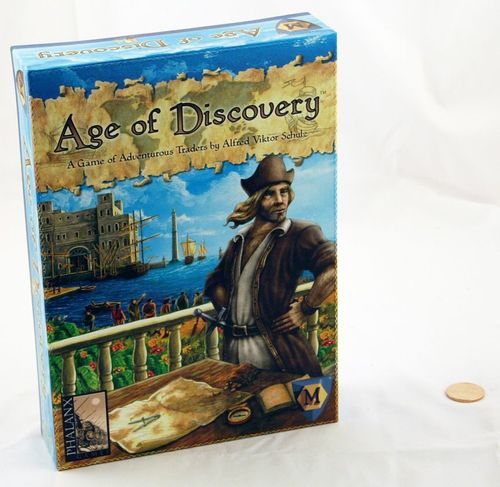
Age of Discovery
Age of Discovery Rulebook
Table of Contents
Table of Contents
1.0 Introduction
During the 15th and 16th centuries, the great royal houses of Europe sent explorers and conquerors all over the world, hoping to discover and secure new areas of influence and sources of wealth. Without the right naval vessels, these voyages would have been impossible. But even the incredible wealth of the royal houses could not sustain these expeditions for long. So they were happy that private entrepreneurs were ready to finance these expensive journeys.
Now your king has come to offer you the opportunity to invest in the great voyages of famous explorers like Columbus and Magellan. You will need to purchase a fleet of ships, and assign them to the most successful expeditions. Of course, you will need a lot of money! To earn money, you must fulfill trade contracts. Can you balance the needs of trade with the demands of the great explorers? It is time to seek wealth and glory in the Age of Discovery!
2.0 Components
Each copy of Age of Discovery contains:
- 50 ship cards (7 each of 6 colors, 6 "Flagship" cards, 1 "First Scoring," 1 "Final Scoring")
- 12 expedition cards
- 24 trade contract cards
- 12 special mission cards
- 12 action cards
- 60 coins (45x"1", 15x"5")
- 88 wooden tokens (22 each of 4 colors: red, yellow, blue, green)
- 1 victory point chart
- 1 rules booklet
If any of these parts are missing or damaged, we apologize for the inconvenience.
Please contact us if you need any replacement parts. Please send your request to:
Mayfair Games, Inc. 8060 Saint Louis Avenue Skokie, IL 60076 USA [email protected] 1-847-677-6655
2.1 Ship Cards
The deck of ship cards includes 3 card types:
- 42 standard ships: Each ship card shows the ship's color (there are 6 colors), the cost to purchase the ship, and the transport value. Transport values are used when ships are assigned to expeditions or trade contracts (section 4.4). In each color, there are 2 ships with a transport value of 1 (cost: 3 coins), 3 ships with a transport value of 2 (cost: 4 coins), and 2 ships with a value of 3 (cost: 5 coins).
- 6 flagship cards: At the beginning of the game, each player receives one flagship card that shows two colors and can be assigned a transport value of 1, 2, or 3. You must pay 2 coins to use your flagship.
- 2 scoring cards (first scoring and final scoring): When you turn over one of these cards, you will have a scoring round.
2.2 Expedition Cards
Each expedition card shows the maximum value of ships that can be included on that journey. The number of ships that can join the expedition is limited by the transport value of those ships. The expedition card also lists the number of victory points each ship will earn during the scoring phases.
The expedition card shows: the total transport value, the color, the first scoring value and the final scoring value (for example 2/3 for the first scoring and 5/6 for the final scoring), and the name of the explorer (for example Francis Drake).
2.3 Trade Contract Cards
In order to earn enough money to finance the expeditions, you need to fill trade contracts. To fill a contract, you must first own ships of the matching color that have enough combined transport value to meet the needs of the contract. The longer you commit your ships to a contract, the higher your payout will be when the contract is complete. There are four trade contracts of each color — one each with a transport requirement of 3, 4, 5, and 6.
The trade contract card shows: the color, the total transport value, the payout/income figures, and the duration of the trade contract (1, 2 or 3).
2.4 Special Mission Cards
At the very beginning of the game, each player receives a special mission card. If you complete the requirements of your special mission, you earn bonus victory points at the end of the game. There are different special mission cards based on the number of players (see 6.1).
2.5 Action Cards
At the beginning of the game, each player receives action cards based on the number of players. Action cards may be used only once each during the game (see 6.2).
2.6 The Victory Point Chart
During the game, you will have two opportunities to score victory points. You can track your victory points on the victory point chart. There is also a place on the chart to track the number of trade contracts you have completed during the game.
2.7 The Wooden Tokens
You use the wooden tokens of your color to mark your ships when they are assigned to an expedition. You can also use them on the victory point chart to mark victory points and completed trade contracts.
2.8 The Coins
You use coins to purchase ships and to perform various actions. You may make change freely as needed. Any time the rules mention "a coin" it always means a value 1 coin.
3.0 Starting Play
-
Place all of the expedition cards face up on the table. There should be enough space to place ship cards between them.
-
Shuffle the trade contract cards and place them face down above the expedition cards to form a draw pile. Turn the top 4 cards face up in a row next to the draw pile. Place the coins in a "bank" pile next to these cards.
-
Remove the first scoring and final scoring cards and the 6 two-colored flagship cards from the deck of ship cards. Shuffle the remaining 42 ship cards together. Turn over 10 ship cards, and place them in 2 face-up rows next to the expeditions. The first 5 cards turned over form the bottom row (the "purchase" row). The second 5 cards are placed in the top row (the "filling" row).
-
Separate the remaining ship cards into 5 draw piles above the top row of ship cards (piles 1-3 receive 6 cards each, piles 4 and 5 each receive 7 cards). Now shuffle the first scoring card into the third pile face down, and shuffle the final scoring card face down into the fifth pile.
-
Place the victory point chart next to the playing area.
-
Give each player the 22 wooden tokens of one color and 6 coins from the bank. Place one of your wooden tokens on the "0" box of the victory point track and the "0" box of the completed trade contracts track. Deal each player 2 cards from the face-down pile of trade contracts.
-
Separate the action cards by type and distribute them according to the number of players:
- 2 players: 3x Wild Ship and 2x Reservation cards
- 3 and 4 players: 2x Wild Ship and 1x Reservation cards
Action cards are explained in detail in section 6.2.
-
Shuffle the special mission cards that match the number of players. Give one special mission to each player, face down. Keep your mission secret from the other players until the end of the game. Special missions are explained in detail in section 6.1.
4.0 General Course of Play
Determine the starting player. During your turn, you may take any 2 of the 4 possible actions. You may take any combination of actions in any order you choose. When you have finished your turn, the player to your left begins his turn, and play continues clockwise.
The Actions:
- 4.1 Take 2 coins
- 4.2 Accept a trade contract
- 4.3 Purchase ships
- 4.4 Send ships on expeditions and/or trade voyages
Important: You can never choose the same action twice in one turn. For example, if you take coins and cannot (or do not want to) choose another action, you must skip your second action that turn.
Note: Before you take your actions, move all the tokens on the duration boxes of your trade contracts one box to the left. When those contracts are complete, you earn coins immediately (see 4.4.2).
4.1 Take 2 Coins
Take 2 coins from the bank.
4.2 Accept a Trade Contract
You may take 1 trade contract of your choice from the face-up contracts, or draw the top card from the draw deck. You must pay 1 coin to claim a contract. Add your new contract to your hand. You should keep your trade contracts secret from the other players until you play them. If you choose to take a face-up contract, a new contract is turned over in its place. Trade contracts are explained in section 4.4.2.
Important: You may never have more than 4 trade contracts in your hand at one time!
4.3 Purchase Ships
You may purchase any number of ships if you have enough coins to pay for them. You may only buy ships from the purchase row (the bottom row).
When you buy a ship, move the adjacent ship from the filling row down to the purchase row. Draw a replacement ship from the first draw pile, and place it in the empty space of the filling row. If there are no more cards in the first draw pile, then draw a ship from the second pile, etc.
If you have enough coins, you may immediately purchase another ship from the purchase row as part of the same action, even a ship just moved from the filling row. Place all ships you buy face up in front of you.
Example: Christopher has 8 coins and buys the green ship with a transport value of 3 for 5 coins. The green ship with a transport value of 1 immediately moves down into the purchase row and a ship from the first draw pile is put in the empty spot. Christopher still has 3 coins left, so he may buy this green ship or the yellow ship with a transport value of 1 from the purchase row.
He does not have enough coins to purchase the green ship with a transport value of 2 (it costs 4 coins).
4.4 Send Ships on Expeditions and/or Trade Voyages
You can assign any number of your ships to any expeditions and your own trade voyages — as long as you have enough coins to pay the crews! You can send ships to expeditions, trade contracts, or both on the same turn.
- Ships sent on expeditions earn victory points.
- Ships assigned to trade contracts earn money. Also, when your ships return from a trade voyage, you can use them again.
4.4.1 The Expeditions
The following rules are in effect when sending ships on expeditions:
-
The first ship assigned to an expedition can be of any color (even if it does not match the color of the expedition card). This ship determines the color that all ships assigned to that expedition must be.
Important: If your ships match the color of the expedition card, they are worth more victory points during a scoring phase.
-
All ships added to an expedition later must be the same color as the first ship assigned to that expedition. (Exception: the action card wild ship.) Place one of your wooden tokens on the ship to show your ownership.
-
You must pay a 1 coin "placement fee" for each ship you send on an expedition. (Exception: a flagship has a placement fee of 2 coins.)
-
You cannot exceed the transport limit of the expedition! Each expedition has a transport limit between 3 and 8: the total transport value of all ships assigned to that expedition cannot be greater than this limit.
Important: Unlike trade contracts, the total transport value of an expedition does not have to be reached for the expedition to score.
Important: If you send a flagship on an expedition, you must indicate the transport value of the ship by placing a number of wooden tokens on top of your ship (1, 2 or 3).
Example: Antonio de Abreu's expedition may only include ships with a total transport value of 3. So three ships with a transport volume of 1 could be sent, or one ship with a transport value of 1 and one ship with value 2, or a single ship with a transport value of 3.
Example (continued): On the Antonio de Abreu expedition, with a total transport value of 3, a green ship with a transport value of 1 has already been played. A ship with a transport value of 3 may not be played, since the total transport value would be exceeded. A ship with a transport value of 2 may be played, and the total transport value would be reached. A ship of another color with a transport value of 1 may not be played, since a green ship has already been played (Exception: Action Cards!). A flagship may be played, as a ship with a transport value of 1 or 2.
4.4.2 The Trade Contracts
You play trade contracts directly from your hand face up on the table. You must assign ships you have purchased to a trade contract when you play it. The following rules are in effect for completing trade contracts:
- You can only use ships matching the color of the trade assignment! (Exception: the action card wild ship.)
- You must pay a 1 coin "placement fee" for each ship you send on a trade voyage. (Exception: a flagship has a placement fee of 2 coins.)
- The total transport value of the ships assigned must exactly match the requirement of the contract. If you send a flagship on a trade voyage, you must indicate the transport value of the ship by placing a number of wooden tokens on top of your ship (1, 2, or 3).
- When you play a contract and assign ships to it, you must decide if the voyage will last 1, 2, or 3 turns. The longer the voyage, the more coins you receive when it is completed. Place a wooden token in the income box on the card you have chosen, and a second token in the space on the turn track directly below it. At the start of each of your turns, before choosing your two actions, move the token on the turn track one space in the direction of the arrow. You complete the trade contract when the token moves off the last box of the turn track. At this point, you take back your ships and tokens, and you receive the income marked from the bank.
Important: Put the completed trade contract card into the game box. Move your token on the completed contract track of the victory point chart to the next box. The number of trade contracts you have completed affects the value of the special mission cards.
Example: Francis plays the yellow trade contract that requires a transport value of 5. He immediately assigns two yellow ships with transport values of 2 and 3 to the voyage (and pays 2 coins to the bank for the placement fees). The transport requirement of the card exactly matches the ships assigned. He wants to earn 10 coins when the contract is complete, so he places one token on the 10 box of the income display, and a 2nd token in the second box of the turn track.
At the start of his next turn, he moves the token on the turn track to box 1 and chooses his two actions for the turn.
At the start of the following turn, he moves the token off the card and receives 10 coins from the bank. He takes his tokens and ships, and discards the trade contract card.
Finally, he moves his token on the completed trade contracts track one box forward.
Afterwards, he chooses his two actions for the turn. He may immediately use the returning ships from his trade contract for another purpose.
5.0 Winning the Game
You have two opportunities to score points during the game. During both of these scoring phases, you earn victory points for any ships you have sent on expeditions. During the final scoring phase, you also earn points for any completed special missions, and any ships that have not yet been assigned to any expeditions.
5.1 Victory Points for Sending Ships on Expeditions
Each expedition card shows the victory points that ships can earn during each of the two scoring phases. You earn victory points equal to the black value for each of your ships that does not match the color of the expedition card. You earn victory points equal to the colored number for each of your ships that matches the color of the expedition card.
During the first scoring phase, you score points based on the scoring box with the half-full hourglass. During the final scoring, you score points based on the scoring box with the empty hourglass.
5.2 First Scoring
When you turn over the first scoring card from the third draw pile, set it aside and draw the next ship as a replacement for the filling row. The current player completes his turn, and then each player takes one more turn (including the player who turned over the first scoring card). Now the first scoring phase begins.
Each player receives victory points for all ships he has assigned to the expeditions (see 5.1). All 12 expeditions score points in succession, and the points earned are recorded on the victory point chart.
5.3 Final Scoring
When you turn over the final scoring card from the fifth draw pile, set it aside and draw the next ship as a replacement. The current player completes his turn, and then each player takes one more turn (including the player who turned over the final scoring card). Now the final scoring phase begins.
Return any uncompleted trade contracts to the game box. You do not receive any money for these contracts, and they do not count toward your completed contracts. However, you do take back the ships you assigned to those voyages.
There are 3 parts to the final scoring:
- Victory points for ships sent on expeditions (see 5.1).
- Victory points for special missions: each player receives victory points as noted on his special mission (see 6.1).
- Victory points for all ships not sent on expeditions: You earn 1 victory point for each ship that is not assigned to an expedition.
Add these to the points you earned during the first scoring phase. The player with the most victory points earns the acclaim of royal explorers all over the world and is the winner of the game! In the case of a tie, the tied player with the most ships not sent on an expedition is the winner!
6.0 Appendix: Special Missions and Action Cards
6.1 The Special Missions
Each player receives one special mission card at the start of the game. At the end of the game you receive extra victory points for each expedition that matches the requirements of your special mission. There is a different set of mission cards for 2, 3, and 4 player games.
The number of points you earn is determined by the number of trade contracts you complete during the game. You earn the points matching the box of the contract track that your token is in.
These are the 4 types of special missions:
- One Ship: At the end of the game you receive victory points for each expedition where you have at least one ship.
- Half of All Ships: At the end of the game you receive victory points for each expedition where you have at least half of all ships.
- Majority of Ships: At the end of the game you receive victory points for each expedition where you have the majority of ships. In order to have the majority, you must have more ships on that expedition than all other players together.
- All Ships: At the end of the game you receive victory points for each expedition where you own all the ships.
Important: The transport value of the ships is not important for fulfilling special missions! Only count the number of ships.
For all special missions: If you are the only player who sent ships on an expedition, you automatically fulfill all special mission requirements for that expedition.
Example: In a 3-player game, Vasco has the special mission "majority of ships" and has the majority on 4 expeditions. He completes 5 trade contracts during the game. For his special mission, he receives a total of 20 victory points (4 x 5).
Each special mission card shows the player count it is used with, the mission type (for example majority of ships), and a table matching the number of completed trade contracts to the victory points earned (for example 5 trade contracts = 5 victory points).
6.2 The Action Cards
Each action card can be played only once during the game. After an action card is played, return it to the box. Playing an action card is "free," and does not count as one of your actions during your turn. You may play any number of action cards during a single turn.
Wild Ship: Play this action card when you assign a ship to an expedition or trade contract that does not match the color of the ship. Any ship can be assigned to any expedition or trade contract by playing this card.
Reservation: You may play this action card at any time during your turn. You may reserve a ship or a trade contract until your next turn by placing one of your tokens on the card (a reserved ship can be in either the purchase row or in the filling row).
No other player may purchase a ship or trade contract marked in this way.
On your next turn, you may purchase the ship (if it is in the purchase row) or trade contract. At the end of that turn, you must remove your token, even if you cannot or choose not to purchase the card in question.