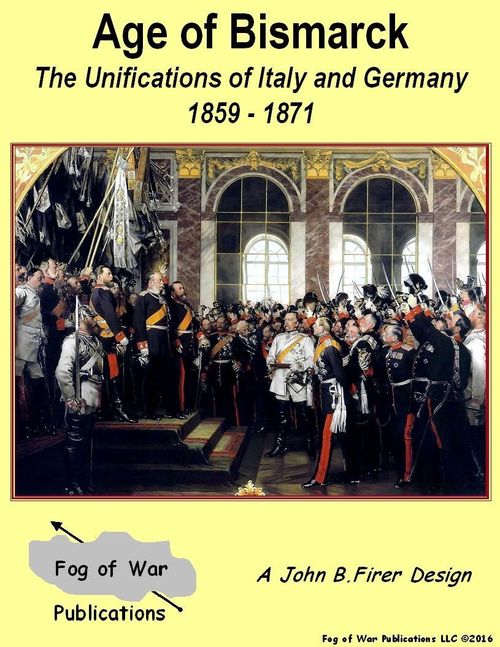
Age of Bismarck: The Unifications of Italy and Germany 1859-1871
Age of Bismarck: The Unifications of Italy and Germany 1859-1871 Rulebook
Table of Contents
Table of Contents
- 1.0 Introduction
- 2.0 Game Components
- 3.0 Setting-up the Game
- 4.0 Sequence of Play
- 5.0 Replacements and Reinforcements
- 6.0 Generals
- 7.0 Strategy Cards
- 8.0 Stacking and Subordination
- 9.0 Land Movement
- 10.0 Naval Movement
- 11.0 Interception
- 12.0 Avoiding Battle and Pursuit
- 13.0 Battles
- 14.0 Retreats
- 15.0 Special Units
- 16.0 Sieges
- 17.0 Mobilization
- 18.0 Logistics
- 19.0 Attrition
- 20.0 Political Control
- 21.0 Control of Major and Minor Powers
- 22.0 Politics and Diplomacy
- 23.0 Country Special
- 24.0 Victory Check Phase
- Age of Bismarck Tables
1.0 Introduction
Age of Bismarck: The Unifications of Germany and Italy 1859-1871 is a four-player game based on the 19th Century Italian Risorgimento and the struggle for supremacy in Germany, both of which were predominately directed against the Austrian Empire. Players control one of the four major powers involved. Specifically Piedmont – Sardinia/Italy¹, Prussia/Germany, Austria, and France. Control of the minor powers varies based upon the strategic situation and individual player strategy. The game also includes rules for shorter scenarios and for three-player and two-player version. Age of Bismarck begins in 1859 and ends at the conclusion of the 1870-71 turn.
¹ Often referred to as Sardinia, Piedmont, Italy, etc., all meaning the same nation-state. There were many names used for this kingdom at the time so in order to avoid any confusion, these names all mean the same thing within the context of Age of Bismarck.
2.0 Game Components
2.1 Inventory
A complete game of Age of Bismarck includes the following files:
- 1 Mapboard of Central Europe
- 1 Rules Booklet with Tables
- 1 Playbook with Designer Notes
- 1 Set of Player's Aid Cards
- 1 Set of Strategy Cards
- 1 Set of Strategy Card backs
- 1 Set of counter sheets
2.2 The Playing Pieces
Divisional Units: Each .7" square playing piece that has a cavalry or infantry divisional symbol (XX) printed on it represents Strength Points of that nationality equal to its printed value. The number of Strength Points (SPs) is roughly equivalent to the number of divisions associated with a particular Divisional Unit. For example an infantry divisional unit with an SP of 5 represents five infantry divisions. Divisional Unit pieces of value 1 can be used to make change for Divisional Unit pieces of value 2, 3 and 5 (and vice-versa) at any point during play. The number supplied with the game is an intentional limit; players should not create more.
NOTE: When referring to "an infantry division" or "a cavalry division" within the rules, a 1SP unit is always implied.
Designer's Note: All divisional units of all powers in AOB are considered equal in capability. Variance between nationalities does not occur until the corps level.
Corps Units: Each .7" square playing piece that has a corps symbol (XXX) printed on it represents a Corps Unit of that nationality with Strength Points equal to its printed value and an Administrative Point level equal to the number printed on the playing piece. The reverse side of a Corps Unit is the reduced strength of that corps.
Other Markers: Two additional .7" markers represent siege artillery and pontoon bridging trains. These brigades (X) have no strength points. Prussia and Austria are the only powers with siege artillery while minor powers have neither type.
Unit Control and Color:
- Austrian – white
- Sardinian/Italian – green
- Prussian/German – blue gray
- French – blue
- Neutral – gray
- Russian – dark green
- British – red
Generals: Each .7" square playing piece represents a single General and his army/corps staff.
Political Control Markers: The small .5" square playing pieces, having a Sardinian, Prussian, Austrian or French flag symbol printed back and front, are used to record which side has Political Control of a space. Throughout the rest of these rules, the term Political Control Marker will be abbreviated as PC marker. Other .5" square playing pieces are used to provide player information such as siege and fortress status, turn record, etc.
2.3 Scale
Each strength point equals approximately 5-10,000 men, roughly the equivalent of a division of infantry or cavalry. The size of divisions, and therefore by extension corps, varied widely during this period. In addition, cavalry divisions tended to be smaller than infantry divisions. Corps, while generally standardized within a particular national army, also varied from nation to nation. Prussian and Austrian corps were mostly smaller than their French or Sardinian (Italian) counterparts. Finally, quality (organizational, equipment, training, etc.) has been factored in to the strength computation at the corps level.
3.0 Setting-up the Game
Place the turn marker in the 1859 space on the Turn Record Track, and set up the playing pieces as indicated below.
3.1 Major Power Setup
The setup for each major power is indicated on the Player Aid Card. Place all of the indicated units in their starting location and then place any remaining pieces in the Build Pool.
3.2 Sardinian Setup
Italian Support for Sardinia: The Sardinian player rolls one die to determine the extent of Italian support for its war with Austria. The Sardinian player then places a number of PCs equaling the die roll on any space in the provinces of the Duchies or the Marches. In addition, if the die roll is 3, 4, or 5, one Sardinian ID is placed on any space in the Duchies or the Marches that has just been marked with a Sardinian PC; if the die roll is 6, two Sardinian IDs are placed on any space in the Duchies or the Marches that has just been marked with a Sardinian PC, no more than one ID per space.
Designer's Note: Upon the outbreak of hostilities between Sardinia and Austria, the Duke of Tuscany fled his duchy after popular demonstrations in support of Sardinia and his army (division strength) was made available to the King of Sardinia as the monarchical-dictator of Tuscany, a position requested by the Tuscans to keep the Austrians out and radical rebels in check. In addition, after the French victory at Magenta, the rulers of Parma and Modena, fled their duchies and in mid-June, Austria evacuated its garrisons from Romagna (part of the Marches). The latter two incidents lead to a movement of volunteers from Central Italy north to join the Tuscan division and the ultimate creation of an armed Central Italian Union. This "union" ultimately opted to join Sardinia in 1860.
Garibaldi: The Sardinian player rolls one die to determine if Garibaldi and his army of Red Shirts will enter the game this turn. On a die roll of 1 – 2 Garibaldi is activated; on any other die roll, Garibaldi automatically enters on Turn 2. Upon entrance, the Sardinian Player places Garibaldi and one ID in any space in an Italian ethnic province without an enemy CU or general and may immediately move Garibaldi and his army up to four spaces and may convert or place one PC per space entered (to include the initial arrival space) provided it is in an Italian ethnic province. If Garibaldi's entrance takes place on Turn 2, the Sardinian player performs this special activation during the Strategy Phase prior to or immediately following his play of a Strategy Card. The timing is entirely up to the Sardinian player.
Designer's Note: Garibaldi began his great adventure in 1860 by invading Sicily, with plausible deniability by the Sardinian government. Cavour and Victor Emmanuel did not totally trust him and it took some time for them to see his usefulness in the pursuit of Italian unity.
3.3 Minor Power Setup
- Denmark (Da) - Copenhagen: 1 ID; Düppel: de Mesa, 3 IDs and 1 CD
- Mecklinburg (Me) - Lübeck: 2 IDs
- Hanover (Ha) - Hanover: Ahrendtsschildt, 2 IDs, 1 CD
- Hesse-Nassau (HN) - Frankfurt am Main: 3 IDs
- Baden-Württemburg (BW) – Rastatt 1 ID; Ulm 1 ID
- Bavaria (Ba) - Munich: von der Tann, I Corps, 1 CD; Nürnberg : II Corps
- Saxony (Sx) - Dresden: Crown Prince Albert, 2 IDs, 1 CD
- The Netherlands (Ne) - Amsterdam: I Corps, Utrecht: II Corps and 1 CD
- Belgium (Be) - Brussels: 2 IDs and 1 CD
- Papal States (PS) - Rome: La Moriciere, 2 IDs
- Naples (Na) - Naples: Ritucci, 3 IDs, 1 CD
Any remaining Minor powers CUs are set aside, as they will enter play later in the game as replacements or unit breakdowns.
3.4 Glossary of Terms
Active Player – The player currently conducting his portion of the Strategy Phase.
Active Power – any major power that is controlled by an individual player at the start of the game.
Administrative Point (AP) – A point value assigned to CUs. Each divisional SP equates to one AP. The AP value of corps (full strength or reduced) varies based upon nationality. Generals or siege and pontoon trains have no APs associated with them.
Army – A general moving or stacked with CUs.
Available Leader – Any general that is eligible to enter play through 6.3.
Battle Rating (BR) – a general's (or corps) tactical ability.
CD – An abbreviation for cavalry division.
Corps – A numbered combat unit representing a specific combat value expressed in SPs, roughly equivalent to an equal number of infantry divisional SPs.
CU – An abbreviation for combat unit; combat units consist of divisional and corps units.
Enemy – A power or faction which is currently in a state of war with a friendly power or faction.
Ethnic Province – A province marked as belonging to a specific ethnic group. There are three ethnic groups in the game: German (G), Italian (I) and French (F). In addition, a small number of provinces can belong to two ethnic groups. These provinces are marked with the appropriate abbreviations for the ethnic groups involved.
Faction – A Major Power and all its allies.
Friendly – Any power, general, force or political control marker that is controlled by a player.
Force – Armies, corps, divisional and special units with or without a general present.
Holding Box – The square boxes on the Player Aid card above each general's name.
Home Province – A province belonging to a power at the beginning of the game.
Hostile – Any power, general, force or political control marker that is not owned or allied to a player.
ID – An abbreviation for infantry division.
Inactive Player – Any player not currently conducting his portion of the Strategy Phase.
Leader Pool – Available generals that are not currently on the map board and have not been permanently retired/eliminated.
Major Power – France, Austria, Prussia, and Sardinia.
Minor Power – Any power which is not a Major Power to include Britain and Russia.
Mobilization Pool – The box on the Player Aid Card used to hold a power's potential deployable forces. Also the box on the map board used for the forces of minor powers, if necessary.
Movement Allowance – The basic measure of a force's ability to move across the map board. It is normally expressed as a number of spaces that a force is allowed to move.
Neutral – Any power that is not friendly towards or enemy of a faction or power.
Operations Number – The number between 1 and 3 on the upper-left hand corner of each strategy card.
Political Control (PC) – A player controls a space if he has a PC marker in it. A player controls a Province if he controls the majority of spaces in the province. A space containing a PC Marker remains under the control of the owning player even if an enemy general and/or CUs are also present on that space until converted or control passes at the end of a turn.
Province – A specific named territory, unnamed geographical area are not considered Provinces.
Regional Naval Superiority – The exercise of naval control over one of the four sea zones.
Replacement Pool – The box on the Player Aid Card used to hold eliminated divisions and corps. Also the box on the map board used for the forces of minor powers.
Ruler – the royal head of one of the four major powers; the Emperor Franz Josef I of Austria, King Victor Emmanuel II of Piedmont-Sardinia, the Emperor Napoleon III of France, and King Wilhelm I of Prussia.
SP – An abbreviation for strength point.
Strategy Cards – A card used to play an event, conduct operations, conduct diplomatic warfare, conduct mobilization, or place PC markers. The diagram in the upper right indicates who may play the card as an event (F=France; A=Austria; P=Prussia; S=Piedmont-Sardinia).
Strategy Rating – a general's ability to be activated for operations.
3.4 Event Deck
Shuffle the deck of 88 Strategy Cards and place them off to the side.
4.0 Sequence of Play
Age of Bismarck: The Unifications of Germany and Italy 1859-1871 is played in turns, each of which must be played in the following order:
- Replacement and Reinforcement Phase (Skip this phase on Turn 1).
- A. Each player in the following Turn Order Sardinia, France, Prussia, and Austria places his Replacements (rule 5.0). In addition, any units indicated on the Turn Record Track are placed in accordance with the reinforcement rules (see 5.6).
- B. Each player in the order above may designate one currently active general to remain on map. Similarly, he may choose to permanently retire one currently active general. The remaining on map generals are returned to the available pool of generals and the player randomly selects and places new generals according to rule 6.0.
- C. The Austrian Player places all neutral Minor power Replacements (rule 5.0). The player who controls a Minor power places any Replacements for that Minor power (rule 21.0).
- Deal Strategy Cards – Each player is dealt Strategy Cards. The number of strategy cards dealt to each player is listed on the Turn Record Track.
- Strategy Phase – The players resolve this phase by playing their strategy cards one at a time, alternating back and forth between them (i.e., one player plays a card, then the next player plays a card, etc.). The Strategy Phase ends when all players have exhausted their hands.
- Attrition Phase – All players conduct Attrition against their CUs as described in rule 19.0.
- Political Phase – Each player converts any enemy PCs that are occupied by his CUs as explained in rule 20.2. Change province control as required. 21.3b and 21.3c are now put into effect for any newly controlled minor power, converting any hostile PCs not stacked with a hostile CU. The Sardinian and Prussian player may establish any new nations as explained in rule 22.5.
- Victory Check – Shuffle the deck of 88 Strategy Cards and place them off to the side. Players calculate their Victory Points as explained in rule 24.1. Each player compares his VP total to his Automatic Victory Level to determine if he has achieved an Automatic Victory. If any player is at war and has fewer Victory Points than he started with, he will lose a number of PC markers as explained in rule 24.2.
5.0 Replacements and Reinforcements
5.1 In General
Replacements are used to either replace destroyed units or to restore reduced units to full strength. If a combat unit suffers losses as a result of normal or battle attrition or retreat, that unit is either flipped to its reduced side if a full strength corps or placed in the Replacement Pool if the unit was a divisional unit. An already reduced corps unit is placed in the Replacement Pool and replaced with an infantry division if it suffers a further attrition or retreat loss. During the Replacement and Reinforcement Phase of the turn, a player may use any available replacement points to replace destroyed units or restore existing units to full strength. Replacement points are not accumulated and any unused points remaining at the end of this phase are lost to the player.
5.2 Replacement Points
Replacement points (RPs) may be used during either peace or war to replace destroyed units or to restore units to full strength. Replacement points differ in quantity between powers but are expended in the exact same manner. The following schedule is used when replacing units using Replacement points:
| Type of Unit to Replace | Replacement Points Cost |
|---|---|
| Replace a corps at full strength | 4 points |
| Replace a corps at reduced strength | 2 points |
| Flip a corps to full strength | 2 points |
| Replace a cavalry SP | 2 points |
| Replace an infantry SP | 1 point |
5.3 Replacement Procedure
During peacetime, a player may only replace units in the Replacement Pool. Divisional units may be placed on the mapboard with any general, or on a Fortress or Major City in a controlled province. Corps units are placed in the Mobilization Pool.
During wartime, a player may replace units from the Replacement Pool and may flip reduced corps on the mapboard to their full strength side. Units replaced during wartime may be placed with any general, or on a controlled Fortress or Major City provided that their placement location can trace an LOC to a supply source. Reduced corps already on the mapboard must be in supply (have an LOC) in order to receive replacements.
5.4 Replacement Points Allocation
SARDINIA. The Sardinian replacement rate is 1 RP per turn, with additional replacements available at a rate of one per the following controlled cities provided the respective province is also controlled: Turin, Milan, Venice, Florence, Rome, and Naples.
FRANCE. The French replacement rate is 1 RP per turn, with additional replacements available at a rate of one per the following controlled cities provided the respective province is also controlled: Paris, Lyon, Marseilles, Lille, Strasbourg, and Brussels.
PRUSSIA. The Prussian replacement rate is 2 RPs per turn, with additional replacements available at a rate of one per the following controlled cities provided the respective province is also controlled: Königsberg, Berlin, Breslau, Ruhr, Hanover, Dresden, Hamburg, and Frankfurt.
AUSTRIA. The Austrian replacement rate is 1 RP per turn, with additional replacements available at a rate of one per the following controlled cities provided the respective province is also controlled: Vienna, Prague, Budapest, Cracow, Zagreb, and Venice.
MINOR POWERS. Each minor power has a replacement rate of 1 RP per turn, with the exception of Denmark, Bavaria, and the Netherlands which receive two RPs per turn. If the British Intervention Event Card has been played, the player controlling British forces receives two British RPs per turn. If the Russian Intervention Event Card has been played, the player controlling Russian forces receives four RPs per turn. Since minor powers are not subject to Mobilization (see rule 17.6), any destroyed corps and all divisional units are placed in the Replacement Pool following their loss in battle or through attrition. Reduced strength corps remain on the board during peacetime and may be built up to full strength per 5.4 above.
5.5 Restrictions on French Replacements
After the establishment of the 3rd Republic, the French ability to replace units is partially restricted. The French may continue to replace all IDs and CDs but may only replace the XIV – XXIV Corps. The other corps may remain in play until eliminated but upon their elimination or replacement by an ID, the corps unit itself is removed from play and returned to the counter mix for the remainder of the game.
5.6 Turn Record Reinforcements
On various turns during the game, players will receive new units as reinforcements. Each player's schedule is detailed on their Player Aid Card and on the turn record track. Newly arriving corps are placed in the Mobilization Pool. Cavalry Divisions are split so that no more than ½ of a player's available CDs are on map (round fractions up). Infantry Divisions may be placed with any general or on a Fortress or Major City in a controlled province, provided the player may trace an LOC to the space at the moment of placement.
5.7 Other Reinforcements
Reinforcements attained through the play of a Strategy Card are deployed to the mapboard per the instructions contained on that card.
5.8 Special Reinforcements
SARDINIA. Sardinia also receives one ID each for control of Lombardy, Venetia, the Duchies, the Marches, and Naples during the Reinforcement Phase following control of the respective province. This is a one time reinforcement and once taken, may not be exercised again even if the province is lost and retaken during subsequent play. In addition to the above-mentioned reinforcements, Sardinia receives special reinforcements after the creation of the Kingdom of Italy (see 22.5). These special reinforcements are substitutes for the existing forces of Minor powers that have been absorbed into this new nation. Immediately after the creation of the Kingdom of Italy, all generals and CUs belonging to the absorbed Minor power are removed from the mapboard and the Replacement Pool and are eliminated from play for the remainder of the game. Sardinia then adds, I, II, III, IV, V, VI and VII Corps and 1 cavalry division to the Sardinian Mobilization Pool. These new Sardinian forces are then put into play in accordance with 17.0.
PRUSSIA. Prussia receives special reinforcements after the creation of the North German Confederation (see 22.5). These special reinforcements are substitutes for the existing forces of Minor powers that have been absorbed into this new nation. Immediately after the creation of the North German Confederation, all generals and CUs belonging to the absorbed Minor power are removed from the mapboard and the Replacement Pool and are eliminated from play for the remainder of the game. The new Prussian forces are then put into play in accordance with 17.0. In addition to the forces listed below, Prussia adds its own Crown Prince Albert counter to the Prussian general officer pool (see 6.3). The following corps are substituted for the CUs of the Minor powers listed below:
- IX Corps – Schleswig-Holstein and Mecklinburg
- X Corps – Hanover
- XI Corps – Hesse-Nassau
- XII Corps – Saxony
Place the corps in the mobilization pool and place an ID in each of the respective provinces. If Prussia controls any other Minor powers, the generals and CUs affiliated with those powers remain in play per 21.3.
FRANCE. France receives special reinforcements after the establishment of the 3rd Republic (see 22.5). These forces are in addition to the existing Imperial forces. Immediately after the establishment of the 3rd Republic, Aurelle de Paladines, Faidherbe, Chanzy, Ducrot, and Bourbaki and the XIV, XV, XVI, XVII, XVIII, XIX, XX, XXI, XXII, XXIII, and XXIV Corps are placed on any friendly controlled space in France, no more than two generals and corps per space. The arriving generals are in addition to those generals currently in play under 6.4 and may remain in play until displaced (9.9) or retired (6.3). Upon displacement or retirement, these generals are then governed by the procedures listed in 6.3 and 6.4.
5.9 Restrictions on Placement
Reinforcements may not be placed inside a besieged Major City or Fortress (see 16.4 for the definition of besieged). If control of the province affiliated with area specific replacements is lost, then that player does not receive those replacements.
6.0 Generals
6.1 Influence on Movement
Divisional units, siege artillery, and pontoon trains may only be moved as part of an army (exception: see 7.4). An army consists of a general and at least one CU. A corps is an autonomous combat unit with a set number of SPs affiliated with it that can move on its own without the presence of a general. In addition to strategic and battle ratings, generals and corps counters represent the staff and logistical support inherent within an army or corps.
Designer's Note: Generals are synonymous with armies and armies in general are more effective at assembling and operating a power's forces.
Designer's Note: Careful early pruning of a power's available generals can ultimately lead to the best led armies downstream.
6.2 Administrative Points and Movement Restrictions
Administrative Points (AP) equate to one AP per SP or a varying number of APs per corps as indicated on the corps counter; siege artillery and pontoon trains do not have APs. A general may move up to 10 administrative points in a given round of movement, while a corps may only move itself in any given round. APs may be interchanged during movement provided that at any particular instant the number of APs being transported by a general does not exceed the 10 AP limit. For example, a general could move six divisional units, two corps (each of 2 APs), and one siege artillery unit at one time: the six divisional units equate to six APs, the two corps equate to four APs, and the siege artillery unit equates to no APs; 6 + 4 + 0 = 10. Thus it is possible for a general to move more than 10 SPs, provided the total number of APs in the force does not exceed 10. Regardless, normal movement restrictions apply.
Designer's Note: APs represent the degree of difficulty in assembling and leading large bodies of organized troops. The differing corps AP factors coupled with the SP strength differential of a national corps are a direct reflection of that power's relative state of military proficiency. For example, Prussia has weaker corps than France or Austria but their lower AP value means they can assemble and lead a stronger/larger army than either of those powers.
6.3 Selecting Generals
Exclusive of Turn 1, each player randomly draws generals at the beginning of their turn. Each player may elect to retain one currently active general while placing the remaining previously active generals in an open, opaque container with the inactive generals. A number of generals equal to that country's respective availability number is drawn and placed on the mapboard within normal reinforcement rules restrictions. A player may choose to retire an active general rather than place him in the leader pool. In this case, the general counter is permanently removed from the game and may not be subsequently activated. No more than one general per Major Power per turn may be permanently retired.
NOTE: Napoleon III can never be voluntarily retired; he is only removed from the game as a result of displacement (see 9.9 and 22.5).
6.4 General Availability
The number of generals in play by a player is limited. General availability of leaders is as follows:
- Sardinia: three generals per turn (exclusive of Garibaldi)
- Austria: four generals per turn
- France: four generals per turn
- Prussia: five generals per turn
The control of minor powers and the presence of minor power generals on the mapboard as allies do not count against leader availability.
Designer's Note: This is another reflection of a power's military capability – the more generals available, the more "armies" in play.
6.5 General Placement
Generals may be placed together or in separate stacks but must be placed in a space containing at least one CU. Generals may be placed inside a besieged major city or fortress if there is no other legal space they may be placed in. Generals may never end movement in a space without at least one CU present. This CU can support an unlimited number of generals.
6.6 Special Capabilities
Certain generals have special capabilities as listed on their respective Player's Aid Cards.
7.0 Strategy Cards
Each Strategy Card has two primary elements, a number between 1 and 3 in the upper left corner (called the Operations Number) and the title and text of an event/response event.
7.1 Receiving Strategy Cards
Each player is dealt the number of Strategy Cards from the Strategy Deck as indicated on the Turn Record Track. Strategy cards may not be exchanged between players.
7.2 Dual Usage
A strategy card can be used for Operations or as an Event. You cannot use a Strategy Card as both an event and operations simultaneously unless the card specifically states so. Garibaldi, Danish Resurgence, Attaches and Agents are the only three cards that may be used as an event and for operations.
7.3 Who Goes First
Normally the Sardinian player will decide who moves first, but if another player has a Major or Minor Campaign Card in his hand and will play it as an Event Card for his first play in the strategy phase, he may go first. Follow this procedure: The Sardinian player first asks the French player if he wishes to use a Campaign card. If he chooses not to, the option passes to the Prussian player and then to the Austrian player. If none of these players elects to use a Campaign Card, The Sardinian player than selects who shall play first. Play then proceeds in the following sequence based upon which player is moving first: Sardinia, France, Prussia and Austria.
7.4 Operations
Playing a Strategy Card for operations allows you to do one of the following:
- MOVE A GENERAL (with or without CUs) whose Strategy Rating is less than or equal to the Operations Number. EXAMPLE: A "1" can only move a general with a Strategy Rating of 1. A "2" can move a general with a Strategy Rating of 1 or 2. A "3" can move any general.
- MOVE A CORPS on the map. Note that since all corps have an inherent Strategy Rating of "3", only a 3 Ops card can move a corps without a general.
- MOVE DIVISIONAL UNITS on the map. Any card may be played to move divisional units on the map without a general. The number of divisional SPs capable of being moved equals the value of the card, e.g a "2" card may move 2 divisional SPs. Divisional SPs moved must begin and end the move in the same space and a larger divisional unit may be broken down to accommodate such a move. Divisional SPs so activated may only enter friendly controlled spaces and may not enter any space containing enemy CUs.
- PLACE A QUANTITY OF PC MARKERS on the map equal to the Operations Number. One PC can be placed in each space that doesn't contain an enemy CU or PC. EXAMPLE: If you play a "3", you could place up to three of your PC markers. (see 20.2)
- CONDUCT DIPLOMATIC WARFARE against one province that has PCs belonging to another player as well as PCs belonging to you. The Operations Number indicates the number of times a player can roll on the appropriate column on the Diplomatic Warfare Results Table.
- CONDUCT MOBILIZATION of forces in the Mobilization Pool. The column equal to the Operations Number is used when rolling on the Mobilization Table.
7.5 Events
The diagram on each Strategy Card is coded to reflect who can use the event. Events playable only by certain factions are indicated by the appropriate abbreviation (F = France; A = Austria; P = Prussia; S = Sardinia). Events that can be played by all factions will have all factions so indicated. Regardless of the faction depicted, either player can always use any card for operations unless restricted by the card itself.
RESPONSE CARDS: Special Events that can be played in the middle of a move or battle. Playing a Response card does not count as your normal move; you must still play the next Strategy Card (if you have one). In effect, playing a Response card may require you to play two (or more) Strategy Cards in a round. Note that the some cards by the nature of the event may be used as a Response card or played during your turn if the conditions are met.
REMOVE IF PLAYED: When a card with an asterisk (*) is played as an event, the card is removed from the Strategy Deck. An asterisked card is not removed if the card is played for operations. NOTE: Some cards are removed from the deck only after the second play of the card as an event.
MUST BE PLAYED: When a card is played that states "MUST BE PLAYED", the event automatically occurs. The Bismarck card is the only must play card. This card may be played at any time during the normal course of Strategy phase play, at the owner's discretion. It may not be retained into the next Strategy Phase nor discarded.
7.6 Discarding
You may discard a Strategy Card rather than play it. In this case no action occurs and it now becomes your opponent's turn to play a Strategy Card. Discards must be played face up for your opponent to see.
7.7 Retaining a Strategy Card
A player may elect to retain one Strategy Card for use during the subsequent turn's play provided he is willing to forego the play of one of his Strategy Cards during the current turn. The retained Strategy Card and the player's subsequent Strategy Cards for the following turn can not exceed the number of cards indicated on the Turn Record Track. The exercise of this option does not require announcement until a player's last round for the current turn. A player may not hold a card on consecutive turns (e.g. if a player holds a card on Turn 1, he must exhaust all of the cards in his hand on Turn 2).
7.8 Ending the Strategy Phase
The players continue to alternate playing Strategy Cards until all cards in each player's hand have been exhausted. A player's hand is considered exhausted when he has played his last card or passed in order to hold his last card for the next turn. At this point, the Strategy Phase ends. It is possible that one player may use all of his Strategy Cards while his opponents still has several left in their hand. In this case, the players who still have Strategy Cards play them one at a time in turn order until they have played all of them.
7.9 Reshuffling
If there are not enough Strategy Cards in the Strategy Deck to deal a full hand to each player for the upcoming turn, the entire Strategy Deck (excluding cards that have been permanently removed from play) is reshuffled before any cards are dealt. The deck is also reshuffled when the Congress of Europe (#25) card is played or discarded (it doesn't matter if the event is played or not). In this case, the deck is reshuffled at the end of the turn.
8.0 Stacking and Subordination
8.1 Stacking CUs
There is no limit to the number of CUs that can be stacked in a space.
8.2 Stacking Generals
There can be more than one general in a space, but only one can be the commanding general. All other generals in the same space are considered subordinates. Keep the commanding general on the map, and place the subordinates in the commanding general's Holding Box. For example La Marmora and Della Rocca are subordinates to Victor Emmanuel II at the start of the game. When a commanding general moves, the subordinate generals move freely with him. A subordinate in a commander's Holding Box does not affect the commander in any way and while acting as a subordinate his Special Capabilities (rule 6.6) may not be used.
8.3 Seniority
Seniority of a general is indicated by the seniority rating displayed on the general's counter, e.g. S10 with 10 being the highest. If one general outranks another, then the ranking general must be the commander. Normally if all generals stacked together have the same seniority rating, the owning player may decide which of his generals will be the commander and which will be the subordinates and he is free to change the commander before he activates the army. However, in certain instances involving allied forces the following order of precedence is used to determine who commands the army:
- If a tie between generals of Major Powers, the side with greater number of initial home provinces commands
- If a tie between Major and Minor power generals, the general of the Major Power commands
- If a tie between Minor power generals, the owning player decides who commands
9.0 Land Movement
9.1 Who May Move
Generals may move with or without CUs. Divisional units may only be moved individually unless stacked with a general. A general or corps can be moved only when a strategy card is played that permits it. A general and the CUs stacked with him are collectively called an army. Only one army or a single corps moves with each Strategy Card unless a campaign card is played (9.10). The same army or corps may be activated each strategy card play.
9.2 Movement Procedure
You can move a general up to four spaces (six if traveling exclusively along a railroad line, see 9.11). A general can move with up to 10 APs. As you move a general, you can pick up and drop off CUs along the way, so long as there are never more than ten APs moving with the general at any time. You may move a general into any space that is adjacent (i.e. connected by a line) to the space that the general occupies. The sequence below must be observed when moving an army:
- STEP 1 - Select the general you wish to activate. If there are two or more generals with an army you may designate which is the commanding general (under the restrictions of 8.3). Then select up to 10 APs and any number of subordinates to accompany the commanding general.
- STEP 2 - Play a Strategy Card that can activate the commanding general (7.3).
- STEP 3 - Move the army. As the army enters each space it triggers a Reaction Phase for the non-active player (11.0 and 12.0), which is conducted before proceeding to step 5.
- STEP 4 - If the non-active player was successful with an Interception, the active army has the option to back up one space and end its move (11.5).
- STEP 5 - If there is only one or two SPs in the space the active army may conduct an Overrun at this time if the appropriate conditions are met (see 9.4).
Repeat steps 3 - 5 until the activated army has completed its move.
The conduct of a battle ends movement for the remainder of the play of a Strategy Card even if there are unexpended movement points remaining.
A single corps or divisional SPs activated without a general conduct movement in the same manner as an army except it may not move any other units. Activated corps always move by themselves. Divisional SPs may be activated for movement by the play of any appropriately numbered Strategy Card. Divisional SPs move in the same manner as armies, but they must move together, may only enter friendly controlled spaces and may not enter any space containing an enemy CU or PC.
9.3 Enemy Occupied Spaces
When you move an army or corps into a space containing one or more enemy CUs, and those enemy CUs do not, cannot, or fail to Avoid Battle (rule 12.0), your army or corps must stop, end its movement and battle the enemy force (exception: 13.4). A general without an army may not move into a space containing an enemy CU.
9.4 Overruns
If your army or corps has at least five SPs and it enters a space containing a single enemy SP without a general, the SP is automatically eliminated with no loss to you. Do not roll for combat. Your army or corps may continue its movement with no loss to its momentum. There is no restriction on the number of times your army or corps may do this in a single turn - it is only limited by the general's or corps' movement ability. Two SPs can be overrun by an army containing 10 SPs, but a force of 3 or more SPs may never be overrun. A corps may never be overrun no matter its current SP posture.
9.5 Mountain Passes and Straits
Movement across mountain passes and across straits counts as two spaces instead of one from your general's, division's or corps' overall movement capability.
STRAITS: Movement across a strait is allowed regardless of control of either terminus.
OTHER AFFECTS: Interception (11.0), Avoid Battle (12.1), and Retreats (14.0) are prohibited across mountain passes and straits.
9.6 Major Cities/Fortresses and Movement
Generals and CUs in a space with a Fortress or Major City may be inside or outside of the city/fortress. The number of APs that can fit inside a Major city is 10 APs and in a Fortress is equal to two times the fortification value of the space. To indicate CUs are inside a Major City or Fortress, place them beneath the PC Marker. CUs that remain outside of the Major City or Fortress stop enemy movement; CUs inside the Major City or Fortress do not. You may move your CUs and generals from inside a Major City or Fortress to outside (and vice versa) in the following situations:
- Through normal movement (the play of a Strategy Card) during your player turn.
- If an enemy force enters non-besieged Major City or Fortress spaces and the non-active player has CUs or generals there, he may declare the CUs and/or generals inside or outside. His decision may change each time an enemy force enters these spaces.
9.7 Combining Armies
An activated general may pick up another general (with or without CUs) and keep moving. The general being picked up must become a subordinate for that move. A general that outranks the activated general may not be picked up. If a general ends its move in a space containing another general and the new general outranks the activated general, then the activating general becomes a subordinate. If a general ends its move in a space containing another general of equal seniority, then the commanding general is determined by rule 8.3 and the other general becomes a subordinate.
9.8 Dividing Armies
An army may drop off subordinate generals (with at least 1 CU – see 6.5) at any time. A subordinate in the commanding general's Holding Box may be activated and moved off with as many CUs from the commanding general's army as the controlling player wishes (provided at least 1 SP is left with the remaining general or generals, rule 6.5). Bring the subordinate back onto the map and use the space occupied by the commander as his starting space. The subordinate becomes the commanding general of this new army and may bring along other subordinates that do not outrank him. A subordinate that detaches and moves off counts as moving one general (i.e., activating a subordinate does not allow the commanding general to move).
9.9 Displaced Generals
A general becomes displaced if all CUs accompanying the general are eliminated due to Attrition and Retreat losses and losses due to the Naval Combat Table. A general also becomes displaced if through a successful interception attempt an enemy CU enters the general's space and the general is not accompanied by friendly CUs (rule 11.0). A displaced general is removed from the map and does not return to play until the next Replacement Phase (see rules 5.0 and 6.0). If a ruler is displaced, he is eliminated. See 22.4 for the political ramifications of a ruler's elimination.
9.10 Campaign Card Limitations
When a campaign card is played each force must complete all movement and battles before another force can be activated. A CU or subordinate moved by one general during a campaign can not be moved by another general during the same Campaign. Once a force participates in a battle, siege, or backs up one space to avoid being intercepted (rule 11.5), or fails its Pursuit die roll (12.4); all CUs and generals in the force are considered to have spent all their remaining movement capability.
SIEGES: A campaign card can be used to conduct multiple siege attempts against the same Major City or Fortress as long as a different general and force performed each separate series of siege actions. These different forces may not start in the same space upon play of the campaign card.
9.11 Railroad Movement
If movement is conducted entirely along rail lines and no space entered contains an enemy CU or PC, then the force moved is allowed to move 2 additional spaces. If the force moving is commanded by a Prussian general or is a Prussian corps or divisional unit, then an additional two spaces may be moved for a total of 8 spaces.
10.0 Naval Movement
10.1 Procedure
A general (with or without CUs) or a corps may move from a port space to any other port space using Naval Movement. Divisional units by themselves may not use Naval Movement. Naval Movement is possible when a 3-strategy card or a Campaign event is played. The movement cost to use Naval Movement is three spaces.
EXAMPLE: You can move one space to a port and then use Naval Movement; or you can start at a port, use Naval Movement and then move one space inland.
10.2 Enemy Controlled Ports
Control of a port is not necessary for embarkation or debarkation. Naval Movement is allowed into and out of any port space including a port that contains an enemy PC.
10.3 Naval Movement and Major Cities or Fortresses
Naval Movement directly into a Major City or Fortress (as oppose to simply landing outside the city) is allowed if the space is friendly controlled and not currently besieged (see 16.4 for definition of "besieged"). Naval Movement is prohibited into and out of besieged Major Cities or Fortresses. Note that this does not prevent Naval Movement into and out of a space containing a besieged Major City or Fortress (in this case the troops are considered embarking or debarking outside the city or fortress perimeter).
10.4 Naval Movement Limit
A Major or Minor Campaign allows a force with up to 10 APs to use Naval Movement (only one of the two or three forces that may move with a campaign card can use Naval Movement). A 3 Strategy Card allows one force with up to five APs or a single general to use Naval Movement. No more than one force may make use of Naval Movement per Strategy Card play.
10.5 Sea Zone Control
There are four Sea Zones in the game, which are controlled as follows:
- North Sea: France
- Mediterranean Sea: France
- Adriatic Sea: Austria
- Baltic Sea: Prussia; NOTE: Prussia does not have local Naval Superiority in the Baltic Sea unless it controls Kiel.
10.6 Regional Naval Superiority
Players have naval control and unrestricted naval movement within a Sea Zone in which they have Naval Superiority. A force may move freely from port to port within a controlled Sea Zone. A force attempting to move within or into a Sea Zone in which they do not exercise Naval Superiority must roll on the Naval Combat Table to determine whether they have successfully completed Naval Movement. If after applying the appropriate die roll modifiers, the force is sunk, then the CUs are eliminated and the general is displaced (9.9). If the force must return, it returns to the port of embarkation and the balance of its movement is lost. CUs lost at sea do not count towards Political Consequences (rule 14.5). A player exercising Naval Superiority over a given Sea Zone may allow another player to exercise unrestricted Naval Movement within normal Naval Movement restrictions. This is done on a case-by-case basis.
10.7 British Naval Supremacy
If Britain enters the game, all Sea Zones are considered to be under British control for the duration of Britain's belligerency. Thus the player controlling Britain can exercise unrestricted Naval Movement in all Sea Zones on the mapboard; all other powers must use the Naval Combat Table to determine successful Naval Movement.
10.8 Naval Combat Table Modifiers
The player with Regional Naval Superiority modifies his Naval Combat Table die roll appropriately:
- +/- Port Modifier/Rating*
- +1 If port contains opponent's PC marker
- -1 If moving one corps or divisional SP
- -1 "Ironclads and Rams" is in effect
*These modifiers apply to both the port from which the force embarks and the port at which they debark and they are cumulative.
EXAMPLE: Your Sardinian opponent sends an army from Genoa (port modifier: -2) to Brindisi (port modifier: 0); the cumulative modifier is -2.
EXAMPLE: He sends an army with only one divisional SP (-1) from Ancona (-2) to Venice (+2). Venice contains an Austrian PC giving you another +1 modifier. The net modifier is (-1) + (-2) + (+2) + (+1) = 0.
11.0 Interception
11.1 In General
Interception is a special kind of movement that allows a non-active force to advance one space during an opposing force's move and interrupt the movement of the enemy force. Interception requires the moving force to fight a battle (rule 13.0) or back up one space (11.5).
11.2 When Can an Interception Occur?
Any army controlled by the non-active player may attempt an Interception. An Interception can occur whenever an enemy force enters (via land or naval movement) a space adjacent to the army and the space does not contain any non-moving enemy CUs. An army may attempt interception each time the above condition occurs, for example if an enemy force tried to move around your army you could attempt to intercept in each adjacent space which did not contain an enemy CU. Prussian corps that are not part of an army have a -1 modifier when attempting to intercept. This represents established Prussian doctrine to "march to the sound of the guns".
11.3 Interception Restrictions
- You may not intercept into a space that contains one or more non-moving enemy CUs.
- You may not intercept across a Mountain Pass, Strait or River.
- Non-Prussian corps may never intercept since they have a Battle Rating of "0" and they do not have the -1 modifier of the Prussian corps.
- You may not intercept an active, moving force if the intercepting force is not currently in a "State of War" with that force's controlling power.
- Interceptions may only occur against movement. You cannot intercept an attempt to Avoid Battle (12.1) or a Retreat (14.0), nor may you intercept an interception.
11.4 Interception Attempt Die Roll
To intercept, roll the die. If the die roll is less than or equal to your commanding general's Battle Rating, the interception attempt is successful. If your interception attempt succeeds, you must move the general and all CUs you declared were participating in the interception, into the space. In a battle caused by a successful interception, the intercepting player receives a +1 battle die roll modifier to simulate the effects of surprise. One +1 modifier is the maximum benefit, even if two or more armies intercepted.
11.5 Backing-up One Space
An intercepted force is never required to give battle; it may instead back up to its last-occupied space and end its movement. If a force has to back up across a pass, it must roll for attrition again. If a force has to back off from a naval move, then it returns to its port of embarkation. If it were a contested naval move, the moving player would have to roll again on the Naval Combat Table. If the result is a "Return" than the moving player may not back up and must remain in the port space. If a force backs up on to an enemy Major City or Fortress space it may still conduct a siege on that site provided it has at least 2 spaces remaining of its movement. In the latter case, spaces to enter and back up from the target space are not counted against the forces available movement.
11.6 Multiple Interceptions
You may conduct more than one interception attempt into the same space if you have more than one army (or a Prussian corps) adjacent to the space your opponent is about to enter. In this case, you must declare all interception attempts before any are resolved, and your opponent may wait until all are resolved before he decides to give battle or back up. If both/all interceptions succeed, then the armies are combined in the space under the command of one general and the combined force faces the moving force.
11.7 Subordinates and Interceptions
You may dispatch a portion of your army (under a subordinate or the commander) for an interception. You must declare which general and how many CUs/SPs will make the attempt. No matter how many subordinates an army has, only one interception can initiate from each space (i.e., you may not make two or more interception attempts from the same space in hopes that at least one will make it). If a subordinate intercepts, the commanding general must be left behind with at least one CU/SP (6.5).
11.8 Interceptions and Major Cities or Fortresses
An army inside a Major City/Fortress may intercept an enemy force in an adjacent space if there are no enemy CUs outside the Fortress/Major City. Conversely, if you intercept a force that enters a Major City/Fortress space by land movement, the battle occurs before the force can enter the Major City/Fortress. If the force entered the space via naval movement, the intercepted force has four options: accept battle, back up into the Major City/Fortress (if the city can fit the force), back up to the port of embarkation, or if an army, split the army between the last two options. An army backing up one space may never leave behind CUs/SPs outside the Major City/Fortress.
11.9 Interceptions and Overruns
Overruns occur after interceptions, so an intercepting army may prevent an overrun.
12.0 Avoiding Battle and Pursuit
12.1 Avoid Battle
This option is available to a non-active player only. If an enemy force enters a space containing one of your armies or one or more of your generals without CUs, you may attempt to Avoid Battle. To determine if the attempt succeeds, roll the die. If the die roll is less than or equal to your commanding general's Battle Rating, the Avoid Battle succeeds. A successful Avoid Battle allows you to move your army or generals out of the space and into any adjacent space (see restrictions below). If the die roll was greater than the commanding general's Battle Rating, then the army/general remains in the space and a battle is resolved (or the generals are displaced). For botching the retreat and for the temporary reduction in moral this would entail, you receive a –1 battle die roll modifier in the ensuing battle.
12.2 Restrictions on Avoid Battle
- No more than 10 OPs may avoid battle. An army that contains more than 10 OPs must leave behind all OPs in excess of 10.
- Armies and generals that failed an interception attempt may not attempt to avoid battle against the same army in the current round (11.0).
- An army or general avoiding battle may leave CUs/SPs and/or generals behind (as long as 6.5 is not violated).
- May not cross a mountain pass or strait.
- May not enter a space containing an enemy CU or PC marker.
- May not enter the space from which the enemy force is advancing.
- Corps may never Avoid Battle since they have a Battle Rating of "0".
12.3 Subordinates and Avoid Battle
You may avoid battle with a subordinate. In this case, the commanding general must be left behind with at least one SP. Only one Avoid Battle attempt is allowed per Reaction phase, so generals may not split up and avoid battle into different spaces, nor may you avoid battle with one general after failing with the other.
12.4 Pursuit
If your opponent successfully avoided battle, you may attempt to continue moving (either to pursue or to move off in a different direction). To determine if the attempt is successful, roll the die. If the die roll is less than or equal to your general's Battle Rating, your army can continue to move. If your general has already moved the four movement point (MP) limit or the die roll is greater than his Battle Rating, then your army must stop in its current space. If your army pursues the army that avoided battle, then your opponent can try to avoid battle again and you may attempt to pursue again. This can continue until your opponent fails his Avoid Battle die roll or your general has moved its limit. NOTE: Since corps have a Battle Rating of "0", corps moving without a general may never Pursue.
12.5 Major Cities/Fortresses and Avoid Battle
CUs located in a Major City or Fortress space but currently outside the space have two options. The controlling player may declare the CUs inside the space when the enemy force appears or he may declare the CUs outside the space and attempt an avoid battle. The first case would not slow the movement of the enemy force, but the second case might (if the Avoid Battle succeeds and the pursuit does not).
12.6 Sieges and Pursuit
An army that fails its Pursuit die roll but ends its move on a Major City or Fortress space, it may still conduct a siege against the space provided it has at least 2 spaces remaining of its movement.
13.0 Battles
13.1 Combat System
Battles are resolved using a combination of a Battle Resolution Table, the Attrition Table, and the Retreat Table. The Battle Resolution Table is used to determine the winner in any battle. The Attrition Table is used to determine battle losses for the attacker and the defender. The Retreat Table is then used to determine additional losses to the loser of the battle caused by the retreat. Combat takes place in the following sequence:
-
Step 1. Determine the column used on the Battle Resolution Table based upon the strength of each force as follows:
- Total number of SPs in each force
- Add one point to the above count if the battle takes place in a friendly controlled province
-
Step 2. Determine any die roll modifiers to be used on the Battle Resolution Table based upon the following formula:
- -1 if attacking across a river without a pontoon train (15.3)
- -1 for a failed Avoid Battle (12.1)
- –2 if attacker or defender is unsupplied, judged at the instant of combat (18.2)
- +1 for a successful Interception (11.4)
- +? for commanding generals Battle Rating
- +? for battle-related Response cards
NOTE: Battle-related Response cards must be declared prior to the Battle Resolution die roll, with the attacker declaring first.
-
Step 3. Determine the winner. Each side rolls one die, modifying the die roll as necessary. Each result is cross-referenced against the appropriate column on the Battle Resolution Table to determine the battle number. The resulting numbers are compared and the player with the highest battle number is the winner. If the result is a tie, both sides follow Step 4 only. The attacker must then retreat to his last space occupied prior to the battle, applying 14.3 as required.
-
Step 4. Take Casualties. Initiate the procedures under 13.2.
13.2 Battle Casualties
After the victor has been determined, one dice is rolled on the Attrition Table to determine the number of SPs that must be removed by both sides for battle casualties. The column used on the Attrition Table equates to the number of SPs with which the smaller force began the battle. Players cross-reference the column with a die roll to determine the number of SPs eliminated. If the exact number of SPs lost can not be met through elimination of single SPs or by flipping one or more corps to their reverse sides, then round losses up to the next number that exceeds the number of SPs lost. If a corps is eliminated, replace it with an ID and place the corps in the Replacement Pool. This ID can then be used to meet any further SP losses required in the battle or retreat. Also, certain corps will only having a combat value of 1 on their reverse sides. Replacing these corps with a division counts as a 1 SP loss for the purposes of removing casualties. Infantry and cavalry divisions that are eliminated are also placed in the Replacement Pool.
EXAMPLE: After the battle is resolved, a "5" is rolled for Battle Casualties. The result is both players lose one SP. The attacking force consisted of a full strength Austrian corps of 4 SPs and the defending force consisted of a flipped Sardinian corps of 1 SP. The attacker must flip the Austrian corps to its reverse side (2 SPs) and the defender must eliminate the Sardinian corps and replace it with an infantry division of 1 SP (see 5.1)
13.3 Retreat Table
In addition to Battle Casualties, the loser of the battle will lose a number of SPs as determined by the Retreat Table. After each battle, the loser must roll the die and consult the Retreat Table. The column used is the size of the loser's force prior to the beginning of the battle. Losses must be taken in SPs. The die roll is modified by +1 if the winner has more cavalry SPs than the loser and by -1 if the loser has more cavalry SPs than the winner at the time of the Retreat die roll.
CAVALRY: If there are cavalry SPs in the defeated force the first SP removed must be a cavalry SP. All other loses may come from non-cavalry SPs.
13.4 Attacker Impetus
If the attacker is the winner of the battle and had at least a 2:1 ratio against the defender in raw SPs prior to the battle, he may continue movement provided he has any remaining movement allowance. This movement can result in further battles provided the appropriate conditions are meet. Theoretically, a winning force could fight four battles during an activation under the right conditions.
14.0 Retreats
14.1 Retreat Procedure
After Battle Casualties and Retreat Table losses have been removed, the loser of a battle must retreat his force and suffer the political consequences of the defeat. If the original attacker was the loser, he retreats one space and if the original defender was the loser, he retreats up to two spaces. The loser of the battle must retreat to a space that is both friendly controlled (contains a friendly PC) or is neutral (contains no PC) and is clear of enemy CUs. If this is not possible, the retreating force may end its retreat on an enemy controlled space provided it is clear of enemy forces. In this latter case, an additional SP must be removed from the retreating force. You may not leave behind any CUs or generals as you retreat. The 10 AP movement limit does not apply during retreats; any size force (commanded by a general or not) defeated in battle must be retreated.
14.2 Restrictions on Retreat
- The retreat may not cross a mountain pass or strait.
- The retreat may not use Naval Movement. If the losing force debarked in the battle space that round, it is eliminated. Exception: If the battle space contains an unbeieged Major City or Fortress friendly to the retreating force, it is assumed the force debarked there and marched out. The force may therefore retreat into the Major City/Fortress. Any CUs that cannot fit inside the Major City/Fortress are eliminated.
- If the original attacker retreats, he must always retreat into the space in which he entered the battle. If the original defender retreats, he is prohibited from entering the space from which the attacker entered the battle from during the retreat.
14.3 Penalties on Retreats
- A retreating force must lose one additional SP if it enters a space that contains an enemy PC marker.
- A force that cannot retreat or has no place to retreat to is eliminated.
- A retreating force must lose one additional SP if it must recross a river and does not have a pontoon train (see 15.3).
14.4 Retreats into Major Cities/Fortresses
A retreating force is never allowed to retreat into a besieged Major City or Fortress except the force (if any) that sorties from the city (16.7). A retreating force may retreat into a friendly controlled non-besieged Major City/Fortress if the battle occurred in such a space. If there are more APs in the retreating force than the space can hold, then the retreating force may split up into two forces; one into the Major City/Fortress and the other retreating to a legal retreat space. The commanding general and subordinates may accompany either force or be split up in any fashion (be careful not to violate rule 6.5). This is the only way a retreating force may be split up.
14.5 Political Consequences
The loser must now remove a number of his own PCs from the map equal to half (round fractions down) the number of SPs he lost in the battle (this includes Battle Attrition casualties, Retreat Table losses, and SPs lost during the retreat). The PCs may come from anywhere on the map he wishes. If the defeated force was commanded by a royal commander, the loser removes an additional five PCs from the map.
EXAMPLE: If the loser of the battle lost three SPs then he would have to remove one PC. If he lost only one SP he would not be required to lose any PCs.
14.6 Sue for Peace
If, as a result of battle, the loser is unable to remove enough PC markers to satisfy the Political Consequences of defeat, the player must instantly sue for peace (see rules 22.3f and 24.3). If Napoleon III is captured as a result of a battle, France must immediately perform a revolution die roll (see rule 22.5f).
15.0 Special Units
15.1 Cavalry and Its Effect on Operations
Cavalry has the following effect on various types of operations:
- An army with a CD present may subtract one from the Interception die roll.
- An army with a CD present may subtract one from the Avoid Battle die roll.
- An army with a CD present may subtract one from the Pursuit die roll.
An army with a greater number of cavalry SPs than its opponent may add one to the Retreat die roll if the winner and subtract one from the Retreat die roll if the loser.
15.2 Siege Trains and Their Effect on Operations
Siege trains enter the game through the play of the appropriate Event Card (#27). Only one siege train may be in play per Major Power. Siege trains can only be moved by a general (see 6.1). Siege trains add a +1 modifier to all siege die rolls undertaken by a besieging force containing a siege train. If there is more than one friendly siege train present in a besieging force, only one siege train may be used to modify the siege die roll. Siege trains can be transported by naval movement but cannot be transported across mountain passes which do not have a rail line present.
15.3 Pontoon Trains and Their Effect on Operations
Pontoon trains enter the game through the play of the appropriate Event Card (#26). Only one pontoon train may be in play per Major Power. Pontoon trains can only be moved by a general (see 6.1). Pontoon trains affect operations as follows:
- An attacking force incurs a –1 battle die roll modifier if it is attacking across a river without a pontoon train present (13.1)
- An attacking force loses one additional SP if forced to retreat back across a river without a pontoon train present (14.3)
16.0 Sieges
16.1 Converting Major Cities and Fortresses
PC markers on Major Cities and Fortresses are difficult to convert. The only way to convert a Major City or Fortress is to conduct a successful siege against it or to play an event card that affects it. In certain End of Turn situations you may gain control of a province's Major City/Fortress spaces.
16.2 Siege Procedure
A siege is a process wherein a besieging force attempts to successfully reduce a Major City or a Fortress. This is done by obtaining a "reduced" result on the Siege Table. Any activated force that occupies an enemy Major City or Fortress space and has at least two spaces of its movement remaining may conduct one siege attempt (one die roll) against that site. In order to conduct a siege attempt, the besieging force must always contain a number of friendly SPs (already there or brought along) equal to the fortification value of the Fortress or Major City. Major cities have an intrinsic fortification value of "1" whereas a Fortresses fortification value varies from "1" to "3". This value is posted on the mapboard near the parent Fortress. A non-activated force on top of a Major City or Fortress is considered maintaining the siege provided the number of SPs in the besieging force equals the fortification value of the besieged space but it may not make a siege die roll until activated. No Fortress or Major City may be subjected to a siege attempt unless the besieging force contains a number of friendly SPs equal to the target spaces's fortification value and expends at least two spaces from its move allowance per siege attempt.
16.3 Subordinates and Sieges
Players may elect to have a subordinate general with the required number of SPs (and their corresponding CUs) make a siege attempt without activating the commanding general. Simply announce that the subordinate is conducting the siege. A subordinate conducting a siege is considered temporarily in command of the siege. If this occurs during the play of a campaign card, only the number of SPs used in the siege attempt (and their corresponding CUs) plus the activated subordinate are considered to have been moved. The remaining SPs and generals (and their corresponding CUs) in the space are available for further operations on the campaign card. NOTE: In order to have the necessary number of SPs to siege, CUs which are in excess of the required number of SPs might be necessary. In this case, the excess SPs are disregarded.
DESIGN NOTE: Subordinates were often given specific, siege related missions by the overall commander of a besieging force.
16.4 Siege Status
A Major City or Fortress is not considered Besieged unless a number of SPs equal to its fortification value are occupying the target space. The number of enemy SPs in the same space has no affect on this status.
16.5 Restrictions on Besieged Forces
A besieged Major City or Fortress may not receive replacements or reinforcements (either during the Reinforcement Phase or as a result of card play). A besieged force may not leave the Major City or Fortress via naval movement nor may a force debark directly into a besieged Major City or Fortress (it may land outside the city perimeter or fortifications). A besieged army or corps may sally forth and initiate battle against the besieging force. If it does, the battle and Response card bonuses are resolved normally. The maximum number of APs which can be placed within a Major City or Fortress by the controlling player is 10 APs for a Major City and twice the fortification value for a fortress, e.g. a Major City with its intrinsic fortification value of "1" could host a force no larger than 10 APs and a fortress with a fortification value of 2 could host 4 APs.
16.6 Lifting a Siege
A siege is lifted the instant there are no longer the required number of enemy SPs in the space to conduct a siege attempt against the Major City or Fortress. If this happens, the space may no longer be used by the besieging force as a line of communications despite the presence of any residual SPs (see 18.1).
16.7 Relief Forces and Besieged Forces
If you send a force to attack an enemy force besieging one of your Major Cities or Fortresses, you may count the CUs inside the space during the battle. When besieged CUs are added to an attack or a besieged force attacks on its own, it is called a sortie. Battle loses can come from either the relief force or the CUs that sortie at the controlling player's option. If there is a general inside the site when a sortie occurs, and that general outranks the commanding general of the relief force, the general inside the Major City or Fortress is considered in command for the battle. If no sortie occurs, the general inside the Major City or Fortress is not used in the battle. Only the CUs and generals that sortie may be retreated back into the besieged space.
16.8 Completing a Siege
When you obtain a "reduced" result on the Siege Table, replace the enemy PC with one of your own. If there were any enemy CUs inside the besieged space, they are eliminated and any generals are displaced.
16.9 Siege Table Modifiers
The following modifiers affect the Siege Table die roll:
- -? modifier equal to the fortification value of the target space
- –1 modifier if the besieger is unsupplied
- +1 modifier if the besieger is using a siege train
17.0 Mobilization
During periods of peace, all corps and ½ (rounded down) of a major power's cavalry units are placed in the Mobilization Pool. These units may be brought onto the map through the mobilization procedures described below.
17.1 The Mobilization Pool
When called for by the Turn Record Track or via Strategy Card play, additional corps and divisions are added to a nation's existing forces by placing all corps in the Mobilization Pool and all infantry divisions on the mapboard. Cavalry divisions are placed somewhat differently. A nation may not have more than 50% of available cavalry divisions (round up) on the mapboard. Any surplus cavalry divisions are placed in the Mobilization Pool along with any newly arriving corps. Newly arriving divisions are subject to normal placement restrictions.
DESIGN NOTE: IDs and the limited CDs represent a power's standing army, whereas the corps and the remaining CDs represent forces capable of being mobilized through the call-up of reserves, purchasing of remounts and other logistical and organizational preparations.
17.2 Mobilization Procedure
In order to place any units in the Mobilization Pool on the mapboard, a player must first declare that his country is mobilizing. This is done through the play of any Strategy Card, cross-referencing the Operations Number on the card with the appropriate column on the Mobilization Table. The Operations Number also equates to the number of PCs lost to the mobilizing nation through the act of mobilizing its forces. A die is then rolled on the appropriate column, applying any appropriate modifiers, with the resulting number of units immediately available for deployment.
DESIGNER'S NOTE: The PC loss represents negative political factors associated with preparations for war.
17.3 Mobilized Forces
Existing infantry divisions on the mapboard are replaced with a corps, in the exact location of the hosting division. The hosting infantry division (1SP) itself is then removed from play and placed in the counter mix (Build Pool). Mobilized cavalry divisions are placed in accordance with normal placement restrictions. IDs and CDs may be broken down in order to accomplish this transfer if the counter mix allows.
17.4 Mobilization Restrictions
If the power remains at peace and mobilization is not immediately followed during its next card play by an additional mobilization procedure or by a Declaration of War (or a DOW was played against it by another player), an additional PC is removed by the mobilizing player. This PC loss continues for every following card play that is not a mobilization or declaration of war until a declaration of war is made. A player may conduct additional mobilization procedures after a Declaration of War if there are still forces remaining in the Mobilization Pool. A nation may choose to suspend Mobilization prior to the play of subsequent Strategy Cards by losing 1 PC and by following the procedures of 17.5 below.
17.5 Demobilization
Once a nation is no longer in a State of War, all full strength corps are transferred to the Mobilization Pool and replaced on the mapboard with an infantry division (1SP) from the counter mix (Build Pool). Reduced strength corps are removed from the mapboard, replaced on the mapboard with an infantry division (1SP), and placed in the Replacement Pool until brought to full strength, which must be done as soon as possible. Once they have reached full strength, they in turn are moved to the Mobilization Pool. 50% of the cavalry divisions are removed from the mapboard (rounding down) and placed in the Mobilization Pool. Any cavalry divisions in the Replacement Pool remain there until replaced (see rule 5.3), when they are then placed on the mapboard in accordance 17.1 above and within normal placement restrictions.
17.6 Minor Powers
Minor powers are not subject to Mobilization and their forces are deployed to the mapboard immediately following a State of War (see rule 22.3) or when a player attains control of that power through political means. In either case, deployment of a Minor power's forces is performed by the player who is allotted control per rule 21.3.
18.0 Logistics
18.1 In General
A force is considered in supply if it can trace a line of communications (LOC) to a friendly controlled Major City, Fortress, or port (in a friendly controlled or neutral sea zone) which in turn can trace an LOC to another friendly controlled Major City, Fortress, or port (in a friendly controlled or neutral sea zone). An LOC consists of a line of friendly controlled or occupied spaces, each adjacent to one another, extending from the occupied space to the supply source. The space actually occupied by a force does not have to contain a friendly PC. Units are unsupplied if they cannot trace a line of friendly spaces (LOC) to a friendly Major City, Fortress, or port (in a friendly controlled or neutral sea zone) which in turn can trace a line of communications to another friendly Major City, Fortress, or port (in a friendly controlled or neutral sea zone). An unbesieged hostile Major City or Fortress blocks an LOC (see 16.6).
18.2 Determining Supply Status
A force assumes a supplied or unsupplied status the instant its supply status changes. It remains in the new status until another change occurs. The only exception to this rule occurs when an unsupplied force departs a space which did not have an LOC to a supply source and enters a space which has an LOC to a supply source; in the event of a battle in the newly entered space, the moving force is considered unsupplied for the battle. However, if the moving force is victorious, it is now considered in supply unless another situation develops which would place the force out of supply.
18.3 Effects of Being Unsupplied
An unsupplied force is subject to the following effects:
- Suffers a –2 battle die roll modifier (13.1)
- Suffers attrition at the end the turn (19.1)
- Is prohibited from converting an occupied enemy PC to a friendly PC through the play of a Strategy Card or at the end of a turn (20.2)
- Has a –1 modifier on the Siege Table (rule 16)
18.4 Off-Board Supply
a. French and French-allied forces may trace an LOC to any of the five supply sources connected by rail to the mapboard in western France. In addition, Russian and Russian-allied units may trace an LOC to any of the two supply sources connected by rail to Poland.
b. A sea LOC may be traced to a controlled port and through sea zones in which the owning player exercises regional naval superiority (see 10.6), naval supremacy (see 10.7), or through any sea zone free of enemy naval superiority or supremacy. French and French-allied forces may trace such a sea LOC to notional controlled ports in the three off-board home provinces of western France (see 24.1).
19.0 Attrition
19.1 When Attrition Occurs
Units suffer attrition under the following circumstances:
- as the result of naval combat
- as a result of the play of an Event Card
- As a result of backing up one space across a strait or mountain pass to avoid Interception
- if in an unsupplied state at the end of the turn (rule 18)
19.2 Procedure
The owning player makes a die roll for each applicable occurrence and consults the Attrition Table. The owning player cross-references the size of his force in the space with the die roll to determine the number of SPs eliminated. As during battle, if a force cannot meet the number of SP losses required, losses are rounded up. Generals are never affected by attrition. However, if attrition eliminates the last CU accompanying that general, then the general is displaced (9.9).
20.0 Political Control
20.1 Political Control
Players gain control of a space and control of a Province through placement of PC markers. A player controls a space if he has a PC marker on it. A player controls a Province if he controls the majority of the spaces in the Province (having the majority of the PC markers in a province is not by itself sufficient for Political Control). If the Province is also a minor power, control comes into effect only at the end of the turn. A space containing a PC marker remains under the control of the owning player even if an enemy general and/or CUs are also present. See 20.2 for the exception to this rule.
EXAMPLE: Bohemia is a Province within the Major Power Austria and may be controlled immediately upon obtaining control of the majority of the spaces in the Province. The Province of Saxony is a minor power and whereas the Province can be controlled immediately upon obtaining control of the majority of its provincial spaces, Saxony as a minor power can not be controlled until the end of the turn. At that time, any hostile PCs not stacked with a hostile CU are converted to that of the controlling player.
20.2 Placing PCs
Strategy Cards can be played to place PC markers on the map. The number of PC markers that can be placed is equal to the Operations Number. You can place PC markers in any minor city space that does not contain a PC marker or an enemy CU. Exception: You can place (convert) a PC marker in a space containing an enemy PC marker that is a minor city if you have a CU in that space; enemy PC markers in minor city spaces are automatically converted to your PC marker at the end of the turn if they are occupied by a friendly CU. During the course of the Strategy Phase, a PC marker may only be placed in a Fortress or Major City spaces as a result of a successful siege attempt, unless that space is unoccupied by a hostile CU and is a home province of the placing power. In addition during the End of Turn Political Phase (4.0 Step 5), if a Major Power controls the majority of spaces in a minor power, it gains control of all Major City/Fortress spaces in the province not occupied by a hostile CU.
20.3 Political Aspects of PC Removal
- A Major Power at war, which cannot remove the required number of PCs due to a lost battle (14.5) must "sue for peace" (14.6).
- A Major Power at war, which cannot remove the required number of PCs due to Year-end Political Repercussions (24.2), must "sue for peace".
- If for any other reason or circumstance, a Major Power cannot remove a required number of PCs, it loses 1VP.
20.4 Characteristics of PC Markers
- PC markers do not stop or slow movement of units.
- You may not Avoid Battle into a space containing an enemy PC marker (12.2).
- A retreat must end in a space containing a friendly PC marker if at all possible (14.1).
- Contiguous PC markers are used to trace a line of communications to a friendly supply source (rule 18).
- You must have at least one PC present in a province to conduct Diplomatic Warfare (22.2).
21.0 Control of Major and Minor Powers
21.1 France
France is allied with and partially controlled by Sardinia at the beginning of Turn 1 (1859). Any French generals and forces either starting in or moved into Sardinian territory or Lombardy, Venetia, and the French province of Provence are under the control of the Sardinian player for the entire turn. French CUs are restricted to entering only province spaces in France, Sardinia, and Austria during Turn 1. This alliance ends at the beginning of Turn 2. Any French generals and forces remaining in Sardinian home provinces or in Lombardy or Venetia at the beginning of Turn 2 are demobilized along with the rest of the French forces per 17.5. The state of war existing between Sardinia and Austria is also considered to be at an end and the provisions of rule 22.3 are put into effect. However, if the French player is in a state of war with another power (to include Austria) through the play of a Declaration of War card, any French generals and forces remaining in Sardinian home provinces or in Lombardy or Venetia at the beginning of Turn 2 are treated as reinforcements and placed in any space in Provence.
21.2 Prussia
Prussia is considered neutral and is partially restricted in its play until the play of the Bismarck card (Card #15). Prussia may not declare war on Austria or any of its controlled minor powers (allies) and may not conduct diplomatic warfare against Austria in any German ethnic province. The holder of the Bismarck card must play this card as an event card in the turn it is received. After play of that event, Prussia becomes an independent operator and all restrictions previously in effect are lifted. Prussia is now free to pursue its own goals such as declaring war on Austria, conducting unrestricted diplomatic warfare, etc. Note: The Bismarck card may not be played on Turn 1; after the conclusion of the Sardinian-French alliance, play of the card as described above may take effect.
21.3 Minor Powers
a. All minor powers are considered neutral at the beginning of the game. Minor powers may be controlled and activated through the play of an event card, the placement of PCs (rule 20.1), or the instant an active player moves a controlled CU through the provincial territory of the minor power. Once activated, the generals and CUs of the minor power are considered controlled by a player as follows:
- Event Card: The player who played the card
- Political Control Markers: The player whose PCs meet the control requirements (see 20.1)
- Movement of hostile CUs: An opposing player selected at random
b. If a player invades a minor power, he may conquer that minor by placing PC markers in the majority of spaces in that province. In order to gain control during a Strategy Phase, the spaces controlled must include all Major City and Fortress spaces of that minor power. As soon as these conditions are met, the minor power is considered conquered and all of its forces are removed from the game.
c. If a player gains control of a minor power through the play of an event card or through the movement of hostile CUs into the province/minor power, all PCs belonging to a player other than the player now controlling the power are removed from the mapboard and replaced with PCs belonging to the new controlling player. If a player gains control of a minor power through the placement of PCs, hostile PCs remain in the province until Phase 5 of the Sequence of Play when all hostile PCs are converted to friendly PCs. In addition, the player controlling the minor power/province may place his PCs on any fortresses/major cities in the minor power/province (see 16.1).
d. Three minor powers comprise more than one province; these are the Papal States, Denmark and Naples. The Papal States consist of the provinces of Lazio and The Marches, Denmark consists of the provinces of Denmark and Schleswig-Holstein and Naples consists of the provinces of Sicily and The Napolitano. In order to control the minor power, both provinces must be controlled by the same player. All other minor powers consist only of the province which encompasses its city and fortress spaces. Players may gain control of only one of the two provinces of a dual province minor power. If this occurs, the player may count the province for victory point purposes, but he does not control the province for any other purpose including transit rights.
e. A player who controls a minor power has unlimited use of that minor power's resources, such as generals, CUs, and provincial territory; in essence the minor power is considered an integral part of the controlling Major Power throughout the period of control. The provincial territory of the minor power may be traversed freely and may be used to trace supply (see 18.1). The forces of the Major Power and the minor power may be stacked together and may be controlled by generals of either power (see 8.3).
f. If a player loses control of a minor power through change in Political Control, he also loses control of the forces of the effected minor power. The new, controlling player gains all the benefits of control previously enjoyed by the former controlling player. If any of the minor power's forces are stacked with forces of the former controlling player, a battle is fought immediately to resolve the situation.
g. Minor power forces are governed by the same rules as the Major Power regarding State of War (rule 22.3).
21.4 Great Britain and Russia
Great Britain and Russia enter the game through the play of the appropriate Strategy Card. Upon activation, they are treated as a minor power for control and activation purposes. The activation of Russia requires the player exercising this option to have Political Control over Poland. Great Britain has no control preconditions prior to play of the Strategy Card except those instructions listed on the card. In both cases the player must be at war with another Major Power to trigger intervention.
22.0 Politics and Diplomacy
22.1 Diplomacy and Player Cooperation
a. Players may freely conclude alliances among themselves on an informal basis. These alliances may begin and end whenever they meet the needs of the players involved.
b. Powers allied with other powers may allow their allies free passage through their own forces, PCs, Fortresses, or Major Cities. However, these allied forces may not stop on a space containing the controlling power's forces unless control of those allied forces is relinquished to that power. These forces can then be moved and used in battle by the controlling power provided they do not exceed normal movement and battle restrictions.
c. Within the restrictions of the rules, players may interact diplomatically provided this interaction does not slow the progress of the game.
22.2 Diplomatic Warfare
a. If a player has at least one friendly PC in a province that also contains enemy PCs, he may chose to use a Strategy Card to engage in diplomatic warfare. Diplomatic warfare takes place by rolling a die on the Diplomatic Warfare Table using the column that equates to the control status of the targeted province. The number of Operations Points on the card equates to the number of rolls on the Diplomatic Warfare Table. The player is not required to make all of the available rolls, but may stop rolling on the table at any point. All die roll modifiers are cumulative. Cross-reference the modified die roll with the appropriate column and apply the result immediately. The owner removes his own PCs.
b. A player may exercise Diplomatic Warfare against any other player provided the conditions of 22.2a are met. Players do not have to be in a "State of War" in order to exercise this option. However, you may not exercise Diplomatic Warfare in another player's home province unless you are currently at war with that player (see 22.3).
22.3 State of War
a. There are two types of "States of War", a formal state of war and an informal state of war. Although identical in effect, the type of "state of war" used by a Major Power determines the degree to which that power experiences a PC loss when initiating hostilities with either a Major or minor power.
- A formal "state of war" exists through the play of a "Declaration of War" event card and involves the loss of 2 PCs by the perpetrating power.
- An informal "state of war" exists through the unauthorized traversing of another power's controlled province, by attacking the forces of another power, or by besieging a Major City or Fortress of another power and involves the loss of 5 PCs by the perpetrator.
b. PCs may not be converted or placed in the home provinces of a Major Power unless a "state of war" exists between that power and the power placing the PCs. Likewise, movement through controlled provinces, combat with an opponent's forces, and siege operations can not be conducted against a power unless either a formal or informal "state of war" is in existence (22.3a, above).
c. A "Declaration of War" card can be used to declare war on one or more powers and may specifically include Major and minor powers controlled by the player declaring war. However, if it is used in this manner, any subsequent play of a "Peace Treaty" card will affect those same powers. If a "Declaration of War" is made against a controlled minor power, the Major Power controlling that minor power is automatically in a state of war with the perpetrator and any and all Major and minor powers joining the perpetrator in the war (see 22.3d below).
d. When a player is at war with another Major or minor power, Major or minor powers controlled by a player and not included in the initial "Declaration of War" may or may not support that player. Upon establishment of a "state of war" between players, each player may immediately roll a die for each controlled Major or minor power to determine if that power joins the controlling player in the "state of war". A roll of 1 – 4 joins that power to its controlling power for the remainder of the "state of war". Non-activated powers may subsequently join the controlling player by performing this roll during subsequent strategy phases, however a +1 modifier is added to the activation roll for each strategy phase that has elapsed since the "state of war" began. This procedure is permitted until the cumulative effect of the die roll modifiers makes it no longer possible to activate the power. This procedure is totally at the discretion of the controlling player.
SPECIAL RULE: If an army commanded by Benedek is currently located in a space in Bohemia or Austria, apply a –1 to the die roll for Baden-Württemburg, Bavaria, and Hesse-Nassau.
e. If a player (the belligerent power) declares war on a Major or minor power (the non-belligerent power), any inactive players that are not currently at war with the belligerent power may choose to immediately declare war on that power. This is done at a cost of 4 PCs (and does not require the play of a Declaration of War Card) and is modified as follows:
- -1 PC for having a shared border with the non-belligerent power.
- -1 PC for having at least one PC within the borders of the non-belligerent power.
- -1 PC if the non-belligerent power shares the same ethnic orientation as the player's power.
- +1 PC if the belligerent power has at least one PC within the borders of the non-belligerent power.
All of the above modifiers are cumulative.
f. Either "state of war" continues until control of the enemy capital by an opposing force (for a Major Power), control of the majority of the spaces in a province (for a minor power), or until ended by the play of a "Peace Treaty" or "Congress of Europe" event card. In the first and second cases, a country whose capital is controlled by an opponent (or the majority of its spaces in the case of a minor power) is considered to have "sued for peace". Regardless, in any situation in which a country has "sued for peace", the current "state of war" ends immediately. A player may also be forced to "sue for peace" in certain other situations (see rules 14.6 and 24.3).
g. Once a "state of war" ends, players retain any province they control at the instant of peace. The opposing player's PCs in that province are then converted to those of the controlling player and any CUs and generals are moved by their owner to a friendly space in a controlled province. Players may exchange provinces in any manner that is mutually acceptable, to include returning any acquired provinces and gaining or losing other provinces at their discretion. To determine the control of individual spaces follow this priority:
- The player that has a PC in a Fortress or Major City space controls the space.
- The player that has CUs in a space controls any minor city space.
- The player that has a PC in a space that does not contain CUs controls the space.
- The player that controls the majority of the spaces of any type in a province is considered to control that province when suing for peace or upon the termination of a state of war.
h. A formal "state of war" exists between Austria and Sardinia with France allied to Sardinia at the beginning of the game. This state ends at the beginning of Turn 2 unless France had played a Declaration of War, which prolongs the war with Austria.
i. If Garibaldi is activated in or moves through a neutral Italian ethnic province or its owning minor power, this action does not constitute a "State of War" between Sardinia and that owning minor power or its subsequent controlling player. Likewise, forces of that minor power may freely attack or intercept Garibaldi within the boundaries of its territory without entering into a "State of War" with Sardinia. Only the entrance of Sardinian forces not accompanied by Garibaldi into that province or minor power triggers 22.3a. This special situation does not include the Austrian Italian ethnic provinces of Trentino, Lombardy and Venetia.
22.4 Royal Prestige
Defeated armies commanded by a ruler double any PC loss due to losing a battle (see rule 14.5). In addition, displacement of a ruler as a result of a Battle Retreat die roll requires the loss of another 5 PCs. These prestige point PC losses must be taken from spaces within home provinces if at all possible.
22.5 The Creation of New Nations and the 3rd Republic
a. The Kingdom of Italy. If at the end of any turn that the Sardinian player controls 7 of the 11 Italian ethnic provinces, the Kingdom of Italy is established. The establishment of the Kingdom of Italy can never be reversed. If in subsequent turns the number of controlled Italian ethnic provinces falls below the required number of provinces, the Kingdom of Italy remains an established political entity. Further, any Italian ethnic province that is controlled by Sardinia is now treated as a home province for all purposes so long as the Sardinian player has control. If he loses control of a province that was originally a minor power, it returns to being a minor power. It may be gained and lost any number of times and is always considered a home province while it is controlled by Sardinia.
b. "Greater Italy". If by the end of the game the Kingdom of Italy has already been established and the Sardinian player controls 10 of the 11 Italian ethnic provinces, the establishment of "Greater Italy" is considered to have taken place.
c. North German Confederation. If at the end of any turn the Prussian player controls 11 of the 16 German ethnic provinces, the North German Confederation is established. The establishment of the North German Confederation can never be reversed. If in subsequent turns the number of German ethnic provinces falls below the required number of provinces, the North German Confederation remains an established political entity. Further, any German ethnic province that is controlled by Prussia is now treated as a home province for all purposes so long as the Prussian player has control. If he loses control of a province that was originally a minor power, it returns to being a minor power. It may be gained and lost any number of times and is always considered a home province while it is controlled by Prussia.
d. The German Empire. If at the end of the game the North German Confederation has already been established and the Prussian player controls 13 of the 16 German ethnic provinces, the German Empire is established.
e. French "Natural Frontiers". If by the end of the game the French player controls 10 of the 11 on-board French ethnic provinces, France is considered to have reached its "natural frontiers".
f. The 3rd Republic. If at any time Napoleon III is displaced as a result of a Battle Retreat die roll, in addition to the loss of PCs, the player controlling France must immediately roll to determine whether the Second Empire has been replaced by the 3 rd Republic. On a die roll of 1 – 4, Napoleon III is considered to have been overthrown and a republic established. The Napoleon III counter is permanently removed from the game and French mobilization and replacement restrictions (see 5.5) and Special Reinforcements (see 5.8) come into effect. The republican die roll occurs each time this situation comes into effect.
NOTE; if Liberal Empire (Card #77) has been played as an event, the 3rd Republic automatically replaces the Second Empire – no die roll is required.
22.6 Denmark and the Schleswig-Holstein Issue
Upon the play of the "Danish Resurgence" event card, Prussia is considered to be in a "State of War" with Denmark. This "State of War" does not cost the usual PC penalty and ends when either Düppel or Copenhagen are controlled by the Prussian player. However, for each Strategy Phase that the war continues, Prussia must lose one PC at the end of its respective portion of the Strategy Phase. Austria must "loan" Prussia two IDs and one CD from its forces on the mapboard for the duration of the war or lose five PCs. The "loaned" forces are immediately deployed to Magdeburg and are treated as Prussian CUs for the remainder of the war. Upon termination of the war, any remaining Austrian CUs are immediately moved by the Austrian player to any friendly space in an Austrian-controlled province. After the termination of the war, if a French CU enters either Emden, Bremen, or Hamburg, Denmark immediately allies with France and Danish forces are controlled per 22.3.
Designer's Note: Denmark controlled the German provinces of Schleswig-Holstein through a complicated tie of marriage even though Holstein was considered to be part of the German Confederation (established in 1815) and thus German rather than Danish. In 1864 when Denmark attempted to completely integrate Holstein into their nation-state, Prussia and Austria were compelled by German public opinion to "free" these provinces from Danish rule and integrate them into the German Confederation.
23.0 Country Special
23.1 Poland
Poland is part of the Russian Empire. No player may enter Polish territory nor use its spaces for LOCs until after the play of "Russian Intervention" as an event.
NOTE: play of the "Russian Intervention" card as an event requires that the playing power have control of Poland.
Designer's Note: "Control" of Poland by a Major Power equates to a political accommodation with Russia and does not mean control in the AOB sense. it is used as a mechanism to so indicate this diplomatic state.
23.2 Lazio (The Papal States)
Any power that violates the neutrality of Lazio immediately causes a state of war to exist between that power and France. This stricture is lifted the instant that the "Rome Garrison" card is played as an event. The French player may declare war on the Papal States, but the cost of that declaration is doubled. This doubling does not occur if the Papal States are controlled by another power.
24.0 Victory Check Phase
Victory Points are counted throughout the turn as they are awarded or lost. However, during this phase players verify Victory Points to see if one side loses PCs for Political Repercussions and/or whether an Automatic Victory has occurred.
24.1 VP Tabulation Procedure
a. During the Victory Check Phase, players count the number of VPs (Victory points) they currently have. Points vary for each type of province that you control as follows:
- Austria receives two Victory Points per home province and one Victory Point per additional province controlled or allied with Austria during the Political Control Phase at the end of each year.
- Other Major Powers. Major Powers receive one Victory Point per home province and one Victory Point per additional province controlled or allied with that power during the Political Control Phase at the end of each year. Prussia (G), France (F), and Sardinia (I) receive two Victory Points for controlling a province belonging to their respective ethnic group, which was not previously controlled by that player, e.g. two points for French control of Savoy (controlled by Sardinia at the start of the game).
- France: France is considered to control three off-board home provinces (Gascony, Brittany, and Normandy) and one other province (Algeria). These provinces may never be controlled by any other player and are only used for VP calculation purposes, i.e. France always has an automatic 4VPs representing these provinces.
b. In addition to VPs awarded for controlled provinces, additional VPs can be obtained (or lost) as follows:
- +1 VP for the play of "Danish Resurgence" as an event (Austria only)
- +1 VP for the adoption of the "Unification Plan" (Austria only)
- +1 VP for the play of "Dual Monarchy" as an event (Austria only)
- +1 VP for the establishment of the North German Confederation (Prussia only)
- +2 VPs for the establishment of the German Empire (Prussia only)
- +2 VPs for the establishment of the Kingdom of Italy (Sardinia only)
- +1 VPs for the establishment of "Greater Italy" (Sardinia only)
- +2 VPs for reaching its "Natural Frontiers" (France only)
- +1 VP after the play of "Liberal Empire" as an event (France only)
- -1 VP for the loss of a previously controlled non-ethnic province
- -1 VP for the loss of a home province (Sardinia, Prussia and France only)
- -2 VPs for the loss of a previously controlled ethnic province (Sardinia, Prussia and France only)
- -2 VPs for the loss of a home province (Austria only)
- -1 VP if a Major Power for any reason or circumstance other than a lost battle or Year-end Political Repercussions, cannot remove a required number of PCs
- +/- VPs per certain card driven events not listed above.
24.2 Year-end Political Repercussions
After calculating Victory Points, the totals are compared by each side with the number of VPs they started the game with. If a side has fewer VPs than he began the game, then that player must remove a number of PC markers from the map equal to the difference in VPs.
EXAMPLE: The Austria player has 14 VPs at the end of the turn and his starting VP level was 16. Therefore the Austrian player must remove two of his PC markers from anywhere on the map.
24.3 Sue for Peace
If a Major Power is at war and does not have enough PC markers to remove due to Political Repercussions, his country sues for peace immediately (see rule 22.3e).
24.4 Automatic Victory
All players compare their current Victory Point total to their Automatic Victory Level printed on their player's aid card and in 24.6 below. If any player's total equals or exceeds this level, he achieves an immediate Automatic Victory. If two or more players reach this goal on the same turn, victory is determined in the following order:
- Sardinia
- Prussia
- France
- Austria
If no player achieves an Automatic Victory, play continues into the next turn. If this is the last turn, follow the procedure in 24.5.
24.5 End of Game
During the Victory Check Phase of the last turn if any player has not obtained an Automatic Victory, players' VP totals are compared to their End of Game Victory Level. If a player's VP total equals or exceeds this level, he wins the game. If there is a tie, the formula listed in 24.4 is followed to determine the winner.
Designer's Notes: The real winner's of the "historical game" were Sardinia (Italy) and Prussia (Germany), with Sardinia having somewhat of an easier time of unification than Prussia. France while initially favoring unification for both countries, found itself on the defensive and subsequently came to fear German and to some extent, Italian unification. Austria was a status quo power and greatly feared nationalism and its child unification, since it would be one of the big losers in that event due to its multi-ethnic character.
24.6 Starting VP, End of Game and Automatic Victory (AV) Levels
| Power | Starting VP | End of Game Victory Level | AV Level |
|---|---|---|---|
| Sardinia | 4 | 16 | 20 |
| Prussia | 6 | 24 | 25 |
| France | 10 | 17 | 21 |
| Austria | 16 | 18 | 22 |
Age of Bismarck Tables
The printed table sheet (pages 31–32 of the rules booklet) is reproduced below. The "c" suffix on Attrition Table results appears as printed; the booklet does not define it.
Battle Resolution Table
SPs + Friendly Province (columns)
| Die roll | 1 | 2,3 | 4,5 | 6,7 | 8,9 | 10-12 | 13-15 | 16+ | Die roll |
|---|---|---|---|---|---|---|---|---|---|
| <0 | - | - | - | 2 | 3 | 4 | 5 | 6 | <0 |
| 1 | - | - | 1 | 2 | 4 | 4 | 6 | 7 | 1 |
| 2 | - |
Die Roll Modifiers:
- -1 if attacking across a river without a pontoon train (15.3)
- -1 for a failed avoid battle (12.1)
- –2 if attacker or defender is unsupplied, judged at the instant of combat (18.2)
- +1 for a successful interception (11.4)
- +? for battle-related Response cards
Attrition Table
| Die Roll | 1 | 2 | 3 | 4 | 5,6 | 7-9 | 10+ |
|---|---|---|---|---|---|---|---|
| 1 | - | - | - | - | - | 1 | 1 |
| 2 | - | - | - | - | 1 | 1 | 1 |
| 3 | - | - | - | 1 | 1 | 1 | 2 |
Retreat Table
| Die Roll | 1-3 | 4,5 | 6,7 | 8,9 | 10+ |
|---|---|---|---|---|---|
| <0 | - | - | 1 | 1 | 1 |
| 1 | - | 1 | 1 | 1 | 1 |
| 2 | 1 | 1 | 1 | 1 | 2 |
| 3 | 1 | 1 | 1 | 2 | 2 |
| 4 | 1 |
Die Roll Modifiers:
- -1 if the loser has a greater number of cavalry SPs than the victor
- +1 if the victor has a greater number of cavalry SPs than the loser
Siege Table
| Die Roll | Result |
|---|---|
| <0 | No effect* |
| 1 | No effect |
| 2 | No effect |
| 3 | Reduced |
| 4 | Reduced |
| 5 | Reduced |
| 6 | Reduced |
Die Roll Modifiers:
- -? modifier equal to the fortification value of the target space
- -1 modifier if the besieger is unsupplied
- +1 modifier if the besieger is using a siege train
* Besieger loses 1 SP
Mobilization Table
Die roll (columns = Operations Card number)
| Die Roll/Ops Card | 1 | 2 | 3 |
|---|---|---|---|
| <1 | - | 1/3 | 1/3 |
| 2 | 1/3 | 1/3 | 2/3 |
| 3 | 1/3 | 2/3 | 2/3 |
| 4 | 2/3 | 2/3 | All |
| 5 | 2/3 | All | All |
| 6 | All | All | All |
| 7 | All |
Results:
- 1/3 = one-third of all available corps/divisions mobilized, round up
- 2/3 = two-thirds of all available corps/divisions mobilized, round up
- All = all available corps/divisions mobilized
Die Roll Modifiers:
- +1 Modifier for Prussia
- -1 Modifier for France
Diplomatic Warfare Table
Columns: number of friendly PCs in province
| Die roll | 1 | 2 | 3 | 4 | 5+ |
|---|---|---|---|---|---|
| 1 | D | D | D | DX | DX |
| 2 | - | D | D | D | DX |
| 3 | - | - | D | D | D |
| 4 | A | - | - | D | D |
| 5 | A |
Results:
- D = 1 defending PC is converted to the attacker's PC
- DX = All defending PCs are converted to the attacker's PCs
- A = 1 attacking PC is converted to the defender's PC
- - = No effect
Die Roll Modifiers:
- -1 if the attack takes place in the attacker's home province
- -1 if the attack takes place in the attacker's Ethnic area
- +1 if target province is not contiguous to an attacker's controlled province
Naval Combat Table
| Die Roll | Result |
|---|---|
| <1 | - |
| 2 | return |
| >3 | sunk |
Die Roll Modifiers:
- +/- Port Rating
- +1 If port contains opponent's PC marker
- -1 If moving one corps or divisional SP
- -1 Ironclads and Rams is in effect