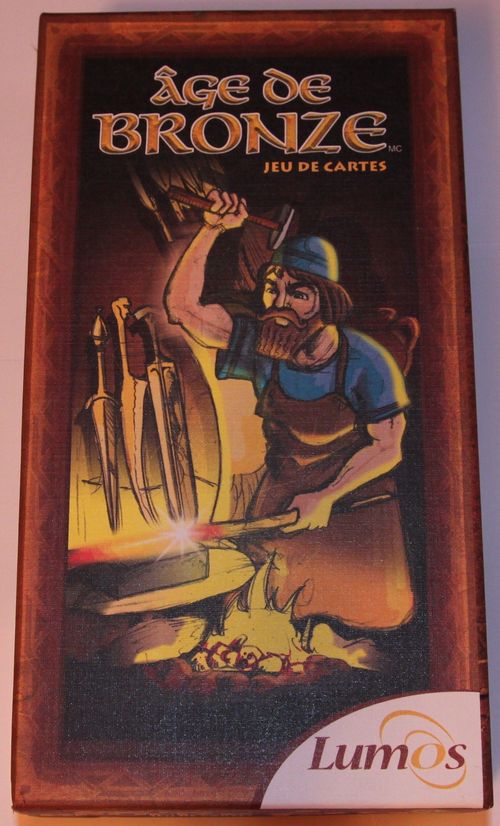
Âge de Bronze
Âge de Bronze Rulebook
Table of Contents
Table of Contents
Setting Up the Game
- Each player draws one of the 6 Nation cards at random and places it in front of them. This is the nation they will govern until the end of the game.
- Each player takes the Deity card indicated on their nation card and places it in front of them next to their nation card.
- Shuffle the cards of the Riches deck and put them on the table so that they are within everyone's reach.
- Remove the End of the Bronze Age cards from the main deck, shuffle it well and deal 3 cards to each player.
- Divide the rest of the deck into 4 roughly equal piles. Add one End of the Bronze Age card to each of these piles. Shuffle each pile well and stack them one on top of the other to form the main deck. DO NOT SHUFFLE THE MAIN DECK ONCE IT HAS BEEN FORMED.
- Place the main deck in the centre of the table so that it is within everyone's reach.
- Turn the top 3 cards of the deck face up, placing them side by side. These cards form the row.
- The oldest player starts the game.
Playing a Turn
The turn is divided into 2 phases:
- Carrying out the actions of your choice
- End of the turn
1. Carrying Out the Actions of Your Choice
On their turn, each player has 4 actions. It is possible to get 5 actions instead of 4 by having the most Temple cards (see the effects of the cards).
Choice of actions (note: the player may repeat the same action several times in the same turn):
- Take a card from the row of face-up cards. (It is forbidden to take a card from the deck unless you play the Augury card or have the Deity card Utu.)
- Develop your nation by playing a progress card (green diamond) on the table in front of you. (Progress cards: Family, Temple, Victory and Riches.)
- Hold back your opponents by playing a dirty-trick card (red triangle) on their nation. (Dirty-trick cards: Famine, Spy, Theft of Statue, Defeat, Earthquake, Curse, Riches.)
- Play a bonus card (orange circle). (Bonus card: Augury.)
2. Ending Your Turn
At the end of each turn, the row of face-up cards is refilled for the next player by taking cards from the deck.
Note: Under no circumstances may a player have more than 8 cards in hand at the end of their turn. If they do, they must discard their excess cards.
End of the Game
The game ends when the 4 End of the Bronze Age cards have come out of the deck. Each nation then scores power points. Note: Cards still in hand do not count.
Scoring
- 1 point per Family card.
- 2 points for the nation(s) with the most Victory cards.
- 1 point for the nation(s) in 2nd place for the most Victory cards.
- 2 points for the nation(s) with the most Temple cards.
- 1 point for the nation(s) in 2nd place for the most Temple cards.
- 3 points for the nation(s) with the most Riches cards.
- 2 points for the nation(s) in 2nd place for the most Riches cards.
- 2 points for the nations that still hold their own nation's Deity card.
If several players are tied in a category, they all get the points. For example, if players A and B have 6 Temple cards, player C has 4 and player D only 2, players A and B each score 2 points, player C 1 point and player D no points.
The player with the most points when the game ends wins the game. In case of a tie, the one with the most Family cards wins.
Effects of the Cards
Nation Cards
Before starting the game, the players must choose a nation at random. Each nation benefits from a deity that it receives at the start of the game. Deity cards allow a free action (not counted as an action) that the player can carry out at any time during their turn. So if a player gets hold of a Deity card during their turn, they can immediately benefit from its power.
THE AKKADIANS (1 card) Deity card: Mammon, deity of riches. Effect: You may take ONE Riches card from the Riches deck for free. If you draw an Ambush card (see below), you must discard it and may not take a Riches card this turn.
THE SUMERIANS (1 card) Deity card: Utu, deity of divination. Effect: You may draw the top card of the deck for free. If you draw an End of the Bronze Age card (see below), you must remove it from play and may not draw another card.
THE AMORITES (1 card) Deity card: Marduk, supreme deity. Effect: You may play ONE Temple card for free per turn.
THE HURRIANS (1 card) Deity card: Nergal, deity of destruction. Effect: You may play ONE dirty-trick card for free per turn.
THE ELAMITES (1 card) Deity card: Kiririsha, deity of fertility. Effect: You may play ONE Family card for free per turn.
THE HITTITES (1 card) Deity card: Inara, deity of war. Effect: You may play ONE Victory card for free per turn. However, the Inara card does not protect against Ambushes.
Deity Cards (6 cards)
The Deity cards are not part of the main deck; they are handed to the players at the start of the game. So there are as many Deity cards in play as there are players. They are placed on the table straight away and are never in the players' hands. Each Deity card gives a special power to the player who holds it in their nation (see above). These powers can be used every turn (free action). In addition, the Deity cards give points at the end of the game (see scoring). They can be stolen by playing the dirty-trick card Theft of Deity. A player may have several Deities in their nation.
Progress Cards
Progress cards are placed in front of the player, face up, so that they can always be stacked and their number seen.
- Family (brown card), 27 cards: Each Family card counts for 1 point at the end of the game.
- Victory (blue card), 22 cards: A Victory card lets you take a certain number of cards from the Riches deck. The player who plays a Victory card rolls a die and takes as many cards from the Riches deck as the number rolled. They keep the Riches cards drawn in their hand, unless they have drawn an Ambush card (see below).
- Temple (yellow card), 22 cards: If a player has more Temple cards than their opponents in their nation (that is, on the table in front of them), they take the Greatest Temple card and immediately benefit from 5 actions instead of 4. They must give up the Greatest Temple card when a player gets more Temple cards than them.
- Riches, 38 cards: Riches cards can only be drawn by playing a Victory card. Riches cards can be played into your nation like all the other progress cards, for one action per card, the only aim being to accumulate as many as possible for the end-of-game scoring. Once played into their nation, a Riches card can no longer be taken back by the player. Riches cards are the only cards that can be played either as a progress card or as a dirty-trick card (see below for its effect as a dirty trick).
Dirty-Trick Cards
Dirty-trick cards are played on another player's nation. They are discarded as soon as they are played.
- Spy (2 cards): Look at an opponent's hand and take one card, which you add to your hand.
- Theft of Deity (12 cards): Steal a deity statue and bring it into your nation.
- Famine (5 cards): The player must discard a Family card from their nation (card on the table).
- Defeat (5 cards): The player must discard a Victory card from their nation (card on the table).
- Earthquake (5 cards): The player must discard a Temple card from their nation (card on the table).
- Curse (2 cards): The player must discard half of the cards in their hand. If they have an odd number of cards, they discard 1 more card than the number they keep.
- Bad King (5 cards): The player must discard a Riches card from their nation (card on the table).
- Riches (38 cards): The Riches card is the only card that can be played either as a progress card (see above) or as a dirty-trick card. As a dirty trick, Riches cards let you steal a Family card from another nation. The active player may play as many Riches cards at once as they wish for ONE action. When Riches cards are played on another nation, they are discarded immediately. The player who played the cards and the victim each roll a die. The player who played the Riches cards adds their die roll to the number of cards played (minimum one card). If the player who played the Riches cards gets the higher score, they take a Family card from the other player (card on the table) and place it in their own nation (on the table). If they get an equal or lower score, the Family card stays where it is. For example, player A plays 3 Riches cards against player B (1 action). They roll a die and get 2, giving a score of 5. Player B must roll a 5 or a 6 (they cannot play Riches cards), otherwise their Family card goes to player A. They finally roll a 6 and keep their Family card. The 3 Riches cards are discarded.
Bonus Cards
- Augury (2 cards): You may look at the top 5 cards of the deck and keep ONE in your hand. The player then puts the cards back on top of the deck in the order they wish, but without showing them to the others. If there are End of the Bronze Age cards among the 5 cards, the player may not take them.
Riches Deck (38 Riches and 7 Ambush)
The Riches cards and the Ambush cards are in a separate deck, the Riches deck, and are drawn only when a player plays a Victory card. When they play a Victory card, the player rolls a die and draws that many cards from the Riches deck. They put them straight into their hand. They may play them immediately (if they have actions left) or later (don't forget that you may not have more than 8 cards in hand at the end of your turn). If they draw an Ambush card, they immediately stop drawing and may keep NO Riches cards. They put them straight into the Riches discard pile. So if a player rolls a 5 on the die and draws 2 Riches cards followed by an Ambush card, they immediately stop drawing and must discard the 3 cards.
Note: It is important to have a separate discard pile for the Riches deck. When the Riches deck is empty, take the discarded cards and shuffle them to form a new deck. It is normal that the further the game goes, the fewer Riches cards there will be for the same number of Ambush cards.
End of the Bronze Age Cards (4 cards)
Players may not hold End of the Bronze Age cards in their hand. If an End of the Bronze Age card comes out when the row is refilled, it must be removed immediately, placed next to the row of face-up cards, and replaced. Likewise, if the player who holds the Deity card Utu draws an End of the Bronze Age card, they must remove it from play and may not draw another. Each time an End of the Bronze Age card appears, one card must be added to the row of face-up cards. So the further the game goes, the greater the choice in the row of face-up cards.
| End of the Bronze Age cards out | Face-up cards in the row |
|---|---|
| None (start of the game) | 3 |
| 1st | 4 |
| 2nd | 5 |
| 3rd | 6 |
| 4th | The game ends immediately |
When the fourth End of the Bronze Age card appears, the game ends immediately.
Rules for 2 Players
The 2-player rules are the same, except that each player must run two nations (with the same hand of cards). The turn order is as follows: player A plays for their first nation, then player B plays their first nation, then each plays in the same order for their second nation. At the end of the game, the points scored by the four nations are counted. The winner is the player who has scored the most points by adding up the scores of their two nations.