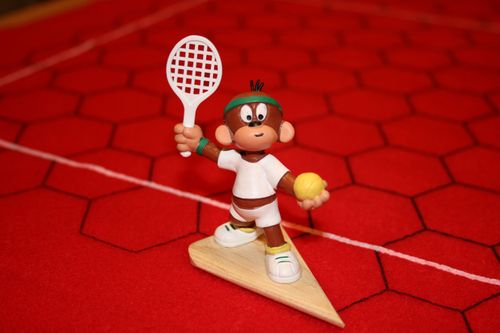
Affentennis
Affentennis Rulebook
Table of Contents
Table of Contents
- Content
- 1. Preparations and technique
- 2. The tip of the player's pedestal marks his/her position
- 3. After each hit the player can take up to five steps
- 4. There are two fields to hit the ball from, forehand and backhand
- 5. You have six points to reach a ball and retreating is expensive
- 6. Your monkey can borrow up to five points to reach a difficult ball
- 7. Mounting and dismounting a volley block costs your monkey two points each
- 8. You freeze when you hit the volley block
- 9. Use the lob ramp to play a lob
- 10. Smash when you are on the net and under no constraint
- 11. Other rules and tricks
- 12. Rules for service and scoring
Content
A beautifully prepared sand court, two rackets, two very experienced banana hungry players, as well as a ball, four counterchips, a lob ramp, a volley block, a smash board and this rulebook. Bananas for the monkeys are not included.
1. Preparations and technique
Place the cloth on a table and straighten it out to remove any bumps. Important: the coloured strip of cloth underneath the court (the net) needs to be straight as well. To use the racket, pull back the bolt and place it close to the ball. Take aim and release the bolt quickly. To adjust the strength of your serve or return there is a scale on the back of the bolt. The ball needs to come to a stop inside the court, otherwise it is a fault and your opponent gets a point. You do not want that! If not stated otherwise, tennis rules and method of scoring apply. A set is usually played to three points. Tennis specific rules are explained in paragraph 12.
2. The tip of the player's pedestal marks his/her position
The tip of the player's pedestal is used like an arrow to mark the position of the player on the court. The tip is also used when the player is moved aside to make space for the racket. You risk being red carded when you threaten your opponent with the tip.
3. After each hit the player can take up to five steps
Every ball begins by placing the monkeys on the court. The serving monkey is positioned behind the baseline, the returning monkey can choose any position. The serving player must play the ball from the baseline to the diagonally opposite quadrant on the other side of the court (in normal tennis the service area is in front of the net). After each hit a player can move his/her monkey five steps in any direction on the hex field pattern to take up a favourable position. It is not obligatory to use all five steps.
4. There are two fields to hit the ball from, forehand and backhand
In order to hit the ball, your monkey needs to be positioned behind the ball to its right or left. Those two fields are the "hit positions" and simulate forehand and backhand. The monkey always has to move to the nearest of the two hit positions. A ball that is in a hex field directly ahead of a monkey, leaves you with a choice.
5. You have six points to reach a ball and retreating is expensive
To reach the hit position your monkey has six points available and needs to pay attention to the "retreat rule".
Every step towards the net costs your monkey one point. That includes diagonal movement as long as your monkey is moving closer to the net.
Moving back diagonally is more exhausting and costs two points per step.
Retreating directly towards the baseline is exhausting your monkey with three points a step.
It is not obligatory to use up all points.
Note: the retreat rule only applies when your monkey is running towards the ball. After having played the ball a step in every direction will cost only one point (see paragraph 3).
6. Your monkey can borrow up to five points to reach a difficult ball
In case your monkey can not reach a hit position with six points, you can "borrow" up to five more points. In that case your monkey plays the ball "under constraint". That means you can only place the racket parallel to the sideline or turn it towards your monkey. After constraint hit your player can only move the remainder of steps. For example, if you needed eight points to reach a ball, then you are left with three points to reach a more favourable position to receive the next ball. In case you need more than eleven points to reach a ball, be a good sport and congratulate your opponent to a perfectly played ball.
7. Mounting and dismounting a volley block costs your monkey two points each
After a hit you can place a volley block instead of retreating from the net. Mounting a block costs you two steps of the usual five your monkey is allowed to move after a hit. Place the block directly in front of your player so that the black arrow touches the hexfield your monkey is on. After your opponent has played the ball you must remove the volley block, which costs another two points.
8. You freeze when you hit the volley block
Try not to hit the block, because it means that you lose all remaining steps to position yourself or to place your own volley block. If your ball touches the block and then comes to a rest outside the court or inside your own half, you will again have to congratulate that other monkey. When the ball comes to a halt on the opponent's half, your opponent removes the block and the game continues.
9. Use the lob ramp to play a lob
A lob (a high ball over your opponent) is free. To play a lob you take the lob ramp, place it on the volley block of your opponent and play the ball. All rules apply.
10. Smash when you are on the net and under no constraint
You can smash, when your monkey is on a hexfield that is at least halfway into the front of the court and under no constraint. You then need to place the smash board on your opponent's baseline. A smash is played like a normal hit. If your ball touches the smash board and it falls over, you take the point and enjoy the applause of the audience. Otherwise the game continues and all rules apply.
11. Other rules and tricks
A ball is good when it virtually covers the line when viewed from above. In case a ball has come to a rest exactly between two hex fields, the decision will be in favour of the player who needs to reach the ball.
The monkeys are part of the game and sometimes influence the position where the ball comes to a halt. Regardless of this, the one who played the ball is responsible for the outcome.
Note: The monkeys are sometimes in the way when you want to play a ball. You can move your monkey to the side, as long as the tip of the pedestal points into the correct hex field.
12. Rules for service and scoring
Every ball begins with a serve from the baseline to the diagonally opposite quadrant on the other side of the net. Failure to land in that quadrant results in a second serve. The second serve must be in or you lose a point. The first serve begins at the baseline to the right of the centre line. The return and all following moves can be played to anywhere in the court. After the ball the same player serves from the left.
Every ball results in a point for a player. The scoring goes 0, 15, 30, 40, game. That means that you need at least four points to win a game as it is called in tennis. Note that you also need to be two points ahead of your opponent to win the game. At a score of 40:40 (deuce) you will have to play at least two more balls to win. The player who scores at deuce has "advantage" and the counter changes to Vorteil. The right to serve changes after each game. The players change sides after the first service and then after every second game. A set is won at a score of 3:0 or 3:1. At a score of 3:2 the match continues to four games to complete the set. No tie-break is played.