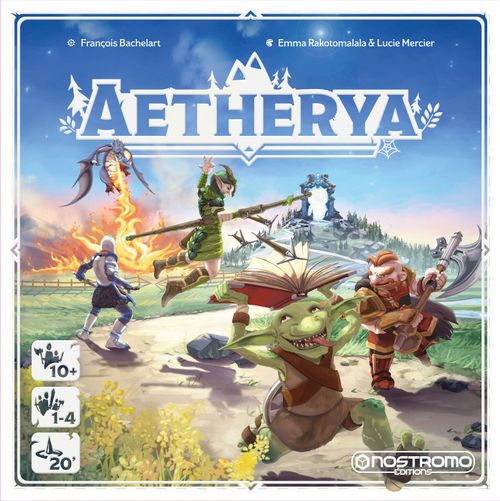
Aetherya
Aetherya Rulebook
Table of Contents
Table of Contents
Objective and Components
In Aetherya, each player explores wild lands and builds a Kingdom made up of varied Terrains, populated by diverse creatures and Tribes. Everyone tries to score as many Harmony points as possible by arranging their Kingdom cards to best effect, while also acquiring Legend cards, which also generate Harmony points. The player who totals the most points at the end of the game is declared the legendary hero of Aetherya.
Components
- 4x12 Object and Character tiles
- A deck of 80 Kingdom cards
- A deck of 15 Legend cards
- A pad of score sheets
The Kingdom cards
There are 10 different cards in the Kingdom deck: Terrains of 4 types (Plains, Forests, Mountains, Marshes), Tribes of 4 types (Humans, Elves, Dwarves and Goblins), and 2 types of special cards: Dragons and Magic Portals.
Example of a Terrain card: the Marsh pictogram appears on a Marsh card illustration.
Example of a Tribe card (here, the Humans): each Tribe card shows its preferred Terrains — here, Plains, Mountains and Forests earn points for the Humans, while Marshes cost them points — and a war banner showing which Tribe this one hates (the hooked dagger corresponds to the Goblins).
The four Tribes are: Elves, Dwarves, Goblins, and Humans.
Dragon and Magic Portal cards: a card's value depends on how many Dragons are present in your Kingdom. A single Dragon is worth 3; if you have 2 Dragons, each is worth 5, and so on.
Goblins cannot use a Portal or tame Dragons, unlike the other Tribes.
The lock icon appears on Portal and Dragon cards: it indicates that once placed in your Kingdom, these cards can never be exchanged, unlike Tribe and Terrain cards.
The Legend cards
Legend cards earn Harmony points for whoever holds them at the end of the game. These cards represent events that players will strive to trigger within their Kingdom in order to claim them.
For example, to acquire a given Legend card you might need to shape your lands so as to have a chain of 3 connected Mountain cards. That card would earn 4 Harmony points.
Setup
Components to use: depending on the number of participants, remove from the Kingdom deck the cards that do not match your game configuration: at 2 players, remove the cards mentioning 3 and 4 players (indicated by the number of small red stones printed under the dragon on the back of the cards). At 3 players, remove the cards with 4 small stones. Shuffle the deck, then do the same with the 15 Legend cards.
Place the Legend card deck in the center of the table. Draw 8 of them and place them face up in 2 rows.
Place the Kingdom card deck in the center of the table to form the draw pile. Each player draws 4 cards and looks at them. If you hold one or more duplicate cards, discard the duplicates and draw new cards until you have 4 different starting cards. Discarded cards are put back and shuffled into the draw pile. Each player then arranges their 4 starting cards as they wish to create their base Kingdom, placing them face up as they like to form a 2x2 square.
Each player then draws 12 additional Kingdom cards and places them face down around the first 4 without looking at them beforehand, so as to form 4 rows of 4 cards each. By convention, we call these cards Unexplored Territories.
Draw the first card of the Kingdom deck and place it, face up, near the draw pile. This card forms the first card of the discard pile. The oldest player at the table is declared the first player. Starting with this player, everyone takes their turn clockwise.
Attention: at 2 players, the cards mentioning 3 and 4 players have been set aside.
Game Principle and Objective
The game continues until one of the participants reveals the last Unexplored Territory card of their Kingdom. At that point, the game stops immediately and each player's Harmony points are calculated. The winner is whoever totals the best score.
On your turn, you either draw the top card of the Kingdom draw pile, or take the top card of the discard pile. If you take the card from the discard pile, you must place it in your Kingdom and replace one of the cards present in one of your 16 regions, which then goes to the discard pile in turn.
Warning: Portal and Dragon cards display a padlock pictogram and can never be discarded once in play (see further on).
When a player chooses to draw the top card of the draw pile, they proceed the same way, except that they may immediately discard the drawn card. In that case, they must reveal one of their Unexplored Territory cards.
Important: it is forbidden to replace an already-revealed card with another card of the same kind. For example, if I draw a Forest, I am not allowed to replace another Forest card.
Examples: I draw a "Dwarf Tribe" card
- I want to keep it. I choose to discard the Plains to place my Dwarf Tribe there. I could also have discarded an unrevealed card to place my Tribe there instead.
- I do not want to take the Dwarf Tribe I just drew: I discard it and must choose an Unexplored Territory, and reveal the Kingdom card found there.
Organizing Your Future Kingdom
Each Tribe has its preferred Terrain: Elves love Forests and gain 2 points per adjacent Forest, but lose 1 point per Marsh. Dwarves favor Mountains (2 points); Goblins favor Marshes (3 points per Marsh), and Humans like to settle in Plains (2 points) but also appreciate Forests and Mountains (1 point for each).
For a Tribe to be happy, it is enough that its card be placed next to its preferred Terrain.
Important: in Aetherya, cards placed diagonally to one another are not considered adjacent.
Placing a Terrain next to a Terrain of a different type is not a problem. The same is not true for Tribes.
Remember this: Goblins hate everyone, and everyone hates Goblins. Dwarves and Elves hate each other. There is no particular issue with placing Humans near Dwarves or Elves.
At the end of the game, for each Tribe in contact with a Tribe it hates, there is a conflict, and the player suffers a 2-point penalty.
On each Tribe card, one or more icons appear that correspond to the peoples hated by that Tribe (weapon icons). Each hated Tribe is identified on the cards by an icon: sword for Humans, bow for Elves, axe for Dwarves, and curved dagger for Goblins.
Special Cards
Dragons
They grant Harmony points at the end of the game if they have been tamed. For this, they must be connected to at least two Tribes of the same kind. If this is not the case, they remain wild, and their value is subtracted from the player's score. The value of each Dragon increases (from 3 to 6) depending on how many are in your Kingdom (from 1 to 3 Dragons). Beyond 3 Dragons in your Kingdom, it becomes impossible to tame them. From the 4th Dragon onward, their value (6) is deducted from your Dragon score.
Magic Portals
They connect the 4 cards adjacent to them orthogonally and can offer great opportunities by bringing Tribes closer to their preferred Terrain. Conversely, if misused, they can generate conflicts.
Note: Goblins are unable to use Portals or tame a Dragon. They are far too stupid for that! However, at the end of the game, if a Goblin Tribe is adjacent to a Portal that is itself adjacent to a hated Tribe, there is a conflict.
These special cards have one particular trait compared to the others: once in play, they can never be replaced. This trait is represented by a padlock.
Important: if the Kingdom card draw pile should run out, reform it with the cards from the discard pile, shuffle it, and draw its first card to form the new discard pile.
Acquiring Legend Cards
Legend cards earn Harmony points for whoever holds them at the end of the game.
On your turn, if you meet the requirements of a Legend card, you may take it and keep it near your play area, face up. The card that was taken is then replaced by drawing a new card from the corresponding pile, so that 8 are always visible (unless the pile is exhausted).
Important: a player may only take one Legend card per turn, even if they meet the requirements of several cards.
There are 5 types of Legend cards (see below). Once a Legend card is in a player's possession, they hold it until the end of the game and are no longer required to keep meeting the card's requirements to retain it. They may therefore rearrange and optimize their Kingdom afterward.
Legend Cards
It is with Aetherya's Legend cards that you will write the history of your Kingdom and earn plenty of Harmony points. So you must obtain them before your opponents do... A reminder: you may only take possession of one Aetherya Legend card per turn (base rules).
You can acquire one of these cards if:
- Alliance: a Human Tribe is connected to a Dwarf Tribe in your Kingdom — an Alliance is formed. There are only 2 Alliance cards in the deck: Human-Dwarf and Human-Elf.
- Terrain chain: you have 3 connected Forests in your Kingdom. There are 4 Legend cards of this type in the deck, one for each type of Terrain.
- Kingdom of a people: you have 2 connected Human Tribes. A Human Kingdom is born! There are 4 Legend cards of this type in the deck: one for each Tribe.
- Legendary Battle: you have 2 Goblin Tribes connected to a Dwarf Tribe, or 2 Dwarf Tribes connected to a Goblin Tribe. This is a Legendary Battle. There are 4 cards of this type in the deck: Dwarves vs Goblins, Humans vs Goblins, Elves vs Goblins, and Elves vs Dwarves.
- The Four Tribes: all 4 Tribes are present in your Kingdom. This card is unique, and it is not necessary for the 4 Tribes to be connected.
Example of a Legend card: a card showing "3 x Mountain" is worth 4 Harmony points (shown in its corner) and is earned by having 3 connected Mountain cards in your Kingdom. They may be aligned, placed in an "L" shape, or even connected via a Portal.
End of Game and Scoring
As soon as a player reveals their last Unexplored Territory, the game ends. All unrevealed cards in the other Kingdoms are turned back over. Calculate each player's score using the score sheet, as follows:
The first row lets you note each player's initials. For each of the 7 following rows on the sheet, each player calculates their corresponding Harmony points.
The first row represents the Elves, and each player reports to whoever is keeping score the points earned with their Elves. Each Elf earns 2 points for each adjacent Forest and -1 for each adjacent Marsh. Do the same for the Dwarves, the Humans, and the Goblins.
Next comes the score earned from Dragons. Remember, a single Dragon is worth 3 points; if the player has 2 Dragons, each is worth 5 points, and so on. A Tamed Dragon (connected to two Tribes of the same kind) earns these points for the player. If it is not tamed, these points are deducted from the player's score.
Then come the points earned from Legend cards acquired during the game, followed by the penalties linked to conflicts (when two Tribes that hate each other are adjacent) — note -2 points per conflict. The same Tribe connected to several hated Tribes incurs this penalty multiple times.
Don't forget that each Human in contact with a Forest or a Mountain also earns 1 point (see example below).
Note that Dwarves are immune to Marshes: no penalty.
Reminder: watch out for Portals, which connect 4 cards to one another.
To break a tie between two players, compare their best score among the 7 categories. If the tie persists, compare the next-best score, and so on.
Scoring example
Following the order of the score sheet, for Jordan (Jd):
- Elves: 10 points (one Tribe in contact with 3 Forests = 3x2 points, and the other in contact with 2 Forests, so 4 points).
- Dwarves: 4 points.
- Humans: 8 points (the top one is in contact with 2 Forests and a Mountain = 3 points. The next one, with a Forest, a Mountain, and a Plain = 4 points, and the bottom one earns only 1 point because it is in contact with a Plain via the Portal but loses a point because of the Marshes).
- Goblins: 0 (there are none here).
- Dragons: a single Dragon is found in this Kingdom. It is worth only 3 Harmony points, which are earned because the Dragon is tamed by the Humans (2 adjacent Tribes, one of them via the Portal).
- Legends written: none, so 0.
- Conflicts: a single one between the Dwarves and the Elves, so -2.
The total score is therefore 23.
In this example, Thomas (Th), Jordan (Jd) and Cécile (Ce) total scores of 19, 23 and 23 respectively. Jordan is tied with Cécile. Cécile's best score is 12, with her Goblins. Jordan, meanwhile, reaches 10 points with his Elves. So Cécile wins, by a very small margin.
You now know the base rules and can start playing!
Objects and Characters Mode (2-4 players)
Overview
The Objects and Characters mode brings tiles into play and creates interactions between players. Each tile offers a bonus to its owner. It may be a power stone, an artifact, or a special action (see details further on).
Setup
Setup is identical to the base game, except that a set of tiles is used for each participant. Distribute 12 tiles of the same family (different card back) to each player. After shuffling them, everyone places one tile face down on each Unexplored Territory.
Gameplay
When a player reveals or replaces an Unexplored Territory card, they may take possession of the tile it holds and must reveal it. Tiles revealed this way are placed near their play area and belong to them.
Important: tiles that offer special effects may be played at the very end of the player's turn. There is no limit to the number of tiles that may be played.
A player may voluntarily refuse to take possession of a tile instead of taking it. In that case, they reveal it once discarded. It is sometimes preferable to give up a tile, particularly regarding the collection of Power Stones (see below). When the game ends, all tiles that have not been revealed are discarded.
Notes on Using Certain Tiles
Griffin: intended to be exchanged with the tile of any Unexplored Territory in play. The Griffin is then placed face up on the card that was the subject of the exchange. It can only be recovered by the owner of the Kingdom where it was placed. To recover the Griffin, simply reveal the corresponding Unexplored Territory. A player may therefore own several Griffins and use them multiple times. The icon on this tile indicates that it is placed on an Unexplored Territory card when its owner uses it.
Power Stones: the only tiles that grant Harmony points at the end of the game. However, once their value is added up, the player only keeps the units digit (so 10=0, 11=1, etc.). Each player with a total of 10 Harmony points from their Power Stones (1+2+3+4) should avoid keeping all of them. Getting rid of the Stone with a value of 1 is the best solution to earn 9 points instead. It's up to you to find the ideal method to earn the most points. This value is added at the end of the game to the "Legends Written" line of the score sheet. The infinity icon indicates that this tile is never discarded.
Trafficker: offers its owner the opportunity to exchange one of their Power Stones for any tile (Character or Object) owned by one of their opponents. However, you cannot exchange a Stone for a Stone. The purchased tile must be in the opponent's possession and not on one of the cards in their Kingdom. The icon indicates that this tile is discarded when its owner uses it.
Objects and Characters Tiles
Exploring Unexplored Territories can allow you to get your hands on treasures and powers. Here are the details:
- Diplomatic Accord (Object): place this scroll on one of your Tribes; it generates no conflict with adjacent Tribes.
- Staff of Command (Object): place this tile on a wild Dragon: it automatically becomes tamed (unless you already have 3 Dragons in your Kingdom).
- Magic Sword (Object): when discarded, it allows you to win a Battle Legend card in a 1-vs-1 instead of a 2-vs-1.
- Griffin (Character): take a tile from a Kingdom (yours or another player's) and replace it with your Griffin.
- Divine Hammer (Object): discard the Hammer and swap 2 cards in your Kingdom. This includes Portals and Dragons.
- Palantír of Sight (Object): allows you, on each turn, to secretly look at the nature of one tile among those still unexplored, whether yours or your opponents'. It is never discarded.
- Power Stones (Object): there are 4 types (4 values from 1 to 4): they earn Harmony points at the end of the game. Add up your Stones and keep only the units digit. E.g.: 12=2, 10=0, etc.
- Trafficker (Character): when discarded, allows you to buy one of a player's tiles by giving them one of your Stones in exchange.
- Thief (Character): when discarded, allows you to steal a tile owned by an opponent. Note: the Thief only steals Objects (this excludes the Thief, the Trafficker, and the Griffin).
Solo Mode
The Solo mode is another challenge that Aetherya offers you. Each game is a mini-campaign across 3 Ages, and the slightest failure during a season ends the game... with a score of zero. You have been warned.
Components
Only the base components for 2 players are used. No tiles.
Setup
The setup for your starting Kingdom is identical to the base game. It is, however, very different for the Legend cards.
Shuffle the Legend card deck and place them in 3 rows of 5, 6, and 7 cards respectively above your Kingdom, and reveal them. These 3 rows correspond to the 3 Ages of the campaign.
Objective
Over the 3 coming Ages, try to reach a Kingdom score strictly greater than the total value of that Age's Legend cards. During Age 1, only 5 Legends need to be written, while at Age 3, 7 Legends must be written.
End of a Season
An Age ends in one of the following cases:
- the Kingdom card draw pile is exhausted (reveal your Unexplored Territories),
- you reveal your last Unexplored Territory card.
Turn
Draw 2 cards: either both from the draw pile, or the top card of the discard pile plus the top card of the draw pile. Immediately discard one of the two cards, then play your turn normally with the one you have left.
Discarding Legend Cards
When you succeed in writing a Legend, turn it face down. Legend cards, unlike in the base game, do not earn points.
Calculating Points and Score
When an Age ends, calculate your Harmony points as in the base version. Do not add the value of that Age's Legend cards.
Score
At the end of each Age, your final score is the difference between your Kingdom points and the objective (the sum of the values of the Legend cards to be written). Example: the objective was 11 points and you achieve 23. Your score is therefore 23-11=12.
The sum of the 3 scores gives you your campaign score. A score can be negative. Use one column of the score sheet for each season, and the 4th for the overall total.
Moving from One Age to the Next
Have you passed the first stage? Well done.
Put the Written Legends back in the game box. Look at your current Kingdom and select a group of 2x2 cards that will form your new starting Kingdom (your Kingdom offers 9 possibilities), discard the other cards and reform a new draw pile that you shuffle. Place 12 new Unexplored Territories. This time, you must write 6 Legends. Proceed the same way for the 3rd phase of the game.
Failure
Whatever phase is being played, if you fail to write all the Legends of that phase before the Age ends, you have lost.
Balancing the Legend Cards
Before starting to play the first Age, you may swap one Legend card from the first Age with one card from the second Age. When you begin the second Age, you may do the same and swap a card from the 2nd Age with a card from the 3rd Age.
Tips
Avoid systematically drawing two cards from the draw pile every turn, as this lets you play for longer. Write Legends as fast as possible, because afterward, and until your Kingdom deck is exhausted, you can devote yourself to optimizing it. The game does not end when all Legends are written. When the discard pile shows a card you really do not want, it is risky to take it while drawing, since you could very well draw the same one for your second card. Toward the end of a phase, start anticipating the next phase by planning what your 4 starting cards will be, with respect to the Legends to be written for the following Age.
Cooperative Mode (2-4 players)
In this mode, everyone wins or loses the game together. It is therefore important to confer and make good decisions during the game. When a player writes a Legend in Cooperative mode, they do not keep the card. It is put back in the box and never contributes its Harmony points to the player's score.
Components
Only the cards are used. No tiles.
Setup
Setup is identical to the base game, except: the row of Legend cards is reduced to 3 cards when playing with 3 players, and to 2 cards when playing with 4.
Certain Legend cards will be discarded during the game; plan for this space near the Legend card pile.
Drawing and Discarding Kingdom Cards
Create two separate discard piles near the draw pile by drawing a second card from the deck during setup. During the game, players may freely discard their card onto either of the two discard piles.
Objective
When the game ends, all the players together win the game if they total a number of Harmony points strictly greater than the sum of the Harmony points of the Legend cards present in the discard pile.
If even a single participant fails, everyone has lost.
Example: at the end of the game, 5 Legend cards are found in the discard pile, for a total of 15 points. 15 is the score that each player must exceed for the game to be a success. If even a single player fails to reach at least 16 Harmony points, everyone has lost. Be careful to play in a way that lets everyone optimize their game.
End of the Game
The game ends in one of these 3 cases:
- the row of Kingdom cards is exhausted,
- one of the players reveals their 16th card,
- the 15 Legend cards have been taken or discarded.
Turn
Designate a player who will start playing. When all players have taken their turn, the round is over.
During a turn, if a player has the possibility of taking a Legend card because their Kingdom meets the requirements, they are obligated to take the Legend card. For the moment, it is simply turned back over in the row; the player does not take possession of it, unlike in the base rules.
If several Legends can be written simultaneously, the player must turn over all the corresponding cards.
At the end of the turn, put the Legend cards that were turned face down back in the game box and refill the row.
Discarding Legend Cards
If, during a turn, none of the players manage to write a Legend, the players must confer to choose one card among the visible cards and place it in the discard pile (not in the box). This card is immediately replaced by a new Legend card taken from the draw pile. When the draw pile is exhausted, the game continues with fewer than 4 cards until it ends for one of the 3 reasons mentioned above.
Calculating Points
Players calculate their Harmony points as in the base version, except that: the points from Legend cards earned during the game are not counted.
Team Score
You may assign a score to your team. This score is the difference between the lowest score achieved by the team and the objective (the sum of the values of the Legend cards in the discard pile).
Example: the objective was 15 points and Jordan achieves 17 points. The team has a score of 2. Room for improvement!
Tips
Avoid, if possible, writing more than one Legend during a single turn. Since there are 15 of them, you have at best 15 turns to explore and optimize your Kingdoms. Writing several Legends in the same turn reduces this playing time, and can prove problematic. Confer about which discard pile you are going to cover during your discard phase. The next player might be interested in a card you could cover, hence the value of having two discard piles. Draw from the Kingdom cards as little as possible, since their number is counted; explore as much as possible using the discard pile cards. Be patient — nearly all of them will come into play.
Beyond the Base Game
The Nostromo Éditions team offers further variants and modes on its website to keep renewing your pleasure in exploring the Kingdoms of Aetherya, including an Invasion mode and a Confrontation mode.
In the Invasion mode, the Kingdoms of Aetherya are in turmoil: Dragons and Goblin armies are said to be advancing on the Kingdom, and some fertile lands are being cursed and turning into uninhabitable Marshes, while Human envoys visit their Elf and Dwarf neighbors to seal alliances as war draws near. In this competitive mode, Goblins, Dragons, and Marshes are not played the same way as in the base game, and will truly give you trouble.
In the Confrontation mode, war has broken out between all four factions, each with its own specialty: Dwarves rely on their impregnable fortresses, immortal Elves are more fearsome than ever, Goblins remain as invasive as ever, and Humans as opportunistic as ever. In this mode, each player takes control of the fate of one of the 4 factions, and all play on the same large Kingdom for a completely different experience. Tiles are used differently here, representing fortresses to be built.