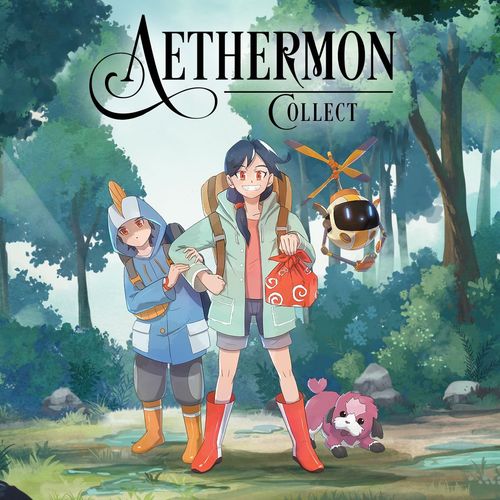
Aethermon: Collect is a 2-4 player set-collection game featuring shared movement.
Aethermon: Collect can be played as either a co-operative game or as a competitive game.
In either scenario, the game is played on a grid of Aethermon cards; the size of this grid is determined by the number of players.
On each player's turn the player moves the Group Token across the grid horizontally or vertically any number of squares ('Rook's move'), collecting any Aethermon on which they land.
At the end of the game, the values of each player's collected Aethermon (including bonuses for complete sets) are tallied: these are combined to form the team score (co-operative), or kept separate as personal scores (competitive).
Co-operative Overview
No Artefacts are used.
Players cannot collect an Aethermon if another player has already collected an Aethermon of the same set.
The game ends when any player is unable to collect an Aethermon on their turn.
Players combine scores to achieve a target.
Special rules for 2-player game.
Competitive Overview
Players draft powerful artefacts that can give them an edge over their opponents.
The game ends after each player has completed a consecutive turn without collecting an Aethermon.
Players score individually.
The player with the highest score wins.
How to read Aethermon Cards
The large digit on each Aethermon card shows the point value of the Aethermon.
The portrait circles indicate if an Aethermon is part of a set, and which Aethermon are in its set.
If there are two or three circles, the card is part of a set.
If a player collects all Aethermon in a set, the value of the set is doubled.
Determine Turn Order
Determine turn order before setting up the grid.
This may be done by dealing each player 3 random Aethermon.
Each player adds up the value of these Aethermon (ignore set bonuses); the player with the highest total value is first in the turn order.
In the case of a tie, continue to draw additional Aethermon.
Play proceeds clockwise from the player who is first in the turn order.
The player to the left of the first player is the second player.
The player to the right of the first player is the last player.
Set up the Grid
Use the table (below) to determine the composition of the grid.
Players
Elements
Grid
2 Players
4 Elements
5x5 Grid*
3 Players
6 Elements
6x6 Grid
4 Players
8 Elements
7x7 Grid*
* Leave the centre position vacant.
If the set-up requires a certain number of Elements, any of the 8 available Elements (delineated by colour and glyph) may be chosen.
Each of these Elements consists of 6 Aethermon; all 6 of these Aethermon must be used if that Element is in the game.
Randomly distribute all Aethermon face-up in a square grid (so that the image of each Aethermon is visible).
Placing the Group Token
In a 2-player or 4-player game, place the Group Token in the empty centre space on the grid.
In a 3-player game, the player who is LAST in the turn order chooses one of the four corner squares to place the Group Token.
Note: The first player must move the Group Token on their first turn, and cannot collect the Aethermon where the Group Token starts.
No Hidden Information
Aethermon: Collect is an open information game; all cards should be visible throughout the game to all players.
At any time, any player may request to see which Aethermon another player has collected, or which Artefacts they have available (next section).
Drafting Artefacts
If playing competitive: players have access to powerful Artefacts that manipulate gameplay.
Randomly divide the Artefacts into pairs:
Create one pair per player.
Each pair must have two Artefacts.
Discard any leftover Artefacts.
Ensure that all Artefacts are face-up, so that all players can read their abilities.
All players take turns choosing one pair of Artefacts:
The player who is LAST in the turn order, chooses first.
Players continue choosing pairs of Artefacts in an anti-clockwise direction.
The player who is nominally FIRST in the turn order will draft last and will be left with whichever pair remains.
Using Artefacts
Players may use an Artefact at the time indicated by the text on the Artefact.
Each Artefact may only be used once.
Once an Artefact has been used, flip it over so that its art and text are face-down.
Artefact Clarifications
Wind-up Beetle:
'Adjacent Aethermon' refers to Aethermon which are horizontally or vertically next to the Player Token, NOT diagonally.
Boxing Gloves:
Skipping a turn by using Boxing Gloves counts as a turn without collecting an Aethermon for end-of-game conditions.
Player's Turn
On each player's turn, the player must move the Group Token.
Players may move the Group Token any number of spaces horizontally or vertically ('Rook's move').
Players may choose to move the Group Token to an empty space on the grid.
All movement must stay within the grid.
If a player moves the Group Token onto an available Aethermon, the player removes the Aethermon from the grid and places it in their collection to be scored at the end of the game.
After this movement, the player's turn is ended and the next player clockwise begins their turn.
Ending the Game
The co-operative game ends when any turn is completed without collecting an Aethermon.
The competitive game ends after each player has had a consecutive turn without collecting an Aethermon.
If a player skips their turn by using the 'Boxing Gloves' Artefact, the turn skipped still counts as a turn without selecting an Aethermon.
Scoring
To calculate each player's score:
Players tally the point value of each Aethermon in their collection.
If a player collects all of the Aethermon in a set, double the value of Aethermon in that set.
If playing competitive and there is a tie:
The player who acted LAST in the turn order wins.
3- or 4-Player Co-operative
Set grid and Group Token as usual.
Special rules apply:
Do not draft Artefacts.
Players cannot collect an Aethermon if another player has an Aethermon of the same set.
The game ends when a turn is completed without collecting an Aethermon.
All players combine scores to reach a target.
2-Player Co-operative
Set grid and Group Token as a 4-player game.
In addition to all the rules in the 3- or 4-player co-operative game, additional rules apply:
The first player may move either vertically or horizontally; in subsequent turns that player is limited to movement along that axis.
The second player may only move along the other axis.
Alternate Competitive Rules
For more intrigue: Hidden Artefacts
Create pairs of Artefacts, face down. Players may only look at the Artefacts when it is their turn to draft. Keep the Artefacts hidden until used.
For a team experience: 2 vs 2 game
Play as usual; at the end of the game, players sitting opposite combine scores (but not sets).
For a distilled experience: Play without Artefacts
Skip the Artefacts draft. This creates an experience focused entirely on the board.
For more Artefacts: 3 Artefacts
When creating pairs of Artefacts to draft, instead create groups of three Artefacts.
For a slightly longer game: Redistribute Artefacts
After each player has taken a turn, fill empty squares on the grid with the leftover Artefacts.
Co-operative Targets
2 Player
3 Player
4 Player
Great
105
90
120
Impressive
120
105
135
Heroic
135
115
150
Legendary
142
120
160
Competitive Tips
Consider not only what move is best for you, but how that move helps or hinders your opponent.
Sets of three Aethermon are worth 12 Points!
If your opponent almost has a complete set of three, try to stop them completing their set.
Sometimes you can force the game to end by denying the next player access to an Aethermon.