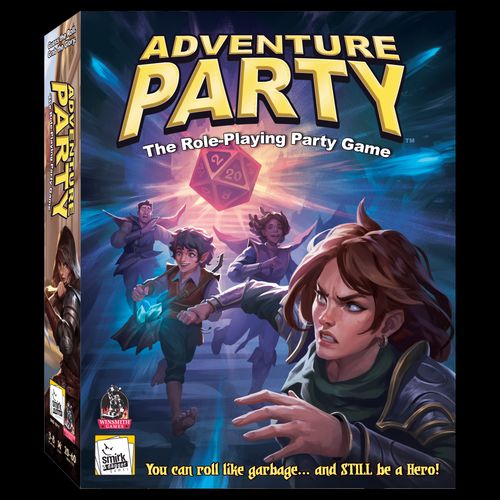
Adventure Party: The Role-Playing Party Game
Adventure Party: The Role-Playing Party Game Rulebook
Table of Contents
Table of Contents
Contents
- (8) Character Player Screens
- (40) Item cards
- (8) 20-Sided Dice
- (25) Adventure Scenario cards
- (48) Experience Point tokens
- (48) Personal Glory tokens
Set Up
- Each player chooses a Character Screen and places it in front of them. The characters are not functionally different from one another, so choose one based on your favorite art or role.
- Each player also takes a 20-sided die, which can be placed behind your screen.
- Shuffle the Item cards and deal two face-down to each player. Players may look at their cards. Leave any remaining cards face-down within easy reach to one side of the play area, forming the Item deck.
- Next to the Item deck, place the Experience tokens and Glory tokens, separated by value.
- Leave a space for your party's earned Experience tokens to be collected (the Party XP space).
- Set the Adventure Scenarios for this game:
Game Length
You may adjust the number of Adventure scenarios to customize the length of the game.
- Three-Card Full Campaign: Recommended for 3-6 players. 30 - 60 minutes, depending on player count.
- Two-Card Skirmish: Recommended for 7 and 8 players. About 60 minutes.
- Single-Card Encounter: Recommended as a quick filler. 3 - 5 minutes per player.
For your first game, consider starting with the Adventure scenario: Dragon's Breath. Then, add Riddle Room, & Rescue the Prince to fill out the balance of a full Campaign. Place them in this order, "scenario description" face-down, with the Dragon's Breath adventure on top. Place the others back into the box. They will not be used this game.
Note: On subsequent plays, shuffle the Adventure deck and deal three face down at random - or choose any three you like.
Each player rolls their die. The high roll will become the "GM" for the first round of Adventure #1.
Playing the Game
- The GM (aka Guess Master) takes Adventure card #1 and reads it aloud to the whole group. It sets the stage for this round's scenario which each player will face, one at a time. Each of the Adventure cards ends by asking, "what do you do?". Afterwards, place the card, with the big image facing everyone, in front of the GM's screen.
- The player seated on the GM's left will be the first to respond to the Adventure's challenge.
-
They will roll their 20-sided die so that no one can see the result.
-
They check their roll against the success chart printed on their character screen.
- A "20" is a Stunning Success and represents the best possible outcome of your intended actions. However, it can never be SO good as to end the encounter. Example: You might mortally wound the dragon, but it isn't dead just yet - after all, the rest of the players still have to play.
- A "1" is a Total Failure of everything you had hoped to do. In fact, you or the party are now in a much worse position as a result of your action. However, as bad as it gets neither you nor any party member will die as a result.
- A "10" is Barely A Success, meaning that your action succeeded but not by much. The overall impact of the action was unimpressive or came with some complications. Technically, it worked - just barely.
- A "9" is Just Failing, your action didn't work - but at least things aren't worse than when you started.
-
Your roll will be somewhere across this spectrum of success and failure, from 1 to 20, and likely in between two of the numbers on the chart. Use this as a guide for the degree to which you failed or succeeded. Closer to 1 is a bigger failure than a roll closer to 9, for example.
-
Example: The Rogue rolls a 13. A success! But not a huge one. Now the player must describe what happens so the GM can guess as close to 13 as possible.
"I'm usually the sneaky one, but with this magic hammer my plan is to charge and smash the dragon right in the face! The dragon draws in a huge breath, getting ready to blast us with fire. Taking my Hammer of Smashiness, I swing with all my might. But he sees it coming and shifts back so my blow lands squarely on his clawed foot instead. Still, the hit crushes it with enough force that he swallows his own fire and gets some major indigestion."
Guessing
-
The GM (Guess Master) ponders what might have been rolled. Before the guess, they may ask one clarifying question, allowing the player to provide additional depth. As before, you may not ask a quantifying question. Should they wish, they can instead ask if any other player would like to ask the question.
For example, you may ask, "What is the dragon's reaction - does it appear frightened?" or "Can you describe the damage you did a bit more?" but not a question like, "How much weaker is the dragon now?"
-
Each other player now sets their 20-sided die to match their guess behind their screen. While only the GM's guess will earn Experience Points for the party, the other players can gain Personal Glory which factors into the end game.
-
When all players signal they are ready, the GM announces their guess - and the reasoning behind the guess.
"Well, the dragon didn't attack - and you bought some time. But you didn't do a lot of real damage to it. Did you roll a 10?"
Scoring
-
If the GM guesses the number exactly, the party earns the maximum Experience of 5 points. For each number away, subtract one Point.
So in the example, 13 is 3 away from the guess of 10. 5 xp minus 3 is 2 Experience Points earned.
13 minus "10" = 3 5 xp minus 3 = 2 xp
Note: Experience cannot be negative. If more than 5 away from the roll, it is counted as "0".
Place a number of Experience Point tokens in the center of the table, equal to the number earned. The pile will grow bigger with each successful GM guess during the game. If you run low on "1" tokens, you can swap for value 5 and 10 tokens to refresh the supply.
-
The other players now raise their screens to reveal their own guess. If they guessed exactly, they earn 2 Glory Points. If one away, they earn 1 Glory Point. Give players Glory tokens for each point earned. Personal Glory is an honor for the end game but does not count towards the party's Experience Points. If you run low on "1" or "2" tokens, have players swap for "5" tokens to refresh the supply.
The Tale Continues!
-
The player who just completed their tale becomes the new GM and will be the lead guesser this turn. They remind us where their character left off and ask... "Now, what do YOU do?"
The next player clockwise continues the scenario's story from that point. They too must roll the die in secret, choose one of their two Item cards and describe their plan and how well or poorly they did.
-
Play continues in this fashion until all players have been the GM and told their part of the tale. The first GM of the round will always be the last to tell their tale - and this will always be clear, as the scenario card remains in front of the GM who first read it. As the last tale of the scenario, this player may wrap up the adventure in their story (killing the dragon, having it escape, etc).
This scenario then comes to an end.
Starting the Next Adventure
You may end the game after one Adventure scenario or continue up to a full game of two Adventures (for 7-8 players) or three Adventures (for 3-6 players).
The Wandering GM
If you continue, a new beginning Guess Master will be determined. Have each player who has not STARTED a round as GM, roll a die. The high roll becomes the new starting GM for the round.
- They discard the previous Adventure card to the box.
- Each player is dealt another Item card, so each player has two.
- Then, the new GM will read the new Adventure Scenario aloud to the group and begin the next round of play.
- The player to their left begins their tale first.
Ending the Game
At the end of the chosen number of Adventures, total the Experience Points earned over the course of the game. Total each player's Glory Points as well. Then hand the rule book to the player with the highest Personal Glory. This player will divide the Party Experience Points by the number of players and check it against the corresponding Scroll of Heroes below. The result is a general ranking of how the party performed.
Scroll of Heroes
| Total Experience Score (1 Adv) | 2 Adv | 3 Adv | Rank |
|---|---|---|---|
| 4.5 - 5+ | 9+ | 12+ | Legendary: Bards will sing of your epic tales for generations to come. |
| 3.5 - 4.4 | 7-8 | 10-11 | Exceptional: Few others have the success and superiority you possess. |
| 2.5 - 3.4 | 6 | 8-9 | Respectable: Your deeds gain the admiration of those who needed you. |
| 1.5 - 2.4 | 4-5 | 6-7 | Inferior: You get the job done, but poorly, and not without a significant cost. |
| 0 - 1.4 | 0-3 | 0-5 |
Announce the ranking to the group, and then, as an additional honor for scoring the most Personal Glory (aside from the obvious bragging rights), you get to describe, in a sentence or two, how your party will be remembered for all time. This will give the end of your game the proper RPG close. Will you be remembered as heroes, legends, or those better left forgotten or jailed?
Example: "Statues still stand in the town square as an honor to the heroic deeds of our party and the tavern owner has hung over the fireplace the tooth of a dragon - a long vanquished terror."
Of course, it's a party game, so if you'd rather just play and not bother with your rank, be our guest. Have fun!