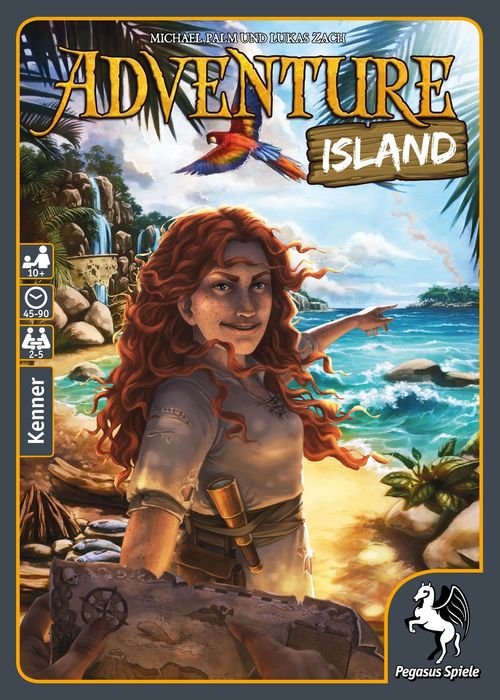
Adventure Island
Adventure Island Rulebook
Table of Contents
Table of Contents
Box Contents
- 180 cards divided into Adventures (Adventure 1 and Adventures 2 to 5): Action cards, Location cards, Wreck cards, Threat cards.
- Do not open the following sets until a card's text tells you to: Cave deck, Hermit deck, Horizon deck, Pirate deck, Bridge deck, Curse deck.
- 6 player boards.
- 65 tokens and 64 markers:
- 20 Food tokens, 10 Fish tokens, 10 Meat tokens, 15 Wood tokens, 10 Hide tokens.
- 14 Experience markers, 15 Fatigue markers, 15 Progress markers, 10 Curse markers, 5 Player markers, 5 Multiplier markers (use them if you need more tokens or markers).
- 5 Player pawns.
- 1 Camp tile.
- 5 dice, each with the faces: 3 green, 2 yellow, 1 orange.
- Cardboard dividers and tabs (slide them into the box insert to sort the cards by purpose. Details in "Before the First Game".)
About the Game
In ADVENTURE ISLAND you will experience, over several games, the life of castaways on a deserted island.
The game is divided into chapters (adventures). As you play successive adventures, new cards enter the game. The manner and order in which they are added depend on your choices and the outcome of the adventures you encounter. Between adventures you must reset the game state, but no game components are destroyed during play (at least that is our intention).
You do not have to play all adventures with the same group, though of course it will be easier if everyone knows the previous events and the effects associated with the cards.
Nevertheless, each adventure is fully self-contained. You begin each of them with the knowledge from previous adventures, but without any items collected earlier. Each time you must discover the locations again and gather equipment. Setbacks such as Fatigue markers also disappear after each adventure. In later games you keep only the achievements gained so far.
Some cards have text that changes the general rules.
Before the First Game
When you open the box for the first time, sort the cards: slide the cardboard tabs into the slots of the insert. Mark the card sections with the cardboard tabs: the half with two sections is intended for the "Upcoming Adventures" tab. In the other half of the insert, slide in the tabs in the following order: "Current Adventure", "Location Cards", "Wreck Cards", "Threat Cards", "Cave Cards, Horizon Cards, Parchment Cards" and "Archive".
Put all the foil-wrapped packs into the largest section of the box without unwrapping them! You will use them later. After the game is finished, this section is also used to store all the remaining components.
For now, place the packs for adventures 2 to 5 in the "Upcoming Adventures" section.
Open the Adventure 1 pack. The cards in it are arranged in order; do not shuffle them. Put the Location cards of the first adventure into the box, into the "Location Cards" section. Also put the Wreck and Threat cards into their corresponding sections. Put all other cards of the first adventure into the "Current Adventure" section.
Goal of the Game
Each adventure has a set goal.
The first is to find shelter and light a fire. The other adventures set other goals, given in the setup section of the given adventure.
The goal is achieved when you find the card containing the corresponding text.
You lose if one of the players receives a Fatigue marker that he cannot place on his player board.
You also lose if the Threat deck runs out and you cannot draw Threat cards during the night.
Cards
There are various types of cards in the game, but almost all look similar:
Card parts: icons, illustration, story text, action, number of the card, name, achievement.
Items, Threat cards and cards with a start-of-day effect are marked with appropriate icons in the upper left corner of the card.
Each item can belong to only one player; item cards are placed next to the player's board.
In a card's description there may be actions marked with an action symbol. Such Action cards are always placed face up in the middle of the table and may be used by any player at any time.
Sometimes, before you perform the action contained on a card, you must meet certain requirements. Such requirements are marked with a requirement symbol.
You can meet these requirements at any moment by placing the indicated tokens from your Camp on the card. This is not considered an action (see below). After placing a token on a card to meet its requirements, you cannot take it back to the Camp.
Camp
This is where you keep food and building materials. Whenever you receive supplies, place them here. All players may use the tokens from the Camp. At night you all gather in the Camp.
Player Boards
Each board contains the attributes and special abilities of a character.
Board parts: attributes; space for a Fatigue marker in a 2-player game; space for a Fatigue marker in a 2- or 3-player game; spaces for Fatigue markers in a game of 2 to 5 players; character description; special ability.
The result of a performed action is usually determined by a dice roll. The number next to a given attribute indicates how many dice the player rolls (see: Dice Rolls on page 8).
Whenever you receive Fatigue markers, you must place them on your player board. In 2- and 3-player games you place them first on the left side of the board (using both designated spaces in a 2-player game and only one in a 3-player game). In 4- and 5-player games you may use only the spaces on the right side of the board. Each space can hold only 1 Fatigue marker.
Markers
Changes on cards and boards are marked using markers:
Progress markers: Sometimes performing an action is spread over several steps. These markers help track its progress.
Experience markers: Whenever a player fails a dice roll during an action, he receives an Experience marker. You learn from your mistakes! A player may spend one Experience marker to reroll all the dice in any later dice roll accompanying an action.
You may spend as many markers as the number of times you want to reroll, remembering that you must always reroll all the dice.
You cannot spend Experience markers to reroll results obtained while resolving a Threat card or an effect that is not an action (e.g. a start-of-day effect).
Fatigue markers: Some cards add Fatigue markers; after receiving them you must place them on your player boards. Each marker lowers the value of a character's attribute by 1. Whenever you receive a Fatigue marker, place it on the character's attribute with the highest value that does not yet have a Fatigue marker on it (in 2- and 3-player games use the spaces on the left side of the board first). Each attribute can hold only 1 Fatigue marker, and if a player has no free spaces left for markers, his character collapses from exhaustion and you all lose! If a card allows you to remove a Fatigue marker, you may choose which one you want to get rid of.
Setup
Note: The game puts special emphasis on unexpected discoveries and adventures, so we do not recommend checking the cards before the game, even during setup.
Setup layout (card numbers): Wreck deck next to card 101, Location deck next to card 104, discard pile of Wreck cards, discard pile of Location cards, discard pile of Threat cards, Threat deck, cards 101, 102, 103, 104 and 105 in a row.
-
Place the face-up cards 101 to 104 in a row in the middle of the table. This layout will change in later adventures (see: Adventures on pages 10 and 11).
-
Shuffle the Wreck cards and make a face-down deck of them, which you place next to card 101 (Beach).
-
Shuffle the Location cards and make a face-down deck of them, which you place next to card 104 (Explore the Area).
-
Shuffle the Threat cards and make a face-down deck of them, which you place within reach of all players. In later adventures you will have to create additional decks of this type.
-
Arrange the remaining cards according to their numbers and put them in the box behind the "Current Adventure" tab.
-
Place the face-up Camp tile in the middle of the table.
-
Create a general supply pile made of all types of tokens. (This is not supplies, since players store those on the Camp tile.)
-
Each player chooses a color and takes the corresponding character board, pawn and player marker. Place your marker on the board to show which pawn belongs to you.
Note: In the first adventure you cannot choose the character Govinda Jaipur!
-
Begin the game by choosing the player who will be the first to perform his 2 actions.
Course of the Game
In ADVENTURE ISLAND you play as a team. It is a cooperative game in which you discuss and jointly decide which actions you will perform. Nevertheless, players take their turns independently, and their decisions must be respected if they decide on something different from what was agreed earlier.
The game is divided into several days and nights; its beginning is marked by the first day.
Day
Each day, on his turn, each player performs 2 actions in a row. Players decide the order of turns among themselves.
You may perform the actions of all face-up cards lying on the table (each time you may choose a different action). When performing the first action, place the player's pawn standing upright on the chosen card. When performing the second action, lay the player's pawn down on the chosen card. A pawn laid down horizontally means that this player has already performed 2 actions this day.
You may also perform an action from your player board, if one is available. If you do so as your second action, or if the Action card on which your pawn stood has been discarded, put your pawn on the Camp. Put discarded cards on the discard pile.
Items
If another player's pawn is on the card you have chosen, you may use that player's items. The item then does not change its owner (you do not change the card's position). You may also spend one action to move your pawn to the place where another player's pawn is. That player, if he agrees, may give you one of his items. If you do not obtain consent, you may not take other players' items against their will.
Dice Rolls
Performing an action often depends on a successful dice roll. The color indicates which result is needed for success, and the symbol shows which attribute of your character you are using. The number next to the appropriate attribute indicates how many dice you roll. If an action requires two colored symbols, you must roll both indicated results. You may use Experience markers to reroll dice (see page 5). Whenever a roll made during an action ends in failure, you receive an Experience marker.
Example: Asia must roll two green results (green, green) for her action to succeed. She rolls 3 dice because her dexterity attribute is 3. She rolls yellow, orange, green.
She uses one of her Experience markers to reroll all the dice. The second roll gives yellow, green, green - success!
Night
When all players have performed their 2 actions in turn, night falls. Move all pawns to the Camp tile. Time for a meal. From the Camp (to the general supply) you discard 1 Food, Fish or Meat token for each player. Each player who cannot or does not want to eat receives 1 Fatigue marker.
Note: You may always use one Fish or Meat token instead of a Food token, but you may not use Food instead of Fish or Meat!
After the meal is finished, each player draws and resolves 1 card from the Threat deck. You decide the order of drawing yourselves, remembering that each player must fully resolve the drawn card before the next player draws his. After a Threat card is resolved, it is discarded unless its text says otherwise. At the end of the night you may freely distribute the available items among yourselves.
Next, resolve all cards marked with the start-of-day effect symbol and begin the next day.
End of the Game
End of an Adventure
If at the end of the game you do not decide to play another adventure, sort all the cards and put them in the box.
Put all revealed and discarded Location cards into the section of the box marked with the "Location Cards" tab.
Repeat the above with the Wreck and Threat cards (including Items), putting them into their assigned sections.
In later adventures more types of cards will appear. Put all Bridge, Cave and Parchment cards into the corresponding section of the box.
Sort all other cards by their numbers and arrange them behind the "Current Adventure" tab (the cutout in the tab lets you see a card's number in the deck without revealing its contents).
Put into the "Archive" only those cards whose text says so. Cards in the "Archive" are out of the game. Cards are put into the "Archive" only after an adventure ended with a win for the players.
Repeating an Adventure
If you want to repeat an earlier adventure, you must first prepare the individual decks.
In the first adventure use cards up to number 199, in the second cards up to number 299, and so on.
Use the End of Game cards to arrange the decks properly, using cards from the "Archive".
Achievements
On the last page of this rulebook there is a list of achievements. Try to collect as many as possible! You may not manage to collect all of them on the first try, but it is worth trying, because they give you an advantage in later games.
After you complete all (3 or 4) tasks of a given achievement, you receive a permanent bonus that you can use during all following games.
Adventures
Adventure 1: First Steps
Place the following cards on the table: 101, 102, 103 and 104.
The Threat deck contains cards from 150 to 157 or from 150 to 159 (depending on the number of players).
The sea has thrown you onto the shore of a deserted island. You should now look for everything necessary for survival. You know nothing about the local climate or potentially dangerous animals, so you should start by finding shelter and lighting a fire.
Goal: Find shelter and light a fire.
Adventure 2: New Friends
Place the following cards on the table: 101, 102, 104, 105 and 200. It is possible that instead of card 200 you will place card 200b.
The Threat deck contains cards 150, 151, 153 to 157 and 250 to 254.
Slowly you get to know the topography of the island. You begin to wonder where you will get food. Is it safe here? How can you leave this island? And will you be able to convince the natives of your peaceful intentions?
Goal: Find friends!
Rule changes: The Threat deck now contains 12 cards (10 in a 5-player game - remove 2 randomly chosen Threat cards from the game). From now on you may also play as Govinda Jaipur.
Adventure 3: You Need More Help
Place the following cards on the table: 101, 104, 105 and 200. It is possible that instead of card 200 you will place card 200b. Additionally, place at least 1 friendly native card (befriended in Adventure 2).
Friendly native cards remain face up the whole time. Depending on the course of previous adventures, the Horizon deck, Bridge deck and Cave deck may be on the table.
The Threat deck contains cards 151, 153, 154, 155, 157, 250 to 254, 350 and 351.
Your new friend tells of dangerous strangers who appear on this island from time to time. The natives keep away from them. Your new friend asks for help in getting rid of the unwanted guests, but you need more allies for this.
You should also think about strengthening your shelter, if you have not yet done so.
Goal: Find another friend!
Adventure 4: Will You Help the Natives?
Place the following cards on the table: 101, 104, 105b, 106 and 200. It is possible that instead of card 200 you will place card 200b. Additionally, place at least 2 friendly native cards (befriended in previous adventures).
Depending on the course of previous adventures, the Horizon deck, Bridge deck and Cave deck may be on the table.
The Threat deck contains cards 153, 154, 155, 157, 250 to 254, 350, 351 and 450 to 454.
Your new friend tells you a little more about the island: incredible things happen in the swamps, and from time to time the natives are terrorized by dangerous strangers. They may be pirates! Will you be able to stand up to these experienced sailors? On the other hand, they surely have their own ship. Perhaps they would want to take you with them?
Either way, you should look among the natives for further allies, and also look around for additional sources of food.
Goal: Decide together: help the natives OR look after your own business.
Rule changes: You begin the game with the Campfire card (105b). The Threat deck now contains 16 cards (in a 3- or 5-player game: 15 cards - remove 1 random Threat card from the game).
Adventure 5: Will You Ever Leave This Island?
Place the following cards on the table: 101, 104, 105b, 106 and 200. It is possible that instead of card 200 you will place card 200b. Additionally, place at least 2 friendly native cards.
Depending on the course of previous adventures, the Horizon deck, Bridge deck and Cave deck may be on the table.
The Threat deck contains cards 153, 154, 155, 157, 250 to 254, 350, 351, 450 to 454 and 550 to 556. Card 455 may also appear in the game.
It is said that this island is cursed. Anyone who spends a longer while here changes beyond recognition or simply dies. You are probably not the only ones who have crashed here - there is one more figure on the island, though he reportedly lost his mind...
If you do not want to fall victim to the curse, you should flee from here as quickly as possible. Or perhaps you will decide to stay here after all?
Goal: Leave the island and return home.
Rule changes: The Threat deck now contains 24 cards (in a 5-player game: 25 cards). If there are not that many in the Threat deck, add Threat cards from the "Archive".
Note: In a 5-player game, each character may perform only one action on the first day!
Achievements
If you find a card with a flag icon, you earn an achievement. Find the corresponding entry on the page below and mark it. If the flag icon is in an action's description, you may earn the achievement only by performing that action.
For collecting all achievements in a given group you receive the title indicated above them. When you have collected all the achievements needed for a title, you may use the associated benefit in future games.
TROUBLEMAKER (Ciamajda): Ouch! / Aaah! / Oops! Benefit: Once per game, one of the players may discard 1 Fatigue marker.
EXPLORER (Odkrywca): At Last, a Bath! / Beautiful View / Learning to Fly Benefit: At the start of each game, peek at the top three cards of the Location deck, then return them to the deck in the order of your choice.
HISTORIAN (Historyk): Bookworm / Mail! / View of the Whole World / Smile, Please! Benefit: At the start of each game, distribute 2 Experience markers among all players.
BUILDER (Budowniczy): Necessity Is the Mother of Invention / Better Than Swimming / Checkmate / No Use Crying Benefit: You begin each game with 2 Wood tokens in the Camp.
ANIMAL LOVER (Miłośnik zwierząt): Faithful Companion / Ooh! Ooh! / Hard Choice / Shut Your Beak! Benefit: Once per game, one of the players may perform an additional action.
COLLECTOR (Kolekcjoner): Found / Amulet / My Precious! / To Feel Better Benefit: You begin each game with 3 Food tokens in the Camp.
MYSTIC (Mistyk): Cultist Helpers / Higher Power / May I Have This Dance? / Strange Voices Benefit: You begin each game with an additional 2 Fish or Meat tokens in the Camp.
DIPLOMAT (Dyplomata): Friends for Life / Tame the Spirits / Tracking Game / What a Strange Bird! Benefit: Once per game, one of the players may use the special ability of another player.
IMMORTAL (Nieśmiertelny): Close Call / The Hunter Becomes the Hunted / Look Death in the Eye / In the Clutches of the Beast Benefit: Once per game, one player may ignore the effect of one Threat card.
TREASURE HUNTERS (Poszukiwacze skarbów): Become Pirates / The Sacramental "Yes" / Ray of Hope / She Smiled at You Benefit: Once per game, one of the players may add 2 extra dice to any roll accompanying an action (rolling at most five).