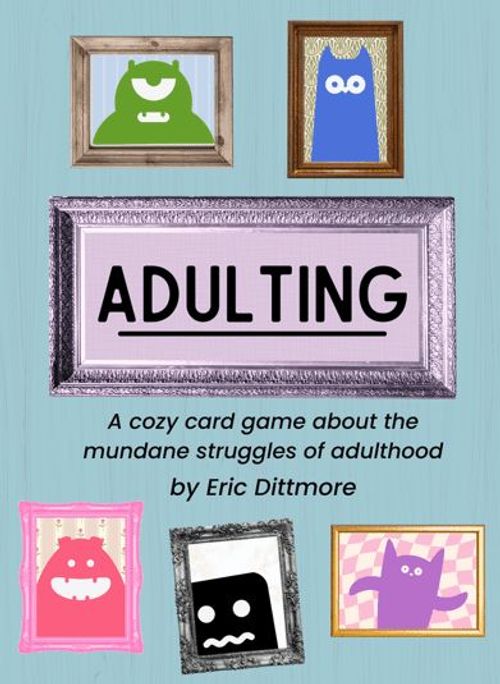
Adulting
Adulting Rulebook
Table of Contents
Table of Contents
Components
147 cards:
- 80 attitudes
- 36 self-care
- 16 chores
- 10 ideal self
- 4 reference
- 1 first player
Setup
(Diagram of a 1-player game)
-
Create a separate pile for each type of attitude. Set these piles face-up in a row. This is the supply.
-
Each player places one "Stare at Screen" self-care card (marked with a star) face-up in front of them to begin their routine. Return any extra "Stare at Screen" cards to the box.
Routine: Each player builds a tableau of chores and self-care in front of them.
-
Shuffle the self-care cards and place them face-down in a pile in the center of the table. Reveal the top 5 self-care cards face-up in a row.
-
Shuffle the chores. Keep a number of chores based on the chart below in a face-down pile in the center. Return the rest to the box.
Player Count 1 2 3 4 # of Chores 4 8 12 16 Solo and Balanced variants on page 14.
Each player draws one chore and places it face-up beside the self-care on their routine. Reveal chores in the center equal to the number of players.
Gameplay
Each round consists of two phases:
Awake Phase: Play attitudes to complete chores and self-care, which allow you to draw, discard, add, and remove attitudes from your deck.
Resting Phase: Gain stress for incomplete chores and clear incomplete self-care. Discard attitudes. Draw a fresh hand. Reveal new chores.
After three rounds, the game ends. Each player checks their outcome (page 13). You may collaborate to ensure positive outcomes for all, or care only for yourself.
Beware! If the supply runs out of stress cards, the game ends poorly for everyone.
Card Types
- Attitudes represent how you're feeling. Play them to complete self-care and chores. Try to get rid of stress and add more useful attitudes.
- Self-care allow players to manage their attitude decks and help them reach a positive outcome. You want more self-care than stress when the game ends.
- Chores cause stress if they are not completed by the end of the round. All chores have the same action listed on them. Someone has to do the chores or you'll all burnout!
Awake Phase
Starting with the first player, take turns clockwise around the table.
On your turn, complete one incomplete chore or self-care card by playing the matching attitude card to your routine. Take all action(s) listed on that chore or self-care card. These cards remain on your routine once completed.
Take actions in the order they are written. Play attitudes beneath the cards they are completing.
You may pass and skip your turn. If all players pass consecutively, begin the Resting Phase.
Keywords
Actions allow you to manage your attitude.
- Draw: Move the top card from your deck into your hand. If your draw pile is empty, shuffle your discard pile to replace your draw pile.
- Discard: Move a card from your hand onto your discard pile.
- Add: Choose a card from the supply and move it where directed. If adding to draw pile, add to top.
- Remove: Return a card to its pile in the supply.
Taking from Center or Others
You can complete face-up chores and self-care cards from the center of the table or another player's routine. When you do, place the card on your routine before you complete it.
(You must get consent from another player before completing a card from their routine.)
Cards with / allow you to play either attitude.
When you take a self-care card from the center of the table, replace it immediately. If the self-care deck is empty, shuffle all cleared self-care to create a new deck.
New chores are only revealed during the Resting Phase.
Wild Attitudes
You may play any two attitudes as a wild when completing a chore or self-care card. These attitudes do not need to match.
Replacing Self-Care in Center
At the start of your turn, if 3 or more self-care cards in the center of the table have matching attitudes, you may replace them. You may do this once per turn.
Neglecting the Chores
When incomplete chores are left in the center of the table, they accumulate stress. If you complete a chore with stress tucked beneath it, add that stress to your discard pile.
Resting Phase
Begin the Resting Phase once all players pass. Complete the following actions in order. (Players may act simultaneously.)
- Clear incomplete self-care from your routine. (Create a pile for cleared self-care.)
- Tuck a number of stress cards from the supply equal to the current round beneath each incomplete chore in the center. (1st round = 1 stress; 2nd = 2; 3rd = 3)
- Add stress to your discard pile for each incomplete chore on your routine.
- Discard all attitudes played onto your routine and any attitudes remaining in your hand. Draw five attitudes. (If your deck is empty, shuffle your discard pile.)
- Reveal new chores equal to the number of players.
- Pass the first player card clockwise. Begin the next Awake Phase.
Outcomes
Your weekend can end in a variety of ways...
If you get too stressed
At any time, if there are no stress cards left in the supply, all players suffer from Burnout and the game ends immediately.
If you make it through the weekend
When you would reveal new chores but none remain, the game ends.
Count your self-care and stress cards. (This includes the stress in your draw pile, hand, and discard pile.) If you have more stress cards than self-care cards, you get a bad case of the Sunday Scaries.
Otherwise, you're Doing OK and can check to see if you reached your goal and became your Ideal Self.
Potential Outcomes
Burnout, Sunday Scaries, Doing OK, Ideal Self.
Variants
Solo Mode
Play without the following self-care: Do a Favor - Make a Snack - Hang Out - Listen
Balanced Mode
For a more balanced game, make sure that you have an equal amount of chores for each type of attitude during step 4 of setup.
FAQ
What if I draw a hand full of stress cards? It might be a tough day, but you can do it! Try asking others for help.
What does X mean? X can be any number, including 0, but must be the same number in all places it appears.
What if I cannot take an action listed on a chore or self-care card? Complete any parts of the action that you can and ignore whatever you cannot.
What does it mean to clear self-care cards? Take them off of your routine and place them in a pile in the center of the table.