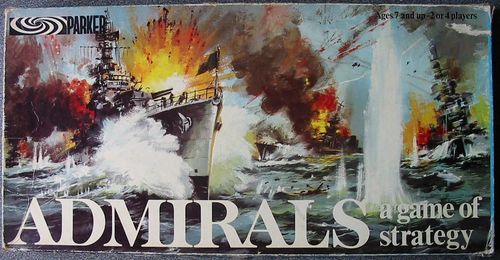
Admirals
Admirals Rulebook
Table of Contents
Table of Contents
The Fleets
Two fleets are placed face to face one WHITE and one RED.
Each fleet is composed of 32 pieces classed by the following decreasing values:
| Pieces | Value |
|---|---|
| 1 Admiral | |
| 1 Aircraft Carrier | 6 |
| 2 Helicopter Carriers | 5 |
| 3 Cruisers | 4 |
| 4 Destroyers | 3 |
| 5 Convoys | 2 |
| 6 Submarines | 1 |
| 5 Mines | |
| 5 Mine Sweepers | |
| 32 Pieces Total |
Preparation
Each player places his fleet on his side of the game board. The strategic positioning of the pieces is fundamental this positioning is the basis for the tactics that follow, and also determines the outcome of the game. The strategic placement of the pieces is the most important aspect of "ADMIRALS".
The opponent must not know the value of the ships and, therefore, each player most place the pieces on the board with the numbers facing him.
Only the "Admiral" is visible to all players.
The Mines, once placed, may NOT be moved. These are the only pieces that are not mobile.
The squares forming the two rows in the middle of the board, must not be occupied at the start. They will be occupied during the course of the game by the attacking ships.
No ship may occupy the squares marked by islands.
Combat Action
The WHITES move first.
Each Player, in his turn, moves one piece at a time in the direction of his choice.
He moves, square by square, towards his opponent or retreats in the same manner, if this is his strategy.
The "Admiral" moves horizontally or vertically, but never diagonally. (Exception, see Individual Combat).
Attacks
Attacks are never compulsory: they are left to the judgment of the players, when two opposing ships are within contact of each other.
BUT:
- The attacking ship is not necessarily the winner.
- The attacking ship could be blindly attacking a mine.
- The attacking ship could be attacking a ship stronger (in value) than himself.
The attacks are of two types:
- those that provide individual combat
- those that aim for the destruction of opposing pieces
Individual Combat
In this type of combat, the value of the pieces is the most important.
- The Mine: destroys all ships, except the "Mine-Sweeper".
- The Mine-Sweeper: destroys the mine, and may be destroyed by all other pieces.
- The Aircraft-Carrier: destroys all ships except the mine.
- The Admiral: The Admiral is superior to all other ships in attack and inferior to all in defense. (The Admiral will be destroyed when attacking a mine.)
To provoke an individual combat, a player may move his piece to any square, in any direction. (Only in this particular instance can the Admiral move in any direction).
If the attacker feels that his ship is stronger, he places his piece on the square occupied by his opponent.
He announces the value of his ship.
His opponent does the same.
The stronger of the two remains in the square and the losing piece is taken by the winning player.
If both pieces have the same value, they are both removed from the board.
Destruction
A player may also destroy his opponent's piece by jumping over it and removing it from the board, just as in Checkers.
In this case, the attacker need not disclose the value of his piece. His piece does not have to be greater in value. Also, he may take the Admiral in this way.
The jumps are done either horizontally or vertically, never diagonally. There may be multiple jumps as well as singular, provided that there is never more than one free square between each piece jumped.
The Winner
The winner is the player who succeeds in destroying the opposing "Admiral".
In the improbable case that the two Admirals are the only pieces on the board, left facing each other, this would be a "null" game.
Hints on Play
One may play a game with 4 players.
In effect, the game of ADMIRALS requires a player to memorize the value of his opponents pieces that have successfully eliminated his own pieces, and also the placement of Mines, over which his pieces have jumped.
Using 4 players, the opponents consist of 2 teams. Within the team, the function of each player is different, but complementary:
- One is in charge of the placement of the pieces on the board, and particularly of the strategy to follow.
- The other keeps score of the attacks, captures, etc.
Players may indicate their captures on the appropriate squares on the left side of their half of the board.
Remember, when planning your attacks, that you may attack or jump over a Mine. Keep in mind, the pieces that your opponent does not move might be Mines. The Mine that destroys a ship remains on the board. However, if a Mine Sweeper jumps over a Mine, the Mine is removed from the board.
In the case of Individual Combat, each player must reveal the value of his ship. The player who loses his ship should remember the value of his opponent's ship, so that he may eventually try to capture that ship with one of his own ships of a higher value.