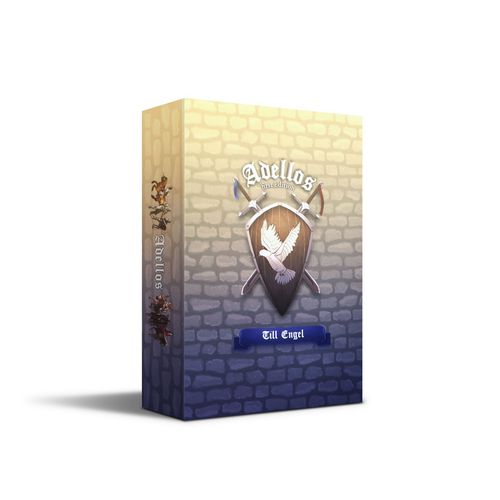
Adellos
Adellos Rulebook
Table of Contents
Table of Contents
Content
- 1 game board
- 120 unit tiles
- 10 token
- 12 noble tiles
- 50 gold coins
- 64 Event Cards
- 20 Time Counters
- 4 Ability Sheets
How to Win the Game
The goal of the game is to defeat the nobles of all players while your own noble must survive. This is accomplished by attacking with hired units. Alternatively, the game can also be won by occupying the bonus field.
Game Preparations
The board is unfolded and the Event Cards are shuffled and placed face down along with the gold next to the board. Now each player receives the unit tiles and nobles of a faction. The distribution of the factions to the players and also the starting player can be determined or randomly chosen; then the game continues in a clockwise direction. All players receive starting gold. The undead start with three gold, all other factions start with five gold. Now each player may choose a noble of their faction. The remaining nobles are put back in the box.
Before the Game Starts
Before the start of the game, each player places their noble in their play area (one of the 4 castles) and then may buy units from his own supply from his starting income. Not all the gold has to be spent. Please note the rules for hiring units (see below). Once all players have purchased units and placed them, the first turn of the starting player begins.
Game Procedure
A turn is divided into two phases: In the first phase, the player receives resources, i.e. gold and Event Cards. Units with "Income" generate gold, units with "Ancient Wisdom" generate Event Cards. Players do not receive automatic gold or Event Card income, but all players automatically receive three Action Points at the start of their turn. Event Cards should be held face down on the hand. Once the player has received all the resources, in the second phase, "Buy and Run", he can now hire units, move them, attack with them, and play Event Cards. Players can play one or more of their units, or no unit. However, all Action Points must always be consumed before a turn ends. Purchases (hire additional units) do not cost Action Points.
Hiring Units
Each unit has a purchase price. Units are hired once, they do not cause running costs. (The undead sometimes have alternative costs in the form of Time Counters, see below.)
Example: A soldier costs 3G (three gold). A player who wants to hire a soldier once pays 3G and takes a soldier from his own supply (as long as one soldier is left in his supply). He places this on an empty field on his side of the board. This completes the purchase and the unit can be used immediately.
The unit tiles may only be placed on fields within their own play area. Only one unit tile may be on each field. If all fields of a play area are occupied, no further units can be hired until fields become free again. Once a unit is in a field, it can not be easily removed or exchanged. There is no limit on purchases, but units can only be hired if the noble is in his play area. Buying units and playing Action Points can go hand in hand. It is therefore also possible to move units from one's own play area and then hire new units in the vacated fields.
Unit tile key (as printed on the example tile "Bandit Captain"): name of the unit; ability (shown as "Leadership"); purchase price; Movement Points; defense value; attack value.
Movement
An Action Point can be used to move a unit tile to a vacant adjacent field. You can enter all free fields, even if they are within the range of an opponent. No fields may be skipped, whether occupied or free, and occupied fields can not be entered. Some characters can move more than 1 field with an Action Point. Units and nobles with more than one Movement Point can also choose not to go their full range. It still costs them one Action Point. In addition, two Action Points can be spent to allow two adjacent units from the same team to swap fields.
Combat
If a player uses an Action Point to attack, he tells which of his units attacks which adjacent enemy unit. This is followed by a combat. The players compare the attack value of the attacker with the defense value of the attacked unit. All effects of adjacent units (e.g. Steel Colossus or Field Marshal) as well as effects of nobles (for example General Iron Fist) should be considered. In addition, Event Cards can be played by all players involved, which can change the outcome of the combat. In combat, any player involved can play any number of Event cards, and the combat will not be resolved until both players are unable or unwilling to play any more Event cards.
- If the attacker has the higher value, the defending unit is defeated and removed from the game. The combat is over.
- If no player has a higher value or the defender has the higher value, the combat ends with no unit leaving the game.
The attacked unit does not attack during a combat itself. It just defends itself. This means that players can defeat enemy unit only in their own turn. Units that are defeated in a combat and have to leave the game are not returned to the player's supply, but are returned to the game box instead.
Event Cards
Whenever a player is allowed to draw an Event Card, he face-down draws the top card of the Event Card deck. There is no limit to how many Event Cards a player may hold in hand. A player can also spend all Action Points on playing Event Cards. Event Cards override the rules of the game should they conflict with them. To play an Event Card, the player reveals it or puts it next to the board. Now the effect described on it is used, if possible. If an Event Card has been played, it leaves the game and is put back in the box. Event cards that affect an opponent's next turn are played in front of him and remain in front of him until his turn starts, so that the effects are visible to all players. Then these cards also leave the game. If the Event Card deck is empty, no more Event Cards can be drawn in the first phase of each players turn. Event Cards and gold coins can not be traded or gifted between players unless all players have agreed on such a settlement at the beginning of the game.
Card key (as printed on the example card "Call to Arms"): event name; playing Event Cards needs a differing amount of Action Points; tells you when to play the event; card effect.
Example card "Call to Arms", as printed: "Play in your Turn: You can exchange up to three own units worth 1 from th[e board] with units worth 2 from your supply (the exchanged units go back into your supply)." The card text is partly cut off in the printed illustration; the visible words are transcribed here.
Bonus-Field
The bonus field is the tower in the middle of the board. If a player succeeds in placing their own unit on the bonus field and protecting it until their next turn, they will receive an additional Action Point for that turn. If a player places a unit on the bonus field, but it is defeated in the turn of an opponent, it generates no additional Action Point. If a player is able to hold any own unit on the bonus field for a number of turns in a row, he wins the game. 4 players – 3 turns. 3 players – 4 turns. 2 players – 5 turns. This is an alternative victory condition.
The Undead & Time Counters
Many units in the faction of the undead are not paid with gold, but summoned. The undead can start 2 new incantations each round and theoretically can keep endless incantations. To summon a unit, place it on a free field in your own play area and then place as many Time Counters on it as it says. If a unit has a Time Counter on it, it cannot move, attack, or use its effect (passive or active) and it won't generate AP on the bonus field or win the game through standing on it, even though its values don't change. Only when the last Time Counter has been removed from it, their effects apply again. Time Counters can also be applied to units that are not summoned by Event Cards or abilities. At the end of each turn, just before the next players turn starts, you may remove 1 Time Counter from each unit. Even if they were summoned this turn.
Abilities
Both the nobles and many other units have abilities. These change and influence the rules of the game. Abilities override the basic rules of the game, just like the Event Cards, should they conflict with them. The explanation of all abilities can be found on the Ability Sheet.
Action Points
Action Points (AP) are required for all player actions except for purchase. All players start with three AP; Abilities of units and Event Cards can affect the number of AP available to a player during the game.
Token
Token are unit tiles that can not be hired or summoned, but come into play through effects or abilities. If defeated, they will leave the game for good, just like other unit tiles. If there is no more token left in the supply, the associated ability no longer creates token. Token do not belong to a faction but to all players.
End of Turn
If a player has used all his Action Points, hired Units and does not want to play any more Event Cards, his turn is over. The next player starts with the first phase of their turn.
End of Game
Nobles, like all other units, must lie on one field and can move and attack according to the same rules as other units. If a noble dies, it is taken off the board and all units under its control leave the game. The player who defeats an enemy noble will receive as a reward two gold from the general supply, one Event Card from the deck and all gold reserves and Event Cards of the defeated player. The game ends when there is only one noble left on the board.
Noble Abilities
The following ability explanations are printed on the last page of the rulebook in German (heading: "Deutsche Erklärungen der Adeligen Fähigkeiten"). They are transcribed here in English translation, in the order printed.
- Pope Anicetus IV: Your units are immune to Time Counters.
- Arch Paladin Mathias: 3G & 1AP: Hire a Paladin token.
- Conquistadora Lucía: Missionizing is now 3G cheaper.
- Jester Caspar: 1AP: Copy the ability of an unused noble, for one turn.
- General Iron Fist: Your Soldiers receive +1 Att.
- Prince Konrad: You start with 3 extra gold.
- Merchant Pinkerton: 2G: Draw an Event Card.
- Battle Maiden Evelyn: Your Bandits receive +1 Att.
- Rebels Favorite Dana: Your Rogues receive +1 Def.
- Zombie-Lord: Zombie Squad + your other Zombies receive +1 Def.
- Vampirelord Darkuhla: Summoning Vampires costs three Time Counters less.
- Lich-Baron Kynoth: You receive +1 summoning.