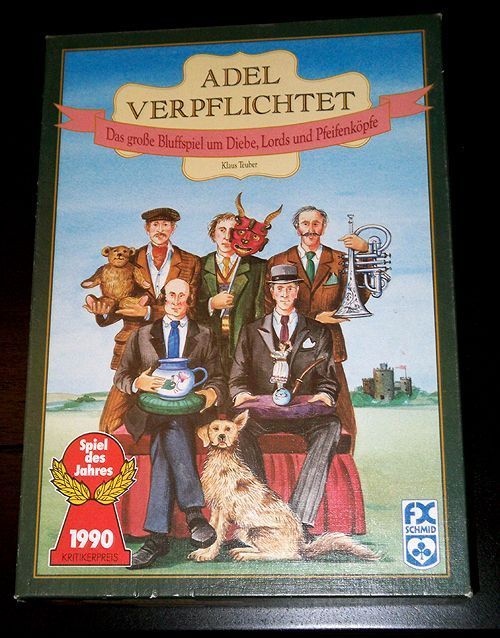
Adel Verpflichtet
Adel Verpflichtet Rulebook
Table of Contents
Table of Contents
Game Components
1 Game Board This shows the club room as the starting space and the dinner table as the goal; the movement spaces passing the castles, where the exhibitions are scored; the Auction House with two shop windows and the cashier's space; the jail cells for thieves.
5 Coat-of-Arms Stones as playing pieces, in five different colors.
50 small Place and Action cards in five differently-colored sets of 10 cards each:
PLACE CARDS:
- Auction House (1 card)
- Castle (1 card)
ACTION CARDS:
- Cheque (4 cards with a total value of 50,000)
- Exhibition (1 card)
- Thief (2 cards with different values)
- Detective (1 card)
For easier distinction, all cards carry small hints as to where which actions are possible. In addition, the Place cards are underlined in red on the front and marked with the numeral 1 on the back. The Action cards carry the numeral 2.
45 large Collection cards The exhibitions are formed from these Collection cards. They show the collectibles in six differently-colored series, along with the year the item was made. The older the item is, the more valuable it is.
Preparing to Play
The Place and Action cards are sorted by color and set out. One player takes one card of each color, shuffles them, and lets the others draw one at random. This determines each participant's playing color.
Each player now receives the complete set of cards in their drawn color, into their hand. Any remaining sets of cards are put back in the box.
Each player takes a playing piece in their color and places it on the starting space:
The Collection cards are shuffled. At the start, each player is dealt four of these cards face down. Each player looks at these and initially lays them face down in front of themselves.
The remaining Collection cards come as two roughly equal-strength face-up stacks onto the two spaces with the shop windows of the Auction House. So there are always two cards available to choose from, as long as neither stack has been used up.
Sequence of Play
The game consists of several rounds. Each round is divided into four phases:
Phase 1: Choosing the Place
First, all players must decide whether they want to play the AUCTION HOUSE or CASTLE Place card.
At the Auction House, Collection cards are offered. Whoever wants to acquire one of the two top Collection cards should choose the Auction House. This is explained in more detail in Phase 3.
At the Castle, exhibitions take place. Whoever, among other things, wants to display their Collection cards in order to move their playing piece forward should choose the Castle. This is explained in more detail in Phase 4.
Playing the Place card: Once the players have decided on a place, they lay the respective Place card face down in front of themselves. Then everyone turns their Place card face up at the same time. Now every player is informed which place their fellow players want to start an action at. The Place cards are taken back into hand once the four phases are complete.
Phase 2: Choosing the Action
The players now consider which action they want to carry out at the place they have chosen. In doing so, it plays an important role to correctly assess the fellow players' possible actions.
The players at the Auction House have the option of acquiring one of the two Collection cards with the CHEQUE Action card, or of fetching a fellow player's cheque from the till with the THIEF Action card.
The players at the Castle have the option of displaying their Collection cards with the EXHIBITION Action card, in order to move their own playing piece forward. Or they play the THIEF Action card, in order to grab Collection cards from their fellow players' exhibitions, if any. Lastly, a player at the Castle can also deploy the DETECTIVE, in order to send thieves who have taken action to jail.
Playing the Action card: Once the players have decided on their respective action, they lay their Action card face down next to their Place card.
Phase 3: At the Auction House
First, all players at the Auction House turn their Action cards face up at the same time and carry out the actions in the following order:
1 Cheque With a cheque, one can obtain one of the two top Collection cards from the shop-window stacks at the Auction House, thereby increasing the number of one's own Collection cards.
If several cheques are bid, the player with the highest cheque wins. They lay this cheque on the cashier's space, take one of the two top Collection cards, and add it to their collection. The losing cheques are taken back into hand.
2 Thief With a thief, one can take the cheque just deposited on the cashier's space at the Auction House, in order to play it as one's own cheque in a later round.
If no cheque is deposited, the thief comes away empty-handed, for cheques from previous rounds are taboo. Caution: if several players deploy a thief, the cheque stays in the till. The thief cards are then taken back into hand.
Phase 3 can be skipped if later on all Collection cards have been used up, or no player owns a cheque anymore.
Phase 4: At the Castle
Once the players have finished their actions at the Auction House, the players at the Castle turn their Action cards face up. They carry out their actions in the following order:
1 Exhibition Through a successful exhibition of their Collection cards, a player can move their own playing piece forward. Whoever wants to exhibit must own at least three cards belonging together and lay them face up in front of themselves. There is no upper limit to the number.
The relatedness of Collection cards is symbolized by the series letters A, B, C, D, E, and F, whose sequence must not be broken.
Example: Exhibitions can be: AABB, CCD, EEE, DEF. Not exhibitions are: AAC, BCE, DE.
The most valuable is the exhibition with the most Collection cards; if the number is equal, the exhibition with the oldest collectible wins.
Each player may only reveal one exhibition. In the case of two separate groups (e.g. AAB, DEE), one must decide which one to exhibit.
If only one player exhibits, they automatically own the most valuable exhibition. The minimum of three Collection cards is sufficient for this. If several players exhibit, each secretly selects a promising quantity of Collection cards. These are then revealed at the same time, and the ranking of the exhibitions is determined.
The foremost playing piece determines how many spaces the two best exhibitions are rewarded. The space it stands on is marked with two scoring numbers. These apply to both movement spaces beneath the respective castle.
The higher number determines how many spaces the player with the most valuable exhibition now moves their piece forward. The lower number determines how many spaces the player with the second-most-valuable exhibition now moves forward. Further exhibitions go away empty-handed.
The EXHIBITION Action card is taken back after each use; the Collection cards laid out for an exhibition are likewise taken back after every round — but only once any thieves that have taken action have done so.
2 Thief The thief steals Collection cards from the exhibitions previously revealed. This allows one to obtain additional Collection cards.
Every player who deploys a thief at the Castle may take one Collection card of their choice from every exhibition. In the case of several thieves, the thief with the higher number (= professional experience) gets first choice; then the others follow. If no detective was deployed, the players take their thief cards back into hand.
3 Detective The successful deployment of a detective brings additional movement points for the playing piece.
The detective may only be deployed at the Castle. All deployed detectives fundamentally send all thieves they can catch there to jail, regardless of whether they were able to steal or not.
All players with successful detectives now move their playing piece forward by the number of spaces corresponding to their piece's position on the game board at this point in time. The detective cards are taken back into hand after each use.
Brown may move 1 space here, blue may move 2 spaces, green + beige may each move 3 spaces, and purple may move 4 spaces, if their detective was successful.
Jail
Thieves who have been caught by one or more detectives at the Castle land in jail. The Collection cards previously stolen are, however, not returned.
The thief card is placed in cell No. 1 on the game board. If several thieves are caught, the one with the lower number goes in first. Whenever a new thief comes into jail, the other thieves are pushed forward one cell.
The thieves get out of jail when they are pushed past the cell marked with the number of players. With 4 players, then, the way to freedom leads past cell No. 4. The thief card is returned to its owner and can now be deployed again.
End of the Game
If a player's piece reaches a space at the dinner party in the "Club Antique," the game enters its final phase. Now all players reveal their largest and most valuable connected collection. The player with the most valuable collection moves forward another 8 spaces, the player with the second-most-valuable collection 4 spaces.
Winner of the game is then whoever sits furthest forward at the dinner table with their playing piece. In case of a tie in position, the most valuable collection decides the win.
Tactical Hints
Think carefully about which place, and then which action, your fellow players might possibly play. The size of the collection, the current offer at the Auction House, the position on the game board, the competition at the respective place, the cheques already issued, the thieves in jail — all of these are important considerations by which you should assess your fellow players. If you bear all this in mind and reach for the right place and the right action, you have already almost won. Just too bad that everyone wants the same thing again at the same time — for noblesse oblige!
Special Rule for Two Players
-
The Surprise Variant: Both players lay out any Place and Action cards face down at once. Then both cards are revealed at the same time.
-
The Confrontation Variant: Both players are always alternately at the same place — at the Auction House or at the Castle. The place is announced aloud beforehand as a reminder, and then only the desired Action card is played.
Both variants have their own appeal and guarantee entertaining gameplay fun for two players as well!