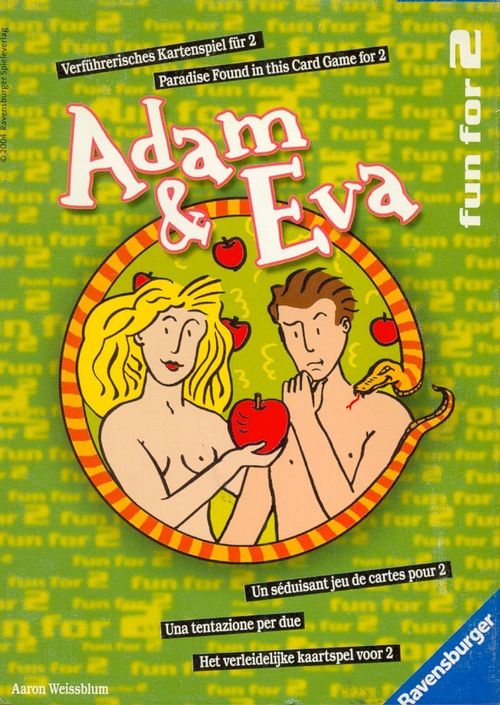
Adam & Eva
Adam & Eva Rulebook
Table of Contents
Table of Contents
Components
- 4 trees
- 2 score boards (with four rows of apples numbered 1 to 8)
- 32 apples (with values from 1 to 8 in four different colours)
- 32 cards (with values from 3 to 9 in four different colours, plus three jokers with values 2/3/4, and a serpent)
- 1 "first player" card
Setup
- Each player takes their score board and places it in front of them.
- The four trees are placed in the centre of the table, between the two players. Enough space must be left between the second and third trees to place cards there during the game.
- The 32 apples are separated by colour and then placed face down, shuffling them slightly so that nobody knows the value of each of them.
- Two apples of the same colour are placed on each of the trees, with their value visible, so that one tree will have two apples of one colour, another tree two apples of another colour, etc.
- The 32 cards are shuffled thoroughly. The two players receive six cards each, taking them into their hand so that the opponent cannot see their numerical values. The rest of the cards are set aside, face down.
- The oldest player starts and places the "first player" card on their side of the table.
Playing the Game
The game is played over four rounds. The player holding the "first player" card begins the first round. The active player offers their opponent one of the cards from their hand, placing it in the centre of the playing area, between trees two and three.
The opposing player must then decide the fate of that card:
- They may take the offered card, placing it under the tree with apples of the same colour, on the side nearest to themselves.
- On the other hand, if they are not interested in the card offered by the active player, they may refuse it. In that case, the active player takes back that card and places it under the tree with apples of the same colour, on their own side.
Attention: If the offered card is a Joker (grey card), the player who keeps it can place it under whichever tree suits them best.
Cards placed under a tree stay fixed in place until the end of the round. If there is more than one card under a tree, they must be overlapped so that their respective values are always visible.
Then the second player becomes the active player — regardless of who kept the offered card — and in turn chooses a card from their hand and offers it to their opponent, placing it in the centre of the playing area, etc.
The players continue switching their role between active and second player until the end of the round.
Attention: during a round the players do not refill their hand of cards. A round is played simply with the six cards dealt to each player at the start of the round.
The Serpent
The "serpent" card is played exactly like the other cards: the active player places it in the centre of the playing area and it is their opponent who decides the fate of the card, accepting or refusing it.
The player who gets the "serpent" card must use it immediately. This card allows them to remove from play one of the opponent's cards placed under one of the trees. The chosen card is then placed, together with the "serpent" card, in the deck of 20 cards that were not dealt at the start of the round.
Attention: the "serpent" card cannot be played until each of the two players has placed at least one card under one of the trees.
End of the Round
At the moment a player places 6 cards on their side under the trees (or 5 if the "serpent" card has been played during the round), the round ends: the rival player takes into their hand all the cards that both players still hold (their own and the opponent's), and places them on their side of the trees, under each of the corresponding trees according to the colour of the card. If the "serpent" is among the cards they take into their hand, they must play it immediately before distributing the rest of the cards under the trees.
At the end of the round both players will have the same number of cards under their side of the trees: 6 (or 5 if the "serpent" card was played). The apples are then distributed.
Distribution
Each tree is looked at individually. The players add up the values of the cards the tree has on each side, and compare them. The player with the higher sum takes the highest-valued apple on the tree, and places it on their score board according to the value and colour of the apple taken.
In case of a tie, the highest-valued card each player has is looked at, and the apple goes to the player who has the lower-valued card of those two. If the tie still persists (which is only possible with the use of jokers), it is the highest-valued card — not counting jokers — that wins the highest-valued apple.
The other player takes the lower-valued apple and in turn places it on their score board.
When one of the players has not placed any card under one (or more) of the trees, the opponent takes both apples and places them in their place on the score board. If neither player has placed cards under one of the trees, the apples of that tree are removed from the game.
(Example illustrations: "beats".)
After the distribution of the apples the next round can begin:
- The "first player" card changes owner.
- The 32 cards are shuffled again.
- Each player receives 6 cards.
- Two new apples are placed on each tree.
End of the Game
The game ends at the end of the fourth round. The players then calculate their victory points: the values of all the apples taken during the four rounds are added up. In addition, players can receive bonuses if they have managed to take all four apples of the same value:
- 15 points for apples of value 1, 2 or 3.
- 10 points for apples of value 4, 5 or 6.
- 5 points for apples of value 7 or 8.
The player who has the most victory points at the end wins the game. In case of a tie, the winner is the player who has the most low-value apples (of 1, 2 or 3).
Variant (for more tactical games)
At the start of each round each player receives 7 cards instead of 6. The rest of the rules remain, so that a round ends when a player places their sixth card under their side of the trees (or the fifth if the "serpent" card has been played). This variant allows each player to keep — without playing it — one of their cards during the whole round. At the end of the round it must be discarded.
Attention: As in the normal rules, when a player places the sixth card under the trees (or 5 with the "serpent") they give their opponent the cards they have left in hand, but in this case the card they want to keep must be excepted. Before they are given, the opponent must in turn announce which of their cards they will not use.