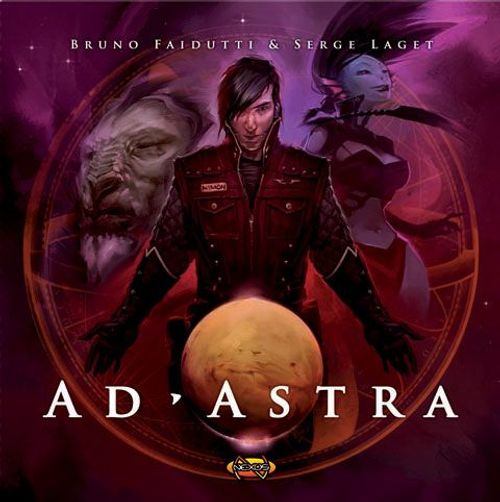
Ad Astra
Ad Astra Rulebook
Table of Contents
Table of Contents
Game Overview
Each player controls a faction that wants to develop its presence in the galaxy by exploring new planets and establishing colonies on them.
By controlling planets you will be able to gather the resources that you will use later to explore other planets, build colonies and factories, and, sometimes, terraform distant worlds.
All these actions are accomplished using action cards. Players will take turns in placing their cards on the planning board during the planning phase (see page 5), at the beginning of each game round.
Actions are then executed in sequence, during the action phase (see page 5), and each player may act when a new card is revealed. When each of the action cards on the planning board has been executed in sequence, the game round is over and a new one begins, with a new planning phase.
How to Win
The players' successes in developing their civilization are turned into victory points by means of scoring actions, one of the different actions players may perform.
The game ends when one player scores 50 points, or when all planets have been explored. At the end of a round in which either condition has been fulfilled, the game ends and the player with the most victory points is the winner.
Components
Inside your box of Ad•Astra you will find the following components:
- 1 planning board
- 150 resource cards, 25 of each resource
- 55 action cards, 11 per player
- 25 starship pawns, 5* per player
- 25 colony pawns, 5* per player
- 25 factory pawns, 5* per player
- 25 terraformer pawns, 5* per player
- 11 alien artifacts cards (including 2 optional cards)
- 2 punchboards of cardboard counters and tokens, containing:
- 43 planets:
- 6 water planets
- 6 food planets
- 8 energy planets
- 6 ore (Xanthium) planets
- 6 ore (Yoyodium) planets
- 6 ore (Zozodium) planets
- 5 alien planets
- 9 stars
- 5 scoring tokens, 1 per player
- 1 first player token
- 5 player reference sheets
- this rulebook
* Note: 1 pawn of each type per color is included in the game as a replacement for lost or broken pieces. However each player is only allowed 4 pawns of each type during the game.
Before playing your first game of Ad•Astra, separate all cards into their individual decks and carefully punch out the cardboard pieces so they do not tear. Separate the plastic components by color. Be sure to keep all components out of the reach of small children and animals.
Overview of the Components
There are nine different stars in the game, recognizable by their shape and color. Each star also has an iconic representation used in the action cards: The Sun (Starting System), Small Star Red, Small Star Yellow, Large Star Red, Large Star Yellow, Twin Star Red, Twin Star Yellow, Nebula Red, and Nebula Yellow.
There are 43 planets in the game. Each planet produces a different type of resource, as shown by the planet's color and the icon appearing on the planet itself: Water Planet, Food (Vegetables) Planet, Energy (Fuel) Planet, Ore (Xanthium) Planet, Ore (Yoyodium) Planet, Ore (Zozodium) Planet, and Alien Planet.
The resource cards are used to keep track of the resources accumulated by each player. There is one resource card type for each of: Water, Food (Vegetables), Energy (Fuel), Ore (Xanthium), Ore (Yoyodium), and Ore (Zozodium).
The alien artifact cards represent special items that players may find on an alien planet. Each artifact card provides the player with a special power, which is explained in detail on the player reference sheet. Scientists of the far future name these discoveries using Latin, as they currently do with new animals and stars. Therefore, the cards show the Latin name of these wonderful items.
Note: the "Omnibus Rebus Responsum" (Answer to Everything) and "Magnum et Antiquum Arcanum" (Great Old Secret) cards are optional. You may decide not to include them in the game if you find that their effect makes the outcome of the game too unpredictable.
Each player has a set of 11 action cards. Each set of cards has a different image on their back, which shows the image of a different faction.
Players place their chosen action cards on the planning board at the beginning of each game round. The first 12 spaces are used in a three or four-player game - all 15 spaces are used in a five-player game.
The planning board is also used to keep track of each player's score.
Each player's scoring tokens are distinguished by their color and image, which match the color and image of their faction.
The first player token is used to keep track of which player must be the first to place an action on the planning board.
Each player has 16 playing pawns in his color, representing what he can build during the game: Colony, Factory, Terraformer, and Starship.
The Nexus Designer Series
The Nexus Designer Series is a new collection of original games created by renowned designers from all over the world. The series places a spotlight on the designers themselves.
We believe that game designers deserve more credit than they usually receive and that more information about them should be provided to the people enjoying their creations.
For this reason, in each game of the Nexus Designer Series we will introduce the game's designer (or designers) in an article written by another author, and we will provide additional information on other excellent games created by the designer(s).
We hope that if you enjoy this game, you will be interested in taking a look at its authors' other creations.
As a publisher, our goal when choosing a game to appear in our Designer Series is not only to choose a good game, but also to choose a designer, or a team of designers, who have created other games that we can recommend!
About the Designers
Introduction by Bruno Cathala — The Ludography of Bruno Faidutti and Serge Laget
When I was asked to write some words about Bruno Faidutti and Serge Laget to include in Ad•Astra as an introduction to their ludography, I accepted with enthusiasm.
I was excited in part because the French gaming scene owes a lot to their efforts. Their first games, published in the 80s (Knightmare Chess and Valley of the Mammoths by Bruno, and Le Gang des Tractions-Avant by Serge) were instrumental in many French players discovering that there was life beyond Monopoly, Clue, and Risk.
I also owe them a lot on a personal level: They patiently guided my first steps as game designer and, through our cooperative efforts, they opened the doors of the publishing world to me.
Bruno and Serge have much in common: their passion for board games, of course, but also teaching (a profession they both share), good whiskey, teamwork with other game designers, and playing Magic the Gathering.
There are differences, too. Bruno is a prolific creator who has published more than 30 games, including Citadels, his greatest international success. He loves game mechanics based on bluffing, double-guessing (I think that you think that I think…), and intimidation, as well as creating game situations where it's pointless or impossible to calculate precise odds and where the most cunning, rather than the most analytical, player will gain the upper hand. It is no surprise that he cites Cosmic Encounter as one of his favorite games, and that he's adept at the poker table as well.
Serge is less active in the game-design scene, with seven games published in the same period, including Mare Nostrum and Shadows over Camelot. However, he loves to develop in depth, taking his time. He carefully refines the small mechanics that are the building blocks of his game, so that they become the foundation of a detailed universe that the players can dive into deeply during the game. At the same time, he loves to offer them a tactical arsenal, doubtless a legacy of his past as a high-level chess player.
In short, thanks to their similarities and differences, Serge and Bruno complement each other.
When they work together, the result is always of the highest level. Mystery of the Abbey is proof of this, a game that breaths new life into the familiar category of "whodunnit" games.
Now, they present us Ad•Astra, an elegant and refined game of space conquest and development. I had the chance to play this game in its first prototype version, as well as through several improvements, up to the final version that you hold in your hands. This game has the virtue of being very simple to explain but also offering great tactical depth. In this game, the player who is able to anticipate the choices of his opponents will have an ace up his sleeve!
I fell in love with this game, and I am convinced that it has a real chance of finding a large, really large following all around the world…
… at least, that is what I wish for my friends!
Games Designed by Bruno Faidutti and Serge Laget
Serge Laget and Bruno Faidutti have known each other for about 20 years. They have designed several games together, and Ad•Astra is the fourth of these to be published.
Their first collaboration was Castle, published in 2000. Castle is a fun and highly interactive card game in which players try to place their characters in the castle and the courtyard before their opponents' – but each character has a special ability, somewhat like in a CCG. Always a favorite of Serge and Bruno, Castle is now out of print and looking for a new publisher.
First published in 1996, and later gorgeously reprinted by Days of Wonder, Mystery of the Abbey is probably Serge and Bruno's best-known game. In this medieval "whodunit'" game, players are trying to find the murderer among the 24 monks in the abbey.
Kheops, published by the French publisher Tilsit, has remained largely under the radar. This is a shame because this clever two-player game, a personal favorite of Italian game designer Emanuele Ornella, combines the strategic depth of Serge's games and the dynamism and nastiness of Bruno's designs.
Some Other Noteworthy Games by Bruno Faidutti
Citadels is probably Bruno's best-known game. In this card game of medieval intrigue, full of bluffing and backstabbing, players try to build the richest and most powerful cities. Citadels is gorgeously illustrated and has been published in more than 20 different languages and has sold several hundred thousand copies.
Designed with Alan R. Moon, Incan Gold, also known as Diamant, is a light and dynamic "push your luck" game. Every round, the players face the same anguished questions – will you take the risk of going deeper into the treacherous cave to seek more treasure, or will you go back to the safety of the camp? And what will your fellow explorers do?
Red November, designed with Jef Gontier, is one of Bruno's most recent games. In this hectic and humorous cooperative game, players are gnomes trying to save a nuclear submarine. Don't ask us how gnomes ever acquired nuclear technology – they should not have!
Some Other Noteworthy Games by Serge Laget
Serge likes big old-style civilization games, and Mare Nostrum is his masterpiece. It is a big board game about rival civilizations of antiquity. Greek, Egyptians, Romans, Babylonians, and Carthaginians use trade, war, and diplomacy to conquer the Mediterranean world.
In Shadows over Camelot, designed with Bruno Cathala, players take on the role of the Knights of the Round Table and must, together, fulfill several quests. These include finding the Holy Grail, killing the Dragon, and winning the wars against the Picts and the Saxons. One of the players might be a traitor, which makes things even more difficult.
Serge also designed Senji with Bruno Cathala. This diplomatic game is set in medieval Japan. Each player wants to become the daimyo, whose honor imposes authority over all the other clans. To gain honor, the players fight bloody battles, trade, settle alliances, and often keep hostile family members as hostages.
Both Bruno Faidutti and Serge Laget maintain their own personal websites to communicate with the gaming community: www.faidutti.com and www.sergelaget.com.
Their games can be discussed in the common forum they share with several other French game authors: www.auteursdejeux.com/forum/.
Starting the Game
Each player chooses one color and takes all the gaming components in that color:
-
11 action cards
-
4 starship pawns
-
4 colony pawns
-
4 factory pawns
-
4 terraformer pawns
-
1 scoring token
-
1 reference card
-
Place the nine stars, face up, on the table. Eight of the stars are either yellow or red, and have a distinct shape (large, small, twin, or nebula). One of the stars is white, instead. This is Sol, our sun, where the players start the game.
-
Place as many face down planets around the white star as there are players. This is the starting system (each individual star with planets surrounding it is called a system).
-
Each player turns one of the planets in the starting system face up, at random, and places a factory on it. No player should have an alien planet as his starting planet. If such a planet is drawn, replace it with another random one.
-
Place all other planets around the other suns, face down. There should be three to seven planets in each system, in any combination.
-
Sort the resource cards by type. Then place them in separate drawing decks next to the gaming area, face up, forming the resource bank.
-
Shuffle the alien artifact cards and place them in a drawing pile next to the gaming area, face down.
Note: Players should decide before beginning whether they want to use the optional "Omnibus Rebus Responsum" (Answer to Everything) and "Magnum et Antiquum Arcanum" (Great Old Secret) cards.
- Each player takes one resource card of each type.
- The planning board is placed on the table. With 3 or 4 players, the first 12 spaces are used. With 5 players, all 15 spaces are used.
- Players randomly select one player to be the first player, who takes the first player token.
- All players place their scoring token on the victory points track of the planning board, on the "0" space.
- Each player places one of his starships in "deep space" (anywhere on the table in-between the star systems).
The first round can now begin.
The Game Round
The game is played in rounds. Each round starts with the planning phase, followed by the action phase.
Planning Phase
In the first round, the first player is randomly determined. This player remains the first player until a player reveals a scoring card. From then on, the first player is the player who last played a scoring card.
Starting with the first player and proceeding around the playing table in clockwise order, each player plays one of his action cards, face down, on any of the empty spaces of the 12 (or 15 with 5 players) spaces on the planning board. This continues until all spaces are full. Each player will play a total of three cards during this phase in a 4- or 5-player game, or four cards in a 3-player game.
Note: You may place the action cards anywhere on the planning board, as long as you place them on an empty space. It is not necessary to fill the lower-numbered spaces before the higher-numbered ones.
Action Phase
After all the spaces are filled, the cards are then revealed. Starting with the card on the first space of the board, reveal the card and completely resolve it before revealing the next.
When resolving a card, the action it depicts may be carried out by each player, starting with the owner of the card and proceeding clockwise around the table.
Exception: The "Identical Resources" and "Different Resources" scoring cards specify that they are carried out starting with the player to the left of the owner.
Each action must be completed by all players that wish to, before proceeding to reveal and use the next action card. See "The Action Cards" section on page 6 for an explanation on how to use each action card.
End of the Round
After the last action card is resolved, no player may have more than 10 resource cards in hand. If necessary, players must discard cards to reduce their hand to 10 cards. Players then take their used action cards back in hand (except their scoring cards, which are only taken back when all three are used), and the next round starts.
The Action Cards
Production
When a production card is revealed, the owner of the card chooses one of the two resource types shown on the card. The owner's choice applies to all players using this card - another player cannot decide to produce a different resource.
Each player then receives 1 resource card of the chosen type for each colony and starship on a planet matching the chosen resource, and 2 resource cards for each factory on a planet matching the chosen resource. These cards are taken from the resource bank.
For example, if a player has a starship and a colony on the planet matching the chosen resource, he receives 2 resource cards. If a player has a factory and a starship on the planet, he receives 3 resource cards.
Special case: If there are not enough resource cards of the appropriate type in the bank, players receive their resource cards in clockwise order, starting with the owner of the action card, until the bank is empty.
Note: Alien planets never produce resources.
Movement
When a movement card is revealed, the owner of the card may move one of his starships, either to one of the two star systems shown on the card, between two planets within one of the two star systems shown on the card, or from a star system into deep space.
Then, proceeding clockwise around the table, each of the other players may move one starship, following the same restrictions.
Then, the owner of the card may move all his other starships, again following the same restrictions.
Moving a starship requires the expenditure of Energy resource cards, as explained in the next column.
Note: Unlike a production card, where only one resource type is used, the movement card enables movement to either of the systems listed.
Movement Cost
- Movement from "deep space" (the area of the gaming table between systems) to a planet is always free. This includes the very first movement in the game, the first movement of a newly built starship, and the movement of a starship that moved into deep space earlier in the game.
- No matter what the two systems on the card are, it is always possible to move into deep space by spending 1 Energy resource card.
- You must spend 1 Energy resource card to move within one of the systems shown on the card – from one planet to a different planet in the same system.
- You must spend 2 Energy resource cards to move from a planet in a different system to a planet in either of the systems shown on the card.
How to Move
When a player moves a starship to a new system, or moves from a planet to another planet in the same system, he may look at all the face down planets in that system, without revealing them to the other players.
Then, he can either move his starship to a planet in the system that was already face up - leaving the other planets face down - or reveal one of the face down planets to all players and place his starship on it.
A player cannot move a starship onto a planet containing any pawn (colony, factory, starship, and/or terraformer) that belongs to another player. It is of course possible for a player to move a starship to a planet where one of his own pawns is already present.
Notes: Since the starting system is not represented on the movement cards, it's impossible to move a starship to it. Additionally, since each player has only six systems represented on his movement cards, he will have to use the action cards of other players to move to the two remaining systems.
Discovering an Alien Planet
When a player reveals an alien planet and moves his starship to it, he immediately draws an alien artifact card, at random, from the alien artifact deck.
However, if a player moves his starship to an alien artifact planet that is already face up (because it was revealed earlier in the game), the player does not draw an artifact card.
See Alien Artifacts, below, for the rules applying to these cards.
Build
When a build card is revealed, the owner of the card may build any number of items (colonies, factories, starships, or terraformers).
Then, proceeding clockwise around the table, the other players may build one item each.
When a player builds an item, he pays the required resource cards by returning resource cards he possesses to the bank.
If there are no unused pawns of the appropriate color, a player cannot build that item.
Colony
Building cost is 1 Water, 1 Food, plus any one ore (Xanthium, Yoyodium, or Zozodium).
A player can only build a colony on a planet where he has a starship, or on a planet he has terraformed. The player places a colony pawn of his color on the planet. There can be only one colony or factory on any one planet - once one is built, neither the controlling player nor any other player can build an additional colony or factory on the planet.
A player who builds a colony on an alien planet scores 3 points. A colony on an alien planet never produces resources.
Factory
Building cost is 1 Xanthium, 1 Yoyodium, 1 Zozodium.
A player can only build a factory on a planet where he already owns a colony. The colony is removed and replaced with a factory pawn.
Note: When a player builds a factory, he takes the colony pawn back from that planet and may re-use it later in the game.
A player who builds a factory on an alien planet scores 6 points. A factory on an alien planet will never produce any resource.
Terraformer
Building cost is 2 Water, 2 Food.
A player can only terraform a Water or Food planet on which he owns either a colony, a factory, or a starship.
The player places a terraformer pawn of his color on the planet and scores 4 points.
Note: There may be a colony or factory on a terraformed planet, and the colony or factory will keep on producing once the planet is terraformed. It is also possible for a player to terraform a planet where he only has a starship. In that case, the player may later build a colony there without having a starship there.
Starship
Building cost is 1 Xanthium, 1 Yoyodium, 1 Zozodium, plus any one ore (Xanthium, Yoyodium, or Zozodium).
The newly built starship is placed in deep space, not in any particular system. Its first movement into any system will be free.
Trade
When a trade card is revealed, all players must display their resource cards in front of them.
The owner of the action card can trade resource cards with any other player. If both players agree, the trade is immediately carried out. The owner can also trade with the bank by returning two cards of the same type to the bank and receiving one resource card of his choice from the bank in exchange.
The owner can make as many trades as he wants, as long as other players want to trade with him or he has enough resources to trade with the bank.
The other players cannot trade between themselves, or with the bank.
Finally, all players take their resource cards back in hand.
Scoring
When a scoring card is revealed, the owner of the card chooses one of the two game elements shown on the card, and all players score points based on that choice. Another player cannot decide to score points using the other element shown on the card. When a player reveals a scoring card, he immediately takes the first player pawn.
Note: A 3-point bonus is granted to the player who scored the most points using the chosen element, as described below. In the case of a tie, no player receives this bonus.
Important: Unlike other action cards, scoring cards are not given back to the players at the end of the round in which they are played. Instead, they are set aside next to the planning board, face up. A player retrieves his scoring cards only when all three of them have been played.
Colonies / Factories
Each player scores 1 point for each colony and 2 points for each factory he has in play. The player scoring the most points also receives a 3-point bonus.
Starships
Each player scores 2 points for each starship he has in play. The player with the most starships in play also receives a 3-point bonus.
Terraformers
Each player scores 3 points for each planet he has terraformed. The player with the most terraformed planets also scores a 3-point bonus.
Systems
Each player scores 1 point for each system where he has a presence (that is, the system contains one or more pawns of his color – colonies, factories, starships, and/or terraformers). The player with a presence in the most systems also scores a 3-point bonus.
Identical Resources
Starting with the player to the left of the owner of the action card, and continuing clockwise, each player may discard as many resource cards (with a minimum of 2) of the same type as he wishes to the bank, and scores 1 point for every discarded card. The owner of the action card is the last to choose how many resource cards to discard. The player discarding the most identical cards also scores a 3-point bonus.
Different Resources
Starting with the player to the left of the owner of the action card, and continuing clockwise, each player may discard as many different resource cards (no two may be of the same type) as he wishes to the bank (2 to 6) and scores 1 point for every discarded card. The owner of the action card is the last to choose how many resource cards to discard. The player discarding the most different cards also scores a 3-point bonus.
Alien Artifacts
Whenever a player discovers an alien planet, he randomly draws an alien artifact card. The "Repositorium Alienum" (Alien Warehouse) must be revealed and applied immediately, as stated on the reference card. Any other alien artifact card in a player's possession remains hidden to the other players, until the owner decides to use it later in the game. Each alien artifact card can only be used once - after the card is used it is removed from the game.
See the player reference sheet for the specific effect of each artifact card.
End of the Game
When the last planet in play is revealed, or when a player reaches at least 50 victory points, the game ends when the current round is completed. The player with the highest score wins.
Tactical Hints
In the first rounds, try to get an Energy producing planet - you will need it to move your starships. If you can't, go for Water and Food, which you'll need to build colonies and are easy to trade.
Colonies are cheaper to build, especially in the first rounds, but starships can be more versatile. Normally you can't win if you don't build at least one additional starship.
Alien planets can slow you down in the first rounds, but they can be very valuable when making a run for victory during the late game. Don't underestimate them!
Look at the resource coupling on your production cards and try to focus your strategy on resources produced by different cards. This will increase your capability to produce more resources when necessary. Avoid focusing on multiple elements that you use the same score card to turn into victory points, since you won't be able to use the card score for both during the same turn.
Adapt to the strategy of your opponents, and try to have one or two scoring elements that will give you the 3-point bonus.
Scoring cards are critical. Don't wait for the fourth of fifth round to play them. Playing scoring cards early, even when you are not sure that you will get the 3-point bonus, can be useful. Playing a scoring card gives you the first player token and, most importantly, it makes easier for you, later, to retrieve your cards. If you play two scoring cards early and then focus on a game element that the third score card converts to victory points, you'll be able to play this third card in two consecutive rounds.
Example of Play
This is a complete example of the first round in a 4-players game.
Setup
The initial setup is shown in figure 1. The Blue player starts with a factory on a Zozodium planet, the Red player on a Food planet, the Yellow player on a Water planet, and the Green player on an Energy planet.
Everybody places one starship in deep space, takes one resource card of each type, and places his scoring token on the '0' position of the track.
The Blue player is randomly chosen to be the first player, and the game begins.
Planning Phase
The Blue player wants to develop his starship fleet as quickly as possible, partly to get the maximum scoring benefit from the strategy. He thinks he'll be able to do so because he has access to metals from the start.
He places a Scoring (Colonies+Factories/Starships) card on space 12 of the planning board. This will keep him as the first player in the next round, and he is sure he will be able to build a starship before space 12!
The Red player, who has access to food initially, envisions a strategy based on terraforming. To implement it, however, he will need access to water.
First, though, he wants more Food, so he plays a Production Food/Xanthium card on space 1 of the planning board.
The Yellow player wants to start exploration as quickly as possible, because he can't do much with only water. He places a Movement Small Star Red/Large Star Yellow card on space 2.
The Green player has access to Energy, a precious resource that will surely be sought after by everybody, since it is necessary to move starships. He wants to leverage this advantage quickly, so he places a Production Food/Energy card on space 3.
It's now Blue's turn again. To build his starship, he will need another ore card – so he plays a Production Food/Zozodium card on space 4.
Red will need to explore to find the water he needs – so he plays a Movement Large Star Yellow/Twin Star Yellow card on space 5.
Yellow knows that, by the end of the turn, his starship will be on a new planet, thanks to the card that he played before, and his initial resources allow the construction of a colony. So he places a Build card on space 11. He is sure he will be able to build a colony, but his choices may be a little more flexible by that time, depending on what happens before.
Green places a Trade card on space 6. He will have multiple Energy by then, and the bank or the other players will be interested in his resource cards.
It's the third and final choice for Blue; he plays a Build card on space 7. He needs it to get a new starship, and he wants to be sure that at least one build action is available, or his strategy will be thwarted from the start!
Red places a Production Water/Xanthium card on space 10. He's optimistically planning that, by then, his starship will have reached a water planet. In the worst case, he can still choose production of Xanthium – nobody is on a Xanthium planet at present, so he will not give an advantage to the other players.
Yellow places a Production Water/Energy card on space 8, to exploit the resources of his home planet.
Finally, Green places a Build card on space 9. He knows that he will have several ways to use it, depending on what happens before – for example, he could trade for a metal on the sixth action, to build a starship on the ninth action, or he could build a colony instead.
The planning board is now full, and the action phase begins.
The planning board at the end of the planning phase is shown in figure 2A/B. Note that the cards would be facedown at this point – they are shown faceup in figure 2B only for your convenience!
Action Phase
The action cards are now revealed and completed one after the other.
1) Red Production Card. The Red player chooses Food as the produced resource. He takes 2 Food cards from the bank. No other player is on a Food planet, so nobody else gets resources.
2) Yellow Movement Card. Each player may choose a destination for his starship, to either one of the two systems, or to deep space. Yellow moves first, to the small red star. He looks at the planets in the system and picks an Energy planet, landing his starship there. Green is next – he moves to the large yellow star, looks at the planets, and picks a Zozodium planet as the destination of his starship. Blue moves to the large yellow star, too. He finds that one of the planets is an Energy planet, which the Green player was not interested in. He lands his starship on that one. Lastly, the Red player decides not to move. He knows he has another Movement card later on to use, and he prefers save his resources to explore a new star.
3) Green Production Card. The Green player chooses Energy as the produced resource. He takes 2 Energy cards from the bank because of his factory. The Blue and Yellow players also take 1 Energy card each, because they each have a starship on an Energy planet.
4) Blue Production Card. The Blue player chooses Zozodium as the produced resource. He takes 2 Zozodium card from the bank because of his factory. The Green player also take 1 Zozodium card, because he has a starship on a Zozodium planet.
5) Red Movement Card. The Red player moves his starship to the unexplored twin yellow star. A good choice, because there he finds the Water planet he's looking for! He lands there with his starship. The Yellow player declines to move – jumping his starship out of the system to another system will cost too much, and he does not want to go to deep space. Green decides to move to a different planet of the large yellow system, spending Energy. One of the planets is an alien planet, and he goes there and draws an alien artifact card, the "Stellarum Ianua" (Star Gate) card. Blue decides he will not move.
6) Green Trade Card. After a quick discussion with the other players, Green decides he is not interested in giving them any Energy, so he trades with the bank, returning 2 Energy and taking 1 Water card in exchange.
7) Blue Build Card. The Blue player, as planned, builds a starship in deep space, spending his three initial metal resource cards, plus one of the Zozodium cards he produced before. He decides to build a colony as well, thanks to his initial Water and Food cards and his last Zozodium card. He builds the colony on the Energy planet where his starship is. The Red player, keeping in mind his terraforming strategy, builds a colony on the Water planet where his starship landed before. The Yellow player, using his initial resource cards, builds a colony on the Energy planet where his starship is. The Green player builds a starship in deep space.
8) Yellow Production Card. The Yellow player chooses Water as the produced resource. He takes 2 Water cards from the bank. The Red player has a starship and a colony on a Water planet, so he also takes 2 Water cards.
9) Green Build Card. Everybody spent all the resources they could with the previous build action, except the Red player who has now enough Food and Water to start terraforming. He spends 2 of each to terraform his starting planet (we may assume that there was some environmental problem there that had to be solved!), placing a terraformer pawn there and scoring 4 victory points.
10) Red Production card. The Red player chooses the Water resource and he and the Yellow player each take 2 Water cards each from the bank.
11) Yellow Build card. Nobody has enough resources to build anything, so the action is quickly over.
12) Blue Scoring Card. The starship strategy of the Blue player did not work as he intended. He now has two starships, but the Green player has two, as well! He could still choose to score for colonies/factories instead, but in this category he has the same number of pawns as the Red and Yellow player. Each of them has three (two colonies and one factory). He decides to score starships. The Blue and Green players receive 4 points each (2 starships), and the Red and Yellow players receive 2 points each (1 starship). Nobody has more points than everybody else, so the 3-points bonus is not assigned.
The situation at the end of the first round is shown in figure 3.
The turn ends with the Red player at 6 points, the Blue and Green players at 4 points, and the Yellow player at 2 points. Everybody takes back the action cards he used, except the scoring card used by the Blue player, which remains outside of the game (figure 4). Blue remains as the first player, and a new round begins.