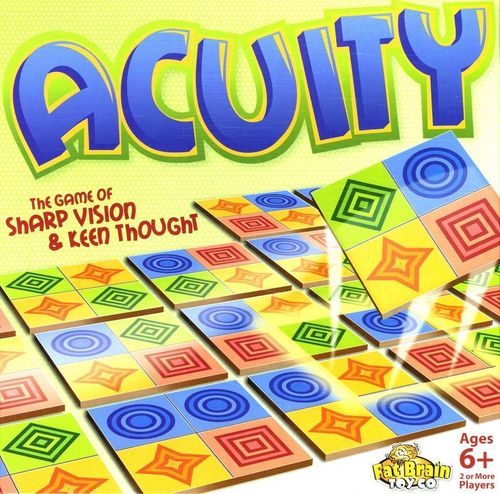
Acuity
Acuity Rulebook
Table of Contents
Table of Contents
Object
Match and collect the most tiles to win!
Setup
Shuffle the Acuity tiles. Construct a grid by placing the tiles face up to create a 6 x 6 playing area. Stack the remaining tiles face-down next to the grid to create the draw pile (see example on the back of the box). The youngest player turns over the first tile of the draw pile and play begins.
Playing the Game
Matching: The first player to spot the pattern on this tile in the grid calls out, "I see it!" and then reveals to the other players where the match is hidden. The player who made the match wins the tile and puts it aside until the end of the round. This player then turns over the next tile in the draw pile for the players to match.
2 or More Players · Ages 6 and up
Winning the Game
Continue matching Acuity tiles until the draw pile runs out. Each tile earned is worth one point. The player with the most tiles at the end of the game wins! If you wish to play multiple rounds, simply keep score on a piece of paper.
Edge Match
Match an Acuity tile from the draw pile to the edges of two tiles in the grid.
Corner Match
Match an Acuity tile from the draw pile to the corners of four tiles in the grid.
Clockwise or Counterclockwise Match
There are several ways to match an Acuity tile in the grid: clockwise or counterclockwise match.
Turn a single tile in the grid either a quarter-turn clockwise or counterclockwise to create a corner or edge match.
By turning this tile clockwise, the tile to the right will match. (continued on back)
Challenge
A player who believes there is no way to match the Acuity tile in play on the grid can call out "Challenge!" The other players have 30 seconds to find a match. If no match is found, the Acuity tile is awarded to the player who issued the challenge. If a match is found, the player who found the match receives the Acuity tile and takes one tile as a penalty from the challenging player.
Note: if the challenging player currently has no tiles, a penalty tile is not awarded.
Woops...
If a player declares a match and is wrong, as a penalty he or she must sit quietly while the other players continue to look for a match. This rule also applies while looking for a match during a challenge.
Variations
Solitaire Game: Try to beat your best time in finding all the tiles in the draw pile within the grid. If you draw a tile for which you cannot find a match, place it to the side. As you continue to match other tiles, try to turn tiles in the grid which enable you to make a match possible. Try a 5 x 5 or 4 x 6 grid for an even greater challenge.
Cooperative Game: Use the same rules as the solitaire game. Players work together as a group, not against each other. Set a timer for five minutes and see if the group can match all the tiles before time runs out.
Point Game: Players score different points based on how they find a match. One point is scored for turning matches where the player turns a tile to make a match. Two points are scored for a natural match where no turning is required.
Race Game: After building the grid, deal out an equal number of tiles to each player. The first player to match all of his or her tiles wins. Whenever you declare "I see it!", the player to your left should verify the match. Hold onto any tiles for which you believe there is no match. When you are otherwise out of tiles, declare yourself the winner. Other players have 30 seconds to attempt to match any of the tiles you have not matched. If no one finds a match, you win. If someone does find a match, the other players continue trying to match all of their tiles until a winner is determined.
Advanced Solitaire Game: Start with a 2 x 2 grid. Whenever you cannot find a match, add the tile to any edge of the grid. Challenge yourself to see how small you can keep the grid.
For Younger Players
There are many ways to give younger players an advantage as they learn to play Acuity:
- Allow younger players to see the tile just drawn before anyone else.
- Count to ten before declaring a match, giving younger players extra time.
- Before claiming a match, show the approximate area where a match is and allow a younger player the chance to "snatch" the match away.
- Older players are not allowed to find matches along the outside edge of the grid.
- Older players are only allowed to find either turning or natural matches but not both.