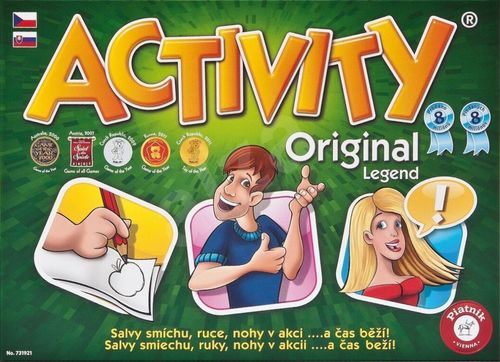
Activity
Activity Rulebook
Table of Contents
Table of Contents
Game Contents
- 2,640 terms
- 1 game board
- 1 sandglass (timer)
- 4 playing pieces
- 1 rulebook
- Paper and pencil are also needed (not included)
For 3 to 16 players, ages 12 and up.
Objective
Reach the finish space by guessing the terms your teammates portray.
Game Material
The Board
The board shows a track of 48 spaces, a start space, a finish space, and three storage spaces for the card stacks.
Each space is marked with a color and a symbol. The color indicates which term on the card is to be portrayed. The symbol indicates the mode of portrayal (drawing, explaining, acting).
The Cards
The numbers on the back of the cards indicate the difficulty level of the terms. In general, 3-cards contain somewhat easier tasks, 4-cards medium tasks, and 5-cards rather tricky tasks. The actual difficulty of a task is, however, always subjective.
The six terms on the front are marked with colors and symbols. These correspond to the colors and symbols of the spaces on the board. The color indicates which term is to be portrayed; the symbol indicates the required mode of portrayal.
So if a team's playing piece stands on a yellow space with the symbol for drawing, the term next to the yellow square on the card must be chosen and that term drawn. If the term itself is printed in red, this is an "Open Round."
Setup
- The players form several teams, as evenly matched in number as possible. Members of a team should sit next to each other. A team consists of at least 2 players (for the rules for 3 players, see below).
- The board is placed in the middle of the table and the sandglass is set down next to it.
- Each team chooses a playing piece and places it on the start space.
- The cards are sorted by the numbers on their backs, then each stack is shuffled well and placed face down on the rectangles provided for them on the board.
- Paper and pencil are set out for the drawing tasks.
- The team that opens the game determines one player as the first "performer." In the following rounds, the players within the team take turns as performer.
Gameplay
- Play proceeds clockwise.
- The performer of the first team chooses one of the card stacks (3, 4, or 5) and lifts the top card so that their teammates cannot read the front of the card.
- In the normal course of play, the player must portray the term that corresponds to the color of the space their team's playing piece is standing on. Since all pieces stand on the start space at the beginning of the game, each player may initially choose a term freely, but must convey it in the required mode of portrayal. This applies as long as the playing piece is standing on the start space.
- The performer studies the term for about 10 seconds. If it is not an "Open Round" being played, they show the other teams the card and set it aside.
- The performer must then portray the term for their own team's members so that they can guess it. The following rules apply to the different modes of portrayal:
Drawing
The term must be drawn with pencil. The performer may neither speak nor gesture, but may nod to indicate to their teammates that they have guessed part of the term correctly. The drawing may not contain letters or numbers.
Explaining
The term must be described in words. Neither the word itself, nor parts of it, nor derived forms of it may be used.
Acting
The term must be portrayed through pantomime. The performer may neither speak nor make any sounds, nor may they refer to or point at objects in the room. They may, however, point to their own body parts.
Warning: if a player violates these rules, their team may not advance, and the next team takes its turn.
- A time limit applies to each task, determined by the sandglass. This is monitored by the members of the opposing teams, who also watch that the rules are followed. It should also be agreed before the start of the game exactly how precisely the terms must be guessed — for example, whether "animal lover" is also satisfied by "animal friend."
- If the team succeeds in guessing the term within the given time, it may advance its playing piece by the number of spaces corresponding to the card's value.
- If the term is not guessed, the playing piece remains in place.
- The next team then takes its turn. Its first player chooses a card stack, lifts a card, and so on.
Bumping
If a team has guessed a term and advances with its playing piece, it may happen that it lands on a space already occupied by another team's playing piece. In this case, the piece occupying the space must move back one space. Bumping is only possible when advancing after guessing a term correctly, not when a piece is moved back (in such cases, two pieces may stand on one space). Choosing the card value allows a team to deliberately bump an opponent (see "Game Tips").
Open Round
- If a term is printed in red, this task is played as an "Open Round." In this case, the performer may not show the drawn card to anyone (compliance with this rule is monitored), because everyone taking part in the game may guess — not only the performer's own team.
- If a player from another team succeeds in guessing the term, their team may advance 4 spaces. The performer's team may advance 2 spaces. If, in this case, both playing pieces would land on the same space, bumping does not apply.
- If a member of the performer's own team guesses the term, that team advances its piece 6 spaces.
- An "Open Round" can occur on any card; the point value printed on the back of the card does not count for open rounds.
End of Game
The team whose playing piece is the first to reach the finish space, or move beyond it, wins.
Rules for 3 Players
- Each player chooses a playing piece and places it on the start space.
- In the game for three people, only "Open Rounds" are played, regardless of whether the term is printed in red or black. The player whose turn it is tries to convey the term to both of their fellow players.
- If the term is guessed, both the performer and the player who guessed the term may advance their playing pieces by the value indicated on the back of the card.
- If neither of the two other players guesses the portrayed term, the next player takes their turn.
- The same rules apply to the portrayal of the individual terms and the movement of the playing pieces as for the game with 2 or more teams. Bumping does not apply in the game with 3 people.
Game Tips
- The terms are made up of at least 2 words. As a whole term, they are often difficult to portray. But if you portray the two parts separately, the task is usually much easier to solve. Example: drawing an "earworm" is very hard, but "ear" and "worm" can be drawn relatively easily on their own. If you split the word this way, you should show the guessers which part you are currently portraying — for example, by first dividing the sheet into two halves with a dividing line when drawing. When explaining, you can tell your teammates this; when acting, you can convey it with one or two fingers.
- The ability to bump an opposing playing piece gives the game an appealing tactical element. In some situations, you can influence whether you move onto an occupied space (and thereby move an opposing piece back) by choosing a card with the value you need.
- Most players have their strengths and weaknesses. For example, if I am good at drawing but weak at the other modes of portrayal, I can play to my strengths by choosing a card with a higher value for "Drawing," and one with a lower value for "Explaining" and "Acting."
- The length of the game can be shortened or extended by agreeing before the game to increase or decrease the card values by 1 or 2.
- Experience shows that the game for three takes considerably less time.