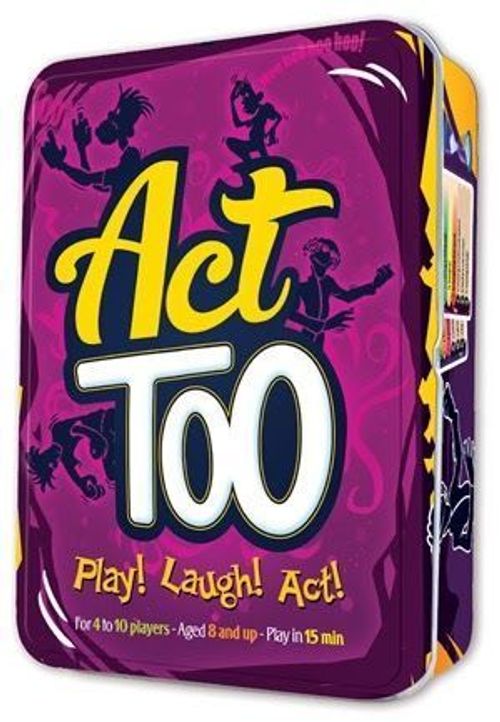
Act Too
Act Too Rulebook
Table of Contents
Table of Contents
Setup
- Form two teams.
- Shuffle the "I am..." ("Je suis") deck and the "Who..." ("Qui") deck separately and place them on the table.
- Decide which letter and which number you will play with for the whole game: choose a letter between A and H and a number between 1 and 8.
The sheet's example: "Play, for example, by choosing B and 4."
Playing the Game
Teams take turns.
On each turn, one member of the team draws a card from each deck ("I am..." and "Who..."). They look at the cards discreetly, place them face down beside them, and then the hourglass is turned over. The player has one minute to get the other members of their team to guess the corresponding phrase using mimes and noises (onomatopoeia and hummed tunes are allowed).
Teammates may make as many guesses as they want.
As soon as the phrase is guessed, the pair of cards is won. The player draws two new cards and continues this way until the hourglass runs out.
Pairs of cards that have been won are kept face up. A pair that was not guessed in time is discarded in the middle of the table.
Tips
- You are allowed to have your teammates guess your character first, and then what it is doing.
- The answers proposed by the players may be slightly inaccurate. Examples: "le" for "un" ("the" for "a"), "des" for "ses" ("some" for "his/her"), etc.
End of the Game
The game ends when the draw piles are exhausted. The team that has won the most cards wins the game! In case of a tie, the team with the highest total of points on its "Who..." cards wins!
Variants
P'tit Joueur ("Little Player")
Once per hourglass, the player may change one of their 2 cards.
Duel en Cocotte-Minute ("Pressure Cooker Duel")
Teams each play one pair of cards in turn. The hourglass is turned over immediately after each validated pair (without resetting it to zero). The more efficient a team is, the less time the opposing team has! The first team to run out of time gives a point to the other team and will play first in the next round.
Components
- 27 "I am..." ("Je suis") cards
- 27 "Who..." ("Qui") cards
- 1 hourglass (about 1 minute)
- The rules
The rules sheet shows some sample cards in an illustration. Several are overlapped and cannot be read reliably, so the full card lists are not transcribed. The legible examples are:
- "I am..." cards: B "Un T-rex" (a T-rex); D "Un garde du corps" (a bodyguard); E "Un avocat" (a lawyer); F "Un scaphandrier" (a diver); G "Un poisson rouge" (a goldfish); H "Un panda" (a panda).
- "Who..." cards: 1 "se coince le doigt dans la porte" (gets its finger caught in the door); 2 "danse sur la table" (dances on the table); 4 "chante sous la pluie" (sings in the rain); 6 "rate son train" (misses its train); 7 "mange avec des baguettes" (eats with chopsticks); 8 "écoute la mer dans un coquillage" (listens to the sea in a seashell).
Goal
Get your team to guess more cards than the opposing team.