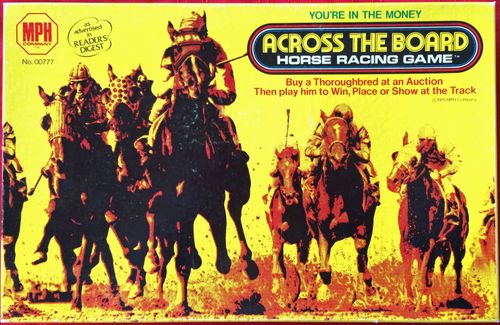
Across the Board
Across the Board Rulebook
Table of Contents
Table of Contents
- Overview
- Equipment
- Player Roles (3 to 7 Players)
- Auctioneer Start Auction
- Across the Board Using the MPH Totalizator
- The Trackmaster Advances the Horses Using the Race Tracks
- The Race Begins
- How Payoffs Are Made: "The MPH Track Handle"
- Invest in Purse Races: Win Extra "Fifties"
- Loans
- Odds
- No Restrictions
- Restrictions
- Optional Play
Overview
Purchase a stable of Thoroughbreds at auction. Then, race your "stable" at one of the world's foremost tracks: Churchill Downs in Louisville, Woodbine in Toronto, Epsom Downs in London and Longchamp in Paris.
The Winner is the player who, through wise bidding, shrewd betting and a little help from "lady luck," wins the largest number of play fifty-dollar bills at the end of eight races.
Equipment
- Play Money: 280 bills, each worth fifty play dollars.
- 28 Handicap "tout sheets" and Auction Newspapers.
- 20 Race Tracks: 5 each of Churchill Downs, Epsom Downs, Longchamp and Woodbine.
- 11 Thoroughbred Ownership Title Cards.
- 2 Dice: When running a race the horse's number always equals the total of both dice thrown.
- 1 MPH Totalizator.
- 1 Grease Pencil: For marking each investor's initial and WIN, PLACE and SHOW horse numbers on the MPH Totalizator.
- 1 Regular Pencil: For marking the advancement of each horse on the race track.
- 1 Parimutuel Board Box Lid: With parimutuel windows and "auction receipt bins" for depositing race investments.
Player Roles (3 to 7 Players)
For 3 to 7 players, the following roles are used.
Totemaster is responsible for:
- marking the MPH Totalizator;
- receiving $150.00 Across the Board bets;
- depositing the total bets by dealing the play money as directed into the seven MPH Parimutuel Windows in the game box lid;
- making all payoffs at the end of each race.
Note: The Totemaster is also responsible for receiving and depositing "Daily Double" bets when this optional version of the game is played.
Trackmaster is responsible for:
- allotting each player (including himself) 40 fifty play dollar bills ($2,000);
- selecting the race track;
- distributing to all players a copy of HANDICAP AND AUCTION NEWS (Note: The color of the newspaper and the race track must be the same color.);
- marking the movements of each horse on the track;
- announcing WIN, PLACE and SHOW horses as they come in for each race.
Auctioneer is responsible for:
- conducting the horse auction;
- obtaining the highest price for each Thoroughbred auctioned.
Note: The Auctioneer must sell all 11 Thoroughbreds because all 11 run in every race.
Auctioneer Start Auction
The Auctioneer starts the auction with the words: "I have $50.00, do I hear $100.00...?"
Eleven Thoroughbreds go on the auction block before the first race. Each has been pre-handicapped by experts in order to provide the players with similar odds as those at the real race track.
Longshots: Horses #2, #3, #11 and #12 are handicapped as "longshots" because of their poor track record.
Field Horses: Horses #4, #5, #9 and #10 are "field horses," which means they are expected to be in the running but not necessarily expected to win. (Note: The term "field horses" in this game is a classification and not a one bet investment.)
Favorites: Horses #6, #7 and #8 are "favorites" because of their winning track records.
REMEMBER, when "they're off and running," it's anybody's race. On the right track with the right conditions "longshots" and "field horses" can win big.
The Auctioneer reads the Thoroughbred's name, number, ancestry and its opening bid from the ownership title card. Players must keep a keen eye on the suggested bid in the SHADY FENCE FARMS newspaper and the "best pick" in the HANDICAP AND AUCTION NEWS and then remember to bid wisely for ownership.
The Auctioneer always tells the other players when he makes a bid by stating "Auctioneer's bid is ______ (so many) fifties."
Players may purchase as many Thoroughbred horses as they wish and may even form a syndicate (comprised of not more than one-third of all players) to purchase a horse. Players may also purchase horses from other players anytime during the game.
The Auctioneer collects all the receipts for all 11 Thoroughbred sales and deals them into the 5 "auction receipt bins" as indicated in box lid. These bins make up the special purse races of the third, fifth and eighth races.
You may invest and win in all races without owning a horse, but you cannot collect the "WINNERS CIRCLE," window #1, unless you own the winning horse.
Check the HANDICAP AND AUCTION NEWS to see the conditions of the track selected for each race. It will help you decide whether your best chance of a winner is with a "field horse," "favorite" or "longshot."
Across the Board Using the MPH Totalizator
After the auction, Across the Board bets for the first race are taken. To win your horse must come in first to WIN, second to PLACE or third to SHOW. The only bet permitted is 150 play dollars for each Across the Board selection made.
Players may bet on as many horses as they wish and they may also "double up" bets as many times as they choose on the same horse. For example: A player may make three bets on horse #7 (a total of 450 play dollars on horse #7). Players should bet on at least three horses per race for the best odds, and there is no limit to the number of players that can invest on the same horse.
The Totemaster writes the investor's initials in the column on the Totalizator containing the number of the horse selected.
[Example image of a completed MPH Totalizator omitted.]
(Note: "R" has bet three times on horse #10.)
After all bets are made, the Totemaster deals these "fifties," from left to right, in the seven MPH Parimutuel Windows (see game box lid), until he runs out of the "fifties." (This will mean that some windows may contain more "fifties" than others.) This procedure is to the advantage of the horse owner and players betting on "favorites."
When the distribution of this play money starts the Totemaster announces that the MPH Parimutuel Windows are "closed." Bets for that race can no longer be accepted.
The Trackmaster Advances the Horses Using the Race Tracks
Each of the four tracks has been preprinted with the horse's handicap, based on the conditions at the track as well as the horse's "track record."
Preprinted X's are given to "field" and "longshot" horses to better equalize them with the "favorites." All horses need a total of 5 X's after their numbers to finish.
The "favorite" horses, numbered 6, 7 and 8, are sometimes preprinted with a circle and shaded, meaning that they have been heavily handicapped. When they are shaded and circled, it means that that horse's first X or two ½ X's will be placed over their circled, shaded square and will therefore need 6 X's to finish the race. When "favorites" 6, 7 or 8 are not circled and shaded, they need only 5 X's to finish in the money.
The Race Begins
All 11 horses must run in every race... the horse number equals the total amount on both dice.
The player to the left of the Trackmaster rolls the dice and has two choices:
- To accept the first roll. The Trackmaster then advances that horse by one full X. The player then passes the dice to the player on his left.
- To reject the first roll. Trackmaster then advances that horse by ½ X (a single diagonal line) and the player receives a second roll of the dice. After the second roll the Trackmaster automatically advances the horse one full X. The player then passes the dice to the player on his left.
Note: When a horse has "come in" first (WIN) or second (PLACE) and a player [part of this line is cut off at the edge of the photograph] rolls that number on his first or second roll of the dice. Either roll is considered a turn. That is, players do not receive extra turns when rolling the number of a horse having already finished the race.
When a horse has a ½ X on its square and the Trackmaster is ordered to add a ½ X or a full X, the Trackmaster must first complete the ½ X'd square first with one diagonal line for a ½ X and the same for a full X, putting the remaining ½ X in the next open square.
Players continue rolling the dice in a counter-clockwise fashion. The horse that reaches his finish square with 5 full X's after its number first, WINS. Players continue to roll the dice for second (PLACE) and third (SHOW). When the SHOW horse (third) comes in the race has ended.
[Example diagram of a finished race (race card with completed X marks) omitted.]
How Payoffs Are Made: "The MPH Track Handle"
The Totemaster marks the Totalizator with WIN, PLACE and SHOW horses as they come in. Totemaster then distributes the invested money to the winners according to the rules printed above the parimutuel windows in the box lid.
If, a "favorite," "field" or "longshot" WINS and there are no investors, the Totemaster will divide the non-payable winnings into the windows that will pay off.
For example:
- A. When any horse WINS and there are no investors, the Totemaster will remove all the play money in windows #2, #3, #4 and #5 and deal these receipts into windows #1, #6 and #7 before the payoff.
- B. When any horse PLACES (second) and there are no investors, the Totemaster will remove all the play money from window #6 and deal it into windows #1, #2, #3, #4, #5 and #7 before the payoff.
- C. Likewise, when any horse SHOWS (third) and there are no investors, the receipts of window #7 are dealt into windows #1, #2, #3, #4, #5 and #6 before the payoff.
- D. The Totemaster always deals the "MPH Track Handle" (bets) into the MPH Parimutuel Windows starting with window #1, #2, etc. until the last piece of play money has been dealt.
Therefore, the Totemaster must first determine the payoffs and must pay out all the receipts of each race to the players. Because the Totemaster can only pay even amounts, the left over odd "fifties" are carried forward to the next race...except after the eighth race when odd "fifties" go to the owner of the WIN horse.
If no players have invested on any of the WIN, PLACE or SHOW horses, the race is then disqualified. Parimutuel investment windows are re-opened after players receive a refund and new investments can be made before the start of the next race.
After each race, the Totemaster wipes the Across the Board section of the Totalizator clean with a dry cloth and begins the next race.
Invest in Purse Races: Win Extra "Fifties"
Before the start of the third race, the third race purse (see "auction receipt bins," third race) is added to the third race receipts and dealt into the parimutuel investment windows from left to right in the box lid. The fifth race is distributed similarly.
At the end of the eighth race...the Totemaster must pay off all of the play money within the MPH Parimutuel Windows, including the remaining receipts from the auction which are in the WIN, PLACE and SHOW "auction receipt bins" of the eighth race purse. These funds will be distributed to the owners of the winning horses. Individual players now total their winnings and the player with the most "fifties" is the winner. Another track may then be set up, a new Totemaster, Trackmaster and Auctioneer selected, another auction held and eight more races run.
Loans
The Totemaster may loan money at any time during play from the eighth race WIN "auction receipt bin" to players who own horses. Loans may be made up to the amount of the horse's opening bid title card. The player must then turn his Thoroughbred Ownership Card over to show that he is "in hock" with his horse as collateral. While "in hock," horses still run in races and their owners collect any entitled winnings.
Loans, plus "$50.00" in interest, for each horse "in hock" must be repaid to the eighth race WIN Purse bin prior to the running of the seventh race. If a player cannot repay the loan, the Auctioneer auctions the horse or horses before the running of the seventh race and repays the eighth race WIN Purse from the auction proceeds. Remaining proceeds go to the former owner.
Players may also borrow from other players on any terms they agree upon among themselves—but beware of the loan shark.
Odds
Odds refer to the probability of any thing occurring at a particular time. The odds used in Across the Board were arrived at by noting the number of times a particular number was rolled for each 50 rolls of the dice. After adjusting for accepting or rejecting the rolls, it was determined that:
- Longshots #2, #3, #11 and #12 were each rolled and accepted about 2 times out of 50.
- Field Horses #4, #5, #9 and #10 were each rolled and accepted about 4 or 5 times out of 50 rolls.
- Favorites #6, #7 and #8 were each rolled and accepted about 6 to 8 times out of 50 rolls.
There are approximately 50 rolls of the dice in the average race.
No Restrictions
- Players lending or borrowing play money.
- Reselling horses.
- Establishing investing rings (pooling play money to make track bets).
- Becoming a bookmaker or dealing with a bookmaker.
Good luck however...these dealings must not interrupt regular play.
Restrictions
Syndicates buying Thoroughbreds cannot be comprised of more than 1/3 of the players.
Optional Play
"Daily Double"
Feel lucky? Try the "Daily Double"...
Players invest 50 play dollars on a combination of two horses—one to win the first race and the other to win the second race. The "Daily Double" is considered by some experts to be the best investment at the track.
Each player (including the Totemaster, Auctioneer and Trackmaster) may invest in as many "Daily Double" combinations as they want. Several players may invest on the same "Daily Double" combination. The Totemaster records the player's name and two horses' numbers selected on the "Daily Double" portion of the Totalizator.
When all investments are in, the Totemaster places the total "fifties" in the "Daily Double" bin in the box lid. Then, after the results of the first and second races, the "Daily Double" receipts are divided evenly among the winning investors.
If there are no "Daily Double" winners, the receipts in the "Daily Double" bin are then added to the player investments of the third race and are dealt into the parimutuel investment windows.