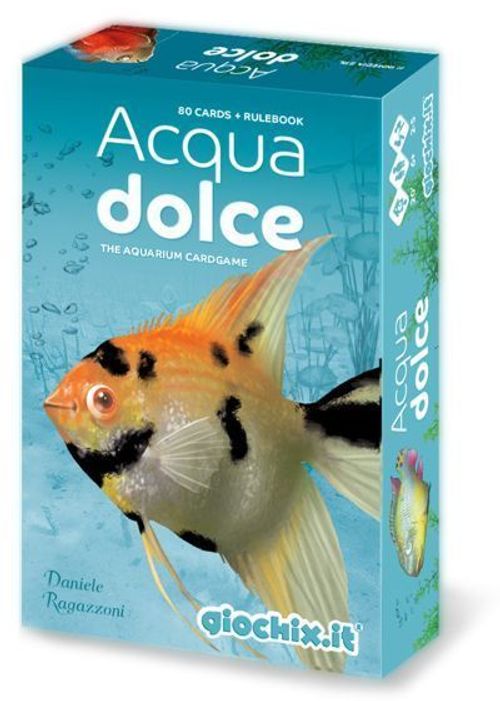
Acqua Dolce
Acqua Dolce Rulebook
Table of Contents
Table of Contents
Box Content
80 cards.
Card Description
The deck is composed of the following cards.
King of the Aquarium Card
This shows the starting player, who will also perform the Control Phase.
Objective Cards
Objective cards represent the victory conditions that must be active in order to win the game: players can vary the number and type of Objective Cards to make the game more or less difficult. The Starting Objective Cards should be used for the first game.
One side of the Objective Cards shows the inactive (Off) condition in black and white. The other side, in colour, shows the active (On) condition. These cards are flipped to reflect the aquarium's state.
Fish Cards
Fish cards represent different fish species that can be put in the Aquarium. Each card includes various symbols:
Game Requirements (shown on the left of the card) show the requirements that must be respected in order to play a Fish Card. They are:
- Decoration / Plant
- School / No school
- No Guppy
Fish Features (shown on the right of the card) show the characteristics of the Fish card. They are:
- Rare Fish
- Colours
- Aquarium zone occupied by the Fish (high, medium or low)
- Fish name
- Temperature Range allowed for Fish survival (only for advanced rules)
Card back: each card in a player's hand represents 1 fish fodder. During the Control Phase, players must feed the fish in the aquarium using cards in their hand and/or by playing Feed Cards (see Control Phase).
Each Fish card has a small icon on the back to remind players of this concept.
Ornament Cards
Ornament cards represent seaweed and decorative elements that players can add to the aquarium to embellish it and to support certain Fish species.
- Decorative Card (Decoration)
- Plant Card (Plant)
Feed Cards
Fish food is represented by the number of cards in a player's hand (1 food ration for each card). In addition, players may also use Feed Cards.
Feed cards remain on the table for the whole game and feed 4, 5 or 6 fish each turn as shown on the card.
- Feed card: Fodder for 4 fishes
- Feed card: Fodder for 5 fishes
- Feed card: Fodder for 6 fishes
Preparation of Game Deck
Prepare the game deck by adding the Feed cards shown below, depending on the number of players:
Feed card deck composition
- 2/3 players: All Feed cards are used.
- 4 players: Use 3 Feed cards only: two 4 fish cards, and one 5 fish card.
- 5 players: Use two 4 fish Feed cards only.
Game Set Up
- Place the 3 Starting Objective Cards with the black/white side up ("off" side).
- Depending on the number of players, select the required Feed cards to be included in the deck.
- Shuffle the deck (containing Fish, Ornament and Feed cards) and deal 7 cards to each player.
- Put 3 cards on the table face up.
- The youngest player takes the King of the Aquarium card and is the starting player.
Game Turn Sequence
The player with the King of Aquarium card places the King card on the table and starts to play. Other players follow clockwise. During their turn, players perform these actions in this exact sequence:
- Draw 1 card from the deck or take 1 card from the 3 face up cards; if the player chooses a face up card, it is immediately replaced by another card from the deck.
- Perform any 3 actions from this list (an action may be performed more than once):
- Play a card from the hand to the table.
- Play one or more Fish School cards from the hand to the table (Fish cards must be identical).
- Draw 1 card from the deck or take 1 of the 3 face up cards.
- Discard 2 cards from the hand and then draw 3 cards from the deck or the face up cards.
- End game turn. The next player clockwise then takes their turn.
Put discarded cards in a discard deck. When the game deck is exhausted, shuffle the discarded cards to create a new deck.
How to Play Cards
Ornament and Feed cards can be played directly from a player's hand to the table. Fish cards must be played in accordance with the fish's Requirements: these are shown as icons on the card as follows:
- Decoration / Plant: this Fish card needs at least 1 Decoration card or 1 Plant card on the table.
- School Fish: a Fish School card requires 3 or more identical School Fish cards on the table. For that, a player can play 1 or more identical Fish School cards during his game action.
- No Guppy: no Guppy cards may be on the table when this card is played.
- No Fish School: no Fish School cards may be on the table when this card is played.
If a player wants to play a card without adhering to the Requirements then he must draw 1 card from the deck as a penalty for each unmet Requirement. Example: to play a Bumblebee fish without meeting its requirements (1 Decoration and 1 Plant card), the player must draw 2 penalty cards.
Aquarium King Card and Control Phase
After all players have had their turn, the Aquarium King plays a second turn and then performs the Control Phase. After completing the Control Phase, the Aquarium King card is passed on to the next player (clockwise).
During the Control Phase, any cards on the table that do not meet their requirements are discarded.
The Control Phase is performed in this order:
-
Piranha Card: if the Piranha card is on the table, the Aquarium King decides which fish card is discarded as a result of being eaten by the Piranha.
-
Feed Card: the Aquarium King checks that all the Fish in the aquarium can be fed. To do this, total up the number of cards in the players' hands and add any Feed Cards on the table to the total. If the number of fish in the aquarium exceeds this total, then the Aquarium King discards the excess.
Example: 14 Fish Cards and 1 Feed Card (4 rations) are on the table. Players have in total 9 cards in their hands: it's possible to feed 13 Fish cards (4 for the Fodder card + 9 for the cards in player hands = 13); 1 Fish card is in excess: the Aquarium King decides which Fish card is eliminated.
-
Fish Card Requirements: The Aquarium King checks the requirements of each of the fish on the table and discards any that don't meet their requirements.
Example: 2 Neon cards are on the table. They are School Fish, which require a minimum of 3 to form a school, so they are both discarded.
Note: if two or more Fish have requirements that conflict, the Aquarium King decides which requirement is checked (and corrected) first. Example: 2 Guppy and 1 Indian Glassfish are on the table; Guppy is a School Fish and needs at least 3 identical cards to survive. On the other hand, the Indian Glassfish cannot remain on the table with a school fish, such as the Guppy. Both don't meet their requirements. The Aquarium King decides in which order to proceed: he could first remove the 2 Guppies and save the Glassfish (because it now meets its requirements), or remove the Glassfish first and then remove the Guppies (because they still don't meet their requirements).
-
New face up cards: the 3 face up cards are discarded and replaced by 3 new ones from the deck.
At the end of the Control Phase, the Aquarium King card is passed on to the next player.
Game End and Objective Cards
To win the game, a player must have played all their cards and at the same time have accomplished one or more of the objectives shown on the Objective Cards.
For the first game, we advise that players use the 3 Starting Objective Cards: to win, a player must meet at least 2 of the objectives. Generally speaking, the number of Objective Cards and the minimum number of objectives to meet is set by agreement between the players at the start of the game. The more cards and the higher the number, the longer the game will be.
Objective Cards are as follows:
Starting Objective Cards
- Fish Variety: at least 7 different Fish species cards must be on the table.
- School Number: at least 3 different schools of fish must be on the table, each composed of 3 or more Fish cards.
- Ornaments: at least 3 Decorative cards and 2 Plant cards must be on the table.
Other Objective Cards
- Rare Fish: Indian Glassfish must be on the table.
- Colour Numbers: All five colours must be present on the table: each Fish card contributes all its colours to this.
- Aquarium Zone: At least 1 Fish card for each Aquarium zone (high, medium, low) must be present on the game table.
When the condition shown on an Objective Card is achieved, it is turned to show its coloured side up. Similarly, if the objective is no longer met during the game, it is turned over to show its black and white side.
When a player runs out of cards, he immediately conducts a Control Phase, regardless of who is the current Aquarium King. If the objective conditions are still met after the Control Phase then the player wins the game. However, if one or more objectives are no longer met, then the player must take 3 cards from the deck as a penalty and the game continues with the next player.
Advanced Rules
Skilled players can use these special advanced rules to make their game more interesting and complex:
- Temperature
- Optional rules: Additional Action and Unique Deck
Temperature
Each Fish card shows the temperature range (in degrees) within which the Fish can survive.
In the Advanced game, the Temperature card is placed on the table with the current temperature set to 25°C as shown in the illustration. This is the aquarium's temperature at the start of the game.
Temperature in Game Turn: During their turn, players may move the current temperature up or down by 1 or 2 degrees. This counts as one of the three actions available for the turn. However, this action can only be performed once per player turn.
Temperature in Control Phase: In the Advanced game, a Temperature Check is added to the end of the Control Phase. Any fish cards that do not meet their temperature requirements are discarded.
Example: if the aquarium temperature is 24°C then any Gourami Dwarf Fish cards in the aquarium will be discarded as their range is 26°C-29°C.
Note: the Temperature Check is a Control Phase requirement, not a Card requirement. It is therefore possible to play Fish cards that are "out of range" without penalty.
Optional Rules
- Additional Action: If a player achieves an objective during his turn, he may take a further (free) action. For example, a player who achieves 2 objectives may take 5 actions instead of 3.
- Unique Deck: Do not use any face up cards, and draw only from the face down deck.
Deck Composition
- 58 Fish Cards:
- 7 Corydoras
- 7 Neon
- 7 Guppy
- 7 Platy
- 4 Dwarf Gourami
- 4 Rainbow Krib
- 4 Angelfish
- 4 Fighting Fish
- 3 Cichlid of Agassiz
- 3 Bumble Bee Fish
- 3 Black Molly
- 3 Piranha
- 2 Indian Glassfish
- 4 Decoration Cards
- 5 Plant Cards
- 4 Feed Cards (1, 1, 2)
- 6 Objective Cards
- 2 Thermometer Cards
- 1 King of the Aquarium card
Note on transcription: the source prints the Feed card counts as "(1, 1, 2)" without labels; the Feed card deck composition table in Preparation of Game Deck is the authority for which Feed cards are used. The set-up steps are numbered in the order of the source's step-marker glyphs (the same markers number the turn-sequence and Control Phase steps), with the shuffle placed before the face-up cards so the deck exists when cards are turned up. Icon glyphs in the source were symbol-font characters and are rendered here as words or list items. The source heading "FEAUTURES" is spelled "Features" here.