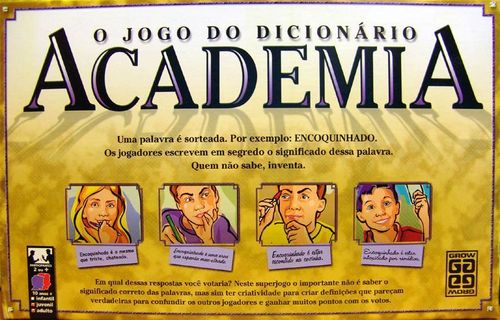
Academia
Academia Rulebook
Table of Contents
Table of Contents
Components
Age: 10 and up. Participants: 2 or more.
- 1 board
- 395 cards with words
- 1 pad of definition sheets
- 6 pawns
- Pencils or pens provided by the participants
Objective
Identify and write down the real meaning of words, bluffing whenever you do not know it, in order to reach the end of the board first and thus win the game.
Preparation
Each player receives a definition sheet, chooses a pawn and places it on the "Saída" (Start) space of the board.
By common agreement, the participants choose a player to be the leader of the first round.
How to Play
If you were chosen as leader, shuffle the word cards and put them back in the box. Then take a card from the pile without showing its contents to the other players. We advise using the box lid as a screen.
Choose 1 of the 5 words on the card and read it aloud, spelling it out if necessary. (To make the game more dynamic, you may choose the word without looking at its meaning on the back.)
The other players must then write the chosen word in the "Palavra" (Word) field of the definition sheet.
Each player may choose one of the following approaches:
- Knowing the meaning, write it correctly.
- Not knowing the meaning, try to bluff the opponents by creating a misleading definition.
While the players answer, you write the correct answer on your definition sheet and put the card back at the bottom of the pile.
As soon as everyone has finished answering, you collect the definition sheets, adding them to yours. To make it easier, mark each of them: A, B, C and so on. Then read the answers aloud, including the one you copied. (You may disguise your voice when reading the answers, so that the other players do not notice which definition is the correct one.)
You may read each of the answers as many times as necessary, without identifying its author, only announcing the letter you marked.
Always following the clockwise direction of the game, ask each player to say which definition he judges to be the correct one. Write down the score (votes) given on the definition sheet of the player who received the vote.
After everyone has voted, you reveal the real meaning of the word, state the total points of each player and ask each one to move his pawn according to his result.
Scoring
- 1 point: for each vote that a player's definition receives.
- 2 points: for each player who chose the correct meaning.
- 3 points: for each player who writes a definition equal or very close to the real one.
- 3 points: for the leader, if no player chose the correct meaning.
Attention: A player who votes for his own definition, in order to deceive the opponents, will not receive any points.
Notes
- If, as leader, you receive one definition very close to the correct one, do not read it aloud: set it aside to read it at the end of the round and automatically award 3 points to the player (this player does not take part in the voting).
- If, as leader, you receive more than one definition close to the real one, cancel the round and choose a new card, awarding, however, 3 points to each of the players who gave the correct definitions.
- If there are only 3 or 4 players, in addition to the correct meaning (back of the card), you, as leader, must present a misleading definition, so that there is a greater chance of bluffing. If all the players vote for your misleading definition, you will receive only 3 points (for nobody having guessed the real meaning), thus forgoing the 1 point per vote that could have been given for your correct definition.
At the end of the round, pass your turn as leader to the player on your left, who will proceed in the same way as you.
End of the Game
The game ends when one of the participants reaches the end of the board.
Winner
The first to reach the end of the board wins.
Tips
- It is important that players write legibly so that the leader has no difficulty understanding the handwriting, thus avoiding confusion.
- The leader should read to himself and try to understand all the definitions before reading aloud.
- The leader can place the game box lid in front of him, making a shield so that the other players do not recognise the other players' answers.
Rule for 2 Players
If there are only 2 players, one chooses any one of the 5 words on the card and reads it aloud. Then he reads all 5 definitions on the back of the card. The other player must then guess which is the correct definition. If he is right, he earns 2 points, moving his pawn 2 spaces. If he gets the answer wrong, the leader earns 1 point and moves his pawn one space ahead.
If there are more than 6 players, pairs or teams can be formed to play. Each pair or team writes a single definition. The rules of the game remain the same.