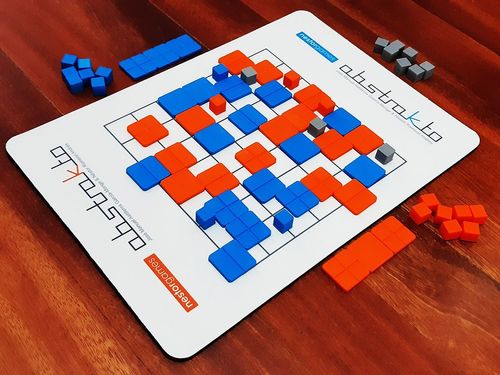
Abstrakto
Abstrakto Rulebook
Table of Contents
Table of Contents
Components
- A 7 × 7 square board
- 18 blue tiles (6 of each type)
- 18 orange tiles (6 of each type)
- 30 scoring markers (10 blue and 10 orange and 10 grey)
Preparation
The board is initially empty. One player plays as blue; the other, as orange. Each player selects 15 of their tiles to play with, and discards the other 3, which cannot be used in the game¹.
¹ You can either discard them randomly, or secretly (you'd need a screen to hide your tiles, then), or agree on which ones to discard.
Play
Randomly determine the starting player. Then, players take turns placing one of their tiles on the board according to this placement rule: The entire tile must be placed on the board in such a way that its lines perfectly overlap the grid of the board; i.e. the board serves as a template for the tiles. This means that:
- "Solid" tiles can only be placed inside the board cells.
- "Line" tiles can only be placed centered on the edges of the board cells, including the edge of the board.
- "Cross" tiles can only be placed on the lines' intersections, excluding the edge and the corner of the board (in those places, the tile's lines would extend beyond the underlying gridlines of the cell borders).
Examples of legal (left) and illegal (right) tile placements.
End of the Game
The game ends when tiles run out or no more placements are possible. If there are no legal placements for your remaining tiles, you must pass your turn. However, you cannot pass if you are able to play a tile.
At the end of the game, count who controls more uncovered areas of the board. Each area is bounded by tiles and/or edges of the board. To determine who controls an area, count each player's tiles bounding the area (i.e. orthogonally adjacent to it; diagonals don't count). Whoever has more tiles bounding the area controls it, and places one of their scoring markers in the area. If it's a tie, place a grey scoring marker, instead.
Whichever player controls more areas (has placed more of their scoring markers) wins! If it is a tie, then the player who controls the "main area" (the controlled area bounded by the most tiles) wins. If this, too, is a tie, play again!
Note: To facilitate scoring, you might wish to place scoring markers as you play; as soon as an area is clearly "complete", place the appropriate scoring marker².
² Note: Wait to score an area until no further tiles can be played to affect it.
Endgame example: Blue and Orange control 6 areas each; a tie. However, Blue controls the "main" area (indicated by the black arrow), which is bounded by 8 tiles. Blue wins. Note that 2 areas have remained unclaimed (grey markers).
Tips for Beginners
- At the beginning, place your tiles somewhat sparsely, in strategic places (corners and sides). Avoid concentrating too many tiles in a single area.
- Tiles lose "potential" when placed next to each other. Avoid placing your tiles together as much as possible.
- Try to diversify the types of tiles you are placing: Do not place the same type of piece many turns in a row.
- Always keep in mind the flexibility of the tiles when placing them. The "Line" tiles are very flexible: On an empty board, it is possible to place a "Line" tile in 112 different positions (any of the cell borders). A "Solid" tile can be placed in 49 different positions (the squares on the board) on an empty board; and a "Cross" tile, in only 36.