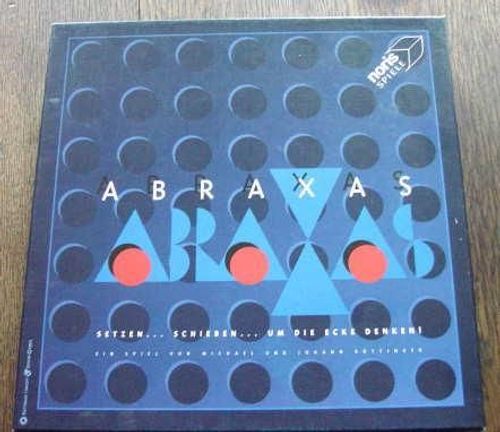
Abraxas
Abraxas Rulebook
Table of Contents
Table of Contents
The Six Game Boards
Abraxas has six different game boards. The numbering from 1 to 6 corresponds to a greater or lesser degree of difficulty. Each side introduces a slightly new playing tactic, so there are always new variants to discover!
Game board no. 1, for example, allows a very simple strategy. It is therefore ideal for beginners, to understand the principle of the game.
Our tip: if a pawn is placed at the start of the game on this board in the centre, you can win!
Goal of the Game
Each player tries to win as many red pawns as possible. You gain pawns when you create a vertical, horizontal or diagonal line of four points or red pawns, by skilfully placing pawns and pushing the perforated plate.
The first player who holds 11 pawns wins the game.
Components
Age: from 10 years / adults. Number of players: two. Playing time: about 15-30 minutes.
Contents: 24 red pawns; "Abraxas" – 6 blue stop pawns; game board and its perforated plate; 3 game sheets with 6 different faces of increasing difficulty; rules.
Setup
Choose one of the six game boards and place it in the game frame, then cover it with the perforated plate (see the illustration). The 24 red pawns stay in the game box; at the start, they belong to no one. Each player receives three blue stop pawns.
Playing the Game
Placing and Pushing
The two opponents play alternately. The player whose turn it is takes one pawn from the common supply and places it on the perforated plate, into a free hole of their choice.
They must then push the perforated plate in one of the directions shown by the arrows marked on the edge of the board, until it bumps against the edge of the board. Then it is the opponent's turn.
Because the red points on the boards count as pawns for forming lines, the situation of the game changes fundamentally after each push.
Creating an Alignment
A player creates a line (an alignment) if, after pushing the plate, four round red markers (red points on the board or red pawns) form a straight line that is visible and uninterrupted, vertical, horizontal or diagonal. An alignment obtained when placing an Abraxas pawn is only valid if it still exists after the push!
(Illustration: diagonal alignment of six, with three pawns and three red points of the board.)
(Illustration: vertical alignment of five, with three pawns and two red points of the board.)
What happens when a player creates an alignment?
The player must take pawns from the alignment created, such that only three pawns and/or points from the original alignment remain after the removal. So a player removes one pawn from an alignment of four, two pawns from an alignment of five, and so on.
The three pawns or points that remain must not be next to each other!
Note: it would sometimes be more advantageous for a player not to take all the pawns they are entitled to. This is, however, forbidden: you must leave only three pawns or points!
The player who has just created an alignment may place another pawn and push again, to try to form a new alignment, take pawns, and so on.
Placing Blue Stop Pawns
There are two ways to place a stop pawn:
- On your own turn, a player may place a stop pawn instead of a red pawn.
- During the opponent's turn, if the opponent has just created an alignment and will therefore play again, a player may place a stop pawn before the opponent plays again. The player must clearly announce "Stop!". If they forget to say it and the opponent has already placed their pawn and pushed the plate, it is too late. As long as the plate has not yet been moved, it is still possible to say "Stop", and the opponent must then remove the pawn they placed.
Important: a player may also decline to place stop pawns, if they manage without them!
Rules for Placing Stop Pawns
- After placing a stop pawn, the player is free to choose whether or not to push the perforated plate in a direction. If they push and thereby obtain an alignment, they take the surplus pawns.
- After placing a stop pawn, in both cases, it is then the opponent's turn. The opponent may not, however, respond with a stop pawn!
- Stop pawns remain in place until the end of the game.
The Value of Blue Stop Pawns
Placing stop pawns allows you to prevent an alignment, and therefore a gain. By placing a stop pawn at the right moment, you can, for example, prevent your opponent in advance from forming an alignment that would let them play again by forming successive alignments.
What Happens When All 24 Pawns Are Used?
From that moment on, all pawns still on the perforated plate's holes may be reused to be placed.
Precisions on the Rules
- In principle, "a piece placed is a piece played". However, a placed pawn must be taken back if the opponent says "Stop" before the plate has been moved.
- A player who does not see an alignment cannot claim its benefit once the opponent has begun their turn.
- A player may form two alignments in the same place: if they remove a pawn from a line and there is a red point beneath that pawn, the same alignment reappears and the player obtains one more pawn from that alignment.
- Points that lie outside the perforated plate, on the game board, may count in an alignment.
- After pushing, a lucky or skilful player may form several alignments and gain pawns from each of these alignments.
End of the Game
The game ends when one player has gained 11 pawns. That player is the winner.