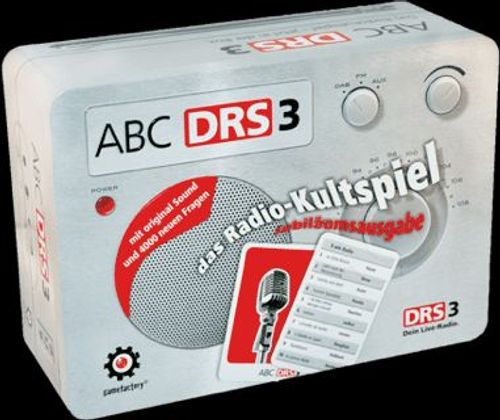
ABC DRS 3 Das Radio Kultspiel-jetzt auf Hochdeutsch
ABC DRS 3 Das Radio Kultspiel-jetzt auf Hochdeutsch Rulebook
Table of Contents
Table of Contents
- Components
- 1. Preparation
- 2. Microphone Cards: Determining Moderator, Candidate and Listeners
- 3. Wager Cards: Listeners Bet on the Number of Terms Guessed
- 4. Question Cards: High Tension!
- 5. Victory Points: for Terms Correctly Guessed by the Candidate and for Correct Wagers by the Listeners
- 6. Further Rounds: New Moderator, New Candidate
Components
- 200 question cards with 4000 questions (do not look at them!)
- 14 wager cards
- 6 microphone cards
- 1 45-second alarm clock
- 1 pad of control sheets and 1 pencil
1. Preparation
For 2 to 6 players, everyone tries to win alone. If there are more than 6 players, form at most 6 equally strong teams that play against each other.
Place in the middle of the table the 45-second alarm clock, the 14 wager cards, the 6 microphone cards, the pad of control sheets and the pencil. Nobody may look at the 200 question cards. It is best to leave them in the box.
You also need a blank sheet of paper or a slate on which to note each player's (or team's) score.
Agree together how many victory points you will play to. If you do not know ABC DRS 3 yet, agree that the player (or team) who first has 10 points wins.
2. Microphone Cards: Determining Moderator, Candidate and Listeners
Take as many of the 6 microphone cards as there are players (or teams) taking part. The cards «Moderator» and «Candidate» must be among them in any case. With 4 players you therefore need two more «Listener» cards. Shuffle the cards. Each player (or team) draws one microphone card blind.
Lay the drawn microphone cards face up in front of you. Now everyone can see who is moderator, candidate or listener in the first questioning round. The moderator is also the referee.
If you play in teams, the moderator team decides among itself which player reads aloud and which other player acts as referee. In the candidate team, all players may guess at the same time.
3. Wager Cards: Listeners Bet on the Number of Terms Guessed
The moderator first shuffles the 14 wager cards and deals them to the listeners:
- 8 wager cards if 1 listener is playing,
- 6 wager cards if 2 listeners are playing,
- 4 wager cards if 3 listeners are playing,
- 3 wager cards if 4 listeners are playing.
The candidate and the moderator receive no wager cards. The undealt wager cards are set aside face down.
Each listener now secretly chooses 2 of the wager cards they received and keeps them in hand. The other wager cards are placed face down with the cards already set aside.
Choose the wager cards for which you believe the candidate will guess exactly the printed number of terms. For example: «I bet that 15 terms will be guessed!» It is also allowed to keep 2 wager cards with the same number in hand.
4. Question Cards: High Tension!
The moderator now draws one of the 200 question cards blind and tells the candidate which letter this questioning round is about. For example: «Letter E as in Eigernordwand!» (Eiger North Face!)
The moderator sets the alarm clock to 45 seconds and releases it. Immediately afterwards the moderator reads the first question to the candidate as quickly as possible. The candidate tries to guess the sought term at once. The moderator then moves on to the second question, and so on, until the 45-second alarm clock signals the end of the questioning round with a somersault.
If the candidate does not know a term, they may call «Weiter!» («Next!») as often as they like and skip the question. After 10 terms the moderator turns the question card over to its back side and continues immediately.
During the questioning round the moderator notes on the control sheet which terms the candidate has guessed correctly. The candidate's name is written on the top line of the control sheet, and the number of terms guessed is totalled on the bottom line. Each control sheet has room for 8 questioning rounds.
After the guessing, the moderator announces which terms the candidate has guessed correctly. For example, if a kitchen herb is asked for with B – Basilikum (basil), then Borretsch (borage), Bohnenkraut (savory) and Bärlauch (wild garlic) are also correct. In case of disagreement, the moderator decides, or in teams the referee decides.
Tip: It is recommended that the moderator first reads the 20 questions silently to themselves. They can then read them to the candidate more quickly.
5. Victory Points: for Terms Correctly Guessed by the Candidate and for Correct Wagers by the Listeners
Depending on how many terms the candidate has guessed correctly, the candidate is credited with the following victory points:
- up to 11 terms: 1 victory point (as a consolation),
- 12 or 13 terms: 2 victory points,
- 14 or 15 terms: 3 victory points,
- 16 or 17 terms: 4 victory points,
- 18 or more terms: 5 victory points.
Now the listeners show their chosen wager cards. Every listener who bet correctly with a wager card receives as many victory points as the candidate. The number of victory points is shown on the control sheet and at the bottom of each wager card.
A listener who chose 2 wager cards with the same number of terms receives especially many points when that bet succeeds.
6. Further Rounds: New Moderator, New Candidate
Before the next questioning round, each player passes their microphone card to their neighbour clockwise. As a result, two other players are now moderator and candidate. The new moderator shuffles the wager cards and deals them to the current listeners. Then the moderator starts the questioning of the new candidate with an unused question card.
Play continues in this way until every player has been moderator once and candidate once, in turn. Then the microphone cards are shuffled and drawn anew, and play continues.
When a player first reaches the agreed number of victory points, the game ends immediately. That player has won and is the winner of ABC DRS 3 until the next game.
Have fun with ABC DRS 3 in the box!
Ätsch Variant
Experts may additionally introduce this game variant. Before the 14 wager cards are dealt, the listeners always agree together on which number will be the «Ätsch number» («Ätsch» is a playful taunt, roughly "nyah-nyah"). For example, for a good player it could be the number 16. Whisper it so that the candidate does not hear! The listeners write the Ätsch number on a slip of paper and turn the slip face down.
If the candidate now guesses exactly as many terms as the Ätsch number, they receive – ätsch – no victory points.
The Ätsch effect applies only to the candidate. The listeners may bet on the Ätsch number and receive their victory points if they have judged the candidate correctly.
Have you gone through all 200 question cards? Usually not all 20 terms of a question card are needed. You can therefore reuse the question cards by beginning to read aloud from the 20th term.
If you want to listen in on ABC DRS 3 on the radio, or even play along live, tune in to Swiss Radio DRS 3 Monday to Saturday at about 7:50 a.m.