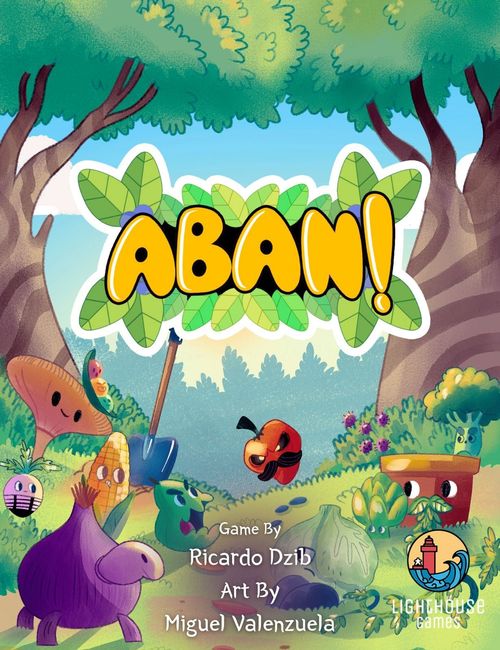
Aban!
Aban! Rulebook
Table of Contents
Table of Contents
Components
The game contains the game sheet pad, 2 graphite-tipped pencils, 11 character boards, 6 dice, 15 fertilizer tokens and 15 espinos and rocky tokens (these tokens have espinos on one side and rocky on the other side) and 20 shovel tokens.
Preparing the Game
Separate the plant boards and group them according to the die face they indicate. For each group, take one at random and place it in a row in view of all the players, so that they have the information on how to score. The die symbol on the boards indicates which plant it belongs to.
Note: If this is your first game, we recommend the following plants to familiarize yourself with the mechanics: 1) Espinos, 2) Apizza, 3) Chichaforo, 4) Fueba, 5) Brocool and 6) Cebollugas.
- Take as many dice as players will participate and add one more (for example, if there are three players, take four dice).
Give each player a game sheet, a pencil, 3 fertilizer tokens, and the corresponding Espino/Rocky tokens (Hand out Espino/Rocky tokens according to the number of players: 2 players = 5 tokens; 3 players = 4 tokens; 4 to 5 players = 3 tokens). Also hand out spade tokens according to the number of players (2 players = 2 tokens; 3 to 4 players = 3 tokens, 5 players = 4 tokens). At the start of the game, the players decide whether to play with the Rocky side or the Espino side.
Note: in the source this paragraph is unnumbered and sits between steps 1 and 3; it is transcribed as printed.
-
Whoever has most recently placed a vegetable or fruit in the cupboard or refrigerator will be the first player.
-
Starting with the first player, and following a clockwise order, each player chooses a number from 1 to 6 without repeating. This will be the food for your Herbivorous Chayote. Write it in the empty space under the chayote pot on your game sheet (see page 7).
Objective
Your goal in Aban! is to have more VPs (victory points) than the rest of the players. You do this by choosing dice and drawing plant patterns to create a garden. Each plant board shows the patterns to plant and the VPs you will get if you complete them.
How to Play
- The first player will roll all the dice and take the one he/she wants. Then, he/she will choose an empty square (pot) of their garden on the game sheet to draw the plant represented on the board with the same number as the selected die. Then, the player to the left will take another of the remaining dice, without rolling them, and will do the same action.
You can also use the dice to use your shovel to remove a Rocky or Espino from your garden. To do this, draw the number on an available shovel space, discard one of your shovel tiles and remove a Rocky or Espino.
Note: the source shows a hexagon diagram beside this text, with the values 2, 3-4 and 5 and the legend "Number of players". The diagram is not explained in the text and is not transcribed as a rule.
When everyone has drawn their plant, one die will be left over. If the number it shows matches the number that any player has as food for their Herbivorous Chayote, he or she will draw a mark in one of the squares next to their chayote. After this, the round is over. The player to the right of the player who started the game will now be the new starting player.
End of the Game
The last round of the game occurs when a player draws a plant on the last empty square of his sheet. The round will proceed normally and, when the round is over, it will be time to count your VPs!
There are two ways to add up VPs in Aban!
1. Plant Boards
Get the VPs of the plant patterns you made, as indicated in the game manual, in the plant section.
Important: to score the patterns correctly they have to be totally independent, i.e., a plant cannot score in two patterns. For example, if you draw 3 adjacent Brocool you would get only 5 VP; you would have to draw 4 Brocool to gain 10 VP.
2. Herbivorous Chayote
Count how many times you managed to feed your Herbivorous Chayote and compare that number with the other players.
- 2 players: Most fed: 5 VP. Tie: 2 VP to each player.
- 3 to 4 players: Most fed: 5 VP. Tie: 2 VP to each player. 2nd most fed: 3 VP. Tie: 1 VP to each player.
- 5 players: Most fed: 5 VP. Tie: 2 VP to each player. 2nd most fed: 3 VP. Tie: 1 VP to each player. 3rd most fed: 2 VP. Tie: 1 VP to each player.
Whoever has the most VPs will receive the blessing of the goddess Ixchel and win Aban!
Espinos and Rocky Tokens
Espinos. You can place this token on an empty space of an opponent's garden. If it stays in the garden until the end of the game, it grants -2 VP.
You can only use them if you have tokens available.
Rocky. You can place this tile only on your opponent's game sheet. If you keep the rocky tokens in the garden until the end of the game, you lose 2 VP for each one. This tile can be placed on your opponent's already-drawn plants. All the Rockys on top of a plant will grant 2 VP to your opponent.
You can only use them as long as you have tiles available.
Plant Boards
Note: next to the symbol on the die, there is a symbol corresponding to each plant. That symbol is the one you must draw on your game sheet.
Note: the source's plant section page is partly garbled in the text layer around the die-1 boards; the individual plant entries below follow the printed text.
Apizza
A celery that feeds only on pizza. Drawing it anywhere will grant you 2 VP.
Ajochechon
This plant does not even tolerate itself. You will get 3 VP for drawing it only where there is no Ajochechon on an adjacent diagonal or vertical. In the example, only one scored correctly.
Romanis
The most popular plant in the forest. The player with the most Romanis drawn will get 3 VP for each one drawn. The second player with the most will get 2 VP for each one and the third, fourth and fifth, 1 VP for each one.
Chichaforo
The soul of the parties. Drawing it will give you 9 VP if you form a diagonal or vertical with 3 Chichaforos. In the example, you get 9 VP for a vertical and another 9 VP for the diagonal.
Tomatillo
A very cheerful tomato. Drawing this plant gives 9 VP if you form a diagonal or vertical lineup of 3 Tomatillos. If you add one more Tomatillo to the vertical alignment, you will get 3 additional VPs.
Ranongo
A mushroom that jumps all over the forest. You will get 8 VP if you form a "J" or an "L", as shown in the example.
Fuebas
Herbs that burn like a bonfire. The goddess Che created them to help humans discover fire. A single one is worth 1 VP. In chain, from the second fire, each one is worth 3 VP.
Elotoche
A corn provides its kernels to humans to prepare tasty snacks. It must be drawn specifically with the pattern shown. The first elotoche will give you one VP, and from the second onwards each one will be worth 4 VP.
Costelon
A fruit that glows in the dark. This plant must be drawn in the pattern shown in the image to obtain 12 VP. If there are more independent Costelons, each Costelon will be worth 1 VP.
Sadahoria
A hug-loving carrot. Two adjacent Sadahorias grant 6 VP. Unpaired Sadahorias will subtract 3 VP at the end of the game.
Brocool
Very cool broccoli. Drawing it gives 5 VP if it is adjacent to another Brocool. It does not score if left alone.
Coliflow
Cauliflower with a lot of flow. Drawing a pair gives you 5 VP. If there is another adjacent pair of Coliflows, as in the example, you get 12 VP.
Paperdida
A potato that is not looking for directions. Drawing 3 Paperdidas forming a triangle (separated by a space, but adjacent to each other) grants 9 VP.
Cebolluga
Even if it makes them cry, everyone has a Cebolluga at home. If you manage to draw 3 together as in the picture you get 8 VP.
Champisopa
A peculiar wild mushroom. Drawing it as shown in the example will give you 7 VP. You can draw it in any direction.
Super Powerful Plants (Expansion)
The following boards are from the expansion included in this edition. These plants consist of four boards that will change the strategy and dynamics of each game: Colemo, Machonero, Don maceta, and Rabamimo. At the beginning of each game, two boards will be selected at random and placed visibly on the table.
Colemo
A cabbage that loves to help. It has 3 variants available; before the start of each game, players can choose which one to use. Try them to improve your strategy.
- Variant (+1 or -1): Once per turn, before you choose a die, you may discard one of your subscription tokens to add or subtract one (1) to the value of an available die.
- Variant (+1 or +2): Once per turn, before you choose a die, you may discard one of your fertilizer tokens to add 1 or 2 to the result of any die.
- Variant (-1 or -2): Once per turn, before you choose a die, you may discard one of your fertilizer tokens to subtract 1 or 2 from the result of any die.
Note: the printed rule for the first variant says "subscription tokens" (the icon shows the same sack token as the fertilizer tokens); it is transcribed as printed. The token type is most likely fertilizer tokens.
Machonero
A very angry and spicy chili bell pepper. It allows you to pay an available fertilizer token to take up to 3 dice and re-roll them.
Don maceta
A very kind pot. On your turn, pay a fertilizer token and choose a die from 2 to 6. Instead of drawing a plant of that number, you will draw an extra space (pot) somewhere on your game sheet to enlargen your strategy and have extra space available.
Rabamimo
A very nice radish. On your turn, pay a fertilizer token and from the available dice pool, select a die from 2 to 6; instead of drawing the plant of that number, you will draw the radish symbol to possibly complete some pattern you have on your game sheet. This will help you to score that pattern even if they are not the required plants, however at the end of the game, for each rabamimo, 1 PV will be subtracted from your score.
Solitaire Mode: Ko'bachan's Mischief
Solitaire mode from the expansion included in this edition.
In this game mode, Ko'bachan will dig in your garden to mess up your Aban ritual!
To start playing, number the spaces on your game sheet as follows:
Take the Ko'bachan board. Place a token you have available in the first space with the green arrow.
-
From the plant boards 2 through 6, randomly take one of each number. For your Herbivorous Chayote, choose a number from 2 to 6 and write it on its pot.
-
Have 2 dice within reach. Get your pencil ready and you're ready to play!
Each time you roll a 1 on the dice, move the token on the Ko'bachan board following the direction of the arrows.
When the token reaches the x signs in a circle, roll 3 dice. If the result matches an empty space on the game sheet, draw a symbol on it that represents a Ko'bachan excavation. If the space already has a plant in it, roll the dice again until the result matches an empty space. Ko'bachan excavations cannot be removed by the shovel.
When the token reaches the green X symbol, the game is over. Count the VPs of your patterns normally. Each plant that feeds your Chayote will give you 1 VP. Compare your VPs with those in the table to see what they think of your garden in Che's forest.
| VP | Results |
|---|---|
| 1-14 | You'll do better in the next Aban! |
| 15-29 | Not bad! |
| 30-42 | Goddess Ixchel will like it! |
| 43-53 | Awesome, the Goddess will love it! |
| 54-70 | Aban-tastic! |
| 70+ | No words... Great! |
Have fun trying to beat your record or comparing it with your friends - don't let Kobachan get away with it!