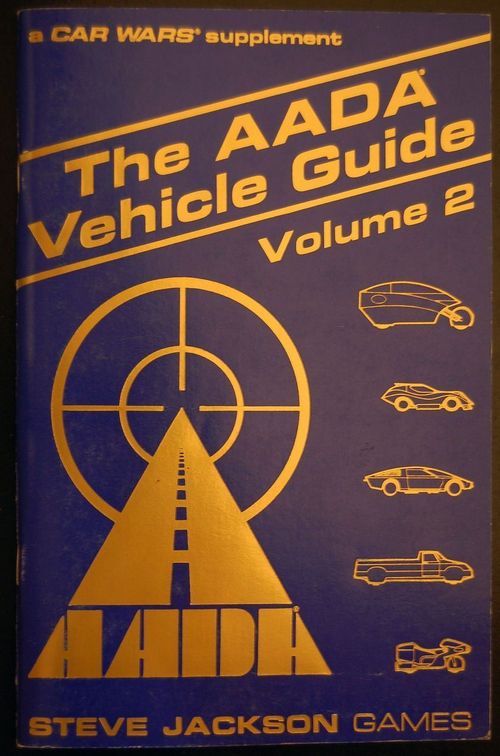
Car Wars Supplement, The AADA Vehicle Guide: Volume 2
Car Wars Supplement, The AADA Vehicle Guide: Volume 2 Rulebook
Table of Contents
Table of Contents
Introduction
Among the new developments are two newly popular vehicles: the sedan*, a compromise between the luxury and the mid-sized; and the* camper*, a pickup engineered with an integral camper shell sufficiently stiffened to be able to mount a three-space turret. The specifications for these new vehicles are:*
| Type | Price | Weight | Max. load | Spaces |
|---|---|---|---|---|
| Sedan | $700 | 1700 | 5100 | 16 |
| Camper | $1400 | 2300 | 6500 | 17 (+7) |
| Type | Normal ($/wt) | FP ($/wt) | LR ($/wt) | LRFP ($/wt) |
|---|---|---|---|---|
| Sedan | 18/9 | 36/9 | 19.8/9.9 | 45/9.9 |
| Camper | 30/14 | 60/14 | 33/15.4 | 75/15.4 |
It is our hope that the members of the AADA will find this volume as faithful a companion in the years to come as their old guide has been. Keeping up with progress in road combat is never-ending, however — check Autoduel Quarterly for additional listings and updates.
How to Use This Book
The Vehicle Guide is organized by chapters, according to general vehicle body type. To identify an unfamiliar vehicle, turn to the appropriate chapter and check the line drawings until the target is found. Remember that turrets, spoilers, body blades, wheelguards, etc., may be added or subtracted, changing the profile. New in this volume are sections for sedans, grasshoppers, car trailers and 10-wheelers; campers are included with pickups.
The armor, armament, and capabilities of each vehicle are fully described. If more than one version exists, all are described under the same heading; information not repeated in an option's listing is the same as for the model listed first. Also included is a brief analysis of each vehicle's strong and weak points, which may be of assistance in a combat situation.
For use during combat — via voice synthesizer or heads-up display — the AADA also has a holodisk version of this Guide, in formats compatible with most vehicular computers.
The "Legal Notes" section (AADA disclaimer) and the "Design Credits" section on p. 3 are omitted (boilerplate and attribution).
Customizing Vehicles
Any vehicle can be customized as much as its potential owner desires, given enough time. However, many modifications are relatively quick and simple. Here is a short guide to such alterations.
Accessories
Many accessories, such as computers, radar and LD radio, require no space or weight and can be added without any work. Accessories like active suspension, spoilers, airdams or HD shocks require weight but no space; stripping off armor is the easiest way to get the pounds needed. If the vehicle has heavy front armor, you can add a ram plate by removing 35% of that armor and increasing that armor's cost by 65%.
Ammunition
See the table on the facing page for the weight and cost changes to load certain weapons with special ammunition types.
In cases where weight is needed, strip off armor. Alternately, you can merely load fewer shots — an MG or VMG with ten rounds of HD ammo costs and weighs the same as one with twenty rounds of regular ammo.
[Ammunition table, pp. 32–33 — omitted.] The printed table lists, for each weapon, the cost and weight of each special ammunition type with its increment over the base weapon, and the location where that ammunition may be found. The scan's cell-to-weapon alignment is too small to read reliably, so no table values are transcribed here. Consult a legible copy of the book for the figures.
Table Notes (printed beneath the table): Cost and Weight are the cost and weight of a weapon loaded with that ammunition. (Inc.) is the increment from the base cost of the weapon; the table's figures assume the base load to be fragmentation grenades for the grenade launcher, oil for the oil gun, normal mines for the mine-flinger and smoke for the gas streamer. Loc. is the location where that ammo type may be found — numbers refer to volume and issue of Autoduel Quarterly, UA1 and UA2 are the Uncle Albert's 2035 and 2036 catalogs, respectively, CS is Combat Showcase, and DCW is, of course, Deluxe Car Wars.
Armor Modifications
Making armor fireproof is simple — just double the cost without changing the weight. Converting normal plastic to normal metal is about as easy. Five points of plastic convert to one point of metal, reducing cost by 50% of the plastic's cost; for fireproof plastic to metal, reduce the cost by 75% of the FP armor's cost (or 150% of comparable normal plastic). To convert from metal to plastic, multiply armor points by five and double the cost. Making metal armor laser-reflective simply adds 10% to the cost of the metal. Normal plastic may be upgraded to laser-reflective for essentially no cost by simply removing one point in ten; for those who really care, this results in the armor cost and weight dropping by one percent. Other simple additions that increase the longevity of a vehicle are wheelguards and wheelhubs — at four pounds a point, they are among the most weight-efficient forms of protection.
Vehicle Catalogue (summarised as omitted)
The vehicle catalogue entries are not transcribed. Entries for Luxuries (pp. 20–21: Firepower, Ranger, Lone Ranger, Express, VMG Express, Ox, Python, Python FC, Python AC, Rocket Bomb, Rocket Bomblet) are stat lines of chassis, power plant, suspension, tires, crew, weapons, armor, acceleration, handling and price, with short descriptive blurbs. The sample page in the source set also carries an owner's handwritten price and weight annotations, which are not part of the book's text. Other chapters of the book are not present in the source set.