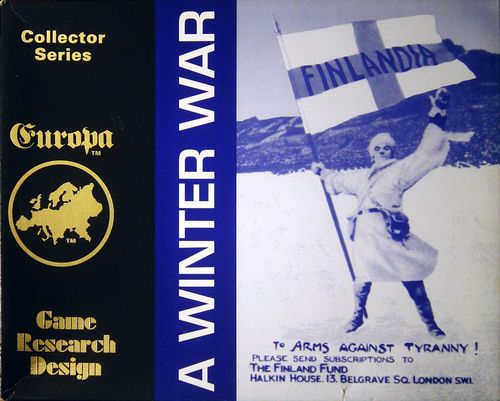
A Winter War
A Winter War Rulebook
Table of Contents
Table of Contents
- Rule 1 – Introduction
- Rule 2 – Game Components
- Rule 3 – Basic Concepts
- Rule 4 – Game Sequence
- Rule 5 – Zones of Control (ZOC)
- Rule 6 – Movement
- Rule 7 – Lines of Communication
- Rule 8 – Stacking
- Rule 9 – Combat
- Rule 10 – Armour and Anti-Tank Effects
- Rule 11 – Support
- Rule 12 – Supply
- Rule 13 – Overruns
- Rule 14 – Special Land Units
- Rule 15 – Unit Breakdowns
- Rule 16 – Introduction to Air Rules
- Rule 17 – Air Bases
- Rule 18 – Air Unit Movement
- Rule 19 – Patrol Attacks
- Rule 20 – Air Missions
- Rule 21 – Air Combat
- Rule 22 – Anti-Aircraft (AA)
- Rule 23 – Air Unit Repair
- Rule 24 – Special Air Rules
- Rule 25 – Airborne Operations
- Rule 26 – Naval Operations
- Rule 27 – Weather
- Rule 28 – The Arctic
- Rule 29 – Special Rules
- Rule 30 – Nations
- Rule 31 – Western Intervention
- Rule 32 – Reinforcements and Replacements
- Rule 33 – Foreign Aid
- Rule 34 – Game Setup
- Rule 35 – Victory
- Rule 36 – Optional Rules
- Rule 37 – "Designer's Rules" (optional rules of choice)
- Errata and Questions/Answers – 13 September 1994
Rule 1 – Introduction
A Winter War is a detailed simulation of the Soviet invasion of Finland during the winter of 1939-40. A Winter War is a game for two players: one plays the Soviet high command (STAVKA), the other the Finnish high command (Paamaja).
The Soviet player must break Finland on the battlefield, by capturing territory, inflicting losses, and isolating Finland from all outside aid, so that the Finnish political leadership has no choice but to ask for peace on Soviet terms. The Finnish player must resist the Soviet storm: yielding ground reluctantly, inflicting the maximum losses, and keeping his army intact, so as to encourage the Soviet leadership to accept a negotiated peace. Both sides manoeuvre their forces and fight battles to achieve their objectives.
Rule 2 – Game Components
Rulebooks:
- This rulebook: the rules of A Winter War.
- The Order of Battle booklet. During play, use the order of battle specific to A Winter War.
Map:
- Europa map No. 35.
- This map covers Finland and neighbouring regions, at a scale of 16 miles per hex. The hexes are numbered and identified by map number and hex number (e.g. 35:2420).
Counters:
- Europa counter sheet No. 58.
- Europa counter sheet No. 59.
- Additional counter sheet No. 2 (1/2 sheet). These three sheets total 656 counters.
Charts:
- Two Combat Results / Terrain Effects charts.
- Two Unit Identification charts.
- Two Game Sequence charts.
- Two specific charts (one Finnish, one Soviet).
- One Victory / Coastal Defences chart.
- One Europa terrain key.
Dice:
- Two dice.
Note: players may photocopy any element of the game for their personal use.
Rule 3 – Basic Concepts
A. Units
The term "units", when used alone, refers only to ground units, not to air or naval units. The term "forces" covers all ground, air and naval units.
Units are defined by their size, their type and their capabilities. In general, a unit has a size, a type, a combat value (or separate attack/defence values), a movement factor and an identification. The Unit Identification chart presents the structure of these symbols, as well as all the symbols or specific values used.
- Size. Two broad categories:
- Divisional unit. Any unit bearing the division or corps symbol, except HQs. Note: the Soviet 10th Tank Corps, organised and used as a division, is the only corps-size unit in the game. It appears only if optional rule 36C3 is used.
- Non-divisional unit. Any unit smaller than a division: brigades, regiments, cadres and battalions.
- Class. Three general classes:
- Non-motorised. All units shown as such on the Unit Identification chart (e.g. a cavalry unit).
- Artillery. All units shown as artillery (e.g. a siege artillery brigade). For the purposes of the game, AA (anti-aircraft) units are not artillery.
- Combat/motorised (c/m). All units shown as such (e.g. a tank brigade). Note: "non-c/m" units comprise all non-motorised units and all artillery units.
- Regimental equivalents (RE). An RE measures the size of a unit or of a supply point.
- 1/2 RE: each battalion, each AA point, or each supply point.
- 1 RE: each brigade, regiment or cadre.
- 3 RE: each divisional unit. Cavalry and c/m units count double for rail transport (rule 7 A2).
- Heavy equipment. The Unit Identification chart lists the units having heavy equipment. In addition, all units benefiting from support weapons (rule 11) have it. Units with heavy equipment cannot be transported by air.
B. Sides
- Finnish. The Finnish player controls the forces of Finland, together with foreign volunteers (where applicable) and the forces of the Western Intervention (if it enters play).
- Soviet. The Soviet player controls the forces of the USSR (regular units, winter-adapted units, NKVD, air force, foreign contingents).
- Neutrals. Estonia, Norway and Sweden begin neutral and are not controlled by either player.
C. Game Mechanics
- Fractions. Unless stated otherwise, fractions are always kept (e.g. half of 7 = 3 1/2).
- Cumulative effects. Unless stated otherwise, all strength modifiers and dice roll modifiers are cumulative. Example: a unit halved twice is reduced to a quarter of its strength.
- Dice rolls. All rolls requiring two dice are identified as such. All others are made with a single die.
- Accumulation. Acquired capabilities are valid turn by turn. They cannot be accumulated, unless stated. Example: the Finnish player may move 5 RE (Regimental Equivalents) by rail each turn (see rule 7 A2). If he does not use them in one turn, he cannot move 10 RE in the following turn.
- Cities. The term covers all categories of cities: major cities, points, reference and location cities.
D. Control
A player controls a hex if he: 1) occupies it, 2) exercises an uncontested ZOC (Zone of Control) over it, or 3) was the last to occupy it or to exercise an uncontested ZOC over it. Exception: a ZOC alone does not confer control of an enemy city or air base. The hex must be occupied to take possession of it.
E. Geography
The map reflects international borders as of 1 September 1939. The numerous islands belong to various countries. An island connected by narrow straits to a country is part of that country, unless stated otherwise. Example: the island of Kemito (35:4430) is part of Finland. All others carry the name of their country in italics beneath their name.
Defined terms:
- Major city. Any multi-hex city or partial/complete major city hex.
- Finland. Territory within the Finnish borders and the Åland archipelago box (on the Finnish player aid).
- Soviet Union. The part shown on the map + the Soviet strategic reserve box (on the Soviet player aid). Includes hexes 35:0201, 0301 and 0302.
- Estonia. The visible part of Estonia on the map.
- Sweden. The visible part of Sweden.
- Norway. The visible part of Norway. Although most of it lies off the map, three areas appear on the northern edge: Narvik (35:0126), Kautokeino (35:0118), and Kirkenes (35:0205).
F. Isolation
A unit or hex is isolated if no land supply line (of any length) can be traced to a complete supply source of the player concerned (see rule 12). Isolation is checked twice per player turn: at the start of the initial phase and of the combat phase. An isolated unit/hex remains so until the next check.
Rule 4 – Game Sequence
The game is played in turns, each representing a half-month. Each turn consists of a Soviet player turn followed by a Finnish player turn.
A. Sequence
Each player turn comprises:
- Initial phase. Check of supply and isolation. The active player receives his reinforcements and replacements, builds forts and airfields, and attempts to repair his inactive air units.
- Movement phase. Movement of ground units.
- Air phase. Movement of air units, air combat and missions.
- Combat phase. Check of isolation. The active player resolves his attacks.
- Exploitation phase. Movement of eligible c/m (combat/motorised) units.
A full summary appears on the back of the Game Sequence chart.
B. Active Player
On the Soviet turn, the Soviet player is active and the Finnish player is non-active. The reverse applies on the Finnish turn.
C. Restrictions
Unless stated otherwise, no action may be performed outside this sequence.
Rule 5 – Zones of Control (ZOC)
The ZOC of a unit represents its influence over the surrounding terrain. ZOCs affect many activities (see related rules). A unit projects its ZOC into the six adjacent hexes. If a unit cannot enter a given terrain type or cross a given hexside, it exercises no ZOC in that direction.
A unit forbidden to cross a hexside (e.g. frozen sea) exercises no ZOC across it.
All divisional units have a ZOC. Brigades, regiments and cadres have a ZOC only in weather zone A; outside it they have none. Battalions never have a ZOC.
A unit out of supply (see rule 12) has a reduced ZOC. Reduced ZOCs are identical to normal ZOCs except for their effects on enemy movement (see rule 6A).
A unit may temporarily lose its ZOC through certain activities (e.g. administrative movement, rule 6B). When it loses it, it exercises no ZOC at all until it recovers.
Rule 6 – Movement
All active units may move in the movement phase. Eligible c/m (combat/motorised) units may also move in the exploitation phase. The active player may move all or part of his units, but is never obliged to.
Each unit has a movement factor (MP – Movement Points) representing the number of points it may spend in the movement phase. Costs depend on terrain, ZOCs and supply. The terrain effects chart gives the costs: one cost for c/m and artillery units, another for other units, and exceptions listed separately. Example: entering a marsh costs 3 MP to an artillery unit, 2 MP to an infantry unit and 1 MP to a ski unit.
Certain hexsides also carry an additional cost (shown by "+"). Example: crossing a frozen narrow strait costs 1 MP in addition to the cost of the new hex.
A unit may not enter a forbidden hex (e.g. a complete lake/sea hex).
In general, a unit may not enter a hex occupied by the enemy, except in the cases provided for by the rules.
Any unit may always advance one hex (unless the terrain is forbidden) by spending all its MP, even if the cost exceeds its potential. This ability allows it to cross an enemy ZOC. In that case it may not spend MP on anything else.
Overruns (see rule 13) may occur during movement. Special movement (rail, etc.) is covered separately.
A. ZOC
Leaving a hex under enemy ZOC costs additional MP, as shown on the ZOC costs chart.
B. Administrative Movement (Admin)
During the movement phase only, a unit may use administrative movement when it moves along a road (see rule 7B) or over clear terrain. This type of movement speeds up the move but imposes restrictions:
- The terrain cost is halved (e.g. a ski unit pays 1/2 MP per hex on a road).
- It may use its MP only for admin/rail movement.
- If it had a ZOC, it loses it for the whole phase.
- It may not begin the phase adjacent to an enemy unit, nor approach one during the whole phase.
- It may not enter a hex controlled by the enemy.
- It may not cross a non-clear terrain hexside unless a road crosses it.
- In weather zone A, administrative movement is limited to roads.
Rule 7 – Lines of Communication
There are two types: railways and roads. A unit benefits from the corresponding movement only if it moves between directly connected hexes.
A. Railways
Two types of railway exist: high capacity and low capacity. The difference concerns only transport capacity. Note: all the adjacent hexes of a multi-hex city are connected by high-capacity railway.
- Rail movement. Units of the active player may use it only in the movement phase. They advance faster, ignoring normal terrain costs, provided they are on a railway. The number of hexes traversed per MP is given by the rail speed chart. A unit and a player may combine rail movement and normal movement in the same turn.
Restrictions on rail movement:
- A unit may not enter/leave a hex under enemy ZOC. Exception: if a friendly unit with a defensive value greater than 0 occupies the hex for the whole phase, the ZOC is cancelled for this purpose.
- A unit may move only along friendly rail hexes connected to a complete supply source.
- A unit loses its ZOC for the whole phase when it uses rail.
-
Rail capacity. Each player has a rail capacity (in RE – Regimental Equivalents). Cavalry and c/m units count double. Example: a rifle regiment (1 RE) counts as 1, but a cavalry regiment counts as 2. Using a low-capacity railway doubles the RE value again (cumulative). Capacity: USSR = 15 RE/turn, Finland = 5 RE/turn. It cannot be increased, but may be temporarily reduced by bombing marshalling yards (rule 20F1d). Note: a unit counts only once per turn against capacity, even if it makes several rail moves.
-
Destruction of railways. A unit may destroy a railway in a hex by spending 2 MP. Bombing (rule 20F2e) may also break them. Use a damage marker to indicate this. A destroyed railway may not be used for rail movement.
B. Roads
The cost is that of clear terrain, whatever the terrain crossed. However, leaving a hex under enemy ZOC costs additional MP. A unit may combine road and off-road movement in the same turn, and roads may be used in the movement and exploitation phases. Railway lines may also be used as roads.
Note: roads cannot be destroyed.
Rule 8 – Stacking
A. Stacking Limit
A hex may contain:
- Three units of any size/type,
- Three additional non-divisional units,
- Two non-divisional artillery units OR one divisional artillery unit.
Examples: (a) three divisions + three brigades + two artillery regiments; (b) two divisions + three brigades + three artillery regiments; (c) one division + one cadre + four brigades + one artillery division.
- Reduced stacking. Applies to Soviet forces outside weather zone A:
- Two units of any size/type,
- Two non-divisional units,
- One non-divisional artillery unit.
- Arctic stacking. In weather zone A:
- One unit of any size/type,
- One non-divisional unit,
- One non-divisional artillery unit.
B. Effects
The limit is checked at the end of each phase (movement, air, combat, exploitation). No hex may exceed the limit. In case of forced retreat beyond the limit, the unit continues to retreat until the limit is respected, failing which it is eliminated.
The stacking limit of a hex also determines how many units may attack it, or overrun it, from each adjacent hex. Exception: the initial phase, where reinforcements may enter even if the limit is exceeded, but the situation must be regularised at the end of the following movement phase.
C. Corps Markers
To simplify stacking in congested areas, each player has corps markers associated with spaces on the player aid. Replace the group of units with the corps marker on the map, and place the actual units in the corresponding space. They are then considered to occupy the hex of the marker.
Finnish and Western Intervention force corps markers. They serve only to ease stacking; they do not increase a hex's stacking limit and have no other effect in play.
Soviet corps markers. They serve to ease stacking and, south of weather zone A, to manage the gradual transition from reduced stacking to normal stacking, as provided by the Soviet Order of Battle. All Soviet corps markers are first placed on the Soviet player aid, with the shaded "reduced stacking" side visible. When the Order of Battle so provides, one or more corps markers are turned to the "normal stacking" (rifle) side. Units assigned to a marker on its "reduced" side must respect the reduced limit; those assigned to a marker on its "normal" side may stack up to the normal limit. Soviet corps markers have no other effect in play.
Rule 9 – Combat
During the combat phase, the units of the active player may attack adjacent enemy units. The active player is the attacker, the non-active player the defender.
A. Procedure
An attack involves one or more active units against a hex occupied by the enemy. During a combat phase, the attacker may resolve a series of attacks, in the order he wishes. Attacks are optional.
Procedure for each attack:
- Total the modified attack strength (terrain, supply, support). Add any ground air support and/or naval support fire.
- Total the modified defence strength (terrain, supply, support). Add any defensive air support and/or naval support fire.
- Calculate the attacker:defender strength ratio. Round down, in favour of the defender, to match a column of the Combat Results Table.
- Determine the result: roll 1 die and apply the modifiers (terrain, winterisation effects, "Finnish woodsmanship", combat engineers). Cross the modified die with the ratio column to obtain the result, then apply it immediately.
B. General Restrictions
- No unit may attack/be attacked more than once per phase.
- No attack may target a forbidden hex nor cross a forbidden hexside.
- All units in a hex defend together; one cannot target only some of the units in a hex.
- An attack must target a single hex. Units in the same hex may attack different hexes, but each attacked hex involves a separate attack.
- A unit may not split its strength to attack several hexes.
- The stacking limit of the target hex limits the number of units that may attack it from each adjacent hex (see rule 8B).
- Any attack above 9:1 is resolved at 9:1. Any attack below 1:4 gives an automatic AE (Attacker Eliminated) result.
C. Combat Results
The results may affect the attacker, the defender, both, or neither. They apply immediately.
- AE (Attacker Eliminated) / DE (Defender Eliminated): eliminate all units concerned; those having a "cadre" side are reduced to their cadre level, the others are removed from the game. Units reduced to cadre must retreat.
- AH (Attacker Half Eliminated) / DH (Defender Half Eliminated): eliminate units representing at least half of the total strength (attack for the attacker, defence for the defender). All surviving units concerned retreat.
- AR (Attacker Retreats) / DR (Defender Retreats): all units concerned retreat.
- AS (Attacker Stopped): attack without effect (no losses or retreat).
- HX (Half Exchange): the side with the lower printed strength is eliminated (or the defender in case of a tie). Units reduced to cadre retreat. On the opposing side, eliminate units for a loss of at least half the strength eliminated on the first side. Example: an attack of 15 against 6 gives HX; the defender loses 6, the attacker loses at least 3.
- EX (Exchange): the side with the lower printed strength is eliminated (or the defender in case of a tie). Units reduced to cadre retreat. On the opposing side, eliminate units for a loss at least equal to that of the eliminated side. Example: an attack of 15 against 6 gives EX; the defender loses 6, the attacker loses at least 6.
D. Losses
Losses are calculated from the values printed on the counters. Modifiers (terrain, supply, support) do not count for this calculation. The attacker's attack value and the defender's defence value are used.
Air units and naval fire may take part (rules 20F2b, 20F2c and 26C2), but their bombardment and fire values do not count in the losses. These units are never eliminated as a result of a land combat.
E. Cadres
Some divisions have a "cadre" side (on the reverse of the counter). When a division is eliminated, it is reduced to its cadre instead of being removed from the game. When calculating losses, the full loss is counted (e.g. a division 5 reduced to a cadre 1 counts as 5 losses, not 4).
A cadre may also be eliminated in the same combat, which adds its cadre value to the losses. Example: two Soviet divisions 5-6 attack and suffer 6 points of losses. The Soviet player reduces one division to a cadre 1-6 (loss of 5), then eliminates the cadre (loss of 1), total 6.
F. Movement After Combat
- Retreats. Units retreat one hex according to these priorities:
- To a hex outside enemy ZOC and respecting stacking.
- To a hex outside enemy ZOC but over the stacking limit.
- To a hex in enemy ZOC. In this case, a unit with a cadre is reduced to the cadre, otherwise it is eliminated.
A unit in stacking violation continues to retreat until it respects the limit, failing which it is eliminated. A unit with no path other than forbidden terrain or enemy hexes is eliminated.
Units that retreat into a friendly hex which is subsequently attacked during the same phase count as strength 0 (see rule 9G), add nothing to the defence, and still suffer the losses of the combat.
- Advances. Attacking units may immediately enter the vacated hex, within the stacking limit. This advance is optional but must be made before any other attack. Defenders may never advance after combat.
G. Units with Zero Strength
A unit with attack strength 0 may not attack alone, but may take part in an allied attack and suffers the results normally.
A unit with defence strength 0 is automatically eliminated if attacked, unless stacked with a unit having a defence greater than 0.
A unit at strength 0 is subject to all the restrictions of this rule.
H. Terrain Effects
The terrain of the defender's hex and the hexsides crossed affect the combat. The Terrain Effects Chart (TEC) summarises these modifiers: division or quartering of strength, or dice roll modifiers (e.g. –1).
I. Retreat Before Combat
Finnish ski units and partisans (see rules 14E and 14F) may attempt a retreat before combat. When an attack targets a hex containing such units, the Soviet player announces the attacking forces. The Finnish player then chooses whether or not to attempt the retreat before combat with his eligible units. Only these units may do so, under the conditions for success; the others remain in place. The normal retreat rules (see 9F1 and 14F2) apply. If all the units defending the hex succeed in withdrawing, the attacker may immediately occupy the hex, as for an advance after combat (rule 9F2). If at least one unit remains, the attack is resolved normally.
J. Mandatory Losses
Certain units with special capabilities must suffer losses if those capabilities are used. Example: during an attack on a fort, the attacker uses combat engineers to modify the resolution roll, and obtains EX: the defender loses 8 strength points, and the attacker must lose as many. As mandatory losses apply when combat engineers are employed (rule 14A2), half of the losses (4 points) must be taken from the engineer units, if possible.
Rule 10 – Armour and Anti-Tank Effects
In most Europa games these effects are important. But in A Winter War, the winter conditions, Soviet doctrine and the small number of Finnish armoured units make them negligible. They are therefore not used, except under optional rule (36B).
Rule 11 – Support
All units possess an intrinsic combat strength. But some cannot fully exploit it for lack of support weapons: these are "unsupported" units.
Supported units:
- All divisions.
- All artillery units.
- All divisional HQs.
- Any unit bearing the "self-supporting" indicator (black dot at the top left of the counter).
Unsupported units: all others. Their strength is halved as long as they remain unsupported.
A supported unit provides support to all unsupported units in its hex, unless it is self-supporting. Self-supporting units are indicated by an asterisk in the Order of Battle (e.g. 1-2-6*). They support only themselves. A self-supporting divisional HQ may support up to 3 RE of units.
In defence, the supporting unit must be stacked with the units it supports. In attack, it must take part in the same attack and be stacked with them.
Rule 12 – Supply
Supply affects movement and combat. Units operate normally if they are supplied, less effectively otherwise.
A. Supply Lines
A supply line may not pass through: an enemy hex, an enemy ZOC not occupied by a friendly unit, a forbidden hex, nor a forbidden hexside.
B. Tracing Supply
Supply is checked at each initial phase. A unit out of supply at the start of a turn remains out of supply for the whole turn.
Supply is traced from the unit to a source, via three elements: land, road, rail.
Summary of ranges:
- Land. May be traced to a road, railway or source. Passes through friendly or enemy hexes.
- Road. Must go to a railway or source. Passes only through friendly hexes.
- Rail. Must go to a source. Passes only through friendly hexes. Unlimited on high-capacity railway, limited to 7 hexes on low-capacity railway (non-consecutive, e.g. 4 low + unlimited high + 3 low).
Note: a broken railway does not prevent tracing.
C. Supply Sources
Each side has its own sources, usable only if they are controlled by that side.
- Complete sources. Usable without restriction. For Finland/foreign volunteers:
- The Tampere factory (35:3825), if:
- the factory is not destroyed (20F1b),
- a continuous railway links the factory to a major Finnish port,
- the port is operational (29B3).
b) Hexes 35:1533 (Storuman) and 35:2333 are sources for the Finns and foreign volunteers as long as Sweden offers no resistance to the Western intervention (see rule 31B). c) The port of Narvik (35:0126) becomes a supply source for the Finns and foreign volunteers as soon as the Western intervention is triggered (rule 31).
- Western Intervention Force: the port of Narvik (35:0126) is a supply source for its units.
- Soviets: any railway hex on the southern edge of the map in the USSR is a supply source.
-
Restricted sources. The ports of Kirkenes (35:0205) and Petsamo (35:0304) become restricted sources for the Finns, foreign volunteers and the Western Intervention Force if the intervention is triggered (rule 31). A restricted source provides at most 4 RE. A unit must trace a land line only in order to use it.
-
Air supply. Air transport units may deliver supply points to an air base or by parachute drop (see rule 20E). A marker is placed indicating the number of points delivered. These points remain for two initial phases and are then removed. Example: Soviet transports deliver points in the air phase of the Dec. I 39 turn; they last until the end of the initial phase of the Soviet Dec. II 39 turn. A unit may use these points if it traces a land line to them. Each point supplies 1 RE. If the enemy takes the hex, the points are immediately lost.
D. Effects of Supply
A unit out of supply suffers:
- Attack/defence strength halved.
- Movement halved.
- Reduced ZOC.
Rule 13 – Overruns
Active units may make overruns in the movement and exploitation phases. They enter a hex adjacent to the enemy units to be overrun, without exceeding the stacking limit. They must have a total attack strength allowing at least a 10:1 ratio against the defenders. The ratio calculation takes into account terrain, supply, stacking and support, but ignores defensive air support (20F2c).
Overrun units immediately lose their ZOC. Each unit in an overrun must pay the normal cost of the hex + ZOC costs + the overrun cost (corresponding chart). A unit without enough MP may not take part.
All units in the overrun hex are eliminated, cadres included, and removed from the game. The attackers may advance into the hex (optional), but must still pay the cost to enter it. If MP remain, they may continue to move.
Road movement applies if all the conditions are met.
A unit with defence 0 may be overrun at 12:1 by any unit with attack greater than 0.
Units able to attempt a retreat before combat (9I) may also attempt a retreat before overrun. In this case, the ratios are recalculated before the overrun is resolved. If all the units withdraw, the attacker does not pay the overrun cost.
Rule 14 – Special Land Units
A. Engineers
-
Construction. Construction engineers may build a fort (unless the hex already contains one). The unit must be supplied and starts the work in the initial phase (place a "fort under construction" marker). A fort on clear or rough terrain takes 2 turns to build; on other terrain, 4 turns. Example: a fort in forest begun in the Finnish initial phase of Dec. I 39 is completed in the Finnish initial phase of Feb. I 40. If the unit leaves the hex before completion, the marker is removed.
-
Permanent air bases. A construction unit may build a permanent air base in any hex (including one with a reference city or fort), unless the hex already contains a base or permanent airstrip. An air base takes 2 turns on clear/rough terrain or a partially frozen lake hex, 4 turns on any other terrain. A construction unit may build a permanent airstrip in any hex (unless it already has a permanent base). The airstrip takes 1 turn on clear/rough terrain or partially frozen lake, 2 turns otherwise. Up to three airstrips may exist in a hex; at the third, they are replaced by a permanent air base. A construction unit may repair damaged ports, air bases and railways. Procedure: spend MP in the hex; 4 MP for base damage, 8 for a port, 8 for a railway.
a. Accelerated construction. Two stacked construction units may pool their capabilities. Each pays half the cost. Example: two Soviet 0-5 regiments build a permanent airstrip on clear terrain; each spends 2.5 MP. Note: forts, permanent bases/airstrips, and railway upgrades must always begin in the initial phase, even when accelerated. The cost cannot be reduced further by using more than 2 units.
- Combat engineers. These are also construction units, but with additional abilities:
- Always supported in attack/defence in a major city, a fort or a fortified zone (but they do not support other units).
- If at least 1/7 of the attacking RE against a major city/fort/fortified zone are combat engineers, the roll is modified by +1. Artillery RE are not counted in this calculation. If this ability is used, the mandatory losses (9J) apply to the engineers.
-
Engineer tanks. When attacking a major city/fort/fortified zone, they are treated as combat engineers.
-
Railway engineers. May repair a railway as a construction unit and may upgrade a low-capacity railway to high capacity. They must begin in the initial phase, be supplied, and take 2 turns. Use an upgrade marker. In accelerated mode, one railway engineer plus one construction unit suffices. A railway engineer has no other construction abilities.
B. Artillery
Artillery units do not defend at full strength if the number of stacked non-artillery RE is less than the number of artillery RE. The surplus defends with a total of 1. Example: 3 Soviet 2-6 brigades + 1 combat engineer regiment 1-6. Only one non-artillery RE; so only one brigade defends at full strength, the other two total 1. Total defence = 4. In attack, the same principle applies: surplus artillery attacks with a total strength of 1.
- Soviet artillery division. If it moves, its attack is halved for overruns and combats in the same turn.
C. Headquarters (HQ)
A HQ has only a movement factor, strength 0. It counts as 1 RE, has heavy equipment and no ZOC. It cannot destroy a railway, base or port.
D. Mountain Troops
They enjoy movement/combat advantages in certain terrain (see TEC).
E. Ski Troops
Any unit bearing a ski or partisan symbol is a ski unit. They have movement advantages depending on terrain (see TEC). In addition, Finnish ski units may attempt a retreat before combat (9I). Finnish ski units may attempt a retreat before combat (9I). If they succeed, they withdraw under the normal retreat rules (9F1). The Finnish player rolls a die and consults the success table. If they fail, they must fight normally.
F. Partisans
Only the Finnish player has partisan units. They have two sides: a hidden side and a revealed side, as indicated on the Unit Identification chart. They operate either in combat mode or in partisan mode, depending on the side showing on the map.
-
Combat mode. With the revealed side showing, the unit acts as a ski unit and follows all the normal rules.
-
Partisan mode. With the hidden side showing, the unit is in partisan mode. The following rules specify the differences from standard units; any standard rule not mentioned applies normally (reference at the end of the paragraph).
- A unit in partisan mode does not control the hex it occupies (3F).
- In the Arctic zone, it has no ZOC (5).
- It ignores ZOCs in movement, except the anti-partisan zones (APZOC) of Soviet NKVD and paratroop units. An APZOC acts as a normal ZOC. Leaving a hex under APZOC costs additional MP (see the ZOC cost chart).
- It may pass through (but not end its movement in) hexes occupied by Soviet units, except NKVD/paratroops.
- Any unit may pass through (but not end its movement in) a hex occupied by a unit in partisan mode. Their presence does not affect administrative or rail movement.
- It may retreat into or through enemy ZOCs, even through an enemy hex, if that is the only path available. But it may not retreat into/through a Soviet NKVD or paratroop APZOC; in that case, it is eliminated.
- It may always attempt a retreat before combat and succeeds automatically (9I).
- It is never affected by isolation and is always supplied (3F, 12).
- It may not make or suffer overruns (13).
- It may not destroy a railway, base or port (7A3, 17D, 29B3).
- It never provides special replacements when eliminated in partisan mode (32C).
-
Change of mode. The Finnish player may change his partisans' mode at each initial phase. Compulsory: a partisan in partisan mode switches to combat mode if it begins an initial phase in a friendly hex or adjacent to a non-partisan Finnish unit, or if it fails a retreat before combat.
-
Dummies. In addition to the real partisans, the Finnish player has dummies. They function as partisans. A dummy is removed from the game as soon as its revealed side is shown to the opponent. The player may also voluntarily remove a dummy at any time.
G. Political Police Units
Only the Soviet player has these. In combat, all Soviet units stacked with a political police unit ignore retreats. Example: attacked and receiving a DH result, they do not retreat. An attack with AR becomes AS if it comes from a hex containing political police. A defence with DR becomes EX if the hex contains political police.
Rule 15 – Unit Breakdowns
Certain divisions may break down into sub-units, then reconstitute.
A. Procedure
A moving division may break down at the start of its movement phase at no MP cost. The unit is removed and its components are placed in the hex. The stacking limit may be exceeded momentarily, but must be respected at the end of the phase. It may reconstitute at the end of the phase if all its components are stacked together. The sub-units are then removed and the division unit is placed again.
B. Game Charts
Each player aid indicates which divisional units may break down and lists their components. These aids detail, by nationality, unit type and values, all permitted breakdowns. Divisions not listed may not break down. A player may not break down more units than the number of breakdown counters supplied.
A divisional unit may break down into supported components or into an HQ and unsupported components. Example: a Finnish 4-5-6 infantry division may break down into two 1-2-6* infantry regiments and a 1-6* ski regiment, the three regiments being supported, or into these same units flipped to their unsupported side, plus a divisional HQ.
When a unit is broken down, place its counter in the corresponding space on the player aid.
C. Breakdown Combinations
- General. Most divisions have no specific breakdown counters. The letter-marked breakdown counters of the appropriate nationality and unit type are then used. Each series of letter-marked counters may be used to break down only one division at a time.
- Specific. Certain divisions have specific breakdown counters, identified on the player aids. Such a division may break down only with its own counters, which may not serve any other unit.
Rule 16 – Introduction to Air Rules
A. Air Units
They are listed on the Unit Identification chart. The air unit types chart defines three main categories: fighters, bombers and transports.
B. Concepts
- Operational status. Under normal conditions, air units are operational and function fully. They may become non-operational for various reasons. A non-operational air unit may not carry out its missions (escort, interception, patrol attack, etc.) and must remain at its air base until repaired. It is placed face down on its base to indicate this.
- Target hex. The target hex of an air unit is the hex in which it carries out its mission. Example: for a bomber on a ground support mission, the target hex is that of the enemy units bombed.
- Terms.
- An interceptor is a fighter on an interception mission.
- An escort is a fighter on an escort mission.
- A mission force groups all air units flying a mission in a target hex, except escorts and interceptors.
C. Air Phase Sequence
Air phase activities follow this order:
- Air movement of the active player.
- Movement of the non-active player's interceptors.
- Resolution of air combat.
- Resolution of missions.
- Return of the non-active player's interceptors.
- Return of the active player's air units.
Rule 17 – Air Bases
Air units take off and land from bases. When they are not flying, they must be on a friendly base.
A. Capacity
The capacity of a base is the number of air units that may initiate missions from it in each air phase. There is no limit to the number of units present or landing there. Capacities are listed on the Air Base chart. The total capacity of a hex is the sum of all the structures present (fortress, reference city, airfield, etc.). Example: a hex with a fortress, a reference city and a permanent base has a total capacity of 5.
B. Evasion of Air Units
If the enemy takes possession of a hex with an air base, all operational units present may attempt to escape. The base's capacity is ignored (even if it is 0). Roll 1 die for each unit:
- 1, 2 or 3: the unit escapes and must reach a base within a radius of 3 times its printed movement value, becoming non-operational on arrival. If no base is available, the unit is eliminated.
- 4, 5 or 6: the unit is eliminated.
C. Capture of Air Bases
Any enemy base becomes usable immediately once captured by a ground unit. It becomes a friendly base and may be used instantly.
D. Damage to Air Bases
A ground unit may reduce the capacity of a base by spending 2 MP to inflict one point of damage. Bombing (20F2a) may also reduce capacity. Each point of damage reduces capacity by 1. "Hit" markers indicate this damage. Bases may be repaired (14A). A base cannot be reduced below 0. The active player may abandon a base/airstrip reduced to 0 capacity at any time, removing its marker from the map.
Rule 18 – Air Unit Movement
Air units reach their target hex by spending movement points (MP). Their movement value is printed on the counter. The actual value used depends on the mission, some missions modifying the MP expenditure.
Each air unit spends 1 MP for each hex it crosses. Terrain does not affect their movement. Each unit moves individually.
Depending on its type and assigned mission, an air unit flies either during the air movement step or during the interceptor movement step. Only the air units of the player indicated in a step may fly during that step.
During the air return step, units must return to a friendly base (not necessarily their starting base). If they cannot, they are eliminated.
Rule 19 – Patrol Attacks
Each operational fighter on the ground at an air base has a patrol zone.
- For Soviet fighters, the zone is limited to the hex they occupy.
- For Finnish or British fighters, it extends to a radius equal to half their movement value (rounded down). Example: a Finnish D.XXI fighter (movement 6) has a patrol zone of 3 hexes.
Fighters with a patrol zone may make a patrol attack during the opponent's air movement step. They target any enemy air unit that takes off or enters their patrol zone. Procedure:
- Compare the fighter's air attack strength with the enemy's defence strength.
- Roll 1 die.
- If the fighter's strength ≤ the enemy's: only a 6 repels the enemy.
- If the fighter's strength > the enemy's but < 2×: a 5-6 repels the enemy.
- If the fighter's strength ≥ 2×: a 4-6 repels the enemy.
The "repelled" effect is identical to that of an air combat (21B2).
- Patrol attacks take place only during the opponent's air movement, never during interception or return.
- They are not missions, do not count as air combat, and are not limited by base capacity, except that a base has a limit of patrols per phase (e.g. 3 for a permanent base).
- A fighter may make only one patrol attack per phase.
- An air unit may suffer one attack per hex crossed, and so potentially several per phase.
Rule 20 – Air Missions
Air units may carry out different missions depending on their type. Each mission specifies which units may take part in it, when it may be flown and what its effects are. Unless stated otherwise, a unit may carry out only one mission per air phase.
The active player announces the general mission of each unit at take-off, during the air movement step: escort, transfer, transport, bombing. The detail of a bombing mission is specified only at the time of its resolution.
A. Interception
A fighter may intercept during its interception movement step. It may fly to a hex within a radius equal to half its movement value (rounded down), provided that hex contains enemy air units on mission. Interception aims to engage these units in air combat.
B. Scramble (Emergency Take-off)
A fighter may scramble during its interception movement step, if its base is located in the target hex of enemy units. It may go to a friendly base within the limit of its movement value, and land there in the air return step. It may not go to a base located in the target hex of the enemy units.
C. Escort
A fighter may escort during the air movement step. It flies to a target hex within the limit of its movement value, which must contain at least least one friendly unit on a mission other than escort. The escort protects these units during air combat.
D. Transfer
All air units may transfer during the air movement step. Two types exist:
-
Normal transfer. A unit may join a friendly base within a radius of 3× its movement value. If this base is out of enemy interception range, it may continue to another base within the same radius, and so on. A unit in transfer may not initiate another mission during the same air movement. Only the capacity of the starting base is taken into account for the mission.
-
Staging. An air unit may move to an air base within the limit of its printed movement value, then initiate a non-transfer mission during the same air movement step. The capacity of two air bases is used for each unit in staging: that of the base where the staging begins and that of the base where the following mission is initiated.
E. Transport
Air transport units may carry out transport missions, carrying land units and supply as cargo during the air movement step. A transport may not carry a land unit with heavy equipment; all others may be carried. The land unit to be carried must begin the air movement step on the base from which the mission is initiated. Supply may be carried from an air base if a supply line can be traced from that base to a complete supply source in the initial phase. Note: restricted supply sources may not be used for this purpose.
All air combat and AA fire (anti-aircraft) affecting a transport also affects its cargo. If a transport is eliminated, its cargo is too. If it is aborted or repelled, the cargo returns to base with it. If two or more transports combine their capacities to carry a unit, any result affecting one of the transports affects the cargo. Always apply the more severe result to the transports and to the cargo. Example: if one transport is repelled and the other eliminated, the cargo is eliminated.
There are two types of transport mission:
-
Regular transport. A transport may carry up to 1 RE of cargo. It may fly to any air base within the limit of 2× its movement value, and land there with its cargo in the return step. Other option: fly to a base within the limit of its movement value, unload the cargo during mission resolution, then return to a base within the limit of its movement value during the return step. In both cases, the transport may be intercepted in the hex where it unloads its cargo. It may not transport during the return step. Note: only the capacity of the starting base is used, not that of the base where the cargo is unloaded.
-
Parachute drop. Transports may parachute supply. The target hex may be any hex except forbidden terrain, mountain or forest. It may be in enemy ZOC. A transport may carry 1/2 RE of cargo. It may fly to any hex within its printed movement value and parachute its cargo during mission resolution.
F. Bombing
Any air unit with a bombing value greater than 0 may carry out a bombing mission. Note: the printed bombing values are the standard Europa values. In A Winter War, they are halved to reflect the reduced effectiveness under snowy conditions.
Air units carry out bombing during the air movement step. They may bomb individually or combine their strength for a single attack. Exceptions are specified in the rules for specific missions.
Most bombing is resolved during the mission resolution phase, after air combat and AA fire. Before each attack, the player announces the target and the unit (or group) bombing. Attacks are announced one by one at the time of their resolution.
Certain missions require the Bombardment Table. For each attack, use the column whose value is closest without exceeding the bombing strength committed. If the strength is < 1, the attack automatically fails. Example: an attack of strength 8 uses column 5. Roll 1 die and cross it with the corresponding column for the result. Two possible results:
- M: Miss, no effect.
- H: Hit, effect according to the mission.
-
Strategic bombing. Units with a strategic value greater than 0 may carry out these missions: a. Ports. Target: enemy port. Each hit inflicts one point of damage; after several, the port becomes inoperative (29B3). b. Factory. Only the Soviets may target the Tampere factory (35:3825). Three hits during a Soviet phase render it unusable for that turn. The Soviet player then scores 5 victory points. c. Terror bombing. Soviets only. Target: the capital Helsinki (35:4526). Each hit is worth 1 VP to the Soviet player. d. Rail marshalling yards. Any major city or black-dot city is one. Each hit reduces the rail capacity of the player concerned by 1 on the following turn (non-permanent effect). Only hits against operational yards count: a yard is operational if a rail supply line can be traced from the yard to a complete supply source at the start of the air phase. A limited number of hits applies per phase and per yard: 1 for a black-dot city, 2 for a major city hex. Hits beyond this limit have no effect. Note: marshalling yards have no other effect in the game.
-
Tactical bombing. Air units with a tactical bombing strength greater than 0 may carry out: a. Air base. Target: any enemy air base. A fighter gains +1 to its tactical bombing strength for this mission (e.g. a fighter at 0 acts at 1). Consult the Bombardment Table for each attack. Each "hit" reduces the base's capacity by 1 (without going below 0) and affects one air unit on the ground: if it was operational, it becomes non-operational; if it was already non-operational, it is eliminated. If there are several units, the attacker chooses which is hit. b. Ground support. Adds the tactical bombing strength to the total attack strength against the target hex (up to the printed strength of the attacking ground units). The aircraft remain in the hex until the end of the combat phase, then return to base. Terrain does not affect the tactical bombing strength. c. Defensive support. Adds the tactical bombing strength to the total defence strength of the hex (up to the printed strength of the defenders). Effect only during the enemy combat phase (no effect during an overrun). The aircraft remain until the start of the next friendly initial phase. Before combat is resolved, the attacker may fire AA (rule 22B) against these air units. d. Harassment. Target: any land hex. For every 2 points of tactical bombing strength delivered in a hex, obtain 1 "harassment hit". Each enemy unit leaving the hex (including by rail) must spend +1 MP. Maximum 2 hits counted per hex and per phase; ignore the excess. e. Railway lines. Target: any enemy railway hex. Each "hit" breaks the railway in the hex (place a marker). f. Ports. Tactical bombing against a port is resolved as strategic bombing on a port (20F1a). g. Terror bombing. (Soviets only.) Target: Helsinki (35:4526). Each "hit" scores 1 VP for the Soviet player.
Rule 21 – Air Combat
Air combat takes place when non-active fighters (interceptors) intercept units of the active player on mission (mission force and escorts). It is resolved hex by hex chosen by the interceptor. Two steps: preparation, then resolution.
A. Preparation
Follow these steps:
- Abandonment of operations. The player who has a mission force may give up: all his units immediately return to a base (it is forbidden to land on a base located in the hex where the abandonment takes place). They may no longer fly other missions during this phase. No air combat, AA fire, or mission resolution takes place in this hex. The enemy interceptors remain there until their return step.
- Preparation of the mission force and screen. If operations are not abandoned, the player with the mission force separates his units into two groups: the escort screen (fighters on escort mission) and the mission force (all other units carrying out the mission). Fighter-bombers may drop their bombs now to join the screen (see 24A).
- Preparation of the interceptors. The intercepting player divides his fighters into two sets: those attacking the screen and those trying to bypass it to reach the mission force. The division is free.
B. Resolution
In air combat, each unit may fire only once per air combat phase, regardless of the number of enemies firing at it.
- Sequence. a) Allocation against the screen. Interceptors allocated to the screen engage the escorts directly. The intercepting player allocates at least one interceptor against each available escort, if he can. Surplus interceptors are distributed freely. If the escorts are more numerous, some escorts may remain free for the bypass step (c). b) Fire (against the screen). Each engagement is resolved.
- 1 against 1: each unit fires once at the other; results are applied after both shots.
- Several against 1: the isolated unit chooses a target and fires once; then each enemy fires in turn until the first result obtained against the isolated unit (R, A or K). Units taking part in these exchanges are removed from the later steps in the hex. c) Bypass allocation. Escorts remaining free are allocated against interceptors attempting to get past. d) Fire (bypass). Resolved as in b), except that the interceptors do not fire during this step. Those that survive get past and reach the mission force. e) Allocation against the mission force. Interceptors having got past the screen are allocated freely against the units of the mission force. Units not attacked do not take part. f) Fire (against the mission force). Resolved as in b). At the end of this step, the air combat in the hex is over.
- Combat results.
- – : no effect.
- R (Return): the unit returns to its base in the return step, remains operational, and its mission is cancelled.
- A (Aborted): the unit returns to its base in the return step, becomes non-operational, and its mission is cancelled.
- K (Killed): the unit is eliminated immediately.
-
Differentials. For each shot, calculate the differential = air combat value of the firing unit − value of the target. Consult the Air Combat Table: roll 1 die and read the result (–, R, A, K) in the column corresponding to the differential. The higher the (positive) differential, the more severe the result for the target. A negative differential penalises the firer. Usual Europa rules: cap the differential within the limits indicated by the table (e.g. from –5 to +5), rounding to the nearest in favour of the attacker if necessary.
-
Notes and special cases (first version as printed).
- Units on escort mission are always in the screen; they may not fire at the mission force.
- Fighter-bombers that drop their bombs (24A) use their full air combat factor, but may no longer carry out the planned bombing.
- A unit that has obtained a result (R/A/K) is immediately removed from any later step in this hex.
- Results apply before any mission resolution or AA fire (22B).
Translator's note: the source text contains two versions of this step (21B3 and 21B4 below). The first version above and the second version that follows are both reproduced as printed, the second giving the worked example and the two-dice roll; they are not fully consistent with each other, and no correction has been made.
- Differentials (second version as printed). The differential is obtained by subtracting the air defence strength of the targeted unit from the air attack strength of the unit firing. Example: D.XXI (3F4) against SB-2bis (2A2) ⇒ differential of the D.XXI: +1; of the SB-2bis: –2. Note: an air unit with an air attack strength of 0 may not fire in air combat.
The differential determines the column used on the Air Combat Results Table. For each attack, roll two dice and modify the result as indicated on the table, then read the result.
- Fighter pilot superiority. When a Finnish or British fighter fires at a Soviet air unit in air combat, the die roll is modified by –1. This modification is cumulative with the others.
Air combat example. Two Finnish fighters, a D.XXI (3F4) and an MS.406 (4F5), intercept two SB-2bis (2A2) escorted by an I-16 (3F3) and an I-15 (2F2).
- Step a: the D.XXI is allocated against the I-15; the MS.406 attempts to bypass the screen. The Soviet player keeps the I-16 to counter the bypass.
- Step b: the I-15 fires (differential –2); a 5 ⇒ the D.XXI must return (R: Return). The D.XXI fires (+1); 9 modified to 8 (superiority) ⇒ no effect.
- Step c: the I-16 is allocated against the MS.406 in the bypass.
- Step d: the I-16 attacks the MS.406 (–2); 7 ⇒ no effect. The MS.406 may not fire at this step.
- Step e: the MS.406 is allocated against an SB-2bis; the other bomber is ignored.
- Step f: the MS.406 fires (+2); 4 modified to 3 (superiority) ⇒ SB-2bis eliminated (K: Killed). The SB-2bis fires (–3); 7 ⇒ no effect.
Rule 22 – Anti-Aircraft (AA)
Air units may suffer anti-aircraft (AA) fire when they carry out certain missions. Various units and map features have AA defence values.
Note: there are two types of AA: heavy and light. This distinction does not affect the resolution of AA fire.
A. Capabilities
-
Intrinsic AA strength. Each British and foreign volunteer division, as well as each HQ, has an intrinsic light AA strength of 1. Note: the cadres of these divisions do not have this AA strength. Certain map features give an intrinsic AA strength when controlled by the Soviet player (see the Soviet chart).
-
Combat AA units. Any unit bearing the AA symbol, a unit size and a printed combat value (even if this is 0) is a combat AA unit. Its AA value appears at the top left of the counter.
-
Position AA units. Counters with no combat value and no unit size; only an AA value is printed at the top left. Special rules:
- Combat strength 0 (whatever the AA value).
- Unlimited stacking (does not count towards the limit).
- Transport: each point of position AA is worth 1/2 RE.
- May not break a railway, nor damage bases/ports.
- If a position AA moves during the movement phase, it may not fire AA in the same turn. The player may freely split/merge his position AA during his turn, as long as the total strength remains the same. Example: a position AA counter of 2 may be divided into two counters of 1.
- Naval AA. Naval units have a printed AA value; all naval fire is of the light AA type.
B. Resolution
-
Restrictions. AA fire is resolved during the mission resolution step (except where stated), before the missions are carried out. All the AA strength in a hex may fire at air units on transport or bombing missions in that hex. It may not fire at other types of missions (e.g. escort, interception). Each point of AA strength may be used only once per turn.
-
Allocation. The defending player freely distributes the AA points available (intrinsic, combat, position, naval) among the air units permitted as targets in the hex. Several sources may be concentrated in a single shot, or split into several separate shots. Each shot must declare the number of AA points committed before the dice are rolled.
-
Roll and table. For each AA shot, roll 2 dice and consult the column corresponding to the AA points committed. Cross the modified die roll with the AA strength column to obtain a result. The results are identical to those of air combat (see Rule 21 B2). Apply the results immediately. Possible results: – (no effect), R (Return), A (Aborted) or K (Killed).
-
Cumulation and coordination. Intrinsic AA, combat AA, position AA and naval AA in the same hex may be combined in a single shot or split among several shots. A single AA point may contribute to only one shot per turn.
-
Effects on missions. An R or A result cancels the mission and the unit returns to its base (operational for R, non-operational for A). A K result immediately eliminates the unit and its cargo (transport). If several transports carry the same cargo, apply the most severe result to that cargo.
-
Limits and special cases.
- AA fire against defensive support: before the land combat is resolved.
- No effect against escort/interception (unless a specific rule applies).
- A base at capacity 0 cannot confer intrinsic AA if the local rule forbids it.
- Exception. Against air units flying defensive support missions, do not resolve AA fire during the mission resolution step. Instead, resolve AA fire against these air units during the combat phase in which the hex they support is attacked, immediately before the land combat is resolved. When firing AA at these units, add the AA strengths of the units attacking the hex and divide the total by the number of hexes from which the attackers come. A unit may fire AA at these aircraft only if it takes part in the attack on the hex. Otherwise, it may not.
Example: Finnish air units provide defensive support over Viipuri (35:4517). The Soviet player attacks Viipuri from three adjacent hexes; his attacking units have 3 AA points in one hex, 1 in the second and 2 in the third. Total = 6 AA points ÷ 3 hexes = an AA attack of 2 points is made on each air unit in defensive support before the combat is resolved.
Rule 23 – Air Unit Repair
During the initial phase, the active player may attempt to repair his non-operational air units. Roll one die for each non-operational unit: if the result is less than or equal to the figure indicated on the Air Unit Repair Table, the unit is repaired and immediately becomes operational.
Rule 24 – Special Air Rules
A. Fighters on Bombing Missions
A type F unit on a bombing mission reduces its air attack and air defence strength by 2 (never below 1) for the whole mission. Example: a D.XXI fighter (3F4) on bombing acts with 1 in air attack and 2 in air defence.
A fighter on a bombing mission may drop its bomb load during the air combat preparation, at the player's choice. It then recovers its printed attack/defence values, but no longer carries out its bombing mission: it is treated as on an escort mission.
B. Extended Range
Certain aircraft may carry out missions at extended range. Fighters may not. Non-fighter aircraft may carry out extended-range bombing by carrying a reduced load: they may reach a target within a radius equal to double their printed movement, but with a bombing strength reduced to one third.
Transports may fly transport missions at extended range by carrying only half the normal cargo:
- either reach an air base within a radius equal to triple their printed movement, to land there with the cargo (in the air return step);
- or reach a target within a radius equal to double their printed movement, to drop/unload the cargo (in the mission resolution step), then return to base during the return step. In both cases, the transport may be intercepted in the hex where it lands or drops its cargo. On return, it may join any base within a radius equal to double its printed movement.
Rule 25 – Airborne Operations
Historically, the Soviets had airborne units, but used only as infantry. Airborne operations are therefore not permitted in A Winter War, except under an optional rule (see rule 36D).
Rule 26 – Naval Operations
Naval operations were limited by the winter and by Soviet caution in the face of Finnish coastal defences. They are therefore very restricted in A Winter War. Naval units appear on the Unit Identification chart. The Naval Units Table distinguishes two types: ships and river flotillas. These units may not leave their original hex. They may use only their AA strength (see rule 22) and their naval artillery strength.
When an enemy takes possession of a port or a holding box, the naval units present there are scuttled and immediately removed from the game.
A. Naval Capabilities
-
Soviets. During the Soviet movement phase, the player may transport by sea up to 4 supply points between Murmansk (35:0701) and Petsamo (35:0304). Condition: control Murmansk and Petsamo and be able to trace a supply line from Murmansk to a Soviet source at the start of the turn. If a Western Intervention (rule 31) occurs, this capability is immediately lost.
-
Naval artillery support. Ships may support land combats through their artillery strength. A ship has up to three values (primary, intermediate, secondary), provided for the Europa naval system. In land combat, they are divided by two. The primary value applies within a radius of 2 hexes, the others within a radius of 1 hex. River flotillas do not divide their strength; range: 1 hex. The naval artillery force must be within range of the attacked hex to support a combat. Each naval unit supporting a combat is treated as a 1 RE field artillery unit (see rules 11 and 14B). Exception: naval artillery forces are not counted in the calculation of losses during exchanges.
Naval units may not fire independently; they may fire only in support of attacking or defending land units. Naval units are never affected by the results of a land combat.
Note: a ship may fire each of its artillery forces once per combat phase, but may support only one attack or defence per phase.
At the start of each enemy combat phase, before the enemy player resolves his attacks, the non-phasing player declares which hex each of his naval units will support in defence. Naval units assigned to a hex may not fire to support another during that phase, even if the assigned hex is not attacked. No similar restriction applies to naval units supporting an attack during the phasing player's combat phase: the phasing player indicates them when announcing the attack.
Rule 27 – Weather
In A Winter War, the weather is constantly winter (snow). As far as possible, the effects of snow are built into the game charts. For example, Europa applies a global –1 modifier to the combat resolution roll in snow; in A Winter War, this –1 is already built into the Land Combat Results Table. Likewise, the movement and supply limits linked to snow are built into the Terrain Effects Chart and the Supply Lines Summary.
One important effect could not be built into the charts and must be applied by the players: in snow, all air bombing strengths are halved.
A. Winterisation
Many units lacked winter equipment; those correctly equipped enjoyed an advantage. Rules:
- The resolution roll of an attack against a hex may be modified according to the winterisation levels of the attacker/defender (see the Winterisation Effects Table).
- Calculated on a regimental equivalent (RE) basis: total RE engaged ÷ winterised RE. Levels: <1/5; ≥1/5 and <1/2; ≥1/2 winterised.
- Winterised ground units: Finnish (all); Soviet ("Winter-Capable" and NKVD units); foreign volunteers (RVV); Western Intervention (ski, mountain, and Canadian "CAN" units).
- When at least half of one side's units are winterised in a combat, the mandatory losses (rule 9J) apply to that side's winterised units (attacker or defender).
B. Sea Ice
The map distinguishes seas that freeze (dark blue) and seas that do not (light blue). Except for the Gulf of Finland, this representation applies throughout the game. For play, the Gulf of Finland comprises all sea hexes on or south of hexrow 35:4100. The Gulf of Finland begins in open water but, at the end of the Soviet movement phase of the Dec. II 39 turn, it largely freezes; the map becomes effective. The Åland Islands holding box begins in open water and also freezes at the end of the Soviet movement phase of the Dec. II 39 turn. Complete sea hexsides are always forbidden terrain, frozen or not. Non-motorised units may cross frozen sea hexsides (e.g. mainland ↔ island), as indicated on the Terrain Effects Chart. Example: a non-motorised unit may move from 35:4919 to the island of Lavan (35:4819), then via Tytar (35:4820) and Suur (35:4721/4621) to Kotka (35:4521) or 35:4522.
Rule 28 – The Arctic
Units in the Arctic (hexes on or north of the weather zone A line) have restricted operations (limited communications, harsh climate). The stacking and ZOC reminders above apply. Specific rules:
- All Arctic terrain costs double in MP (except roads/rails; double the cost from the Terrain Effects Chart). Example: forest in the Arctic = 4 MP for infantry, 2 MP for ski.
- c/m units: no exploitation movement in the Arctic. Cavalry may not enter/attack a hex in the Arctic.
- Supply lines in the Arctic are shorter (see the Supply Lines Summary).
Rule 29 – Special Rules
A. Fortifications
-
Forts. When an enemy unit takes possession of a hex containing a fort, the fort is immediately destroyed and its marker removed from the map.
-
Fortified zone unit. The Soviet fortified zone unit is a combat unit with an intrinsic fort. It may not advance after combat. If it is forced to retreat as a result of combat, it is eliminated.
B. Terrain
-
Bridged straits. Lake or sea hexsides crossed by transport lines are bridged straits. The Terrain Effects Chart gives their effects on movement and combat.
-
The Vuoksa river system. A large hydroelectric plant located at the Imatra falls on the Vuoksa river (hexside 35:4317/4316) generates enough heat that the lower course of this river (including the two lakes along its course) never freezes enough to allow land units to cross the ice. This portion of the Vuoksa, including its two lakes, therefore remains open water throughout the game; use the effects given for "open sea" for these water hexes.
-
Ports. Any hex containing a port symbol is a port. There are four types of port: minor, standard, major and great, but these distinctions concern only later use in Europa. In A Winter War, ports serve for supply purposes (see Rule 12C), as well as for the appearance of foreign aid (Rule 33) and of the Western Intervention Force (Rule 31C).
Air units may damage a port by bombing (Rule 20F). A land unit may also damage a port by spending MP in the port hex. The port takes one point of damage for each 3 MP spent by the unit. A port becomes inoperative when it takes 10 points of damage, and can take a maximum of 12. Use damage markers to record damage.
The operating status of a port matters for Rules 12C1a, 33 and 35. A port is considered operating if it has 9 points of damage or fewer, and if a path of friendly, unfrozen coastal hexes (partial sea) can be traced from the port to open sea. Open sea, in the game, means any complete sea hex that is not frozen (this does not include restricted waters even if they are not frozen). Example: the port of Turku (35:4230) is inoperative if hex 35:4331 or 35:4332 is in enemy hands, if the port has taken 10 points of damage or more, or if the coastal hexes around Turku are frozen.
Rule 30 – Nations
A. Finland
- The Finnish government. The Finnish government begins the game at Helsinki (35:4526). Use the capital marker to mark its position. During any Finnish initial phase, the Finnish player may evacuate the government to another city in Finland. Note: this evacuation costs the Finnish player no rail capacity. If the Soviet player takes possession of the hex containing the government, roll one die. On a result of 1 or 2, the government escapes capture and the Finnish player must evacuate it in his next initial phase. On any other result, the Soviet player captures the government. Remove the capital marker from the map. The Soviet player then gains one victory point for this capture. Certain Finnish units may surrender once the government has been evacuated or captured. At each Finnish initial phase, if the government has already been evacuated or captured, check the supply status of all Finnish units. Then, check for surrender in each hex that meets both of the following conditions:
- The hex contains one or more unsupplied Finnish units.
- The hex is in a Soviet ZOC. If both conditions are met, roll one die:
- Result of 4 or less: all unsupplied Finnish units in the hex surrender and are immediately eliminated.
- Result of 5 or 6: no Finnish unit in the hex surrenders.
-
Finnish icebreakers. The Finnish icebreaker fleet (the largest in the world in 1939) may keep open either the port of Turku or that of Helsinki once ice has formed in the Gulf of Finland. At each initial phase after the Gulf of Finland has frozen, the Finnish player may declare that his icebreakers keep Turku or Helsinki open. If a port is kept open, the hex path from the port to open sea (for Turku: 35:4230, via 35:4331 and/or 35:4332; for Helsinki: 35:4526, via 35:4527, 35:4528, 35:4628, 35:4727, 35:4827) is considered unfrozen for the purposes of sea routing.
-
The Finnish factory. The Tampere factory (35:3825) serves as a supply source for Finnish units (see Rule 12C1a). The Soviet player may bomb this factory (Rule 20F1b). The factory counter is not a unit, has no combat value and does not prevent enemy units from entering its hex. The factory is destroyed and removed from the game if its hex is in Soviet hands at the start of a Finnish initial phase.
-
Operational limits. Because of defensive forces not represented in the game, Finnish and foreign volunteer land units may never enter or attack a Leningrad hex (35:5014 and its adjacent partial hexes) or Kronstadt (35:4916).
-
Finnish woodsmanship. When at least half of the attacking RE in a wooded terrain (woods, forest, rough wooded, wooded swamp, wooded intermittent lake) are non-motorised Finnish units, the combat resolution roll is modified by +1. The RE of attacking artillery are not counted. If this special ability is used, the mandatory losses (see Rule 9J) are borne by the non-motorised Finnish units engaged in the attack.
-
Åland Islands. The Åland Islands are a demilitarised group of islands at the entrance to the Gulf of Bothnia. They have a special status for certain Europa rules; in A Winter War, use the indications specific to the scenario for their control and logistical use. The Åland Islands may be occupied or used only in accordance with the scenario rules. Finnish units may occupy and use them freely. Soviet units may occupy them only if the scenario permits. Useful information for play is recalled in the Åland Islands box on the Finnish player aid.
B. The Soviet Union
-
Mobility limits. Soviet c/m (combat/motorised) units have mobility limitations. A c/m unit may not move in the exploitation phase if: (1) it begins this phase in the ZOC (zone of control) of an enemy unit; or (2) it attacked during the previous combat phase. In addition, isolated Soviet c/m units do not benefit from the one-hex move (see Rule 6) in the exploitation phase: they may move to an adjacent hex only if they have enough MP (movement points).
-
Intrinsic defence of Murmansk. The Soviet player has an intrinsic defence of 6 strength points at Murmansk (35:0701). Treat it as a rifle division with attack 0 / defence 6, and: - it does not count for stacking; - if it should retreat, it is eliminated instead; - its strength counts in the losses in case of exchange; - if it is eliminated, Murmansk no longer benefits from intrinsic defence for the rest of the game.
-
Occupations and garrisons. The Soviet player must leave garrisons in the Finnish cities he captures, on pain of supply restrictions. Garrisons required:
- 1 RE (regimental equivalent) per "point" or "reference" city;
- 3 RE per "black dot" city (dot) and per major city. Garrisons may be made up of any Soviet units, except position AA units. Garrisons are checked at the start of each initial phase soviet initial phase. Soviet units may not trace supply through a captured Finnish city that is not garrisoned as required.
- FNA (ANF) – uncertain reliability. The Soviets raised units from among Finnish expatriates, forming the Finnish National Army (ANF, FNA). They represent all the units of the Soviet Foreign Contingent. When an FNA unit takes part in a combat (attack/defence), the Soviet player rolls one die for that unit immediately before determining the strength ratio. Success: the unit takes part normally. Failure: its combat strength is halved for this resolution. If there are several FNA units in the same combat, a roll is made separately for each.
C. Neutral countries. Unless stated otherwise, no force may enter, cross, overfly or attack a hex of a neutral country. Neutral countries at the start:
-
Estonia. Officially neutral, bound by the Soviet–Estonian mutual assistance pact of 29 Sept. 1939. Up to 3 Soviet air units may be based in Estonia or carry out missions there each turn. Finnish air units may bomb air bases in Estonia. Finnish and Soviet land units may not enter Estonia.
-
Sweden. Officially neutral but favourable to Finland. Sweden may serve as a supply source for Finland, and Finnish units may trace their supply along Swedish railways (Rule 12C1b). It may also provide foreign volunteer units (Rule 33). The Western Intervention (Rule 31) may affect its neutrality.
-
Norway. Strictly neutral at the start, forbidden to all Finnish and Soviet forces. The Western Intervention (Rule 31) may affect this neutrality.
Rule 31 – Western Intervention
The development of the war in Finland gave rise to Western plans to intervene. The game simulates this uncertainty through the Western Intervention rule.
A. Triggering. At the start of each Finnish initial phase, roll 2d6: on a roll of exactly 3, the intervention is triggered.
B. Norwegian and Swedish reaction. The Baltic is closed by Germany; Murmansk is excluded for political reasons. What remains is a landing in Norway followed by a march through Sweden. The Norwegian and Swedish governments may or may not resist:
- Norway: roll 1d6; on 1–4, it resists; otherwise, it does not resist.
- Sweden: roll 1d6, –1 if Norway resists; on 1–5, it resists; otherwise, it does not resist.
Effects of resistance:
- For the purposes of the game, all hexes of the country that resists immediately pass under Soviet control (Soviet forces are not thereby authorised to enter them).
- Because of guerrilla warfare, the Finnish player applies a –1 modifier to all his reaction rolls (Rule 19C [as printed]) in the country that resists.
- The Finnish player may use supply lines and replacement routes through a country that resists as if it were Finland. He may not, however, trace road/rail supply through a city of a resisting country without a garrison. The garrison required for a city is 2 RE of Western Intervention Force units.
- Only Western Intervention Force units may enter hexes of a country that resists. For political reasons, Finnish units may not.
- If Sweden resists: 1) all foreign volunteer RVV units (units whose ID contains "RVV") are removed from the game; 2) Swedish railways are no longer a supply source for Finnish units; 3) the Swedish aid route (see Rule 33) is closed.
C. Intervention. When the intervention is triggered, the land units of the Western Intervention Force are chosen from their reserve and placed during the Finnish initial phase in ports of Norway, or at Petsamo if it is Finnish.
- The turn in which the intervention is triggered: up to 8 RE of units may be placed (only 4 RE if Norway resists).
- Each following turn: up to 4 RE of units may be placed. Distribution per turn: up to 2 RE each at Bodø, Kirkenes and Petsamo; any number at Narvik. Units spend 2 MP to be placed in a port.
- The two air units of the Western Intervention Force are immediately placed on friendly Finnish air bases when the intervention is triggered.
- All units of the Soviet strategic reserve are immediately released for active operations when the intervention is triggered.
- The Soviet player immediately loses the capability to transport supply points by sea between Murmansk and Petsamo; in addition, the Soviet destroyer flotilla at Murmansk (35:0701) is immediately eliminated.
- Restrictions. The land units of the Western Intervention Force may never enter or attack a hex of the Soviet Union. If they must retreat to such a hex, they are eliminated instead.
Rule 32 – Reinforcements and Replacements
A. Reinforcements. Reinforcements appear in the player's initial phase, at the locations indicated by the Order of Battle (OB). They must enter play as soon as possible; if the planned hex is forbidden/enemy, place them in a valid hex of the same area, consistent with the unit type.
B. Replacements (RP). Replacement points (RP) represent men and materiel used to restore reduced units or rebuild eliminated units. RP accumulate at the start of the initial phase, according to the OB and the losses, then are spent on restorations/rebuilds at the costs given in the OB.
The Finnish player may receive air units as air replacements under certain conditions specified in his OB; they are placed on any friendly Finnish air base.
C. Special replacements. When units that are not isolated are eliminated in combat or by overrun, the owner receives infantry RP (note: eliminated c/m units yield infantry RP). All nationalities receive special replacements and may receive them at any time from the start of the game. When a non-isolated unit is eliminated, the owner sets the counter aside; when a non-isolated unit is reduced to cadre, the owner notes… [text as printed, incomplete in the source]
C. Special replacements (continued). The player calculates his losses by adding the total loss of attack strength points of his units eliminated since his last initial phase, plus the loss of attack strength points of his units reduced to cadres since that same phase. These losses are counted separately by nationality (Finnish, foreign volunteer, British, French, Soviet). The player then determines the number of infantry RP received as special replacements according to these losses: divide the total Soviet losses by 5, and that of all other nationalities by 4. The result indicates the number of infantry RP received by that nationality. (Keep fractions.) These RP are added to their national RP reserve. They may be used immediately or accumulated for later.
D. Conversions. The OBs specify from which turn a player may convert certain units (land or air) into other types, models, sizes or strengths. A conversion may be carried out during any initial phase from the specified turn onward. A land unit may be converted only if it is supplied and not in an enemy ZOC. Remove the original unit and place the new unit in its place. Units removed by conversion may not be replaced.
E. Improvements. An improvement works like a conversion, but the player must spend RP to improve the unit. These costs are given in the OB.
Rule 33 – Foreign Aid
During the game, the Finnish player receives foreign reinforcements from various countries. (Note: the OB specifies the source country, for historical interest only, with no effect on play.) Aid is routed to Finland in two distinct ways: by sea and via Sweden, as indicated in the Finnish OB.
Reinforcements arriving by sea enter any operating Finnish port, except those within 10 hexes of a Soviet naval unit. If no operating port is available, the planned reinforcements do not arrive this turn. If a sea reinforcement (land unit or anti-aircraft artillery point) is due, roll 2 dice: on a result of 4 or less, its arrival is delayed to the next turn. Repeat this test at each arrival attempt, a reinforcement possibly being delayed indefinitely if the result is always ≤ 4.
Reinforcements arriving via Sweden are placed as follows: a) land units in any Finnish hex adjacent to the Swedish border; b) air units on any air base in Finland. If Sweden resists the Western intervention (see Rule 31), the reinforcements of that turn do not arrive. Reinforcements that do not arrive are not considered eliminated.
Rule 34 – Game Setup
Deploy map 35. Sort the counters by nationality, type, size and strength. Unit designations are generally historical and may be ignored, except for the Finnish 21st, 22nd and 23rd divisions, used for the breakdowns. Some supplied counters are not used in A Winter War but in Europa.
The A Winter War OBs indicate the initial deployments of both sides. Each player deploys his forces as specified. Stacking limits must be respected, but units may be deployed broken down. Set-up sequence:
- The Finnish player deploys all his initial forces except his high command reserve.
- The Soviet player deploys all his initial forces.
- Finally, the Finnish player deploys his high command reserve.
Certain units must be deployed a precise number of hexes from the border. Count these hexes from the border edge (e.g. 35:3706 is three hexes from the Soviet–Finnish border).
After deployment, the game begins with the Soviet turn of Dec. I 39. During this Soviet movement turn, Finnish units exert no ZOC outside Finland. From the Soviet combat phase, they exert it normally. At the start, the Finnish player controls all hexes of Finland, the Soviet player all hexes of the USSR, and Estonia, Norway and Sweden are neutral.
Rule 35 – Victory
A. Duration. The game begins with the Soviet turn of Dec. I 39 and ends with the Finnish turn of Mar. I 40.
B. Determining victory. At the end of the game, the players calculate the results. Victory points (VP) are gained or lost according to the actions and objectives achieved during the game. At the end of the game, each player… [text as printed, incomplete in the source; continues on page 25 of the source]
At the end of the game, each player totals his VP. The Victory Table indicates the possible VP gains for each side.
Once the totals are established, subtract the Finnish total from the Soviet total to determine the victory margin. Consult the "victory margin" section of the Victory Table to know which player has won and the level of victory achieved. For example, if the margin is 19 points, the game is a Finnish marginal victory.
Rule 36 – Optional Rules
These rules are optional and are used only if both players agree. They add realism and complexity. Some favour one side, so it should be decided before starting.
A. Advanced Game Mechanics
- Supply effects. Replace Rule 12D with the following: an out-of-supply unit has its capabilities reduced according to the number of consecutive turns spent out of supply (one turn = two player turns). Example: a Finnish unit is out of supply from the initial phase of the Jan. I 40 turn. Its first out-of-supply turn includes Jan. I 40 and Jan. II 40. Use markers to record the duration.
- First turn: attack ÷2; movement ÷2 for c/m units. Defence, AA, anti-tank and movement (non-c/m) normal.
- Second turn and following: attack, defence, AA, movement ÷2. The unit loses all anti-tank capability (AECA, AECD, ATEC ignored).
- From the 4th turn: an out-of-supply and isolated unit must roll on the Success Table (success = survival, failure = elimination).
- Terrain and supply lines. Mountains, forests and rough wooded terrains count as 2 hexes in the supply calculation (Rule 12B1). A non-frozen narrow strait hexside counts +1 hex, unless the line follows a road.
B. Armour and Anti-Tank Effects
-
Categories. a. AEC: Armor Effects Capability: capacity to employ armour effects. b. ATEC: Antitank Effects Capability: defensive anti-tank capacity against AEC.
-
Values. Expressed in regimental equivalents (RE). Each unit has a value: full, half, neutral or nil.
- Full: 1 RE = 1 RE of capability.
- Half: 1 RE = 0.5 RE of capability.
- Neutral: RE ignored.
- Nil: RE counted as having no capability.
- Proportions. Calculate: RE with capability ÷ non-neutral RE. Example: two Soviet infantry divisions (6 RE, no capability), two tank brigades (2 RE, full AEC), two artillery brigades (2 RE, neutral). → 2 RE out of 8 have AEC, i.e. 1/4. A modifier is then applied to the dice roll:
- Proportion < 1/2 (AEC) or < 1/7 (ATEC): no modifier.
- AEC attack ≥ 1/2: +1.
- AEC defence ≥ 1/2: –1 (unless the attacker has AEC ≥ 1/2; then the defender must use ATEC).
- ATEC used if the attacker has AEC ≥ 1/2: – 1/7 ≤ proportion < 1/2: –1 – 1/2 ≤ proportion < 1: –2 – proportion = 1: –4
Example 1. Two Soviet infantry divisions (6 RE, no capability), two Soviet tank brigades (2 RE, full AEC) and two Soviet artillery brigades (2 RE, neutral) attack a Finnish infantry division (3 RE, full ATEC). Attacker: 2 AEC RE out of 8 RE engaged = 1/4 < 1/2, so no modifier. Defender: 3 ATEC RE out of 3 RE = 1, proportion = 1; so the modifier = –4 to the Soviet attack roll.
[Text in the source continues on the next page; the following paragraph is a continuation of rule 36 B 3 as printed, which is partially truncated in the source.] … if the proportion reaches at least 1/2, add +1 to the die roll.
Example 2. Units capable of more than half AEC (Armor Effects Capability) attack a stack composed of a rifle division, a tank battalion (1/2 RE, regimental equivalent) and an artillery regiment. The artillery is neutral ATEC (Antitank Effects Capabil[ity]… [text truncated in the source]
- Cumulative effects. In an attack where the attacker has AEC and the defender has AEC or ATEC, the modifiers are added together. Example: attacker with full AEC (+1) and defender with full ATEC (–4) → net modifier "–34" as printed (the arithmetic of +1 and –4 gives –3; the printed figure appears to be a typographical error).
Restriction on neutrals. A player may have a number of neutral RE at most equal to double the total of his full- or half-capability units. Neutral units beyond this limit are treated as having no capability rather than as neutral. Example. Three motorised divisions and three tank brigades attack. Of twelve RE in total, three are AEC and nine are neutral. Only six (twice three) may be neutral; the remaining three are without capability. Six RE are therefore counted for the proportion, three of them AEC; the proportion is <… [text truncated in the source] Note: for this rule, all RE of half-capability units are counted. For example, 2 RE of neutral units may be present without penalising the AEC if they accompany a unit of 1 RE with half AEC.
-
Terrain. The terrain effects chart lists several terrains as "no AEC". This means that AEC may not be used by a unit attacking into such a hex, attacking across such a hexside, or defending in such a hex. ATEC is not affected: it applies if the attacker … [text truncated in the source] Example. A Soviet tank brigade attacks a British AA battalion in a "black dot" city. Because of the "black dot" city, the attacker may not use AEC. As the tank brigade has at least 1/2 AEC, the defender uses ATEC: –4 to the attack roll for the defender's full ATEC.
-
Mandatory losses. If the attacker employs at least 1/2 AEC, at least half of his losses resulting from the combat must be taken from units having at least 1/2 AEC. If the defender employs at least 1/2 AEC or ATEC, at least half of his losses must be taken from units having at least 1/2 AEC or ATEC, respectively.
C. Special Unit Capabilities
- Soviet ski units. Several Soviet units in Finland officially bore the designation "ski units". Their ski training was however practically nil; in the OB (order of battle, OB) they appear as rifle units. Assuming better training, apply:
- The rifle brigades "UDOL" and "UBOS", and the rifle regiment "USA" (all in "Winter-Capable" colours) called up by the Soviet OB appear as ski units instead.
- Soviet ski units have anti-partisan ZOCs (see Rule 14F2).
-
Reliability of the FNA (ANF). The Soviets raised combat units from among Finnish expatriates, forming the "Finnish National Army" (FNA, ANF). Assuming these units more reliable than historically, do not apply Rule 30B4 (FNA Unreliability).
-
10th Tank Corps. The tank corps assigned to the Leningrad military district does not appear as a combat unit because its elements operated separately during the war. Assuming it had operated intact, apply:
- The 13th and 20th tank brigades and the 50th motorised machine-gun brigade (Mot MG) called up by the Soviet OB (initial units of the 7th Army) are replaced by the 10th Tank Corps.
- If used, the tank corps may not be broken down.
D. Airborne Operations
If this rule is used, all Soviet 1-2-8 airborne infantry brigades in the OB appear as 1-2-5 airborne brigades instead. The airdrop mission (Rule 20E2) serves to transport and drop airborne units on a target hex. For this mission, a transport aircraft may carry 1/2 RE of airborne units; two transports are therefore needed for a 1 RE airborne unit.
- Disruption. An airborne unit may suffer disruption during a drop. During the mission resolution step, roll one die for each airborne unit being dropped. Modify the roll as follows:
- –1 if it is dropped onto enemy units and/or into enemy ZOCs.
- –1 if it is dropped into a non-clear terrain hex.
- –1 if it is dropped into a major city hex (cumulative with the non-clear terrain modifier).
- –1 for each block of five hexes (or fraction) flown by the Soviet air unit to bring its load to the target hex.
- –1 for a drop in bad weather, which prevails in every turn of the game.
Resolution:
- Roll ≥ 2: no disruption.
- Roll 1 or 0: the unit is disrupted; attack and defence are halved.
- Roll –1 or –2: the attack falls to 0, the defence is halved, and the unit is immediately eliminated if it is in a hex occupied by the enemy.
- Roll ≤ –3: the unit is immediately eliminated.
A disrupted unit remains so until the start of its next friendly initial phase. For example, a unit disrupted during the Soviet air phase remains disrupted for the rest of the Soviet turn and for the whole of the following Finnish turn.
The disruption roll is also used for each aer[…] [text truncated in the source; the second version below states the same roll for each air-dropped supply point].
D. Airborne operations (continued), first version as printed
-
Ownership of hexes. A target hex occupied only by airborne units is immediately considered controlled by their side. If enemy units are present in the hex, a combat is resolved immediately. After a success, the paratroops take possession of the hex; in case of failure, the hex remains controlled by the enemy.
-
Combat and retreats. If a result requires a retreat, the paratroops retreat to the nearest empty and legal hex, following the usual retreat and ZOC rules. If they cannot withdraw legally, they are eliminated.
-
Planning. Any airborne operation must be declared during the Soviet initial phase: designate the target hex and assign the required transport aircraft. Each transport aircraft may carry out only one drop per turn and must have sufficient capacity (see capacity in RE).
-
Surprise. During the drop turn, the paratroops receive a +1 to their first combat, provided they are not disrupted by the drop procedure.
-
Åland Islands. Soviet paratroop forces may attempt to seize the Åland Islands by drop. Apply the island terrain restrictions and any naval ZOC in force.
E. Variable game length
By default, the game ends at the Finnish turn of Mar. I 40. If both players agree to extend, at the end of each turn after Mar. I 40 the Soviet player rolls a die:
- Result 1–3: the game continues for one additional turn;
- Result 4–6: the game ends immediately. The war may not go beyond the Mai II 40 turn.
F. Accelerated foreign aid
Foreign units and RP indicated by the OB appear two turns earlier than planned. Reinforcements carried by sea are never delayed. The triggering of the Western intervention occurs on a roll of 2–3 instead of only 2 (see Rule 31). In return, apply –10 VP to the Finns at final scoring.
G. Increased Soviet preparation
If this option is used, the Soviet OB provides additional forces available from the initial set-up (Dec. I 39 turn). They are deployed in accordance with the set-up restrictions; the stacking, ZOC and supply limitations apply normally. The precise list of these reinforcements appears in the OB.
D–G, second version as printed in the source
Second version of the airborne rules, which the source gives in parallel with the above:
-
Ground operations. If a hex is captured by paratroops, it is immediately considered controlled by their side. If the hex already contained enemy units, a combat is resolved immediately. On victory, the paratroops occupy the hex; on defeat or elimination, the hex remains in enemy hands.
-
Combat and retreats. Paratroops that must retreat as a result of a combat result must withdraw to the nearest empty and legal hex. If they cannot withdraw legally, they are eliminated.
-
Planning. An airborne operation must be announced during the Soviet initial phase. The player must indicate the target hex and assign the necessary transport aircraft. A transport aircraft may carry out only one drop per turn and must have sufficient RE capacity.
-
Surprise. During the drop turn, the paratroops receive a +1 modifier to their first combat, provided they are not disrupted.
-
Åland Islands. Soviet paratroops may attempt an operation against the Åland Islands. Apply the restrictions related to island terrain and any naval ZOCs.
E. Variable game length (second version). By default, the game ends at the Finnish turn of Mar. I 40. If both players wish to extend, at the end of each turn after Mar. I 40 the Soviet player rolls a die:
- Result 1–3: the game continues one additional turn.
- Result 4–6: the game ends immediately. The game may never go beyond the Mai II 40 turn.
F. Accelerated foreign aid (second version). In this variant, the foreign units and RP indicated by the OB appear two turns earlier. Moreover, reinforcements carried by sea never suffer delay. Western units may enter the war on a roll of 2–3 instead of only 2 (see Rule 31). In return, apply –10 VP to the Finns at final calculation.
G. Increased Soviet preparation (second version). If this rule is used, the Soviets have additional forces from the Dec. I 39 turn. These units must be deployed in accordance with the OB restrictions and respect the usual limitations (stacking, ZOC, supply). The exact list is given in the OB. Apply the following rules:
- The Soviet rail capacity is raised to 30 RE.
- Optional rules 36C1 and 36D apply.
- All units shown in the Soviet OB as Dec. I 39 and Dec. II 39 reinforcements are treated as initial units. They may be added to the forces of any Soviet army/group. Also carry out the conversion provided for the Dec. II 39 turn.
- Soviet airborne units may be deployed on any air base in the USSR. The Soviet player may plan drops for the Dec. I 39 turn.
- All reinforcements and conversions appear two turns earlier than planned in the Soviet OB. Note: the turning of corps HQs to their "regular" stacking side remains as indicated in the OB. For balance, deduct 20 VP from the Soviet total if this option is used.
H. Early Start of the Campaign
The campaign could have begun two weeks earlier, at the autumn freeze. Apply:
- The game begins at the Soviet initial phase of the Nov. II 39 turn.
- The Soviet player removes 10 RE of his initial forces from the map and places them in the Strategic Reserve. At least 6 RE must come from the 8th and 9th Armies. These units are released from the reserve on the Soviet Nov. II 39 turn.
- The railway lines in hexes 35:2107 and 35:3106 are under construction: they are completed only at the Soviet initial phase of the Dec. I 39 turn. Until then, treat these sections as roads.
- The breakdown regiments of a Finnish division indicated in the OB are removed from the initial forces and appear as reinforcements on Nov. II 39.
- The fort in hex 35:4616 is under construction: it is completed only at the initial phase of the Finnish Nov. II 39 turn. For balance, deduct 20 VP from the Soviet total if this option is used (the historical result, not the player score, is evaluated without this deduction).
Rule 37 – "Designer's Rules" (optional rules of choice)
These optional rules reflect other assumptions. They may be used separately or together, with the agreement of both players.
A. Special Unit Capabilities
-
Soviet heavy tanks. If the OB calls up the 20th and 21st tank brigades, treat them as heavy tanks: they confer full AEC and impose an additional –1 on the defender when they take part in an attack.
-
Finnish ski units. In addition to those already provided for in the OB, treat units explicitly designated as ski units as such. A Finnish ski unit may move in the exploitation phase with a movement value equal to half its movement allowance: for example, a Finnish 1-8 ski regiment has 4 MP in exploitation if supplied, 2 MP if not. Procedure: when a Finnish ski unit moves in the movement phase, place a marker on the unit if it uses more than half its MP during that phase. Example: mark a supplied Finnish 1-8 ski regiment if it spends more than 4 MP in the movement phase. A unit so marked may not move in the exploitation phase. All unmarked Finnish ski units may move in the exploitation phase as above.
B. Variable Demolition Costs
Rules 7A3 (railway breaking), 17D (airfield damage) and 29B3 (ports) set a fixed MP cost per unit for inflicting a level of damage. With variable costs, the cost depends on the size of the unit. The Demolition Summary Table indicates the number of MP to be spent per unit size to cause a level of damage to each type of installation. Engineer-category units count as double their size in RE for this rule: thus, an engineer regiment (1 RE, counted as 2 RE) needs only 1 MP to break a railway, whereas an ordinary regiment (1 RE) would spend 3 MP (the same cost as a unit of 2+ RE).
C. Western Intervention Resolved
The political context postulates a more assertive Western will, and a greater propensity of Norway and Sweden to accommodate it. Modify Rule 31 as follows:
- The Western intervention is triggered on a roll of 4 or less.
- Apply a cumulative –1 to the triggering roll each turn after the first (Dec. I 39). E.g. –1 in the second turn (Dec. II 39), –3 in the fourth (Jan. II 40).
- Norway resists on a roll of 1 (2–6: offers no resistance).
- Sweden resists on a roll of 1–2 (3–6: offers no resistance). (Modify the –1 of Rule 31B if Norway resists.)
Errata and Questions/Answers – 13 September 1994
The following errata and questions/answers are reproduced as printed in the source document, which presents them after the rules text. References to "VO" (the English original) are as printed.
Units and Orders of Battle
- 1st Finnish Division. Its initial OB must include the 1/JP–1 and 2/JP–1 battalions (and not be left empty).
- Coastal defence command. Coastal defence units are correctly represented as coastal artillery (and not as fortress artillery).
- Various minor adjustments to Soviet units in the OB were corrected in the revised 1992 edition.
Maps
- First edition only. Hex 35:2721 is a forest (and not clear terrain).
- First and second edition. Hex 35:3019 should be treated as swamp (and not clear).
- Hex 35:3223 contains an additional secondary road leading east.
Charts
- Terrain Effects Chart. The movement cost of secondary roads in winter is 1 MP (and not 2).
Rules (Errata)
- Rule 5A (Zones of Control). Finnish cavalry units do exert a ZOC, despite a typographical omission in the VO.
- Rule 7A3 (Destruction of railways). A unit may damage only one railway hex per movement phase, whatever the number of MP spent.
- Rule 12C (Reinforcement units). Reinforcements must enter on any map-edge hex designated as an entry point, unless the OB states otherwise.
- Rule 14F2 (Anti-partisan ZOC). Only units explicitly indicated as having an "anti-partisan ZOC" actually have one. The omission of this mention on certain units is corrected in the 1992 edition.
- Rule 14B1 (Soviet artillery division). Add to the text: "A Soviet artillery division may never advance after combat."
- Rule 30B5 (Murmansk garrison). Until the Western intervention has taken place, the Soviet player must permanently maintain a minimum of 6 RE in the coastal hexes bordering the Arctic Ocean, from Murmansk to Polyarny inclusive.
Questions and Answers
- Q: Can supply points be used in any way? A: Yes. The supply points mentioned in rules 12C3, 20E and 26A1 may be freely spent for any function provided by the rules.
- Q: Do HQs have a use outside fort construction and engineering? A: Yes. HQs also serve as a supply point for the units of their army, and certain events affect them directly.
- Q: Do Soviet NKVD 0–1–8 units possess an anti-partisan ZOC (APZOC)? A: Yes. In accordance with rule 14F2, they do have an APZOC.
- Q: Do APZOCs exist outside weather zone A? A: No. Anti-partisan ZOCs are valid only in weather zone A.
- Q: Can units in partisan mode cut enemy supply lines? A: Yes. A unit in partisan mode projects a normal ZOC and may forbid supply, in accordance with the general rules.
- Q: How does a unit change from partisan mode to combat mode and vice versa? A: See rule 14F3: the change of mode takes place only during the initial phase of its own player. A unit may not change mode twice during the same turn.
Suppose a Finnish unit in partisan mode decides to "return home" and comes back to a hex controlled by Finland. At the next Soviet initial phase, this partisan unit must change mode to combat mode, since it begins the initial phase in a friendly hex. On a later turn, the Finnish player could again decide to send this same unit on a raid into Soviet territory by placing it back in partisan mode and moving it onto an enemy hex.
- Q: Can a partisan unit change to combat mode in the initial phase in which it arrives as a reinforcement? A: Yes, in accordance with the summary of the General Game Sequence.
- Q: (Rule 14G) If a defending unit with a cadre obtains an EX result by converting a DR, must the surviving cadre withdraw from the hex? A: No. The rule specifies that survivors do not retreat from the hex, including surviving cadres.
- Q: (Rule 29B2) May units attack across the hexsides of Vuoksa lake? A: Attacks across hexsides 4516/4515 and 4614/4715 are forbidden. The presence of the transport line crossing 4614/4714 makes it a bridged strait hexside (open water), which permits combat (see the modification of the TEC above).
- Q: Are movement and combat permitted between hexes 4713 and 4613 (frozen lake)? A: Yes. This hexside corresponds to a frozen lake and is not affected by the Vuoksa system. This is a deliberate design choice.
- Q: (Rule 30B3) May Soviet units trace their supply through an uncaptured Finnish city? A: They may trace only a land element through such a hex, provided it is not occupied by Finnish units nor blocked by a Finnish ZOC.
- Q: (Rule 31B) This rule states that "the Finnish player may not trace road or rail supply through a city of a resisting country unless that city is garrisoned". Does this include Narvik? A: Yes. Narvik must be garrisoned for supply lines to pass through it.
- Q: (Rule 31C) May French and British units of the intervention force use rail movement (Finnish rail capacity)? What if Norway or Sweden resist the intervention? A: A Western Intervention Force (WIF) unit may use rail if an allied-controlled railway line connects its hex to Finland, or if it is already in Finland. So, if neither Norway nor Sweden resists, a unit may use rail as soon as it arrives (all hexes of Norway and Sweden then being considered Finnish under rule 31B). If Norway or Sweden resists, the situation is more complicated: WIF units must first gain control of a railway line leading into Finland (since all hexes of a resisting country are considered Soviet). Once the line is clear (or the units have arrived in Finland), rail movement proceeds normally.
- Q: In the Dec. II 39 turn the Western intervention is triggered. The Finnish player must then face the Soviet strategic reserve. He has 11 emergency replacements, but not enough units in his reserve to use them fully. Is this early intervention a bad joke for the Finns? A: It may seem so. If this is a problem, apply the following variant: in the turn when the emergency replacements are taken, allow the Finnish player to use his emergency RP to "buy" any of his reinforcements not yet arrived. Finland still receives no other reinforcements or regular replacements. These units represent the training apparatus of the Interior army, which is not represented by counters in the game of small nations such as Finland.
Note from John Astell (as printed in the source)
In the course of my work coordinating the OB of Scorched Earth with that of Second Front, I examined the Finnish OB of A Winter War and noted a few problem points.
-
Foreign volunteers. Several foreign volunteer units may appear if Finland is at war with the USSR. Nothing is provided for their departure if the war ends, although they would certainly have gone home. I propose adding: A. To the mobilisation forces: Turn 14 (Historical – Mai II 40). If Finland is no longer at war from this turn on, remove: 1x 0–1–6 Inf X Sisu (FV) B. In the Foreign aid section: Repatriation of land forces. On the fourth consecutive turn without war for Finland, remove the following units if they had been received as reinforcements: 1x 3–8* Ski X RVV/1 (FV) 1x 3–8* Lt Inf X RVV/2 (FV) 1x 2–3–6 Inf X UVV (FV) 1x 1–2–6 Inf X LVV9 (FV)
-
Position AA artillery. The regular end-of-war reinforcements provide for the conversion and removal of several position AA units. But Finland may not have enough if some foreign-aid AA never arrived. In that case, if the Finnish player has no available position AA point to convert, he ignores the conversion; if he lacks a unit for the removal, he ignores that removal.
-
Confusion about reinforcements. On rereading the Finnish OB, I realised that the Finnish mobilisation reinforcements are sometimes misunderstood. Some players thought that if the war ended before a given turn, the reinforcements scheduled for that turn would not be received. This is not the case. Once mobilisation is triggered, Finland receives all of its mobilisation reinforcements, even if the war ends prematurely. Otherwise, the reinforcements indicated in the "End of war" section would contradict the mobilisation conditions. These reinforcements assume that all mobilisation units have already been brought into play. The only way to guarantee this consistency is to consider that Finland receives all its mobilisation reinforcements from the start of mobilisation, regardless of the actual length of the war. This is not strictly speaking an errata, but a useful clarification. The mobilisation rule does not appear explicitly in the OB; it is therefore preferable to add this note to avoid any confusion.