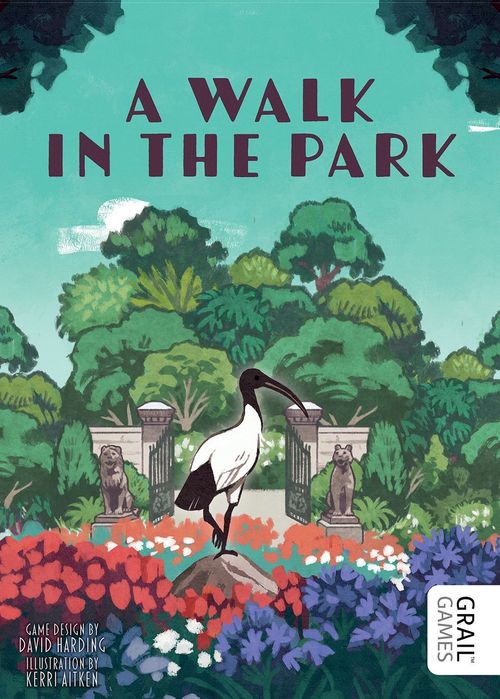
A Walk in the Park
A Walk in the Park Rulebook
Table of Contents
Table of Contents
Overview
Sydney's Royal Botanic Garden holds a special place in the hearts of locals. World renowned for its location, beauty, and historical and scientific significance, each of its 30 hectares are not only stunning, but a calming retreat from the city's streets.
In A Walk in the Park, players will draw pathways in the grid of their score sheet, to try and connect Landmarks and achieve other goals. The player who scores the most points for seeing different Landmarks, Statues, Ponds and Ibises will win!
So join the picnickers, joggers, lorikeets, and bin chickens, and enjoy your day in the beautiful Botanic Gardens!
Getting ready to PLay
To set up a game of A Walk in the Park, simply give each player a score sheet and something to draw with. Keep the die in reach of all players.
A look at the score sheets...
The area of the gardens you will walk through is shown on each sheet as a 5x5 grid of 25 squares. The centre square is already filled in for you with a 4-way pathway that players will extend with their pen or pencil through the other squares of the grid.
There are also 8 different landmarks shown on each grid, and a listing of 10 different bonuses that may be gained by the players whenever they walk to a landmark.
On the bottom-right of the score sheet there is an area to help you calculate your score at the end of the game.
The score sheet callouts read:
- These squares have landmarks that you will try to connect to the centre square with paths. There are 8 landmarks in total.
- When you connect a landmark to the centre with paths, you may select a bonus for doing so. Tick the box of the bonus you select.
- These squares are where you will draw paths. Once a square has a path or an ibis drawn within it, it is "filled".
- Here is where you will tally your score at the end of the game. Your total can be entered in the large diamond.
A look at the 6-sided die...
The are 4 possible results on the die as shown below.
- Curved path (on two sides)
- Straight path (on two sides)
- T-intersection (on one side)
- Ibis (on one side)
How to play
Each turn of the game begins with any player rolling the die. Then, every player will draw the object shown on the top face of the die into any empty square on their personal score sheet. An "empty" square is a square without a path or ibis drawn within it. (Squares with statues and landmarks within them do not block players from drawing a die result inside them.)
Drawing Paths...
If the object to be drawn is a path, the path should fill the square it is drawn in from edge to edge. The object drawn does not need to be adjacent to any previously drawn objects. Paths do not have to connect to each other (though you may score better if they do). Gaps may be left between paths to (hopefully) be filled in on a later turn.
The object to be drawn may be rotated by the players when they draw it on their sheet, but each pathway may only be drawn at 90 degree rotations, for example:
Curves may be drawn like this: [diagram of example curve orientations omitted]
Straights may be drawn like this: [diagram of example straight orientations omitted]
T-intersections may be drawn like this: [diagram of example T-intersection orientations omitted]
Drawing ibises...
Ibises must be drawn inside squares on your sheet, just like with paths. Ibises block squares from having pathways drawn inside them. This means an ibis on a landmark will block the landmark from that player! Depending on which landmark bonuses are unlocked by players, drawing ibises may also score players points (see later).
Drawing Statues...
Whenever a player completes a loop in their pathways, they must draw a statue (or simply an "S" within a circle) somewhere inside the loop. Statues do NOT block grid squares from being drawn on later. If there are no empty squares inside the looped pathway, simply draw the statue inside the loop wherever it might fit. Depending on different landmark bonuses that are unlocked by players, drawing statues may score you points at the end of the game (see later).
The rulebook illustrates two examples. In the first, this player has already made one loop and drawn one statue. (Note that they were also the first person to visit the duck pond, so they have scored a bonus point there for the end of the game!) In the second, this player has been able to complete two loops with the same pathway route and drawn two statues. (Note that this player was the first person to visit the lion gate so they have scored a bonus point for the end of the game, and though they did visit the fig tree, they were not first to do so, so the bonus point there has been crossed out.)
Visiting Landmarks...
Each sheet has 8 different landmarks drawn on them, with a "1" nearby. A landmark is considered "visited" by a player when they draw a pathway on its square, AND this pathway is connected to the central intersection. The first person to visit each landmark must announce it (ie: "I am visiting the Opera House!"), and circle the "1" on its square (this earns them 1 point at the end of the game for being first to the landmark). The other players must then cross out the corresponding "1" on their own sheets. Remember it isn't enough to draw a path next to a landmark - you draw on it!
Notes: Other players may visit the same landmarks on later turns, they will just not score the bonus point. If more than one player visits the same landmark on the same turn, each of them circles the "1".
Once a player visits a landmark, they must select an available lndmark bonus on the right side of their sheet. Once they choose one, its corresponding white box must be ticked. Multiple players may choose the same bonuses during the game. No player, however, may ever choose more than 6 landmark bonuses during a game.
The Landmark Bonuses...
The ten landmark bonuses printed on the score sheet are:
- Gain 1 point at the end of the game.
- Gain 2 points at the end of the game.
- Gain 1 point for every ibis you have drawn on your sheet at the end of the game.
- Gain 1 point for every separate group of ibises you have drawn on your sheet at the end of the game (diagonally adjacent ibises are not considered adjacent to each other).
- Choose 1 group of orthogonally adjacent ibises you have drawn on your sheet (diagonally adjacent Ibises do not count) and score 1 point for each ibis in this group at the end of the game.
- Gain 1 point per statue you have drawn on your sheet at the end of the game.
- Immediately draw an extra statue anywhere on your sheet.
- Immediately draw a curved path in an empty square on your sheet.
- Immediately draw a straight path in an empty square on your sheet.
- From now on, whenever a T-intersection is rolled, you may draw an ibis instead.
Some notes: Bonuses stack! In other words, if a player has drawn 5 ibises on their sheet - 2 in one connected group, and 3 in another group - and the player achieves all three ibis-scoring bonuses, they will score 10 points for ibises at the end of the game (5 ibises = 5 points, 2 groups of ibises = 2 more points, and 3 ibises in their biggest group = 3 more points!)
Also, yes, it is possible to immediately earn another landmark bonus on the same turn after choosing one of the final two bonuses that allow a player to draw an extra path.
On the final round, a player could visit a 7th landmark using these bonuses, but in this situation, the player may not unlock a 7th landmark bonus. They would, however, score the bonus "1" point if they were the first player to visit that landmark.
Getting stuck...
At any time, players may choose to change one curved path they have already drawn, and/or one straight path they have already drawn, into a T-intersection. Each type of path can only be transformed once. Try to avoid doing so, however, because each time you do this, you must circle the corresponding reminder icon at the bottom right of your score sheet and lose 3 points at the end of the game!
Note: When a player changes a straight or curved path into a T-intersection, it is possible that a loop will be created in a pathway - don't forget to draw a statue if that happens!
Ending the game
At the end of a turn, if any player (or more than one player) has visited 6 landmarks OR has drawn 6 ibises on their sheet, the game will end. (Note: In the unlikely event that no players can achieve either of these game-ending goals, the game ends when one player has filled their entire grid of squares.)
Players then score!
Once the game is over, each player tallies their score for the following features:
- Score 1 point for every landmark you visited first. (The "1" on your sheet will be circled.)
- The player who drew the most statues earns 1 point per statue they drew (if multiple players tie for the most statues, they each score 1 point for them).
- Then look at your landmark bonuses and score points based on these.
- Finally, lose 3 points for each time (twice maximum) you changed a path into a T-intersection.
The player with the most points, wins!!
Note: In the case of a tie, the tied player who triggered the end of the game wins. If more than one player triggered the end of the game and they are tied, the tied player who visited the most landmarks first, wins. If still a tie, the tied player with the fewest statues wins. If still a tie, the players share the victory.
Scoring example
At the end of this 2-player game, the top player ended the game by seeing 6 landmarks. (Note that the player on the bottom had drawn paths on 6 landmarks, but only visited 4 of them as not all the landmarks were connected by paths back to the central square.)
The top player scored 4 points for visitng 4 landmarks first. They scored 0 points for statues as they didn't have the most statues. They then scored 7 points for their landmark bonuses:
- 2 points,
- 1 point per ibis (2 points),
- 1 point per ibis group (2 points),
- 1 point per statue (1 point)
For a total of 11 points.
The bottom player scored 2 points for visiting 2 landmarks before the other player. They scored 2 points for having the most statues (1 point per statue). And then they scored 6 points for their landmark bonuses:
- 1 point per ibis (2 points)
- 1 point per ibis in 1 group (2 points)
- 1 point per statue (2 points)
For a total of 10 points.
The top player wins! Perhaps the bottom player would have done better if they had lost 3 points to turn a curved path into a T-intersection?
Solo Variant
You can play A Walk in the Park solo. Simply try to beat your own score from game to game. However, there are some extra handicaps if playing on your own:
- If you score less than 18 points, you automatically lose!
- You have a maximum of 18 turns! The game ends after 18 die rolls, even if you have not yet visited 6 landmarks. (If you visit 6 landmarks or draw 6 ibises the game will still end immediately as in a multiplayer game.) To keep track of the turns, simply tally them on your sheet, or know that the game will end when you have 6 empty squares on your sheet (less if you unlock the landmark bonuses that let you draw extra paths.)
You will gain the bonus point each time you visit a landmark as no one can beat you to them. And, in the solo game you simply score 1 point per statue (2 points per statue if you have unlocked the landmark bonus for an extra point per statue, of course).
If you wish to make your solitaire game more difficult, decrease the number of turns you have. The above rules are for playig the solo game at Level 1. To play at Level 2, you have a maximum of 14 turns. To play at Level 3, you have a maximum of 12 turns. To play at Level 4, you only have 10 turns (probably impossible)!
Solo score table
- -18 points = loss
- 18-20 points = Sightseer
- 21-23 points = Sydneysider
- 23-25 points = Botanist
- 25+ = Lachlan Macquarie
Lachaln Macquarie was the Governor of New South Wales from 1810 - 1821. His major building works, foundation of the Royal Botanic Garden, and other programs helped transition the penal colony of Sydney into the modern city it is today.