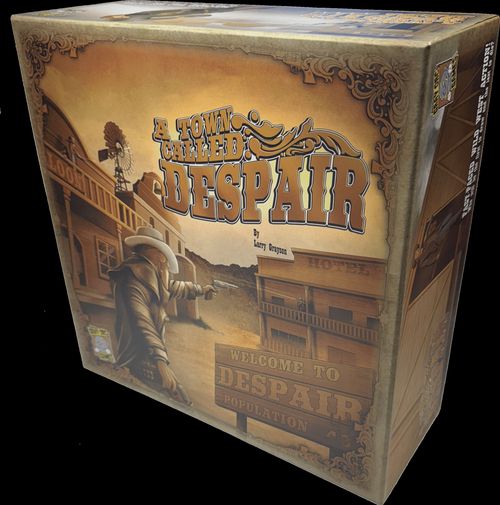
A Town Called Despair
Official rulebook: Gray Orc Games · PDF
A Town Called Despair Rulebook
Table of Contents
Table of Contents
- [1.0] INTRODUCTION
- [2.0] GAME EQUIPMENT
- [3.0] GAME SETUP
- [4.0] GAME MODES
- [5.0] GAME TURN SEQUENCE OF PLAY
- [6.0] ACTIONS
- [7.0] OUTDRAWING
- [8.0] BRAWLING
- [9.0] WOUNDS & CASUALTIES
- [10.0] KEEPING SCORE
- [11.0] MONEY BAGS
- [12.0] FINAL SHOWDOWN
- [13.0] SAMPLE TOWN SETUP
- [14.0] GANG CARDS
- [15.0] SKILLS CHART
- [16.0] MINIATURE MODELS
- [17.0] WEAPONS
- [18.0] TIPS FROM THE DESIGNER
[1.0] INTRODUCTION
A Town Called Despair is a "wild west" themed game for two to four players.
Each player creates a gang armed with pistols, shotguns, and rifles.
The 36" x 36" gaming area, complete with banks, saloons, hotels, jails, stables, stores, gallows, etc., is created using 3D buildings to simulate a small town in the post Civil War late 1800's.
Each player fills out Gang Cards for their gang members, gives them names, and assigns some of them special skills.
Players are dealt a hand of cards used to establish the order of play, outdraw someone in a gunfight, or defeat an opponent in hand-to-hand combat. Dice are used to determine the success and outcome of gunplay.
Players take turns deploying detailed miniatures representing their gang members and taking actions to move, take cover, enter and exit buildings, aim, shoot, reload weapons, and engage in fist fights.
Players receive money in the form of coins for wounding or dispatching enemy gang members and completing objectives. The player with the most money wins the game.
In a multi-game campaign, you can use the predesigned scenarios provided in the Campaign Handbook, or design your own campaigns.
A Town Called Despair provides everything you need for challenging, fast-paced western action. Will your deputies thwart the outlaws attempting to rob the bank? Will your gang manage to break your leader out of jail? Will you be the fastest gun in the showdown on Main Street?
[2.0] GAME EQUIPMENT
BUILDINGS & TERRAIN Six buildings (bank, sheriff's office, dry goods store, barber shop, hotel/saloon, and gunsmith shop) and over thirty pieces of terrain including gallows, wagons, cactus, barrels, crates, ladders, fences, and corrals.
OUTLAW GANGS Four colored-coded gangs (each with five gang members) armed with pistols, rifles, and shotguns.
GANG CARDS & MARKERS Twenty corresponding Gang Cards and four dry-erase markers used to keep track of your gang members during the game, including their weapon ranges, skills, wounds, and rounds spent.
PLAYING CARDS A deck of 54 playing cards used to assign special skills, determine the order of play, outdraw opponents, and brawl.
DICE Four sets of 6-sided dice and six special "wound" dice used to determine the outcome of gunplay (dice storage bag included).
NEOPRENE GAME MAT A 36" x 36" stitched neoprene playmat with 1" hex grids.
RULERS Two 17-inch rulers with weapon ranges, four 6-inch rulers for measuring movement and four 36-inch retractable rulers.
COINS Fifty-four coins in a variety of denominations used to keep score during the game (coin storage bag included).
TOKENS Sixteen "money bag" tokens and ten "dead cowboy" tokens.
INSTRUCTIONS Rule Book (this one), Building & Terrain Assembly Guide, Campaign Handbook, and Quick-Reference Cards.
[3.0] GAME SETUP
[3.1] SELECT GAME MODE
Pick a game mode (Free-for-All, Teams, or Lawmen vs. Outlaws) and decide how many gang members (from three to five) each player will start with.
A four-player game with three gang members each will take approximately one hour to complete. Games with more gang members will take longer.
See [4.0] GAME MODES.
[3.2] SET UP THE TOWN
Unroll the game mat. Place buildings on either side, forming a street between them. Scatter additional terrain (gallows, wagons, cactus, crates, barrels, fences, and corrals) around the town to provide extra cover. You may place ladders up against the side of any one-story building to provide additional access to the roof. See [13.0] SAMPLE TOWN SETUP.
Optionally, you can include money bags as additional objectives in the game. See [11.0] MONEY BAGS.
[3.3] CREATE OUTLAW GANGS
Each player selects their starting gang members, names them, and marks one gang member as their leader on the Gang Cards. See [14.0] GANG CARDS.
[3.3.1] REINFORCEMENTS
Using reinforcements is optional and will lengthen the overall game time. Reinforcements do not deploy at the start of the game and are kept in reserve. Give each reinforcement a name and place their card and model off to one side. You cannot select a reinforcement as your leader.
In a Free-For-All or Team game mode, each player receives the same number of reinforcements:
- 3 gang members: 1 or 2 reinforcements.
- 4 gang members: 1 reinforcement.
- 5 gang members: no reinforcements.
[3.4] ASSIGN SKILLS
Roll three (3) six-sided dice. For each roll of 5 or 6, draw a card from the top of the deck. If you draw a duplicate card, discard it and draw another card.
Assign the skill printed on each card to one of your starting gang members. No gang member may have more than one skill. You may not assign skills to reinforcements.
A gang member's skill cannot be used if they are dead, in jail, or stunned.
See [15.0] SKILLS CHART.
[3.5] DEPLOY GANGS
Each player rolls two dice to determine the order of deployment, re-rolling to break ties. In deployment order (high to low), each player:
- Selects a spot on the outer edge of the playing area and places their starting gang members in base contact with the leader around that spot.
- Moves each of their starting gang members up to 6". Gang members may enter buildings but may not climb stairs, climb ladders, or move into base contact with an opposing gang member during deployment.
[3.6] DEAL STARTING HANDS
Reshuffle all cards and deal five cards to each player. Place the remaining cards in a stack face-down. If the deck is depleted during the game, reshuffle all of the discards.
You are ready to play.
[4.0] GAME MODES
[4.1] FREE-FOR-ALL
You can play with 2-4 players with 3-5 gang members each where it is every man for himself and each player scores money awards independently.
[4.2] TEAMS
You can play with two players each on a team. Each player on the same team plays initiative cards and takes actions independently as in a free-for-all, but money awards are accumulated as a team.
Players on the same team may look at each other's cards and strategize during the game.
[4.3] LAWMEN VS. OUTLAWS
If playing with 3 or 4 players, you can have one player take on the role of town sheriff and deputies (lawmen) and the other players act as outlaw gangs, as in a free-for-all. All players start with three gang members. In a three-player game, the lawmen get one reinforcement. In a four-player game, the lawmen get two reinforcements. Outlaw gangs do not get any reinforcements.
The rear door to the Sheriff's Office is locked. Only the lawmen have keys to this door and can enter/exit through it. Outlaw gang members may not use the rear door to the Sheriff's Office.
A lawman may not attack a stunned outlaw, either by shooting or brawling.
$2 is awarded to the lawmen player at the end of the game for each outlaw gang member still in jail.
[4.3.1] JAILING PRISONERS
If a lawman wins a brawl with an outlaw and does not kill him, place the outlaw in a jail cell, stunned. Note: If the outlaw has the HARD HEADED skill, place him in jail standing.
If a lawman moves into base contact with a stunned outlaw, place the outlaw in a jail cell.
Prisoners cannot take actions other than recover. They cannot be attacked while they are in jail and are not considered when checking for end-of-game conditions.
[4.3.2] JAIL BREAKS
At the start of each outlaw player's turn, before taking any actions, that player rolls a six-sided die for each of their standing gang members in jail. Do not roll for stunned gang members in jail. A stunned outlaw in jail must stand up first using a recover action on that player's turn before they can attempt a jail break.
On a roll of 5 or 6, that gang member breaks out of jail. Place the gang member anywhere on the first floor of the Sheriff's Office outside of the jail cell so that it is not in base contact with any opposing gang member. That gang member gets a free reload action.
[5.0] GAME TURN SEQUENCE OF PLAY
[5.1] START OF GAME TURN
INITIATIVE CARDS A player's initiative card will determine the order of play for the game turn (high card to low card) and the card opponents must beat if they are attempting to outdraw a player's gang member that is shooting at them. The highest card is a Joker, followed by Ace, King, Queen, Jack, 10, and 2 being the lowest.
-
PLAY INITIATIVE CARDS At the start of each game turn, all players select one card from their hand and place it face down in front of them. Turn all initiative cards face-up at the same time.
-
RESOLVE INITIATIVE TIES After the initiative cards are turned face-up, discard any tied cards and replace them with new cards from the top of the deck. If this creates a new tie, resolve it by drawing new cards to replace the tied cards. Repeat until there are no ties remaining.
IMPORTANT! Initiative cards are to be left face-up and visible in front of each player until all players have taken their turns and then discarded.
[5.2] PLAYERS TAKE TURNS
Players take turns in initiative order (high to low):
-
JAIL BREAKS (LAWMEN VS. OUTLAWS game mode) At the start of each outlaw player's turn, check to see if any of their standing gang members in jail break out.
-
ACTIONS The player may take up to three actions with their gang members. See [6.0] ACTIONS.
-
BRAWLING After the player has taken their actions, resolve brawls for any gang members that player has that are in base contact with opposing gang members. See [8.0] BRAWLING.
Repeat these steps for each player in initiative order until all players have taken a turn.
[5.3] END OF GAME TURN
After all players have taken a turn:
-
END-OF-GAME CHECK A standard game ends when only one player has one or more gang members alive, standing, and not in jail at the end of a game turn. That player receives a LAST MAN STANDING award and the player with the most money wins the game.
NOTE: If each remaining player has only one gang member left alive, standing and not in jail at the end of game turn, use the rules in [12.0] FINAL SHOWDOWN.
-
DEPLOY REINFORCEMENTS Each player that has one or more reinforcements in reserve rolls a six-sided die. On a roll of 5 or 6, that player deploys one of their reinforcements from reserve on any edge of the playing area. This simulates new gang members arriving in town to join the fight.
If more than one player has reinforcements deploying in the same game turn, roll two six-sided dice to determine the order of deployment.
Reinforcements get a free 6" movement and may enter buildings but may not climb stairs, climb ladders, or move into base contact with an opposing gang member during deployment.
-
REPLENISH HANDS Before starting a new game turn, each player may discard one card from their hand. Discarding a card is always optional. After discarding, each player draws cards from the top of the deck to replenish their hand back up to five cards. If you run out of cards, reshuffle the discard pile.
Start a new game turn.
[6.0] ACTIONS
Each player may take up to three actions on their turn using any of their gang members. The same action may be taken more than once in a turn. No gang member may ever take more than two actions in one game turn. You must complete one action before taking the next one.
There are six different actions you can take:
- Move ([6.1])
- Shoot ([6.2])
- Aim ([6.3])
- Reload ([6.4])
- Recover ([6.5])
- Heal ([6.6])
Remember to check Gang Cards for any bonuses or penalties resulting from skills or wounds before taking any actions.
[6.1] ACTION: MOVE
A gang member has a base movement of up to 6". When moving, you can use the 1" grids on the play mat to speed up the game.
- A stunned gang member may not move.
- You may move through the front or rear doors of buildings, which close behind you when you go through them. Interior doors, with the exception of locked jail cell doors in the sheriff's office, are always open.
- You may move freely through your own (or teammate's) gang members. You may not move through opposing gang members. If an opposing gang member is on the opposite side of a door, you must stop in base contact with them after going through the door.
- It costs 3" of movement to go up or down a set of stairs or a ladder. You cannot stop midway. The top and bottom of stairs are clearly marked on the floor plans of two-story buildings.
- It costs 2" of movement to climb over a low obstacle (e.g. fence, barrels, etc.). It costs 2" of movement to climb into a wagon. It does not cost extra movement to leave a wagon.
- Interior walls (thick dark-brown lines) hinder movement and block line of sight. All other images in the building (tables, chairs, etc.) are for visual effect only.
- If you move out of base contact with an opponent, there is a chance you will take a wound as you flee. See [8.3] RUNNING FROM A BRAWL.
- If you finish your move touching a money bag, you may pick up the money bag as a part of your move action. See [11.0] MONEY BAGS.
[6.1.1] JUMPING
A gang member may jump through a window or down from the edge of a roof or balcony to a lower level. (The printed text reads "down from a the edge"; the stray "a" is corrected here.) It costs 2" of movement to jump and there is a chance that the gang member will suffer a wound when they land.
- A gang member may jump through a first-floor window into or out of a building (GREEN arrow). After going through the window, roll a six-sided die. On a roll of 5 or 6, the gang member takes a FLESH wound.
- A gang member may jump down one level (BLUE arrows). Roll a six-sided die and on a roll of 5 or 6, take a LEG wound.
- A gang member may jump down two levels (RED arrow). Roll a six-sided die and on a roll of 4, 5 or 6, take a LEG wound.
- A gang member may jump out of a second floor window to the ground (ORANGE arrow), but they must make two separate wound rolls; (1) for going through the window, and (2) for jumping down one level.
After jumping, if the gang member is still alive and standing, they may continue to take the rest of their move action.
[6.2] ACTION: SHOOT
You may attempt to shoot a single round with any weapon at any opposing gang member that is in your line-of-sight and within range, as long as that weapon has rounds left.
You may not shoot if you are in base contact with a standing opposing gang member. You are too busy grappling with your opponent to use your guns. You would first have to use an action to move out of base contact before shooting.
You may not shoot if you are stunned.
Stunned gang members behind cover may not be targeted by a shooting attack.
For each round that hits your target, roll a wound die. Mark expended rounds on the Gang Card.
Two 17" stick rulers with weapon short ranges are included for your use. The play area measures 36" square and 50" diagonally.
[6.2.1] LINE-OF-SIGHT
Line-of-sight is taken from the shooting model's perspective. You and your opponent should agree that it is reasonable for the target model's body (ignore bases) to be seen from that angle. In the case of a discrepancy regarding line-of-sight, roll a die to decide.
- A gang member on ground level touching the wall of a building is "hugging the wall" and cannot see or be seen by a gang member on the roof or second floor of the same building.
- If you are inside a building, you must be in base contact with a window to shoot out of it.
- If you are outside of a building, you cannot target a gang member inside the building unless they have already fired a shot from a window in the same game turn. See [6.2.5] SHOOTING THROUGH WINDOWS.
- A "kneeling" gang member can see over and be seen over obstacles as if standing erect.
- Your own gang members do not block line of sight or provide cover. Opposing gang members do.
[6.2.2] COVER
A gang member is considered to be behind cover if it is within 1" of an obstacle (fence, barrel, cactus, opposing gang member, etc.) that obscures at least half of the target's body from the shooter. A gang member cannot gain cover from an obstacle that it is more than 1" away from.
A gang member in a wagon always counts as being behind cover unless being targeted by an opponent also in that wagon.
[6.2.3] HITTING YOUR TARGET
Roll a six-sided die to determine whether or not a shot hits your target.
- Shots at short range hit on a 4, 5, or 6.
- Shots at long range hit on a 5 or 6.
Various factors may affect your chance to hit your target. See [6.2.4] CHANCE TO HIT.
You cannot target a gang member that is outside of both ranges for a weapon. The only exception to this is snap shots, which ignore range when outdrawing. See [7.0] OUTDRAWING.
[6.2.4] CHANCE TO HIT
6's always hit. 1's always miss.
- Aiming increases your chance to hit by +1, but this does not apply when fanning.
- Shooting at a target that is behind cover decreases your chance to hit by -1.
- Shooting at a stunned target at long range decreases your chance to hit by -1.
- HIGH GROUND: Shooting at a target that is on a lower level increases your chance to hit by +1.
- Level 1: Ground level, first floor windows, front porches, wagons.
- Level 2: Second floor windows, second floor balconies, roofs of one-story buildings.
- Level 3: Roofs of two-story buildings.
If you win an outdraw, you increase your chance to hit. See [7.0] OUTDRAWING.
[6.2.5] SHOOTING THROUGH WINDOWS
At the start of each new game turn, gang members inside a building cannot be seen by a gang member outside of the building.
A gang member inside a building becomes visible for the rest of that game turn if they fire a shot through a window.
When firing a weapon from inside a building at a target outside of the building, the shooter must be in base contact with the window. Line-of-sight and range are measured from the window to the shooter's target.
After firing from a window, the gang member may not move in the current game turn and can be targeted for the rest of the current game turn by any opposing gang member within range that can draw a line of sight to that window. Windows do not provide cover from shooting attacks.
[6.2.6] FIRING MULTIPLE ROUNDS WITH ONE ACTION
Note: You may not use a weapon to fire multiple rounds at a target that is in base contact with one of your standing gang members. You would have to fire a single round instead.
FANNING If a pistol has the fanning attribute, you may fire all rounds remaining in the pistol at a single target within short range with one action. Fanning always fires all rounds remaining in the pistol.
When fanning, you always hit on 6's only, regardless of high ground, cover, etc. Nothing affects the chance to hit when fanning unless you win an outdraw with a Joker.
Roll a six-sided die to hit for each round in the pistol and roll a wound die for each hit.
FIRE BOTH BARRELS If a shotgun has the fire both barrels attribute and has both rounds loaded, you may fire two rounds at a single target with one action.
Anything that increases or decreases the chance to hit affects both shots.
Roll a six-sided die to hit for each round in the shotgun and roll a wound die for each hit.
COLLATERAL DAMAGE If you score multiple hits with one shooting action (fanning or firing both barrels) and there are other opposing gang members within 1" of your target, before you roll the wound dice, you may (a) allocate all hits to your original target, or (b) allocate at least one hit to your original target and remaining hits to any opposing gang members within 1" of your original target.
MULTIPLE ROUNDS THROUGH WINDOWS If you fire multiple shots (fanning or firing both barrels) through a window, roll a six-sided die to hit for each round, but only roll one wound die if you hit, regardless of how many times you hit.
[6.3] ACTION: AIM
Aiming increases a gang member's chance to hit by +1 when shooting during that turn except when fanning.
You may not aim if you are stunned or in base contact with an opposing gang member.
[6.4] ACTION: RELOAD
One gang member may reload up to three (3) rounds in their weapons. You may divide reloaded rounds between weapons. Erase the marks on the Gang Card.
You may not reload if you are stunned or in base contact with an opposing gang member.
[6.5] ACTION: RECOVER
You may recover a stunned gang member by discarding an Ace, King, Queen, or Jack from your hand. Stand the gang member back up on its feet. Recovering does not heal a HEAD wound.
[6.6] ACTION: HEAL
You may heal any one ARM, LEG, or FLESH wound by discarding an Ace from your hand. Erase the circled wound on the Gang Card.
You may not heal a CHEST or HEAD wound.
You may not heal if you are stunned or in base contact with an opposing gang member.
[7.0] OUTDRAWING
Gunplay is not as simple as just plinking away at targets. Your opponent is not expected to stand still while you shoot at them.
When you target an opponent's gang member with a shooting action, that player may declare that their targeted gang member is attempting to draw their pistol and outdraw your shooter before you roll any dice to hit.
[7.1] PLAYING OUTDRAW CARDS
To outdraw a shooting attempt, the player that owns the targeted gang member (defender) must play a card from their hand with a value higher than the attacker's face-up initiative card.
The targeted gang member attempting to outdraw must have at least one round left in a pistol. Gang members can only outdraw with a loaded pistol.
A targeted gang member may not attempt to outdraw:
- If the attacker's initiative card is a Joker.
- If the player that controls the targeted gang member cannot play a card higher than the shooter's initiative card.
- If the targeted gang member has no rounds left in a pistol.
- If the targeted gang member is stunned.
- If the targeted gang member is in base contact with a standing opposing gang member.
You are expected to give your opponent sufficient time to make a decision to outdraw before you roll any dice. It is considered good sportsmanship for you to ask the defending player that owns the targeted gang member if they would like to outdraw before you roll the dice to hit.
The winner of an outdraw gets credit for any wounds or kills resulting from the outdraw.
After the defender plays their outdraw card, the attacker may play a higher card to attempt to counter the defender's outdraw attempt.
Players may continue to take turns playing cards higher than the opponent's previous card until:
- A Joker is played.
- A player cannot play a higher card.
- A player chooses not to play a card.
The last player to play a card in the outdraw wins.
Discard outdraw cards. Leave original initiative cards face-up.
[7.2] OUTDRAW RESULTS
If the DEFENDER wins the outdraw:
- The attacker misses with all rounds that were fired in that shooting action. Make marks on the Gang Card to record spent rounds.
- The defender's gang member must take a snap shot with their pistol at the attacker. Snap shots hit on 6's only and ignore both range and cover. Make a mark on the Gang Card to show they fired a round from their pistol.
- The defender's gang member may then move up to 2" in any direction, ignoring any movement penalties resulting from wounds.
If the ATTACKER wins the outdraw:
- The attacking gang member increases their chance to hit by +1, in addition to any other bonuses they receive, unless fanning.
- The defender's snap shot misses and the gang member does not get to move 2", but they must mark a round spent on their gang card.
[7.3] OUTDRAWING WITH A JOKER
If either player plays a Joker during an outdraw attempt, they win the outdraw and no more cards can be played. The outdraw results are modified as follows:
- If the DEFENDER wins the outdraw, their snap shot hits on a 5 or 6 instead of only a 6.
- If the ATTACKER wins the outdraw, their chance to hit is increased by +2 instead of +1. If they are fanning, all of their shots hit on a 5 or 6 instead of only a 6. Note that this is the only situation that affects the chance to hit when fanning.
In addition, if the loser takes a wound as a result of an outdraw with a Joker and they are on a roof or second floor balcony/window, they fall out of the window or off the closest edge of roof/balcony to the ground below.
If there is any question about which edge of the roof/balcony the gang member would fall from, the player that won the outdraw chooses.
Roll a six-sided die. On a roll of 3, 4, 5, or 6, the gang member takes an additional wound from the fall.
[8.0] BRAWLING
A brawl simulates two gang members fighting each other in hand-to-hand combat using knives, gun butts, brass knuckles, fists, broken chair legs, or anything else handy at the time. All brawls take place at the end of each player's turn.
[8.1] WHO MUST BRAWL?
After you have taken your actions, any standing gang member you have that is in base contact with one or more opposing standing gang members must attack one of those gang members using brawl.
You do not have to brawl with a stunned opposing gang member you are in base contact with.
Gang members are not considered to be in base contact if there is a fence between them, even if their bases are touching under the fence.
[8.2] OUTCOME OF A BRAWL
In a brawl, both the attacker and defender play a card from their hand face-down.
EXCEPTION: If the defender is stunned, they do not play a card from their hand and draw their brawl card from the top of the deck.
- If one of the players cannot play a card, the other player may discard an Ace, King, Queen, or Jack to win the brawl. Otherwise no one wins the brawl.
- If neither player can play a card, no one wins the brawl.
Reveal both cards at the same time. If they tie, the attacker wins the brawl. Otherwise, the highest card wins the brawl.
The loser of a brawl takes a wound. If a stunned gang member wins a brawl, the attacker does not take a wound.
[8.3] RUNNING FROM A BRAWL
Standing opposing models in base contact continue to brawl on each player's turn until one of them dies or someone runs from the fight.
On their turn, a gang member in base contact with one or more standing opposing gang members may use a move action to run away from the fight, but each standing opposing gang member engaged in that brawl will get a free swing at them as they turn tail and run.
Note: A gang member may not move through opposing gang members. If a gang member is surrounded such that they have no avenue of escape, they cannot flee from the brawl.
Before the gang member runs away, each standing opposing gang member that was in base contact rolls a six-sided die and, on a roll of 5 or 6, inflicts a parting wound.
[9.0] WOUNDS & CASUALTIES
[9.1] WOUNDS
Each time a gang member takes a wound, roll a wound die and circle the wound on their Gang Card.
| Roll | Wound Effect |
|---|---|
| LEG | Move once per turn. |
| ARM | Shoot once per turn. Cannot fan or fire both barrels. |
| FLESH | Bleeding. Movement -1. |
| CHEST | Movement -2. Cannot aim. |
| HEAD | STUNNED (AKQJ to Recover) |
| Skull (INSTANT KILL) | INSTANT KILL |
Note: Wound effects are cumulative, i.e. if a gang member has both a FLESH and CHEST wound, they move at -3 and cannot aim.
STUNNED If a gang member takes a HEAD wound, they become stunned. Place the gang member on its side.
SHARPS RIFLE When you hit a gang member using a Sharps rifle, rolling a HEAD wound counts as an INSTANT KILL.
[9.2] CASUALTIES
A gang member is killed when:
- They take an INSTANT KILL wound.
- They take two wounds in the same location during a game.
- They take any three wounds during a game.
Remove dead gang members from the playing area. Optionally, you may replace them with "dead cowboy" tokens, which are for visual effect only and do not hinder movement.
[10.0] KEEPING SCORE
[10.1] WOUNDS
You receive $1 for inflicting any wound on an opposing gang member.
[10.2] KILL BONUSES
You receive additional rewards for each of the following when you inflict a wound that kills a gang member. These rewards are cumulative.
- INSTANT KILL: $1 for killing a gang member with a die roll that counts as an instant kill.
- KNIFE FIGHT: $1 for killing a gang member in a brawl.
- FIRST BLOOD: $1 for the first kill in a game.
- BOUNTY: $2 for killing a gang's leader.
- WANTED DEAD OR ALIVE: $2 for killing a gang member that has the GUNFIGHTER skill.
Example: If you kill a gang leader in a brawl, you would receive $4 ($1 for the WOUND, $1 for KNIFE FIGHT and $2 for BOUNTY).
[10.3] LAST MAN STANDING
An additional $3 is awarded to the player with the last gang member left alive and standing at the end of a game.
[11.0] MONEY BAGS
Optionally, you can add money bags as objectives. Each money bag can earn you between $2 and $5 in additional rewards.
During the town setup, place one or two wagons in the center of the playing area. Turn the money bags face down, mix them up, and place six of them face-down in each wagon.
- A gang member may pick up a money bag by using a move action to come into base contact with the money bag. A gang member may only carry one money bag at a time.
- A gang member's move action ends when the money bag is picked up.
- Turn the money bag over to reveal the denomination and place it face-up next to the gang member to indicate it is being carried.
- A gang member's base movement is reduced to 4" while carrying a money bag.
- You may not fan or fire both barrels while carrying a money bag.
- A gang member may drop a money bag voluntarily before they take an action.
- If a gang member is stunned by a HEAD wound or is KILLED, they drop the money bag they are carrying.
- When a money bag is dropped for any reason, turn the money bag face-down. It remains there until a gang member picks it up again.
- If a gang member reaches any edge of the playing area carrying a money bag, their move action ends. The player receives money according to the denomination on the money bag. Money bags are removed from the game when they are cashed in.
[12.0] FINAL SHOWDOWN
A game can sometimes turn into a long drawn-out battle when each remaining player has only one gang member left alive, standing and not in jail at the end of a game turn.
When this occurs, the game becomes a final showdown. At the start of the next game turn:
- Remove any stunned gang members that are not in jail from the game and clear all terrain from the center of town between the four grey outlined hexes.
- Roll two six-sided dice to determine deployment order. Each surviving player deploys their one remaining gang member on one of the four grey outlined hexes. No movement is allowed during deployment.
- Drop all money bags. Wounds are retained. Each player gets a free reload action. Discard all hands, reshuffle the cards, and deal each player a new hand of five cards. Start a new game turn.
No reinforcements or jail breaks are allowed for the rest of the game. The game ends when there is only one player with a gang member left alive, standing, and not in jail at the end-of-game check. The player with the most money wins the game.
[13.0] SAMPLE TOWN SETUP
The diagram below shows one possible layout for the town. Set up the buildings on either side facing the street. Gallows, wagons, fences, corrals, crates, barrels, and cactus can be placed anywhere in the town to provide extra cover during the game.
[Diagram omitted: the printed sample town layout is a map image.]
[14.0] GANG CARDS
Each gang member has a corresponding color-coded Gang Card with an image of the model and their weapons.
This game comes with four dry-erase markers. Please use ONLY dry-erase or wet-erase markers suitable for writing on white boards.
The enclosed markers have ink that will erase from the cards easily. If you wish, you can also use wet-erase markers (not included) to write in the name and the skills. Wet-erase ink is more durable and can be wiped off with a damp cloth.
DO NOT use anything other than wet-erase or dry-erase markers on these cards. If you need more markers, they are available from any office supply store at a reasonable price. If you have any doubts about the suitability of markers, test them on another surface first.
At the start of the game, name your starting gang members and reinforcements. Mark the LEADER box on one of your starting gang members. Make notes about any skills assigned to gang members.
During the game, keep the cards in front of you and use the dry-erase markers to:
- Keep track of spent rounds: erase your marks when you RELOAD.
- Keep track of wounds by circling them: erase the circle if you HEAL that wound.
These cards have color-coded images of the actual miniatures, along with weapon ranges and special abilities for quick reference during the game.
Remember to replace the caps on the markers when not in use to keep the ink from drying out.
[15.0] SKILLS CHART
Make the note on your Gang Card about any assigned skill so that you can refer to it during the game. Effects are not transferable and only apply as long as the gang member is alive and not stunned or in jail.
| Card & Skill | Effects | Note on Card |
|---|---|---|
| A, Gunfighter | This gang member may take one extra action each turn, but is still limited to two actions per turn. This extra action may not be transferred to another gang member. | Extra Action |
| K, Cool head | When outdrawing, snap shots hit on 5 or 6. | Snap Shots 5/6 |
| Q, Fast draw | Cannot be outdrawn when shooting with a pistol at short range. | Pistol Short Range, No Outdraw |
| J, Rapid reload | May reload up to 6 rounds with one action. | Reload 6 Rounds |
| 10, Hard headed | Is never stunned by a HEAD wound. | Never Stunned |
| 9, Cold Stare | Can only be outdrawn with an Ace or Joker. | Outdraw Ace/Joker |
| 8, Dead Eye | +2 when aiming (instead of +1). | +2 aiming |
| 7, Windage | Reroll 1's when rolling to hit at long range. A die may only be rerolled once. | Reroll 1's to hit (Long Range) |
| 6, Near Sighted | May only shoot weapons at short range. | Short Range Only |
| 5, Drunkard | -1 to hit when shooting and cannot fan a pistol. | -1 to hit (No Fanning) |
| 4, Yella belly | Loses all ties in brawls, even when attacking. | Loses Brawl Ties |
| 3, Backstabber | When this gang member wins a brawl, a CHEST wound counts as an INSTANT KILL. | CHEST = IK (Brawl) |
| 2, Bad luck | Just a normal cowpoke. | No Skills |
| JOKER, Dirty cheat | During each initiative phase, before cards are turned face-up, you may exchange your initiative card for one of your opponents' face-down initiative cards (unseen). | Exchange Initiative Card |
[16.0] MINIATURE MODELS
The character descriptions printed beside the miniature photographs (Sam Jericho, Louis "Doc" Smithers, Sally "Scattergun" McPherson, "Deadeye" Dan Whatley, Clyde "Snake" Munroe) are flavour text and are omitted.
If you plan to paint your models, we suggest that you either leave the edges of the bases unpainted or paint each gang with different colored hats to easily differentiate them.
(Example of a painted model is not included.)
[17.0] WEAPONS
Peacemaker "God created men, Sam Colt made them equal." The Colt Army pistol, also known as the "Peacemaker", was a highly dependable single-action revolver handgun and the most widely used side arm of the day, favored by outlaws and lawmen alike.
- WEAPON TYPE: Pistol
- SHORT RANGE: 8"
- LONG RANGE: 14"
- ROUNDS: 6
- SPECIAL: Fan at short range
Sawed-off Shotgun Also known as "messenger guns" because of their use by stagecoach drivers and mail carriers, sawed-off shotguns were favored for their close range effectiveness and the fact that they required very little skill to hit their target.
- WEAPON TYPE: Shotgun
- SHORT RANGE: 12"
- LONG RANGE: None
- ROUNDS: 2
- SPECIAL: Fire both barrels
Winchester The Winchester Model 1866 repeating rifle was famous for its rugged construction and lever-action mechanism that allowed the user to fire ten rounds before having to reload. Accurate at long distance, it could also be effectively fired from the hip at close range.
- WEAPON TYPE: Rifle
- SHORT RANGE: 14"
- LONG RANGE: 36"
- ROUNDS: 10
Sharps Rifle Sharps rifles were a series of large-bore, single-shot, breech-loading rifles, beginning with a design by Christian Sharps in 1848 and ceasing production in 1881. They were renowned for long-range accuracy and stopping power. Sharps rifles became icons of the American Old West and appeared in many films and books about that era.
- WEAPON TYPE: Rifle
- SHORT RANGE: 17"
- LONG RANGE: 50"
- ROUNDS: 1
- SPECIAL: Instant kill on HEAD wound
[18.0] TIPS FROM THE DESIGNER
HIGH GROUND Moving your long range weapons (Sharps rifle or Winchester) up to a roof or second floor balcony is almost always a good idea, since it gives you a clear view of the town and a bonus on your chance to hit when shooting at targets on a lower level.
INITIATIVE You will have to gauge when it's time to play a high card for initiative versus playing a medium rank card and saving your high cards for opportunities to brawl, outdraw, counter, or recover during a turn. Consider holding onto an Ace to heal a wound.
FREE MOVE Don't forget to take your free movement (up to 2") whenever you successfully outdraw an opponent. It may be just enough for you to duck back inside a building or behind cover.
WASTING BULLETS Fanning six rounds with a pistol seems attractive, but an outdraw can thwart your plans and leave you with an empty weapon. If you think you might be outdrawn, it's sometimes wiser to first try a single shot and then fan as your second action. Your opponent may not have cards high enough to outdraw both of your attacks.
WEAPON RANGES Avoid placing your gang members with twin pistols or a shotgun on a roof or in a position where they can't move freely. These gang members need to get within short range (up close and personal) to be effective. If they are stuck on a roof, they are vulnerable to long range attacks.
CHARGE THE ENEMY If you have a high card in your hand and you can reach an opposing gang member with two move actions, you might consider moving twice to charge at them and brawl instead of shooting and risking not hitting them or being outdrawn.
EMPTY PISTOLS If a gang member has fired all of the rounds in their pistols without reloading, they become defenseless targets because they cannot outdraw an opponent shooting at them.
BLUFFING Bluffing works sometimes. Instead of discarding a low card, if you declare "I don't need to discard anything!" before you replenish your hand, your opponents might be hesitant to attack you thinking you have a hand full of high cards to outdraw them or beat them in a brawl.
PICK YOUR TARGET It's almost always better to shoot at a wounded gang member. It gives you an extra chance to score a kill with your shot (wounding them twice in the same location or scoring the third wound). If a gang member has two wounds, any successful shot will kill them.
CHECK YOUR SKILLS Check the skills on your Gang Cards regularly and make effective use of these skills when planning your strategy for a game turn. If one of your gang members has the DIRTY CHEAT skill, don't forget to use it before initiative cards are revealed.
JOKERS Jokers are powerful cards. There are only two Jokers in the deck each time it is shuffled. Be cautious about shooting from a roof if there are few cards left in the deck and no Jokers have been played yet. Playing a Joker as your initiative card makes it impossible for opponents to outdraw you that turn.