A La Huguenotte
A La Huguenotte Rulebook
Table of Contents
Table of Contents
Introduction
This game uses all of the rules from Tinker Fox (and of course, the cards from the Captain's "Battlefinder" system) except where noted. Some new rules have been included and others modified as shown below in blue. You may insert them directly into the rules sections noted.
New Definitions
Auxiliaries: Foreign Protestant or Catholic nationals, volunteers, and exiles. Specified per scenario special rules. They may be commanded by an officer of any nationality.
Mercenaries: Foreign Mercenaries, always including Landsknechts and Reiters, but may include other troops specified in the scenario special rules. They may be commanded by an officer of any nationality.
7) Letters
Add Coup to the list of Letters that can be carried out. See new Spying rules below.
Arduous Duty (9+ on 2d6) Coup: None
How do "Letters" work?
Coup - A player that has spent Affiliation points on Burghers (see Spying) may attempt to seize control of a fortified district. This is Arduous duty. Subtract one from the roll for every Affiliation point above five spent on Burghers in the district. An attempt may only be made if the garrison has two companies or less. If successful, the garrison is immediately moved to the nearest friendly district and may not act further that turn. Place one Civic Militia company in the fortified district that acts as a garrison for player that has performed a successful coup. It may not be moved. Otherwise the fortified district acts as any other for the player.
8) Revenue & Maintenance
What is the cost of the various activities?
Recruiting a company of Local troops*, £300
Recruiting a company of Local Horse*, £600
Recruiting a company of Petronels*, £500
What are "Local" companies?
Unless stated otherwise in the scenario, Levy Shot, Levy Pike, or Petronels are the only types of troops that can be raised during a campaign. Scenarios may allow for native soldiers (such as Dutch Beggars in 1572 Holland & Zealand) or nearby mercenaries being available, depending on the campaign year and location.
Why can't I raise other sorts of troops included in SF: Actions?
This game, as stated in the introduction, is meant to simulate garrison warfare on the continent during the Wars of Religion. The scope of any scenario restricts players to merely organizing and equipping the indigenous militia of the district, along with the local gentry for cavalry. Seasoned units, artillery and troops from the various Field armies would only be available according to scenario special rules, either at start or as reinforcements. These could not be created in the local garrisons, within the short time span allowed for the scenarios.
10) Dissention, Demoralization and Mutiny
Mutinous: As per Tinker Fox with the following addition: Any Mercenaries present immediately pillage the district they are in and become an independent garrison that is hostile to both sides. They may not move from the district, and if the district is captured the mutinous forces are removed from play.
11) Spying
General:
All rules for purchasing spies are not used in A La Huguenotte (the actual mechanics of spying still apply). Instead, a new system called "Affiliation" will replace it. At the beginning of a scenario, each player must decide how to allocate his Affiliation points in any of three areas: Spies, Partisans and Burghers. Points allocated to spies will dictate how many a player may call on in the game; Partisans modify recruitment; points allocated to Burghers are apportioned to an enemy fortified district, for the purpose of handing over the town.
How are Affiliation points allocated?
Before the first turn of the campaign, players choose how many of their available points (per scenario) are allocated to Spies, Partisans or Burghers. There are no restrictions on the way they are divided, if at all with these three areas.
What do Affiliation points allocated to spying do?
For every two points spent on Spies, the player receives one spy to use per the Tinker Fox rules. You may still only use one spy per turn; the other spies are available to take the place of those lost, until there are none left a player may perform no other spying for the rest of the game.
What do Affiliation points allocated to partisans do?
For every point spent on Partisans subtract one from every recruiting roll for the duration of the campaign. The amount spent on Partisans by the opposing player affects this total. After allocations, both players reveal how much was spent on Partisans. The lower total is subtracted from the higher giving the higher player a modifier, with the lower total recruiting with no modification.
What do Affiliation points allocated to Burghers do?
After districts are chosen by players per Tinker Fox rules, one fortified enemy district may be chosen by a player allocating points to Burghers as a place that may be taken by a Coup or that may aid a player performing a surprise attack on it. For five points, a player may attempt a Coup, or makes a Surprise one level easier. A player may choose to allocate some Burgher points to one of his own fortified districts. This total is subtracted from the enemies total (upon being revealed during play), and if the acting player has less than five points, the Coup attempt automatically fails and any surprise attack becomes unmodified.
17) Prisoners
What is the fate of any prisoners taken?
The captor of each company of prisoner must roll to see if they switch sides. This is troublesome duty (does not require a Letter - it is performed immediately after the battle). Any prisoners that do not change sides are removed from play. Any officers captured are immediately taken to the captors' capitol where they remain until recaptured or exchanged for another captured officer. Note that auxiliaries will never change sides. No horse companies will ever change sides (except Mercenaries).
Appendix A
Scenarios Players may choose to use one of the scenarios provided or create their own. The three scenarios below have their boards fixed (they are historical). When making your own scenarios use the "Setting up a Board" Rules (see Appendix B of Tinker Fox). Each player must have a Capitol district, a number of officers, Affiliation points and troops (possibly money also). Garrisons are then placed sequentially by the players. The first garrison chosen must be within two districts of the player's Capitol. Otherwise the setup of a campaign is dictated by the scenario special rules - any at start controlled districts must be the first "picks" until all are taken. All scenarios have a set duration of ten turns - after which players roll 1d6 at the start of each subsequent turn. On a 5-6 the game ends immediately.
Scenario 1: In Alva's Wake
Holland 1573
The Duke of Alva is busy prosecuting the siege of Alkmaar. In the meantime he has dispatched Don Francisco de Valdez and his Tercio de la Ligue, some Horse and some Walloon companies to occupy the fertile area around The Hague for supplies and some rest, with orders to undertake nothing significant. Valdez has no intention of taking it easy.
Victory: To win a marginal victory, The Spanish must occupy at least one of the following towns: Delft, Rotterdam or Maasluis. If they occupy two they score a moderate victory, and all three a substantial victory. However, If they suffer more casualties than the Dutch they cannot win more than a marginal victory.
Mandatory Districts: The Spanish Capitol is The Hague. The Dutch Capitol is Rotterdam. Controlled by the Dutch at start are Maasluis and Delft. Otherwise pick as per Appendix A notes above.
Special Rules: The Spanish may not recruit. The Spanish Capitol may NOT be fortified.
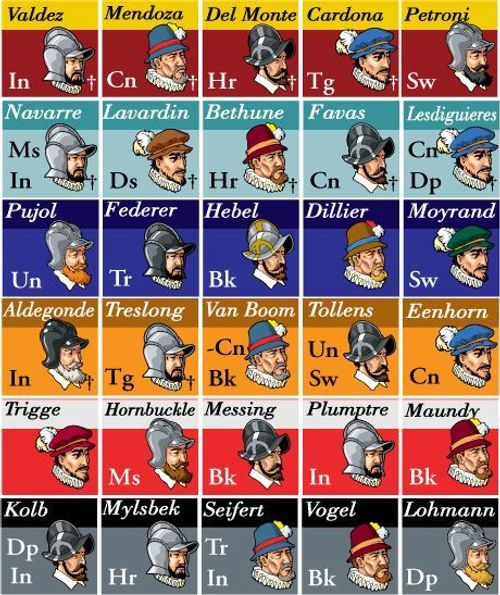
Spanish at Start: Governor, Valdez, subordinates Mendoza, Del Monte, Cardona £600 Treasury 2 Affiliation points Place Garrison first. Forces: 2 coy Spanish Musketeers, 3 coy Spanish Arquebus, 6 coy Spanish Pikemen, 4 coy Walloon Musketeers, 2 coy Light Lancers, three medium guns. Capitol: (The Hague) produces £600+1d6x£100
Dutch at Start: Governor, Aldegonde (Dutch), subordinates Chester (English), Treslong (Dutch), Poyet (Huguenot) £600 Treasury 6 Affiliation points Place Garrison second. Forces: 4 coy Huguenot Shot, 2 coy Veteran Huguenot Shot, 1 coy Scottish Volunteer Shot, 1 coy Scottish Volunteer Pike, 1 coy English Volunteer Shot, 1 coy English Volunteer Pike, 1 coy Landsknecht Shot, 1 coy Landsknecht Pike, 2 coy Dutch Beggar Shot, 2 coy Levy Shot, 2 medium guns Capitol: (Rotterdam) produces £600+1d6x£100
Scenario 2: A State Within a State
Guyenne 1576
The Huguenots have recovered from the shock of St. Bartholomew's day and have rebuilt their military power. Rather than seizing towns at the outbreak of hostilities, they now maintain almost continuous control of entire regions of the south and west. In between truces, Navarre and his courtiers are trying to clear the region west of Toulouse of Catholic forces.
Victory: To win, a player must control at least 24 provender points at the end of the game. Further, if Navarre is killed or captured, the Huguenots lose.
Mandatory Districts: The Huguenot Capitol is Montauban. The Catholic Capitol is Marmande.
Huguenots at Start: Governor, Navarre, subordinates Lavardin, Bethune (Cousins), Favas £400 Treasury 10 Affiliation points Place Garrison first. Forces: 2 coy Millers, 1 coy Petronels, 6 coy Huguenot Shot, 2 coy Huguenot Pikemen one medium gun. Capitol: (Montauban) produces £700+1d6x£100
Royalists at Start: Governor, St. Criq, subordinates Villars, La Devese, Fillion £600 Treasury 10 Affiliation points Place Garrison second. Forces: 3 coy French Gendarmes, 2 coy Levy Shot, 2 coy Legion Musketeers, 4 coy Levy Pikemen, 2 medium guns Capitol: (Marmande) produces £600+1d6x£100
Scenario 3: Lesdiguieres in the Alps
Dauphine 1574
During the fifth War of Religion in France, Francois de Bonne, sieur de Lesdiguieres (second in command in the province to Montbrun) has begun a campaign to sever the link between Grenoble in the north and the towns of Gap and Embrun to the south and southeast. Victory here will secure a commanding position for the Protestant in Dauphine.
Victory: The Huguenots must control the towns of La Mure and Corp and at the end of play. If Lesdiguieres is killed or captured the Huguenots lose.
Mandatory Districts: The Huguenot Capitol is Mens. The Catholic Capitol is Gap.
Special Rules: If the Protestants capture La Mure, the Catholics receive as reinforcements the Genoese Condotierre Jules Centurione entering from any district of the north end of the board, as if he had received a successful plant garrison letter during the Catholic player's turn. His forces are himself, 1 coy Gendarmes, four coys of Levy Shot and two Light Guns.
Huguenots at Start: Governor, Lesdiguieres, subordinates Bastien, Glandage, and Roure. Treasury £800 10 Affiliation points Place Garrison second. Forces: 1 coy Millers (post 1573), 1 coy of Petronels, 4 coy Veteran Huguenot Shot, 4 coy Huguenot Shot, 2 coy Levy Shot, 2 coy Legion Pikemen (well trained Huguenot Pikemen), two medium guns. Capitol: (Mens) produces £400+1d6x£100
Catholics at Start: Governor, Laboral, subordinates Beauregard, Beaumont, Pedescaux. £400 treasury 6 Affiliation points. Place Garrison first. Forces: 2 coy Gendarmes, 2 coy Legion Arquebusier, 2 coy Legion Musketeer, 4 coy Levy Shot, 2 coy Levy Pikemen, 2 Medium Guns (Guns start in Gap). Capitol: (Gap) produces £600+1d6x£100
A Brief Description of the new SF:Actions! Cards
All of the new cards are designed to represent Protestant forces during the period (the Catholics are well represented by standard actions cards). The English and Scots are better than levies but not quite veterans, representing a period of where they were "going to school" in the wars. They often brought enthusiasm which at times made up for experience, but not always. The Dutch Beggars are meant to show the rank-and-file of Dutch forces in the early period, made up as they were of religious and political exiles bearing a grudge and more motivated. The new Huguenot cards bring their Pikemen up a level from Levy (which can still be used to represent raw troops of any nationality). Since they lacked armour there were never many of them, and thus they were not as valued as their Arquebus armed associates who were well trained by the likes of D'Andelot and Coligny in light infantry tactics, as well as by Navarre. The Veteran Shot represent those highly prized experienced soldiers that served in the Netherlands in the 1570's and those kept in almost continuous service in the south of France.
Finally - What does "A la Huguenotte" mean?
This was a period term for "doing it on the cheap" or hurriedly. It also meant "small scale", which makes it perfect for these rules!