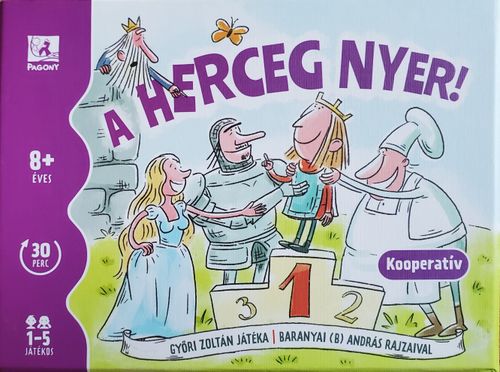
A Herceg Nyer!
A Herceg Nyer! Rulebook
Table of Contents
Table of Contents
Accessories to the Game
18 Route Cards
- 7 blank route cards + 1 starry route card
- 3 whimsical route cards
4 Competitors
Theophil the prince, Sigismund the knight, Brunhilda the courtier and Eugene the cook.
3 Additional Characters
75 Cards
- 60 programme cards (17 red, 17 blue, 17 green, 9 black)
- 10 royal whim turn cards (5 easers with heart icons, 5 aggravators with little monster icons)
- 5 trick-cards
Preparing to Play
First, you'll explain the basic game. For this, take out the route cards marked with icons on the top right corner, the trick-cards and the royal whim cards. You're not going to need these now, so you can put them back in the box. You can use them later if you want to make the game easier or more difficult (see details at the end of the rules).
- Find the 7 blank route cards and the 4 contestants - Theophil the prince, Sigismund the knight, Brunhilda the courtier and Eugene the cook. Place them in the middle of the table as shown in the picture.
- All competitors should point their arrows towards the draw deck because that is the finish line! The prince should be at the front, the other competitors can be in any order.
- Shuffle the race programme cards and deal 4 cards to each player! Make sure no one else sees your cards! The rest will be the draw deck (place them face down). The last person to have done any running, either in the gym or after the bus, starts the game.
How to Play
The game lasts for four rounds, during which time you control the contestants with the race programme cards you have in your hand. Players do not have their own characters: everyone can move all the characters. The common goal for everyone is to get to the fourth round and finish the game with the prince card closest to the finish line, so that he wins the race. If any runner goes off the track during the race, the game is over, and you lose.
Every round has 2 parts
- The creation of the programme from the 10 programme cards
- Playing the game (i.e., the race) - moving the racing cards according to the programme
1. The creation of the programme
- The starting player plays a card from their hand face up on the table, starting the programme, and then draws one from the draw deck (to keep 4 cards in their hand).
- Then it's the next player's turn. This player also plays a card from their hand, matching the programme card previously played, and then rounds up their hand to 4 cards again.
- And so on, the other players follow in sequence (everyone sees the cards they have previously laid down), until they form a programme sequence of 10 cards in total. Then the game really begins.
During the game, you cannot show your cards to the others, and you cannot give recommendations to the others on which cards to play!
Using the programme cards
- The programme cards are moved/turned by the player whose colours match them (the character whose colour matches the card).
- The prince's colour does not have a matching programme card - he is moved if the programme card being played has a crown on it - in this case, WHEN the character of that colour carries out the instruction on the card, the prince plays the same moves.
- The cards with black backgrounds are the wild or joker cards. If you come to a black card while the programme sequence is being played out, discuss it together and decide which character to move/rotate with it.
- The turn arrow on the programme cards rotates, and the numbers move the characters. If both are on the card, the rotation always comes first!
- When you turn the card over, you turn it face up - from now on, your character faces in the opposite direction, and even if they move, they move in the direction the arrow is pointing.
- A move is a change of position with the next card in line, and each character moves to where the arrow below it points! If a competitor moves three places, simply raise that card and move the three cards in front of it back one place and move the competitor's card forward to the empty space.
2. Play
First, carry out the instruction on the first card that is laid down (see the section on the effect of the race programme cards). Once this is done, flip it over (this shows that the instruction has been completed), and then do the same for the second card. Then turn that one over, and the next one up to the 10th card. After that, the played (downturned) programme cards will no longer be needed and can be returned to the box.
Remember that you always rotate first, only then move, and for the cards with crowns, the contestant in question moves first, and only then move the prince!
If any character runs off the track as a result of a played programme card (i.e., is one or more cards away from or ahead of the line), you lose immediately.
Example: the cook, Eugene, is standing at the end of the line at a given moment of the play and is running to the right. The current race programme card is the "cook turns and takes a step, then the prince" (1). But when this is played, i.e., the cook is turned around and moved 1 step forward, taking him off the track (2). Unfortunately, in such a case you have lost.
If all 10 programme cards have been played and no one has run off the track, the next round can be played (i.e., a new sequence for the 10 programme cards is created and played)! Here, the player to start will be the one who would have been next in the previous round after the tenth card was played. Do not change the players' order!
In the first 3 rounds, it's okay if the prince is not at the front (i.e., closest to the draw deck), he just needs to be in a winning position by the end of round 4!
The End of the Game
You win if you have made it to the fourth round, and - after playing the race programme sequence - the prince is in the lead, i.e., closest to the draw deck (it's OK if he's running backwards). However, if at any time during a round you cannot get a contestant to follow the instructions on a card (because they run off the track forwards or backwards), or if at the end of the fourth round the prince is not in front, the set-up is revealed and you face the wrath of the king.
Solitaire Game
The game works in exactly the same way as when played by more than one player, but with one player controlling all the characters.
The Simplified Game
You can simplify the game with the 8-card programme, trick cards and "easer" royal whims. You can try these separately or in different combinations!
8-card programme sequence
If you are playing with smaller children, you can easily simplify the basic game by building a race programme of only 8 cards instead of 10.
Trick cards - a single-use help card
At the start of the game, you shuffle the trick cards face down and deal 1 to each player (the rest go back in the box, you won't need them). Then deal 3 more cards to each player for a total of 4 cards, and the game can begin as described in the rules.
Players can only use their trick card once during the game. At any time during their turn, they can choose to play their trick card instead of a race programme card. When played, the effects of these cards are as follows:
- You can move any 2 of the route cards anywhere.
- You can turn any (or all) of the competitors. Except the prince!
- The runner seen on the card can be moved anywhere.
'Easer' royal whim turn-cards (with icons in the top righthand corner)
These sheets contain various 'easers'. At the start of the game, you shuffle them and place them face down on the table. In the first 3 rounds, you flip 1 card each time, the effect of which applies only to that round. You play the 4th round without the easer cards!
- +1 route card! Place the extra route card marked with a star at the beginning or end of the line to make the track longer. At the end of the round, remove the extra route card from the beginning or end of the row. If there are no empty cards in either place, you lose.
- You can give advice! In this case, in this round, you can discuss which card the player on the turn should play or warn someone if you feel they have played the wrong card.
- An 8-card race programme sequence! The play starts after 8 cards are laid.
- You can start the playback after 5 cards too! Play the programme in two parts (after the 5th card and again the next 5 cards, too).
- You can have 5 cards in your hand! You can choose from 5 cards instead of 4.
Harder Game
You can create an even bigger challenge for yourselves with the aggravator royal whim turn cards, additional players, whimsical route cards, or an extra programme sequence. First, choose 1 type of difficulty each, but later you can combine them freely.
Aggravator royal whim turn cards (with an icon in the top right corner)
At the beginning of the game, they are shuffled and placed face down on the table. In the first 3 rounds, you always flip 1 card, the effect of which applies only to that round. Round 4 is played without complicating cards!
- -1 route card! Take a road card from the beginning or end of the row at the beginning of the round. At the end of the round, put the road card back at the beginning or end of the row.
- The prince always moves, too! When playing, the prince carries out all of the tasks (treat them as if they all had crowns).
- The prince shall come first in every round! At the end of the round the prince must be in front (if not, you lose).
- Each card moves 2 places! All the cards have the value of 2 moves, including the regular turn card, and including the x3 kind.
- An invisible race programme sequence! See the explanation at the end of the rules under the heading "Invisible programme sequence".
Additional characters
The Black Knight, the dragon and Merlin - only one of them should be in the game at a time! In the last round they can no longer compete - take them out of the game at the end of round 3.
- The Black Knight (Igor, the prince's dashing personal bodyguard): Replace the middle route card with the Black Knight. If a black card is played, he plays the effect of the card (instead of a competitor of your choice). But beware, if he runs off the track in the move, the game is over, and you lose.
- Merlin (a wise wizard, whose every word Theophil clings to): He takes the place of the middle route card and always points somewhere. When anyone moves him (even the prince), he turns around and points in the opposite direction. He has a strong influence on the prince - he always runs in the direction Merlin is pointing (so the turn cards should be ignored in the prince's case). When the prince runs past Merlin (and Merlin changes direction), the prince finishes the move and only then turns around.
- The Dragon (a friendly local beast, who occasionally eats someone by accident): At the end of each round, he moves one place towards the finish and throws the panel in front of him out of the game, thus shortening the track. If a competitor's card is discarded in this way, the game is lost.
Whimsical route cards (route cards marked with a unique icon in the top right-hand corner)
You can use just one alone, or all three at the same time. The more there are in the game, the harder the job. Only use them in the first three rounds! At the beginning of the 4th round, take them all out and replace them with blank route cards.
In preparation, shuffle these in with the blank route cards, so that there are 7 cards in total (so put as many blank route cards back in the box as whimsical route cards).
The basic rule for whimsical route cards is that they turn when someone moves on them. Once turned, this rule applies to them:
- The pit: Even if the contestants have another step to take, when they reach the pit, they stop and can take no further steps. The pit is then turned down.
- The trampoline: Increases the moves of a competitor by one. If a runner crosses it, just don't count it as a move.
- The Clown (the prince's silly friend): If the clown's tile is flipped after a move has been made on it, the next move the prince would have made is made by the clown (in the direction the prince's arrow is pointing, or, if there is a rotation, in the opposite direction to the prince's arrow). Turn him back over again after the move. Take care though, if the clown runs off the track during this move, you lose.
A whimsical route card can be turned over several times during the game and cause trouble.
Invisible programme sequence
When you add a card to the programme sequence, turn the previous one face down. This way, only the last programme card is visible, and for the others you have to keep track of who has moved how much and where! When 10 cards have been reached, each card is turned face up and played back as usual.
Enjoy the game!