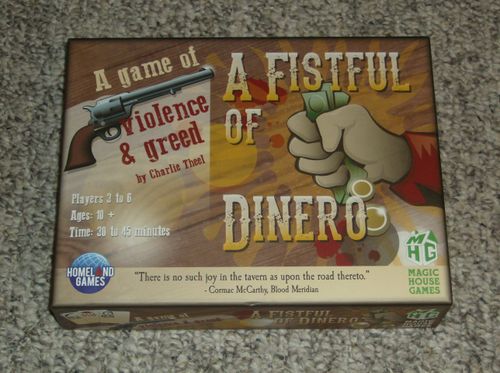
A Fistful of Dinero
A Fistful of Dinero Rulebook
Table of Contents
Table of Contents
Components
- 6 Gun Belts (player boards)
- 2 six-sided dice (2D6)
- 15 ammo markers
- 20 poker chips
- 140 Game cards
- 1 first player / draft direction card
Setup
To begin playing A Fistful Of Dinero, perform the following:
Table Setup
- Pass out a Gun Belt to each player. If right handed, make sure the main weapon is on the right hand side, or left for left handers.
- Place a number of chips in the center of the table as follows:
- 3 Players: 14
- 4 Players: 16
- 5 Players: 18
- 6 Players: 20
- Form a community pile of ammo markers as well as a pile of extra chips set aside.
- Place the 2 six-sided dice within easy reach of all players.
- Give the first player token to the person at the table who last watched a Sergio Leone film making sure the draft direction marker shows the direction arrow.
Card Setup
- Take the weapon cards and set aside a Peacemaker for each player at the table.
- Shuffle the remaining weapon cards and then give two to each player, face-down, in addition to the Peacemaker that was separated in the previous step.
- Players now simultaneously look at ALL THREE weapons they were dealt and CHOOSE TWO to start the game with (the other weapon is discarded face down and removed from the game).
- Players choose which weapon they currently have in their Main Weapon slot, and place the other in their Off-Hand slot.
- Each player is dealt 6 cards from the Action Deck and the game begins.
Game End
The game ends at the end of the round (all players complete all action phases of the round) when either:
- the chips in the middle of the table run out (winner is person with the most chips), or
- last man standing.
Tie Breaker Mini Game!
Collect all Damage cards and shuffle them together. Deal 6 Damage cards face-down to each tied player. A player not tied for the lead then counts down and yells "draw!" Tied players now physically throw the Damage cards at their opponent's player GUNBELT. As soon as one player throws his final card everyone stops throwing and Damage cards that are touching player mats are revealed and the Light Wound applied. Whoever has taken the least around of Wounds is the winner.
Transcription note: the printed text reads "the least around of Wounds"; "around" appears to be a typesetting error for "amount" and is transcribed as printed.
The Round
A Fistful Of Dinero is played over a series of game rounds. Each round consists of three phases that are resolved in the following order:
- DRAFT & PLAN: Cards are selected and actions are programmed for the round.
- EXECUTION: Actions are resolved as players dive for cover, scrape up handfuls of coins, and let their hog-legs loose like iron dragons spitting fire upon their foes.
- CLEANUP: The playing surface is cleaned up and the table is organized in preparation for the next round.
Once cleanup has finished, if the game has not ended the players begin a new round starting again with the first phase (The Draft) and so on.
Phase I: The Draft
During this phase, players will draft cards and program them to their GUN BELT.
Each player picks up the 6 action cards he has been dealt, looks over his options, and selects one card to play FACE DOWN on his GUNBELT in ANY open Action Space (either the 1st, 2nd, or 3rd). Once everyone has selected and placed their first card, players simultaneously pass the remaining cards (in the direction noted on the Draft Direction marker).
Players continue performing the same process of selecting a card from those they were passed, and placing the card in an Open Action space on the GUN BELT, until players have selected their third card, signaling the end of the passing portion of the Draft Phase. The remaining cards are discarded face up next to the deck of action cards.
All players should have a card in each of the three Action Spaces on their GUN BELT. All players may now perform a single swap of any two Action cards on their GUN BELT, as during the Execution rounds they will be executed in order.
Phase II: Execution
The next phase of the round is where the Action cards selected during the Draft Phase are resolved, one by one.
The first player flips over and reveals his Action card in the first Action Space and may completely resolve its effect. If a card is split into 2 (split action card), players may choose EITHER SIDE to resolve as the card is revealed.
After the Action card is resolved, play continues clockwise with the next player revealing his first Action card and resolving it, and so on to the next player. When it gets back around to the first player, he now reveals his second Action card and again play continues clockwise. This occurs a third time when the final Action card of each player is revealed and played.
Example: Johnny has three cards face down in his slot. Since he'd rather have the COVER card in slot one, and the FIRE! card a little later, he switches their position, keeping them face down.
There are three types of Action cards that function differently when resolved.
Standard Action Card
The most common is a STANDARD ACTION CARD in which you may resolve the text on the card immediately upon its reveal.
Card That Remains in Play
The second type is a CARD THAT REMAINS IN PLAY. These cards have a graphical background depicting a poker card. When they are revealed on your GUN BELT, you do not perform the action listed on the card itself. Rather, the text effect on the Action card is utilized under specific circumstances as denoted on the card. These cards will also persist round to round if they are not used or discarded.
Some Action cards will confer bonuses or penalties depending on who has the High or Low card in play. The player with the High card in play is the player who has a card in play of the highest value. Similarly, Low card in play refers to the card with the lowest value. Suit is disregarded in this instance, and if you tie with another player then neither of you have the High (or Low) card.
Cover Cards
The third type of Action card are COVER CARDS. They remain in play, but function very differently. COVER cards are discussed in detail below in the FIRE! section.
Phase III: Cleanup
The final phase of the Round consists of the following performed in the listed order:
- Players discard all of their Action cards from their GUN BELT (not Cards in Play).
- The first player draws the top card from the Damage deck and then chooses the Wound value listed in either the Light or Heavy Damage side of the card. The number chosen is how many chips are discarded from the center of the table, effectively bringing the game closer to end. IMPORTANT: Add one to this number for each player eliminated as well.
- If the game is not over, then the first player token passes clockwise to the next player, and each player is once again dealt six cards. The Draft Direction marker is flipped to its opposite side.
Card Anatomy
Some cards possess an AIM discard symbol in the top right corner. When you play a card with this symbol, you must discard all of your AIM cards from play. If a card is placed above the GUN BELT and remains in play, the symbol has no further effect and subsequent AIM cards may still be played.
If you play a split-card and only one side has the AIM discard symbol, you only have to discard your AIM cards in play if you perform the action on the side with that symbol.
Weapon cards have their own distinct properties:
- Weapon cards remain face down so that only the owner knows what the weapon is. A weapon may be revealed at any time but must be revealed when it is first used. When this happens, the player places an ammo marker on the highest number ammo space, signifying the weapon has full ammo.
- When you perform a FIRE! action, you move the marker down the ammo track 1 space (unless the weapon specifies otherwise).
- The weapon type has no effect but will be utilized in future expansions.
(Peacemaker card face, as printed: "DAMAGE - LIGHT; AMMO 6; TYPE - SMALL"; ammo track numbered 1 to 6; "FIRE! If you roll a 12 to hit, deal Heavy Damage.")
Damage Cards
The final type are Damage cards. The player resolves either the LIGHT or HEAVY damage side of the card, depending on the damage type of the weapon used in the attack. Damage cards remain in play and are kept face up for players to keep track of damage. If a player has 5 or more Wounds, that player is dead.
Card face (Light Wound card): "LIGHT WOUND - SHOCK! - 1 WOUND. Replace the next Action card on your GUN BELT with the top card from the Action draw deck. FIRE! -1 to attack roll."
Card face (Heavy Wound card): "HEAVY WOUND - CRIPPLED - 2 WOUNDS." The remaining text on the Heavy Wound card face is not legible at the print resolution of the source scan and is not transcribed.
Actions
There are several common actions appearing in the Action deck in addition to a smaller number of special actions that are found in more rare quantities. The standard Actions are detailed below.
FIRE! Action
(Card face: "FIRE! - ATTACK ANOTHER PLAYER!")
When you resolve a FIRE! Action, take the following steps:
- choose who you are going to target.
- declare (and reveal if unrevealed) the weapon you wish to use.
- adjust the ammo marker appropriate to the amount of ammo you're using.
- Roll the two six-sided dice.
- account for any modifiers (AIM, COVER, etc.) to find your final attack roll.
If the final attack roll total is a 7 or higher then you have hit your target.
Regardless of modifiers, a roll of double 1's is always a miss and a roll of double 6's is always a hit.
If an opponent has been hit, that player proceeds to draw a single Damage card from the Damage deck and refers to either the Light or Heavy Damage side of the card (depending on the weapon used by the attacker).
Damage appearing on each card has a Wound value as well as a possible damage effect which may hinder the player. The player places the damage card next to his player mat to keep a running total of damage, and takes whatever penalty is given by the damage effect. Damage effects are permanent unless specified otherwise.
If a player ever receives 5 or more total Wounds, then they immediately die and are removed from the game (although their corpse remains in place for purposes of players' cover cards). The player who delivered the final killing attack receives a poker chip from the dead player (if applicable), as well as any chips from the special action card Bounty. All other chips from the killed player are discarded.
AIM Action
(Card face: "AIM +1 - TO ATTACK - +1 to attack roll on FIRE! actions. Discard after firing.")
When the AIM action is played the player places the AIM card on the table above their GUN BELT. Multiple AIMs may accumulate until they are used or discarded. Each AIM card adds +1 to the attack roll when performing a FIRE! Action, and are not optional (each AIM card must be used and then discarded after any FIRE! action).
RELOAD Action
(Card face: "RELOAD - Add 1 ammo to one of your weapons, up to its maximum.")
The RELOAD action reloads a single round of ammunition up to the weapon's maximum. Move the ammo marker one space up on the ammo track of one of your weapons.
MAD DASH Action
(Card face: "MAD DASH - Discard your COVER and AIM cards in play and take 1 chip from the pot. You may gamble and roll 1D6. On a 1-3, discard this chip. On a 4-6, take a 2nd chip.")
MAD DASH represents the player making a headlong sprint towards the poker table and grabbing some of the cash. It leaves you vulnerable but takes you one step closer to victory. The player must discard all of his AIM and COVER cards when performing this Action.
HIT THE DIRT Card
HIT THE DIRT cards remain in play and players may accumulate multiple copies. When targeted with a FIRE! Action, a player may discard a single HIT THE DIRT card to subtract 1 from the attacker's to hit roll. Only one HIT THE DIRT card may be played per attack roll. A player must decide to use the HIT THE DIRT card before the attack roll is made.
(Card face: "HIT THE DIRT - You may discard HIT THE DIRT when targeted with FIRE! to give attacker -1 to attack roll. You may only use 1 HIT THE DIRT per incoming attack roll.")
Example: Ben has two HIT THE DIRT cards when Matt decides to target him with his Derringer. Matt has two AIM cards, giving him +2 to hit. Ben decides to use one of his HIT THE DIRT cards, subtracting one from Matt's roll. Matt now has a net +1 to hit, causing him to need a 6 or above on his attack roll.
HIT THE DIRT = -1 to attack!
RE-ARM Action
RE-ARM is how a player swaps weapons between his Main Weapon and Off-Hand weapon slots.
(Card face: "RE-ARM - Switch your Main Weapon with your Off-Hand Weapon.")
COVER
When revealed/executed COVER cards are placed onto the table above the player's GUN BELT and provide protection from FIRE! Actions. Each COVER card has three areas:
- side in a 5 player game
- side in a 6 player game
- end in a 3-4 player game
Each side of a COVER card is used for a different player count, and will remain the same throughout the entire game.
The red circles graphically represent opponents sitting around a table relative to your position. The furthest left circle represents the player adjacent to your left, with the next red circle to the right representing the player sitting next clockwise and so on all the way to the furthest right circle which is the player sitting to your immediate right. The strength of your cover is denoted by the horizontal line bisecting the path drawn to your enemy.
A single horizontal line denotes Light cover, which is -1 to attack rolls made by that player against you. Two horizontal lines would denote Heavy cover, which is -2 to the attack roll.
If a second COVER card is played, discard the first and place the new card in its place.
(Diagram captions: "LEFT PLAYER - NO COVER"; "LIGHT COVER - -1 TO HIT"; "RIGHT PLAYER - HEAVY COVER - -2 TO HIT".)
(Card face: "COVER DOOR WAY - PLACE CARD TOWARDS 1 PLAYER. THAT PLAYER HAS -1 TO HIT YOU." - 3-4 PLAYERS.)
If playing with 3 or 4 players: COVER works slightly differently; the middle graphic on the card is ignored. Instead, when you execute the COVER card, you point the end of the card towards a specific player. You are considered to have Light COVER (-1 to hit) against this opponent.
(Diagram caption: "OPPONENT 1 - LIGHT COVER".)
Throw
Several Action cards allow you to perform a unique Throw Action. When you perform a Throw, you pick up the card used and toss it towards any opponent's GUN BELT. You are not allowed to extend your hand beyond your own player mat.
If the Thrown card is touching an opponent's GUN BELT at all (regardless of it being your intended target), that player takes damage according to the card effect.
(Diagram captions: "HITS COVER, TOMAHAWK FAILS"; "HITS GUNBELT, TOMAHAWK SUCCEEDS".)
A Thrown Weapon is handled a bit different than a Throw Action. Instead of physically throwing the weapon, you instead will throw the FIRE! Action card used. If the weapon was in your Off Hand, you must perform the Throw Action with your Off Hand.
Several Thrown weapons function in special ways.
Dynamite
This is a special action card that is capable of devastating effects. When it comes time to Execute the Dynamite Action card, you must throw the card at another player. If you hit another player they receive this card, otherwise the thrower receives it.
When you receive Dynamite, you may swap it on your GUN BELT with a face-down Action card. When it comes time to play the swapped Dynamite card he must toss the Dynamite card at another player, using the same rules as the original toss. The Dynamite can be thrown multiple times throughout the round.
At the beginning of the Clean-up phase, the Dynamite EXPLODES dealing Heavy Damage to whoever possesses it, and Light Damage to adjacent players. Dynamite is then removed from the game.
(Card face: "DYNAMITE - This card is Thrown. If you hit another player they receive this card, otherwise the thrower receives it. When you receive Dynamite, you may swap it on your GUN BELT with a face-down Action card. Dynamite explodes at the beginning of the Clean-up Phase dealing Heavy damage to the owner and Light damage to adjacent players. Remove Dynamite from the game.")
Example: Ben played his dynamite card and throws it on Matt's GUNBELT. Matt swapped the dynamite card for the action card he had in slot 3. When it is his turn to play card 3 he throw the dynamite at yet another player.
The Frogsticker
This is a versatile knife found in the weapon deck. It may be used to make normal FIRE! actions against adjacent opponents but it may also be thrown as a special one-time action. If the Frogsticker is thrown, you would play a FIRE! action and upon executing the FIRE! you would throw the Action card instead of rolling dice. The Thrown attack deals 1 Light damage, just as if you used the Frogsticker in a normal FIRE! Action. Once this is done you must discard the Frogsticker weapon card from the game.
(Card face: "FROGSTICKER - FIRE! Non-adjacent targets require the weapon be thrown.")
Iron Stinger
The Iron Stingers are a set of throwing knives and may only be thrown. When performing a throw, you play a FIRE! action and physically toss the Action card itself, not the weapon card. The Iron Stingers have 2 ammo allowing you to throw them twice. They may not be reloaded and should be discarded back to the game box when both ammo have been used.
(Card face: "IRON STINGERS - These small knives are only thrown. Remove an ammo after each throw. This weapon may not be reloaded.")
Clarifications
During the Execution phase, if actions that are being performed simultaneously need to be performed in a specific order, do so in player order, starting with start player and going clockwise around the table.
The players sitting to your left and right are considered adjacent. If a player dies, their corpse is considered adjacent (you do not have a new adjacent player). Dead players are still considered in their original seat when referencing COVER cards as well.
If the Action deck is ever empty, immediately reshuffle the discard pile and form a new Action deck to continue drawing.
Glossary
- ACTION - The resolution of an Action card and all of its effects.
- ACTION PHASE - Three sub-phases taking place during the Execution Phase of the round. The first Action Phase begins when the first player reveals his first Action card, and ends when the last player in turn order reveals his first Action card. The second and third Action Phases follow the same pattern with the second and third Action cards being revealed, respectively.
- ACTION SPACE - One of three spaces on the GUN BELT where a card is placed (programmed). Each Action Space corresponds to its associated Action Phase.
- ADJACENT - The players sitting to your left and right.
- ATTACK - The result of a FIRE! Action, typically consisting of an attack roll unless the attack was thrown.
- ATTACK ROLL - The act of rolling 2D6 and needing to score a 7 or higher to hit your opponent.
- CHIP - A circular token in the middle of the table that is an abstract representation of dinero being fought over.
- GUN BELT - A player board each participant is given. Actions are programmed to the GUN BELT and later executed.
- MAIN WEAPON - The weapon in your main hand, which hits on a 7+ when committing a FIRE! action. The GUN BELTS are doubled sided so you may select which side your Main Weapon is on (depending on if you are right or left-handed).
- OFF-HAND WEAPON - The weapon opposite your Main Weapon. If you perform a FIRE! Action using a weapon in this slot, you have -1 to attack. If you perform a throw using a weapon located in the Off-Hand, you must physically throw the FIRE! Action card with your actual off-hand, making the throw more difficult.
- POT - The pile of chips in the middle of the table.
- PROGRAM - The act of selecting an Action card and placing it on the GUN BELT in one of your available Action Spaces.
- SWAP - A special procedure which is performed after players have finished drafting/passing cards but before moving on to the Execution phase. Players may swap the position of two cards on their GUN BELT.