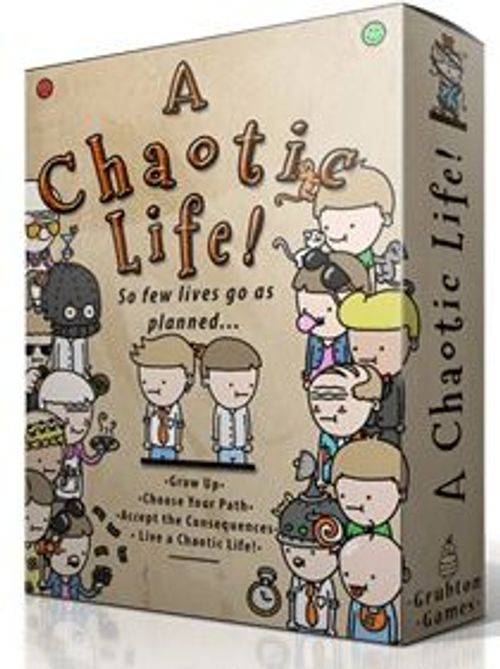
A Chaotic Life!
A Chaotic Life! Rulebook
Table of Contents
Table of Contents
- Objective
- Components
- Setup - Card Removal
- Setup - Building the Deck
- Setup - Creating the Timeline
- The Item Pouch & Discard Pile
- Setup - Choosing a Life-Goal
- Starting the Game
- Remember!
- What's in a Turn?
- Actions!
- Cards - And How to Play Them!
- Cards to Consider
- Other Small Reminders
- How to Win - Or Lose!
Objective
Work with or against your opponents to raise a baby through the stages of life - both choosing its actions and accepting the consequences - to ultimately live a wonderful (or terrible) life!
Components
- 7 Age, Event, Interact, and Neighbor Cards
- 13 Special Cards
- 18 Item Cards
- 3 Pet and Mini-Goal Cards
- 2 Life-Goal Cards
- 1 Rule Sheet
- 25 green Happiness Counters (HC)
- 25 red Sadness Counters (SC)
Setup - Card Removal
Remove the following cards from the deck:
- Baby
- Child
- 1 Adult
- 1 Senior
- 2 Life-Goals
- Teen
- 3 Mini-Goals
Setup - Building the Deck
To build the Deck, divide the remaining cards into 4 near-equal piles. Shuffle the previously-removed Child, Teen, Adult, and Senior cards into the first, second, third, and fourth piles respectively. Stack the piles so the Child's pile is on top, followed by the Teen's pile, then the Adult's pile, and finally the Senior's pile at the bottom. The Deck is now built allowing your life to progress linearly, but still chaotically!
Setup - Creating the Timeline
Place the newly-built Deck far left on the play area, leaving room for cards to be played to its right as the game progresses. Place the HC and SC above and below the Deck. Place the 3 Mini-Goal cards within the play area, so all players can reference them at any time. Leave room to the left of the Deck as this will be used as the Discard Pile - cards will be placed here,
[Printed column break: the next word, "face-up.", opens the following column. The sentence is transcribed as printed; the Future Cards and Timeline slots appear in the setup diagram.]
face-up. Finally, place the Baby card face-up to the right of the Deck. This creates the Central Person (CP) and begins the Time Line!
The Item Pouch & Discard Pile
During the game, you'll have a great variety of Item cards at your disposal. They can be very handy if you need to alter your opponents' plays or enhance your own! The Item Pouch helps keep things tidy and ensures your favorite Items are close by - without the need to clog up your hand! Each player may "store" 2 Item cards face-down in front of them. These Item cards act as if they were in your hand: they can be played, traded, stolen, etc. but DO NOT count toward your hand limit of 5. Other Item cards beyond the 2 in the pouch can still be held in your hand and do count toward the 5.
The Discard Pile sits to the left of the Deck. Cards are placed here if they have instructions to do so, if players need to discard down to the hand-limit, etc. Players can also Draw from the Discard Pile as an action. When the Deck is exhausted, the Discard Pile is shuffled and becomes the new Deck. So if your opponent discards something you'd like, be sure to grab it on your turn before it gets shuffled away!
Setup - Choosing a Life-Goal
During the game, each player will work toward 1 of 2 possible Life-Goals (shown on the 2 Life-Goal cards): A "Happy Life" or a "Terrible Life" and these goals determine whether players aim to collect HC or SC respectively. The number of players determines how goals are chosen:
- 2 Players: The youngest player chooses 1 Life-Goal card at random - this is their goal. Their opponent takes the opposite goal.
- 3 Players: The youngest player chooses 1 Life-Goal card at random - this becomes all of the players' goal.
- 4 Players: The youngest player chooses 1 Life-Goal card at random - this is their goal. The players to their left and right take the opposite goal. The remaining player takes the youngest player's goal. This results in 2 players with the goal of a "Happy Life" and 2 with the goal of a "Terrible Life" - each taking their turn after an opponent with the opposite goal.
Starting the Game
Now it's time to begin your own chaotic life! After choosing Life-Goals, deal 5 cards from the Deck to each player - this fills the hand-limit of 5. If any players have been dealt either the Volcano! or Gifts! cards, they discard them and draw replacement cards. The youngest player then takes their turn, beginning the game!
Remember!
Players collectively play as the CP through their life. Each player's actions affect the CP, and so affect all other players as well. So remember, it's not just your life you're messing up!
What's in a Turn?
During a turn, a player may complete up to THREE of the following actions:
- Play a card from their hand or Item Pouch
- Draw a card from the Deck or Discard Pile
- Trade cards, counters, or a combination of the two with any other player
- Claim a Mini-Goal (if requirements are met)
- Swap a combination of any 2 Item, Special, or Pet cards for 1 counter of their choice
- Discard a card to the Discard Pile
Players can play more than one of the same action per turn, and can also choose to do nothing and simply watch their life pass by!
Actions!
A more detailed description of the many actions available to players:
Play a Card: The player uses a card from their hand or Item Pouch. These can be played to the Time Line, used against opponents, played in front of you, and to affect other played cards. Each has specific rules/requirements, and these are detailed on the following pages.
Draw: The player takes the top card from the Deck or Discard Pile. So will you take what you can already see or gamble for a chance at a different, but perhaps better card? If the Volcano! or Gifts! cards are drawn from either location, they are played immediately and your action is complete - you do not redraw, unlike the start of the game with the initial cards.
Trade: The player trades with an opponent. However, what a player holds is a secret, so you'll have to attempt a trade "auction style". Hold up a card you want to trade, ask if anyone would like it, and field offers. A trade can consist of cards or counters. An action is used only if a trade is completed. So if no deal is made, the player hasn't wasted an action!
Mini-Goals: The player claims a Mini-Goal if the requirements are met. These are available to everyone, so players will need to plan well if they hope to secure them. They have very difficult requirements, but reward greatly! Mini-goals give players "side areas" to focus on - guiding the life of the CP to complete them!
Swap what's Unusable: During the CP's life, some cards may become unusable. The CP may become Injured while in the Child stage, and so if the Bandage card appears later on, it would be unusable. In this situation, the card can be seen as a missed life opportunity! So during a player's turn, they can swap a combination of any 2 Item, Special, or Pet cards for a counter of their choice. The cards can come from the player's hand or Item Pouch and are removed from the game face-down.
Discard: The player discards 1 card from their hand or Item Pouch. It is placed face-up on top of the Discard Pile. This is a great way to lower the number of cards in your hand to ensure a larger amount of cards gained after your turn when you draw back up to the hand-limit.
When a player finishes their actions, their turn ends and they either discard down or draw up from the Deck, to their hand-limit of 5 cards. As a reminder, the Item Pouch does not count toward the hand-limit, and moving cards back and forth between the Item Pouch and hand is not considered an action. However, players cannot move Item cards into their pouch after drawing back up to the 5 card hand-limit.
When drawing back up to their hand-limit, if either the Volcano! or Gifts! cards are drawn, they are played immediately as stated on the cards, after which the player continues to draw back up to their hand-limit.
After returning to their hand-limit, the player to their left takes their turn, and so on. Players continue to take turns until the game ends.
Cards - And How to Play Them!
Cards can affect the CP differently depending upon which stage of life he/she is in (which Age card has been played most recently). This means that cards can have vastly different results depending upon when they are played!
Age Cards are played in chronological order. Meaning, the Teen card can only be played if you're currently a Child, the Adult card can only be played if you're currently a Teen, etc. After all, you can't skip life stages no matter how painful they might be!
When an Age card is played, if the CP satisfied any events shown on the card since the previous stage of life, the text across from those events is read and the player who used the new Age card gains the counters. The card is then added to the end of the Timeline.
Example: The CP is currently a Teen. Mark plays the Travel card and collects 1 HC and 1 SC because he ran away! Jenny then plays the Adult card and collects 1 HC because the CP was a "Traveled Teen".
Event Cards can be played at any life stage. The Event card is added to the Timeline and the text on the card across from the current stage of life of the CP is read. The player who used the Event card collects the HC and SC.
Special Cards are just that - SPECIAL! Their requirements are as well, so be sure to read them closely! Some of these cards are placed on the Timeline above certain other cards that they affect. Each Special card details how and where to play it, so the best way to learn about each is to play them! These cards truly do marvelous - and terrible - things...
Interact Cards are used to interact with your opponents - both positively and negatively! Steal cards, swap counters, and even cause a volcanic eruption!
Item Cards are used to alter the effects of other cards! These can be played at any time (not just on your turn!) as long as the conditions on the card are met. They can alter the effects of other cards for you as well as for your opponents! These cards are to be played immediately when another is played.
Pet Cards allow you to raise pets alongside the CP! The Mouse, Cat, and Dog cards are played in front of you, and they're worth HC at the end of the game if they remain in play. But if a Mouse card in play, and a Cat card is played after, the Mouse is removed! As is the case for the Dog card versus the Cat!
Neighbor Cards are played in front of you, stacking up to 7. It seems it does take a village to raise a child! Neighbor cards give rewards depending on how many of them the player has played. And as you play more Neighbor cards, their rewards get better and better!
Cards to Consider
Gifts! and Volcano!: These two cards are played as soon as they are drawn, for they affect more than just the player who drew them. Prepare to give your opponents a "gift" or lose a card to a chaotic lava flow when these cards come up!
Early Riser: It truly does pay off to get up early! When you play this card and pay the associated cost (1 counter of the type you have most of), you'll be able to take an extra action during that turn. So instead of the usual 3, you'll be allowed to take 4 actions - and playing the Early Riser card doesn't count as one of them. So get up early whenever you can!
Death!: Don't take this card lightly - for whichever goal you have, this card will hurt! When you play this card, you collect 3 counters of the type opposite your goal. So a player with the goal of a Happy Life will collect 3 SC. But that player may have a large amount of HC stocked up to buffer those SC - absorbing them with enough HC left over to remain in the lead! So while this card can end the game while you're in the lead, use it only if you can handle gaining 3 counters you don't want!
Other Small Reminders
- When playing a 2-player game, "shuffling" of the Deck is removed. To prevent the linear progression of Age cards from breaking, when a card states to shuffle it back into the deck, place the card randomly back into the deck instead. Do not shuffle the Deck. This ensures a Time Line that will age properly for the CP! However, the Discard Pile is still shuffled to create a new Deck when the previous Deck is exhausted.
- If a player has no counters of either type, they cannot play any card that costs a counter. It seems they're just not ready for that part of life yet!
- If a player has an equal amount of both counters, they choose which to spend when playing a card that costs a counter.
- If a Spouse card has already been played above an Adult card, and a player would like to play the other Spouse card, they can do so by placing the new card on top of the first Spouse card. They then collect the counter. The CP just got remarried!
How to Win - Or Lose!
The game ends if either:
- No players are able to / choose to take any actions for an entire round
- The CP dies due to the Death card
All players then add up both their HC and SC and find the difference. One of each type of counter cancels out, so players will be left with just a few of one type.
Example: Mark ends the game with 10 SC and 6 HC. So Mark is left with 4 SC - resulting in a "Terrible Life" lived for Mark!
Any cards which give HC or SC (mini-goals, pets, etc.) are now added to the owner's total. Whoever has the most counters related to their Goal wins! If players tie for the highest amount of counters relating to their goals, the player who has the most total counters is declared the winner - for they lived a much more CHAOTIC LIFE!