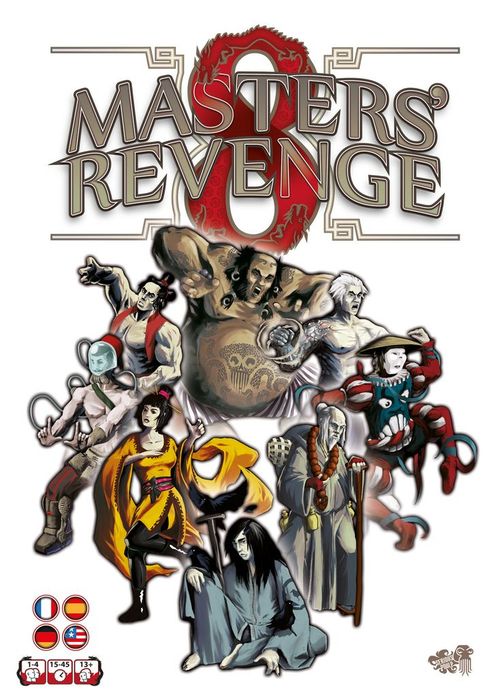
8 Masters' Revenge
8 Masters' Revenge Rulebook
Table of Contents
Table of Contents
Components
This rule booklet
- 4 two-sided boards showing the fight area and the fighter played
- 100 cards representing the blows dealt by the fighters
- 8 "bow" cards (2 per player)
- 36 effect tokens
- 4 "health" markers
- 4 "fury" markers
Overview and aim of the game
8 Masters' Revenge is a fighting game for 1 to 4 players.
You are a martial arts master and you want to beat your opponents, strike after strike. Your only weapons are your 2 hands, represented by the 2 cards you have in play. Find the weak point in your opponent's guard to deal damage to him.
As soon as his "health" marker reaches the last space of his life track (whose length depends of the number of players), he is out of the game.
The last surviving player wins the fight.
Setup
Each player places 2 "bow" cards side by side on the attack zones in the center of his fight area.
The first player is determined at random, by any method chosen by the players. He shuffles the deck of cards and deals 2 cards to each player. Gather all remaining cards face down to form a draw pile.
[Optional] Players may play one of the 8 available characters (they may choose or take one at random). For related specific rules, read on to section "Play a character" further.
Bow to your opponent. And now, fight!
General ideas
Cards
Cards represent the blows dealt by the fighters. Each card has:
- a color (there are 4 colors: blue, red, green, yellow);
- 2 numbers used to determine the player's attack and defense values. Note: each card shows these numbers twice so that you can read them easily when holding your cards in hand.
Some cards also have:
- a number of damage dealt when the attack is a hit;
- a "dragon" feature which may be used to counter the opponent's attacks;
- an effect which may indirectly affect the active player or an opponent and is applied when the card is discarded from the fight area.
Fight area
Your fight area is the space in which your fighter moves.
It is divided into attack zones and block zones.
"Health" marker & life track
When a fighter suffers damage, his health marker moves ahead on his life track. When the marker reaches the last space of his life track (whose length depends of the number of players), he is out of the game.
Effect tokens
Some cards have a lasting effect represented by a token which may be placed on a card in play or on an attack zone.
"Fury" marker
This marker is used to indicate that a fighter is in the state of "fury" (see "Play a specific character" below).
Game turn
Players play in turns, in clockwise order.
On his turn, a player (therefore called "the active player") must perform one of the following two actions:
Draw 2 cards, without exceeding 4 cards in hand
Note: if a player has 3 cards in hand before drawing, he only draws one card.
After drawing, the active player may move 1 "damage" effect token from:
- one of his cards in play to the adjacent card;
- one attack zone of his fight area with no card on it to an adjacent attack zone with no card on it.
Note: if, at any moment during the game, the draw pile becomes empty, players must shuffle the discard pile into a new draw pile.
OR
Attack by putting a card in play
The player must place a card on one of his attack zones that does not have a card on it and is adjacent to one of his 2 cards in play.
The card that is not adjacent to the new card is discarded (the blow is dealt) and then the attack is resolved in the following order:
1. Apply token effects (if any)
If there are any effect tokens on the attack zone covered by the new card, or on the discarded card, their effects are applied and these tokens are then discarded (see "card effects").
2. Check if the attack is a hit
An attack is a hit if the attacker's attack value is exactly equal to the defender's defense value.
The attack value is obtained by summing the two numbers in the center of the couple of cards formed by the new card and the card next to it.
The defense value is obtained by summing the two numbers at both ends of the couple of cards in play.
3. Deal damage if the attack is a hit
If the attack is a hit, the defender suffers the amount of damage shown in the top part of the discarded card. However, he may first reduce this amount by blocking or cancel it by countering.
Blocking an attack
If the defender has, in play, a card of the same color as the attacker's discarded card, he may move it down to his block zone to prevent 1 damage he should take.
Attention!
- A card that is in the block zone will be resolved normally when discarded. However, it can not block another attack or form a pair (see point 5 below).
- When an attack is a hit (and is neither blocked nor countered), the discarded card deals 2 additional damage if it has the same color as a card that is in the defender's block zone.
- A player may not block an attack after attempting to counter it.
Countering an attack
If an attack is a hit, the defender may attempt to counter it. In order to counter, the defender must immediately put in play a card with a "dragon" feature, placing it on an attack zone of his fight area that has no card on it and is adjacent to another card with the "dragon" feature. The card that is not adjacent to the card played to counter is discarded without being resolved.
If his attack has been countered, the attacker may decide to "counter back", by putting in play a card with a "dragon" feature, placing it on an attack zone of his fight area that has no card on it and is adjacent to another card with a "dragon" feature. And so on until a player cannot (or does not want to) put in play a card with a "dragon" feature.
If the defender counters successfully, the attacker's turn ends immediately (even if he has a pair). The damage and effect shown on the card discarded by the attacker at the beginning of the attack are not applied.
If the defender fails to counter, the attacker's turn continues normally. The damage and effect shown on the card discarded by the attacker at the beginning of the attack are applied.
4. Apply the effect of the discarded card
The attacker may apply the effect of his discarded card (see "card effects" below), even if his attack was not a hit.
5. Play a free turn if you have a pair
Usually, each player performs one action during his turn. However, after the effect of his discarded card has been applied, if the two numbers at the center of his couple of cards in play are identical (e.g. 1/1, 2/2, 3/3, etc.), the attacker may immediately play again – put a card in play or draw one card.
Attention! When a player decides to draw on a free turn, he may draw only one card.
Example – game sequence
Bruno attacks by putting a card in play and gets an attack value of 4 (2+2). Ludovic has a defense value of 5 (3+2). Bruno's attack is not a hit, but the effect of his discarded card is applied – Bruno moves his cards aside on his fight area. Since Bruno has a pair (2/2), he may immediately play again – draw only 1 card or put a card in play to attack. He decides to draw 1 card.
Now comes Ludovic's turn.
- He puts a card in play to attack with an attack value of 6 (4+2). Bruno's defense is 6, so Ludovic's attack is a hit and should deal 2 damage to Bruno.
- Bruno decides to counter the attack by playing a card with a "dragon" feature next to the card with a "dragon" feature that he already has on his fight area. The effect of the card discarded by Bruno as he counters is not applied.
- Ludovic decides to "counter back" by playing a card with a "dragon" feature too. The effect of the card he discards thereby is not applied either.
Bruno is not able to "counter back" back, so he takes the 2 damage from the card Ludovic discarded at the beginning of his attack. Ludovic may now apply the effect of latter card.
Play a specific character
Players may decide to play one of the 8 available fighters. Each fighter has two specific martial techniques which he can use when in fury (see "Fighters' martial techniques" below).
A fighter automatically enters the state of "fury" at the beginning of a player's turn (his turn or an opponent's) if his 2 cards in play have the same color. He leaves the state of "fury" at the beginning of a player's turn if his 2 cards in play do not have the same color.
Solo game
Setup is the same as with 2 players, with the following exceptions:
your opponent has no cards in hand;
place 1 plus-side "damage" marker and 1 minus-side "damage" marker on either side of your opponent's board;
shuffle together 3 plus-side "damage" tokens and 3 minus-side "damage" tokens, plus, depending on the desired difficulty:
- 4 blank "damage" tokens for an easy game;
- 2 blank "damage" tokens for a normal game;
- 0 blank "damage" token for a hard game.
Then stack all these tokens.
You start the game with your fighter. You win the fight if your opponent's "health" marker reaches the last space of his life track.
On your turn
Play as per the normal rules. Your opponent cannot counter but he systematically blocks the attacks he is able to.
On your opponent's turn
Put the top token under the stack of tokens. The revealed token and the associated marker indicate the side where your opponent's actions are performed.
If you have revealed:
- the blank "damage" token: your opponent does not do anything this turn.
- the plus/minus "damage" token: draw a card for your opponent. Put it in play as per the normal rules on your opponent's fight area, on the side where the marker corresponding to the revealed token is. Exception: if only one attack zone is available on your opponent's fight area, the card must be placed on it, regardless of what the token shows (+ or –).
All of your opponent's attacks are hits and deal their damage regardless of your defense value. You may block or counter them as usual.
Your opponent never takes a free turn when he has a pair and only applies the following card effects:
- the "acrobatic jump" card effect: slide your cards to the end of your fight area corresponding to the marker associated with the revealed token. If your cards are already there, then slide them to the other end of your fight area.
- the "caltrops" card effect: the "damage" token is placed on an attack zone that is adjacent to one of your cards in play, on the side corresponding to the revealed token. If only one attack zone is available on your fight area, the damage token must be placed on this zone.
- the "armlock" card effect: the "damage" token is placed on your card in play that is on the side indicated by the revealed token.
3- or 4-player game
In a 3-player game, fighters start with 8 life points each (instead of 10).
In a 4-player game, they start with 6 life points each.
Every man for himself
On his turn, the active player may draw cards or put a card in play to attack the first player on his left who is still in the game.
However, he may apply the effect of his discarded card to any player, except for the "caltrops" and "armlock" effects, which can only be applied to the player on his left.
The last surviving player wins the fight.
Team fight
Players make 2 teams of 2 players and each player must be sitting between 2 opponents.
On his turn, the active player may draw cards or put a card in play to attack the player on his left. However, he may apply the effect of his discarded card to any player, except for the "caltrops" and "armlock" effects, which can only be applied to the player on his left.
When an attack is a hit, if the card discarded by the active player has the same color as the 2 cards in play on his team-mate's fight area, then both opponents take the damage shown on the discarded card.
When a player reaches the last space of his life track, he continues the fight, but:
- all damage he should suffer from now on are taken by his team-mate;
- he may not have more than 2 cards in hand (instead of 4 usually). If he has more than two cards in hand when losing his last life point, he must discard the excess cards, without resolving them.
A team is out of the game as soon as the "health" markers of both team-mates have reached the last space of their respective life tracks.
Card effects
"With an acrobatic jump, you throw your opponent to the other end of the fight area or replace yourself in its center." You may slide the cards on any fight area to the left or right (in only one direction, by as many zones as you wish). If a card slides onto an attack zone with a "damage" token on it, the token is resolved and then discarded.
"You throw a handful of caltrops to the ground, hoping that your opponent treads on them." You may place a "damage" token on an attack zone with no card on it. When a card is placed on, or slid onto this zone, the owner of the zone suffers 1 damage and then the token is discarded.
"You grasp your opponent and watch out for a weak moment to hold him in an armlock." You may place a "damage" token on a card in play. When this card is discarded, its owner suffers 1 damage and then the token is discarded.
"You take a run-up to boost one of your attacks or weaken one of your opponent's attacks." You may place this token on a card located on any fight area, in order to increase or decrease by 1 the amount of damage it will deal.
"With a swift move, you thwart your opponent's plans." You may remove any effect token in play.
"You adopt a new stance or force your opponent to change his guard." You may switch the 2 cards on any fight area.
"You concentrate to think more efficiently about your next move." You may draw 1 card or force another player to draw 1 card (without exceeding 4 cards in hand).
"You have well observed your opponent and are now able to imitate one of his moves." You may copy/apply the effect of any card on any fight area.
Fighters' martial techniques
The following actions are available when the fighter is in fury.
- When you put a card in play, you may apply its effect instead of applying that of the card you discard.
- When you put a card in play, you may immediately draw a card. If you do so, put it aside. At the end of your turn, put in your hand any card(s) put aside this way and discard until you have no more than 4 cards in hand.
- On your turn, before performing an action, you may place your cards in play on any attack zone of your fight area (side by side, without switching them), even if your cards are on a block zone.
- At the beginning of your turn, you may reveal the top card of the draw pile and apply its effect immediately. If this card has a "dragon" feature, its effect is not applied and you immediately suffer 1 damage.
- You may block your opponent's attacks regardless of their color.
- All your hits deal 1 additional damage. You cannot block or counter the attacks that target you.
- At the beginning of your turn, you may place 1 "crow" token on any attack zone with no card on it (max. 3 "crow" tokens in play). When a card is placed on an attack zone with a "crow" token on it, the effect of the discarded card is not applied. "Crow" tokens remain in play when you are no longer in fury.
- Give this marker to a player. If this player has more than 3 cards in hand at the end of his turn, he suffers 1 damage. You take back the marker as soon as you leave the state of "fury".
- When one of your attacks is a hit, you may (instead of dealing its damage) place 1 "damage" token on any card in play and take a free turn immediately, as though you had a pair.