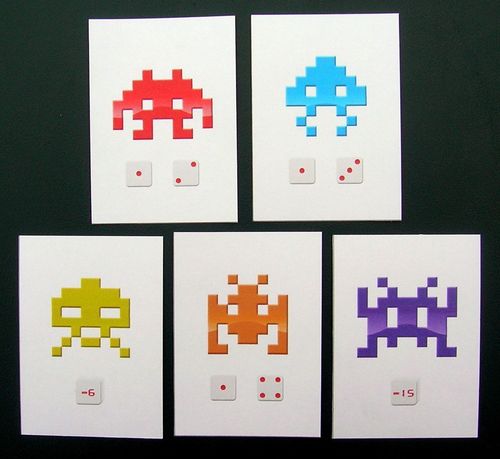
8-Bit Invaders
8-Bit Invaders Rulebook
Table of Contents
Table of Contents
Components
- 54 cards (6 sheets of 9 cards each)
- 35 Alien Invaders
- 3 Shields
- 7 Countdown cards
- 9 Bonus cards
- 1 small board for organizing decks; includes Alien Movement track.
You will need to provide:
- 9 six-sided dice
- 2 counters for the Alien Movement track (tens and ones)
Set-Up
Shuffle the deck of alien cards and deal them out into formation---five rows of seven cards each. Then place the shield cards under the second, fourth, and sixth columns of aliens. Place the play mat near the alien formation. Shuffle the bonus cards and place them face down on the Bonus Card draw deck space. Stack the countdown cards in ascending order on the count down space. (in your first game, the 7 should be on top). Place counters at both the 00 and the 0 spaces of the Alien Movement track. You are now ready to begin.
Victory Conditions
Each turn, the aliens approach the planet's surface. If you can destroy them all before they land, you win. If they land, or can concentrate their fire in counterattack, you lose.
Gameplay
Each turn of the game follows the same sequence. First you attack the aliens; then they counterattack and move closer to the planet's surface.
The turn sequence in more detail:
A. Player Actions
The player does the following in sequence:
-
Optionally discard one shield to immediately draw a bonus card.
-
Roll the attack. Gather 6 dice and roll them.
-
Allocate the attack. Place one or more dice on attacking aliens.
Placement must follow these rules:
- The first placement must be on an alien that is at the bottom of its column. The column must not be blocked by a shield.
- Subsequent placements must be adjacent to a previously placed die.
- Vertically, this can be any alien above an alien with a die as long there are no aliens between the two without dice placed on them. You may skip any amount of space above an alien on which you placed a die.
- Horizontally, the die must be in an adjacent column: you cannot "skip over" empty spaces. Nor can you pace adjacent to an empty space you skipped vertically.
- Further, all horizontal placements must be in columns adjacent to the initial placement.
- It is expressly allowed to place dice that will not kill the alien they are on.
- Every placed die must be on an Alien card; however, you are never obligated to placed dice. Feel free to scatter laser fire into the vastness of space at your whim.
(Diagrams: Two Legal Sequences of Placement (1-2-3, A-B-C-D) From Circled Initial Placement; Four Illegal Placements (A-B, A-2-3-4, A-b-c, α-β) From Circled Initial Placement.)
-
Kill aliens. If the dice placed on an alien match the dice necessary to kill it, the alien is removed to the "Dead Aliens" pile.
B. Alien Actions
The aliens do the following in sequence.
-
Counterattack. All aliens which are at the bottom of their column now counterattack. It is possible that this attack will be blocked by your shields. If there are 3 or more aliens of the same type (picture) at the bottom of their columns which are not protected by shields, they can coordinate their fire and destroy your ship. You lose.
- If there are 4 or fewer columns, the bottom 2 aliens in each column fire. As before, if these include three (or more) unshielded aliens of the same type, you lose.
- If there are 2 or fewer columns, the bottom 3 aliens in each column counterattack. If these include three or more unshielded aliens of the same type, you lose.
(Diagrams: "You survive because shields are blocking two aliens. If the shields move to the right, you must kill one or perish." — "You lose." — "Your shield protects you".)
-
Bombers. The four aliens numbered "=12" "=13" "=14" and "=15" are heavy bombers. If one of them is the bottom-most alien in a column that is immediately above a shield, that shield is destroyed.
-
Alien movement. Roll two six-sided dice, and subtract one from each. Add them together, and advance the alien movement track by that amount.
- If the current value of the alien movement track equals or exceeds the number of aliens remaining in formation, remove the top card from the countdown then reset the alien movement track to 0. The aliens are one step closer to landing.
- If the countdown reaches 0, the aliens have landed. You lose.
- Now determine whether the sum of the dice is even or odd.
- If the roll was even, move all shields one column to the left. Do not move the shields if this would cause the leftmost shield to move past the leftmost column of aliens.
- If the roll was odd, move all shields one column to the right. Do not move the shields if this would cause the rightmost shield to move past the rightmost column of aliens.
C. Next Turn
Collect any remaining dice from the alien formation. Now start the next turn with player actions.
Bonus Cards
Each bonus card provides a one-time benefit. If you need to draw a Bonus card and the draw pile is empty, shuffle the discard pile to form a new draw pile. If the discard pile is also empty, do not draw a bonus card.
The bonus cards (as printed on the card sheets in the same file):
- Rapid Fire (×3): Discard prior to attacking to add an extra die to the attack.
- Time Slip (×2): Discard after rolling an attack to re-roll any number of dice.
- Smart Bomb (×2): Discard after rolling an attack to flip one die to its opposite face.
- Extra Life: Discard to avoid dying from alien fire. Cannot prevent death by landing.
- Rocket Fuel: Discard to only roll one die for enemy movement this turn. You still subtract 1.
Difficulty Adjustments
The game as described above is the "easiest" setting. For a slightly harder game, start the countdown at 6 instead of 7. To make the game more difficult still, only roll 5 dice for your attack. You can mix-and-match these settings.