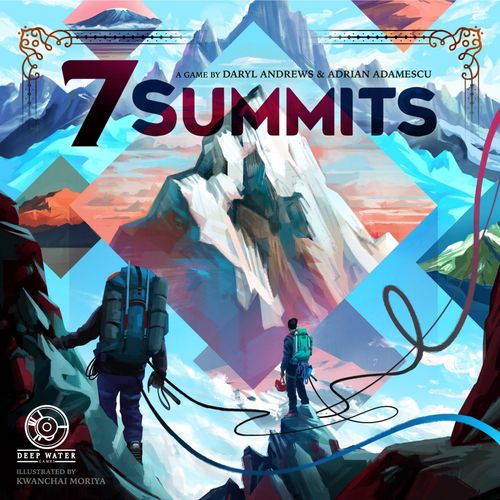
7 Summits
7 Summits Rulebook
Table of Contents
Table of Contents
Object
The object of 7 Summits is to climb (summit) the tallest peak on each continent. Players are racing against time, each other, and the elements until at least one of the players has summited each mountain peak.
Components
- 1 Game Board
- 5 Player Boards
- 6 Mountain Dice
- 1 Risk Die
- 54 Cards (36 Equipment Cards, 18 Mission Cards)
- 15 Skill Markers, 3 in each of 5 colors
- 35 Climbers, 7 in each of 5 colors
- 1 First Player Token
- 14 Discovery Tokens
Setup
- Place the Game Board in the center of the table within reach of all players.
- Shuffle the Equipment Cards and place them in a facedown stack near the Game Board.
- Shuffle the Discovery Tokens facedown and place one facedown on each purple space with a Discovery icon on the Game Board. Return any additional Discovery Tokens to the game box.
- Players each select a player color to represent them on their treks. Give each player a Player Board, 3 circular Skill Markers, and 7 Climbers in their selected color. Place the Skill Markers on the start spaces on the Player Board.
- All players place 1 Climber of their color below each mountain, next to the bottom of the game board.
- Shuffle the Mission Cards and deal 1 facedown to each player. Place the remaining mission cards facedown near the game board.
- The starting player is the youngest player at the table, give them the First Player Token.
Gameplay
Begin each round with the First Player rolling the 6 Mountain Dice and placing them below their matching colored mountain (Orange = Vinson, Purple = Denali, etc.) on the mountain die spaces.
Player Turns
Beginning with the first player and then proceeding in clockwise order, each player takes a turn. On your turn, select a Mountain Die from the bottom of the board and use it to climb. Then place the used die at the top of the board and end your turn.
- 2 or 3 Players: Each player takes turns clockwise around the table until all dice are taken.
- 4 or 5 players: each player takes a single turn each round.
- At the end of the round, pass the first player marker to the left.
Note: If you cannot climb any mountain using the available mountain dice, select a die and place it at the top of the board, but draw an equipment card instead of climbing.
Equipment Cards
You may play any number of your equipment cards on your turn.
Climbing
Move your Climber up the mountain a number of spaces equal to the number on the chosen Mountain die. You may move up only on the Mountain matching the Color of the die or Everest. Then make a choice:
a.) Stop and stay where you are
- Collect any discovery tokens or skills on the space you finish climbing on.
b.) Press On and continue climbing
- Take the die you selected and re-roll it together with the Risk Die.
- The result of the Risk Die affects how you will continue to climb.
Risk Die results:
- Clear Trails: Climb the mountain again a number of spaces equal to the amount shown on the Mountain Die. You may continue to climb and Press On again or stop and end your climb.
- Hazard 1 / Hazard 2 (-1 / -2): Subtract 1 or 2 spaces from the Mountain Die and then climb that many spaces. This may result in your climber moving backwards down the Mountain. Your climb is over and you may not Press On any more this turn.
- Avalanche: Move your climber all the way down off of the Mountain to the bottom of the game board. Your climb is over and you may not Press On any more this turn.
When you finish climbing collect any Discovery Tokens and Skills on your space, your turn is then over.
Example: Patrick chooses the Denali Mountain Die showing a 3 and moves his climber up 3 spaces on Denali. Then Patrick chooses to Press On and re-roll the Mountain die he drafted together with the risk die. The risk die shows green Clear trails and the Mountain die is a 2. He moves his climber up 2 spaces again.
He then decides to again Press On one more time. He re-rolls the Mountain die with the weather again. The risk die shows "-2" and the Mountain die 1, so he subtracts 2 from his climbing value of 1 and actually slides down by 1 space. He now has to stop and can't continue to Press On to go up the mountain again.
If Patrick had rolled the Avalanche on the risk die instead he would have slid all the way down to the Base Camp of Denali.
Summiting a Mountain
The summit of each mountain is marked by its die icon surrounded by a large ring. To reach the Summit you need the exact number of moves (you can't overshoot). If your climb would take you past the Summit, your climber does not move; then decide to Stop or Press On as normal. When your Climber reaches a Mountain's Summit, place your Climber in the highest valued unoccupied scoring space for that mountain.
4 or 5 players: If more than 3 players summit the same mountain each player after the third draws 1 equipment card but does not receive any points.
Example: Richard selects a 3 but the Summit is only 2 spaces away. He may not continue but instead Presses On and rolls a Mountain die with the Risk die. He rolls a 2 and moves up to the mountain's summit.
Climbing Everest
You may climb Everest with any colored die. Mt. Everest is very dangerous, if you decide to Press On while climbing Everest you must roll the Risk Die twice and resolve the worst result.
Note: Avalanche is worse than Hazard 2, which is worse than Hazard 1, which is worse than Clear Trails.
Example: Junko selects the Orange 3 die and instead of climbing Vinson, she uses it to climb 3 spaces on Mount Everest. Junko then decides to Press On and rolls a 2 on the Mountain Die, and a clear on the Risk Die. Junko then re-rolls the Risk Die and gets an Avalanche. Having to take the worst result Junko moves her climber all the way back down and off of the mountain from the Avalanche.
Equipment Cards
You'll need to take advantage of your gear in order to make the most of your climb.
You may use any number of your Equipment cards during your turn, discarding them after use. You may use equipment before or after you've climbed.
Mission Cards
Every climber has a goal — something that keeps them going when things get tough.
Mission cards are kept secret from the other players and counted for points at the end of the game. You may look at your own mission cards at any time.
Plateau
Some equipment and mission cards refer to the plateau – this is the thick line that runs horizontally across the center of the board. Spaces above the Plateau are blue and the ones below it are red.
Gaining Skills
Gaining Preparation and Expertise
If you finish climbing on a space that shows either an Expertise or a Preparation icon, or if you reach that space using skills or equipment, immediately move your skill marker up one space on the corresponding track and gain or unlock the reward shown.
Gaining Teamwork
When you finish climbing or reach a space by using skills or equipment that contains another player's climber, all players on that space move up one space on their Teamwork skill track. The active player resolves the newly unlocked corresponding skill first followed by the other player(s) in clockwise order. Each player may only gain at most 1 Teamwork per turn.
Discovery Tokens
When you finish climbing or reach a space by using skills or equipment that contains a Discovery Token, take that token and flip it over to reveal a bonus that you may use once immediately. Keep all Discovery Tokens that you collect next to your Player Board until the end of the game as they might affect final scoring.
Using Skills
Using an unlocked skill is always optional. Some Skills will allow you to modify die rolls. Anytime you select or roll the corresponding die you may choose to apply the modifier. If a skill has you move a climber, you may gain any Skill or Discovery Tokens on the space you move to.
Game End
The end of the game is triggered when there is at least 1 climber on the Summit of each mountain. Once the end of the game has been triggered, finish the current round (all players have an equal number of turns).
Scoring
Add up your points from
- The Mountains you summited
- Mission cards you accomplished
- Any Discovery tokens with points on them
The player with the most points is the winner.
Skills Reference
Expertise Skills
- +1: Draw 1 Equipment card.
- +2: Draw 2 Equipment Cards.
- Use Adjacent: On your turn, when you select a mountain die, you may use it to climb an adjacent mountain instead of the mountain it corresponds to.
Preparation Skills
- +1: Draw 1 Mission Card.
- Draw 2 Keep 1: Draw 2 Mission Cards, then discard 1 Mission Card.
- +1 / -1: Whenever you use a Mountain Die to climb you may adjust its value by +1 or -1 (this may even make the value 0 or 5).
Teamwork Skills
- Move 1: Move one of your climbers up one space on any mountain.
- Move 2: Move one of your climbers up two spaces on any mountain.
- -1: Whenever you roll the Risk Die you may treat a "-1" as -0 or a "-2" as -1. Rolling either of these faces will still end your climb.
- +1 Everest: This skill step is repeatable. Move your climber on Everest up one space each time you would gain a teamwork beyond your third.
The 7 Summits
Puncak Jaya
Elevation: 4,884 m (16,024 ft). Oceania (Australian Continental Shelf). Puncak Jaya is on the Indonesian island of New Guinea, and is the tallest island in the world. Despite having the lowest elevation of the 7 Summits, this mountain has one of the highest technical ratings.
Mount Vinson
Elevation: 4,892 m (16,050 ft). Antarctica. Mt. Vinson is the highest peak on the large Vinson Massif, a thrust up section of the Earth's crust 21 km (13 mi) long and 13 km (8.1 mi) wide. During the summer season, November through January, Mt. Vinson receives constant sunlight. While the average temperature during these months is -30 °C (-20 °F).
Mount Elbrus
Elevation: 5,642 m (18,510 ft). Europe. Mt. Elbrus is a dormant volcano in Southern Russia. This is the tallest peak in the Caucasus Mountains which form the intersection of Europe and Asia. Geologists believe Mt. Elbrus last erupted around 50 AD.
Mount Kilimanjaro
Elevation: 5,895 m (19,341 ft). Africa. Located in Tanzania, Kilimanjaro is the tallest single free-standing mountain in the world. A dormant volcano Kilimanjaro has 3 distinctive volcanic cones named Kibo, Mawenzi, and Shira.
Mount Denali
Elevation: 6,190 m (20,310 ft). North America. Denali is located in central Alaska. The United States government officially called this mountain Mount Mckinley from 1917 until 2015 but the local Koyukon Athabaskans and most Alaskans have always referred to the mountain as Denali. In the native Koyukon language Denali literally means "the tall one". Denali has the longest rise from base to summit of any mountain on Earth.
Mount Aconcagua
Elevation: 6,960.8 m (22,837 ft). South America. Aconcagua is located in Argentina and is part of the Andes Mountain Range. It is the tallest mountain outside of Asia and thus the tallest peak in both the Southern and Western hemispheres. In mountaineering terms Aconcagua's northern route is relatively easy and thus the mountain is known as the highest non-technical climb in the world.
Mount Everest
Elevation: 8,848 metres (29,029 ft). Asia. Earth's highest point, located in the Himalayas on the border of Nepal and China. Everest was first summited in 1953 by the famous mountaineering team of Edmund Hillary and Tenzing Norgay. Everest presents many hazards and has claimed the lives of over 300 climbers. One of the fiercest hazards is the high winds at the top. The peak of Mount Everest extends through the upper troposphere and into the stratosphere, which can expose it to the winds of the jet stream.
Iconography
Icons: Point; Mountain Die; Discovery Tokens; Mission Card; Equipment Card; Expertise Skill; Preparation Skill; Teamwork Skill; Clear Trails; Hazard 1; Hazard 2; Avalanche.
Discovery Token bonuses: Advance 2 on Everest; Gain any Skill; 2 points at end of game; Advance 1 on displayed Mountain; Draw 1 equipment card.