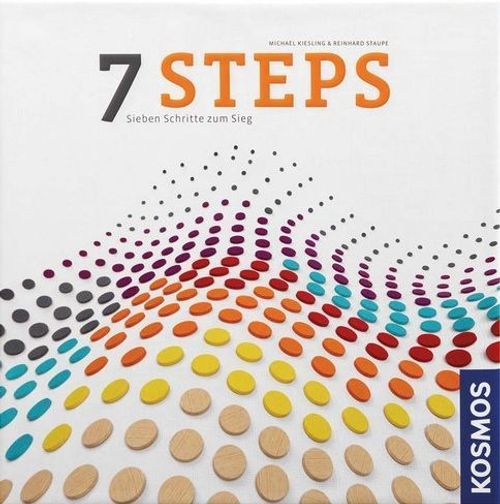
7 Steps
7 Steps Rulebook
Table of Contents
Table of Contents
- What is it about? (Worum geht's?)
- Game Components (Spielmaterial)
- Setup (Spielvorbereitung)
- Course of a Turn (Ablauf eines Spielzugs)
- The 7-Point Rule (Die 7-Punkte-Regel)
- Using the Special Tiles (Einsetzen der Sonderplättchen)
- Further Rules (Weitere Regeln)
- End of the Game (Spielende)
- Overview of Building-aid and Victory-point Tiles (Übersicht über Bauhilfe- und Siegpunkte-Plättchen)
- Variants (Varianten)
What is it about? (Worum geht's?)
In each turn every player has 7 discs available and builds as many of them as he likes. In this way, step by step, towers arise that grow ever higher, to a maximum of 7 discs. Every newly placed disc scores points, depending on the height of the tower. The player who places his discs cleverly and makes the best use of the various special tiles scores the most points and wins.
Game Components (Spielmaterial)
- 140 discs (20 each in 7 colors)
- 1 bag
- 7 board tiles (each tile shows 7 spaces). The tiles are printed on both sides to allow a variable board setup.
- 4 screens (in the player colors)
- 4 scoring stones (in the player colors)
- 1 scoring track (from 0 to 40)
- 12 "40+" tiles
- 1 start player tile
- 20 special tiles: 10x "Building aid" (Bauhilfe), 10x "Victory points" (Siegpunkte)
Setup (Spielvorbereitung)
- All 140 discs go into the bag.
- The 7 board tiles are put together in the middle of the table to form the game board. Decide on variant 1 or variant 2, whichever suits you better:
- Board variant 1 (use the front sides): easy introduction, higher luck factor.
- Board variant 2 (use the back sides): more tactical, lower luck factor.
- The 7 board tiles can be arranged in any way. It is only important that the depicted "basic shape" results.
- The Building-aid tiles and the Victory-point tiles are shuffled separately and placed next to the board as two face-down draw piles.
- The scoring track is placed next to the board. The "40+" tiles are placed next to the scoring track. Each time a player's scoring stone goes all the way around the scoring track, he receives a "40+" tile.
- Each player chooses a player color (light brown, dark brown, white or gray) and receives 1 screen and 1 scoring stone in his color. Assemble the screen from its 3 parts and set it up in front of you. The scoring stone is placed on space 0 of the scoring track. With fewer than 4 players, unneeded screens and scoring stones go back in the box.
- Each player secretly and randomly draws 7 discs from the bag and places them behind his screen.
Course of a Turn (Ablauf eines Spielzugs)
Draw lots to determine who becomes start player. He receives the start player tile, which stays with him until the end of the game. The start player takes the first turn and carries out the following 3 actions in order:
- Build 1-7 discs
- Collect points
- Draw up to 7 discs
When a player has finished his turn, the next player clockwise takes his turn and carries out the 3 actions in turn. The game continues clockwise in this manner.
1. Build 1-7 discs (1-7 Scheiben verbauen)
When it is your turn you must first place one of your 7 discs on an empty space. The color of the disc and the color of the space must match. This creates a tower of level 1.
Then you must decide: Do you place another disc, or do you not place another disc? If you want to place another disc, you must place it on a space adjacent to the disc you just placed.
Every further disc must always be placed adjacent to the disc placed last, and either on the same level or at most one level higher than the previously placed disc. If you build on a space of the next higher level, you simply put the new disc on top of the disc(s) already lying there. In this way, step by step, towers of higher levels arise.
You are free to decide in which direction you continue building adjacently; you do not have to place your discs in a straight line. However, you may not build on any space more than once in a turn. Each tower can therefore grow by only one level per turn.
It is not possible to build "downward", that is, onto an adjacent space of a lower level than the space last built on.
It is not possible to build onto an adjacent space that is more than one level higher than the space last occupied.
This decision repeats until you cannot or do not want to place any further disc.
Levels (Ebenen)
Gradually, towers of discs will arise on the board. The towers will be of different heights. The height of the towers is given in levels. A tower consisting of 1 disc has level 1. A tower consisting of 2 discs has level 2, and so on.
Example (Beispiel)
Start player Arnd laid the discs without arrows in his first turn. Now it is Bärbel's turn.
- Bärbel places a turquoise disc on an empty turquoise space (level 1).
- Then Bärbel places a yellow disc on an adjacent yellow space (also level 1).
- Then Bärbel places a beige disc on the adjacent beige space one level higher (level 2).
- Now Bärbel places a purple disc on the adjacent purple space. This space has the same level as the previously occupied space (level 2).
- Bärbel cannot place any more, because she has no further suitable discs.
- For her four placed discs Bärbel receives 1 + 1 + 2 + 2 = 6 points.
Further examples:
- Caro places the turquoise disc on level 1. She now cannot place a red disc on the adjacent red tower, because she would otherwise "jump" from level 1 to level 3.
- Next it is Caro's turn and she places these six discs: first the black disc, then the red, then a beige, another beige, then the yellow (on level 2) and finally another beige (on level 3). She receives 1 + 1 + 1 + 1 + 2 + 3 = 9 points for it.
- Dirk places the yellow disc on level 2. He now cannot place a purple disc on the adjacent empty purple space, because he would otherwise be building "downward".
2. Collect points (Punkte kassieren)
Irgendwann kannst oder willst du keine weitere Scheibe mehr verbauen. Most of the time you will also not be able to build all 7 of your discs. Next you receive points for the discs you have just built.
For building each disc you receive points corresponding to the level on which the disc was placed: 1 point on level 1, 2 points on level 2, and so on.
Note: Via the Victory-point tiles you can possibly score additional points (see "Using the special tiles").
You walk the points you scored as steps with your scoring stone on the scoring track.
Tip: It is best to count the points aloud while placing each individual disc and add them up directly.
3. Draw up to 7 discs (Auf 7 Scheiben nachziehen)
At the end of your turn you may throw as many of your discs as you like that are still lying behind your screen into the bag. This can be helpful to get rid of discs of colors that you consider useless for your next turn.
Afterwards you refill your supply behind your screen to 7 discs by secretly and randomly drawing discs from the bag.
Next player (Nächster Spieler)
Then the next player clockwise takes his turn. He must again begin on an empty space (level 1). He does not have to begin adjacent to the last disc of the player before him, but can begin anywhere on an empty space.
The 7-Point Rule (Die 7-Punkte-Regel)
Did you score only 7 or fewer points in your turn? Then you receive a special tile as "compensation". Decide whether you want a Building-aid tile or a Victory-point tile. Take it from the respective draw pile.
Each player may have at most 1 Building-aid tile and 1 Victory-point tile. Do you already have 1 Building-aid tile and 1 Victory-point tile and you receive another? Then you must decide whether you want to keep the newly received tile or the old tile of that kind. The tile you do not choose you lay unused on the corresponding discard pile.
Received special tiles are laid face down next to your screen until you use them in a later turn. You may therefore not use a special tile in the same turn in which you received it. You may of course look at your special tiles at any time.
Using the Special Tiles (Einsetzen der Sonderplättchen)
Building-aid tiles are used in your turn before you place the first disc.
Victory-point tiles are used in your turn when you collect points.
Used special tiles are laid face up on the corresponding discard pile. Should one of the draw piles ever be empty, shuffle its discard pile and place the shuffled tiles as a new face-down draw pile.
The victory points you receive from a Victory-point tile are added to the points you received for the placed discs. For the 7-point rule, the sum of "points from discs" + "points from Victory-point tiles" counts to determine whether you receive a new special tile.
Further Rules (Weitere Regeln)
Towers of level 7 (Türme der Ebene 7)
A tower that reaches level 7 is taken from the board after the turn. Then the 7 discs of this tower are distributed onto the 7 spaces of this color, 1 disc on each space. Should the distribution again create a tower of level 7, this tower is also taken from the board and distributed again. This rarely happens.
All spaces of a color occupied? (Alle Felder einer Farbe belegt?)
In the course of the game it can happen that at least one disc lies on all seven spaces of a color. In this color you can then of course no longer begin on an empty space. Nevertheless you may begin with a disc of this color. You then place the first disc on a space of the lowest level of this color.
End of the Game (Spielende)
The game ends when a player at the end of his turn cannot refill his supply to 7 discs (because the bag is empty). The round in progress is however played to its end, so that every player has had the same number of turns. During the game you may check by feeling how many discs are still in the bag, but you may not look inside.
Each unused Building-aid and Victory-point tile is worth 2 points at the end.
The player with the most points now wins the game. Do not forget the collected "40+" tiles.
In case of a tie, the players involved in the tie share the placement.
Overview of Building-aid and Victory-point Tiles (Übersicht über Bauhilfe- und Siegpunkte-Plättchen)
Building-aid tiles (Bauhilfe-Plättchen)
You use Building-aid tiles in your turn before you place the first disc. After you have used a Building-aid tile, you must put it on the discard pile.
- Remove 1 or 2 discs and put them in the bag. With this tile you may remove 1 or 2 discs lying on the board. The discs can be of the same color or of different colors. You can also remove discs on towers with it. Removed discs go into the bag. Attention: Should the bag be empty when you use this tile, the discs do not go into the bag but into the box.
- Move or swap towers. With this tile you may move 1 tower to an empty space of the same color. You take the whole tower and put it on an empty space of this color. Or you swap 2 towers of the same color. You take both towers and swap their positions.
- Move a disc within its color. With this tile you may move 1 disc anywhere within its color. Take the disc and put it on another space of the same color. The disc can lie alone or on a tower. You can put it on an empty space or on a tower.
- Place the first disc one level higher. With this tile you may place the first disc in your turn 1 level higher. So instead of in level 1, in level 2; or even higher if in one color all spaces are occupied. Attention: When you use this tile, you may however build at most 5 discs in this turn (not up to 7 as usual)! This is to prevent this tile from being too powerful.
- Remove 1 disc to your supply. With this tile you may remove 1 disc lying on the game board. You can also remove a disc on a tower with it. You take the removed disc into your supply behind your screen. Afterwards you must throw any other disc from your supply into the bag. Attention: Should the bag be empty when you use this tile, the disc does not go into the bag but into the box.
Victory-point tiles (Siegpunkte-Plättchen)
You use Victory-point tiles in your turn when you collect points. After you have used a Victory-point tile, you must put it on the discard pile.
- Different colors. After you have built 1-7 discs in your turn, you look at how many different colors you built. You receive 1 point per color.
- Most discs of one color. After you have built 1-7 discs in your turn, you look at which color you built the most discs of. For each built disc of this color you receive 2 points. Note: If you built the most discs in several colors equally, you receive points for only one of these colors.
- Edge spaces. After you have built 1-7 discs in your turn, you look at how many discs you built on edge spaces of the board. Not all built discs must have been placed on edge spaces. For each built disc on an edge space you receive 1 point. Note: In the board variants "The Ring" and "The Mask" there are edge spaces lying on the inside, which also count for this.
- Straight line. After you have built 1-7 discs in your turn, you look at how many discs you built in a straight line. Not all built discs must have been placed in a straight line. You consider the longest straight line of your built discs. For each built disc in a straight line you receive 1 point.
- 3rd level (two colors). After you have built 1-7 discs in your turn, you look at whether you placed at least one disc of one of the two indicated colors on the 3rd level. If so, you receive 5 points. You receive these 5 points only once, even if you placed a disc on the 3rd level on several spaces of the indicated colors. (Per the English card translation, the indicated color pairs are Red/Purple on some tiles and Yellow/Black on others.)
Variants (Varianten)
Alternative end of game
Would you like to play a bit longer? Then after the actual end of the game you play exactly 1 more round. Each player thus gets exactly one more turn. In this way you build even more discs. However, it is very likely that not every one of you will have the same number of discs available for his last turn.
Variable board setup
Whoever wants even more variety can also arrange the board tiles differently at the start of the game. Here are five suggestions: "The Mask", "The Turquoise River", "The Butterfly", "The Ring" and "The Big Cross". But other shapes are also possible. Just try it out!