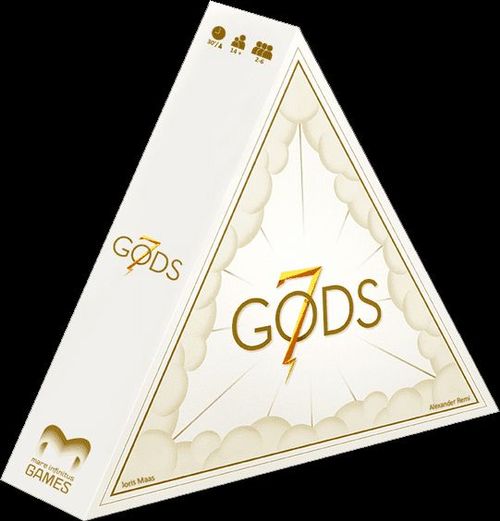
7 Gods
7 Gods Rulebook
Table of Contents
Table of Contents
Introduction
Ancient civilizations used to spread stories of mighty gods who created the world and its inhabitants. Standing high above all creation, the gods ruled this world and were worshipped by the creatures living there.
This fact was enjoyed so immensely by the gods that some of them decided to create a new world to spread even more of their stories, and in doing so get more beings to worship them.
On this new world, 7 Gods from different ancient cultures send forth their envoys to spread word of their greatness, each aiming to become the most popular god of this new world. But there is only room for 6!
In this rulebook, we use "she" or "her" for the envoys or players, but you can also read "he" or "his".
Game Components
- 1 Game board
- 7 God Boards
- 7 Envoys, 1 for each god
- 14 islands, 2 for each god
- 119 Story Tokens (4-sided dice)
- 1 Cloth bag: The Well of Wonders
- 56 Triumph Tokens, 8 for each god
- 210 Envoy Cards, 1 deck of 30 cards for each god
- 12 Personal objective cards
- 1 Old Stories card
- This rulebook
Goal of the Game
You are a god! Score points by sending your envoy across the board, discovering new lands and telling impressive stories that persuade the people of this world to spread these tales. The player with the most points at the end of the game is the most popular god, and is declared the winner.
Game Setup
A. Unfold the game board and place it on the table.
B. Determine the End Phase triggers. Reaching either the number of story tokens or VP will trigger the end phase.
| Players | Story Tokens in Otherworld | Victory Points |
|---|---|---|
| 2 | 4 | 24 |
| 3 | 5 | 22 |
| 4 | 6 | 20 |
| 5 | 7 | 18 |
| 6 | 8 | 16 |
C. Randomly choose one of the seven God Boards and place it next to the game board, visible to all players, showing the disturbances on the back of the god board. This god is excluded from this game; return its envoy and its two islands to the box.
D. Place all remaining islands (six small and six big) in a facedown pile. The player who usually tells the most awesome stories draws the top island from the pile and places it facedown on the board, without looking at it. Then the player to their left does the same, and so on around the table until all twelve islands have been placed.
When placing an island, follow these rules:
- They need to align with the spaces on the board.
- They can't overlap and can't be placed partially off the board or in the clouds.
- Make sure to leave the first ring of spaces around the Otherworld (the central island) free.
- You cannot place an island so that it would make one or more water spaces inaccessible.
E. All players (randomly) choose a God Board and place it on the table in front of them. Each player takes three story tokens of their own colour and places them on their God Board.
F. All players take the deck of envoy cards belonging to their god (indicated by the colour of the image), shuffle it and put it in front of them face down.
G. The player who picked a god last puts her envoy on one of the six spaces on The Otherworld, then the player left of her chooses a start space and so on until all players have placed their envoys on The Otherworld.
H. Put the Triumph Tokens of the corresponding colour next to each player's God Board and use one of each to track the score on the VP track.
I. Put all remaining story tokens - including those belonging to the excluded god, and any gods that are not in play - into the Well of Wonders.
J. Put the Old Stories card next to the board so all players can reach it.
K. Shuffle the personal objective cards and deal two to each player. Each player chooses one, then returns the other one facedown to the deck.
L. Each player draws three cards from their envoy deck.
M. Return all unused God Boards, envoys, envoy decks and Triumph Tokens to the box, with the exception of the God Board that was excluded and placed facedown next to the game board.
N. The player who picked a god last is the starting player. Player turns proceed clockwise.
Turn Overview
- Draw a random story token from the Well of Wonders, place it in the Story Token Pool on your God Board and draw one card from your deck. Every story token can be used for a specific action, as explained later. When you draw a story token with the colour of the excluded god you can use this story token for any colour except for the colour of the excluded god and your own colour.
You cannot have more than nine story tokens in your story pool, or more than five cards in your hand. At the end of your turn discard any surplus cards to your discard pile. Place any surplus story tokens on the "Old Stories" card (this is a shared discard pool).
If a player's deck is depleted, they shuffle their discard, remove ten cards from it at random and return them to the box, and use the remaining cards as a new, smaller deck. The third time a player does this they will return their whole discard pile to the box, so they will no longer have a deck.
- Play one card to move.
When a card is played to move, the player whose god has the same colour as the played card draws one random story token from the Well of Wonders.
Move the envoy over the sea exactly the number of steps shown on the played card.
And/or you can play one or more cards for its card text.
Other possible actions for one player during their turn:
- Discard a card to draw a random story token from the Well of Wonders or vice versa (once per turn and not both).
- Use the Power of your own god once per turn for free.
- Use the Power of each other face-up god once per turn by discarding one story token with the corresponding colour to the Old Stories.
- Discard four story tokens to the Old Stories to draw one story token of your choice from the Old Stories.
- Meditate: Instead of moving you may draw one random story token from the Well of Wonders.
Possible actions when it's not your turn:
- Play one or more cards for their card text.
Moving
From any space an envoy can move into any adjacent sea space - they cannot move onto or over land. When moving over Currents on the board, players can move in the direction of the current costing one step or against the current costing two steps (see example on top of page).
A maximum of two envoys can be on one space at the same time. When an envoy ends her movement next to an undiscovered (face down) island, turn it face up. Discovering an island rewards the player with 1 Victory Point (VP). If the colour of that card that was played to move matches that of the island, you can start Storytelling. When seven islands have been discovered, remove the rest of the undiscovered islands from the game, unless all six colours in the game have not been discovered yet. As soon as all different colours in the game have been discovered the undiscovered islands will be removed.
Envoy Card (key)
- Movement steps (the number shown in the corner of the card)
- Card colour
- Timing icon: During your turn / During moving / During storytelling / Any time
- Card text
- Card name
- Card number
God Board (key)
- Power of your god
- Turn overview
- Trading
- Story Tokens
- Power of other gods
- Disturbances
Story Telling
If your envoy ends her movement adjacent to a village on an island that is the same colour as the card you played, she can start Storytelling in that village. Take a story token in your god's colour from your pool, roll it and place it on the village.
Each player can only have one of their own story tokens on any village at any time. A village can have no more than two different story tokens at any time.
Example (page 6 diagram): The Red Envoy wants to Tell a Story on this Black Island where a story has already been told by the Green Envoy. The Story of the Green Envoy has a value of 2 (A). The Red Envoy rolls her Story Token Dice and rolls 4 (C). Together 2+4=6 and when this is equal or higher than the Persuasion Value (B) the player with the highest roll wins a number of VP equal to the Persuasion Value, in this case 6VP. The other player's Story Token goes to The Otherworld.
Persuasion
Each village shows a number that indicates how easy or how difficult it is to persuade the villagers by Storytelling. This number is called the Persuasion Value.
If a village has two story tokens with a total score equal to or greater than the village's Persuasion Value, the village favours the god whose story token has the highest score (the most recently placed one, in the case of a tie). That token is discarded to the Old Stories pool, and its player puts one of their Triumph Tokens onto the village to show that the village chose a story. Then that player scores Victory Points equal to the Persuasion Value of the village. A village can only be persuaded by one god, and once it has been persuaded, no more stories can be told there.
The story token with the lower number on it will be placed on the Otherworld. This player also draws a story token from the Well of Wonders and activates a disturbance (see below).
Sharing Thoughts
Whenever the envoy of the active player ends her movement on the same space as another envoy, the envoys exchange stories about divine matters. Both players roll all story tokens from their pool. The player with the highest total gets 1 VP and the other player draws one random story token and one card. In the case of a draw, re-roll all dice. The dice are returned to the pools.
These verbal exchanges will most likely last hours on end, so after Sharing Thoughts the turn ends. A player who Meditates cannot Share Thoughts, but can play one or more cards for their text.
Disturbances
A disturbance is activated after a village chooses which story is best. When the player with the lower number puts her story token in the Otherworld she also draws one story token from the Well of Wonders and activates a disturbance. The colour of the story token drawn determines which disturbance is activated. The available disturbances are listed on the back of the excluded God Board. When a story token of the excluded god is drawn the player chooses which of the available disturbances will be activated.
Disturbances (colour of story token drawn):
- Torn Pages (yellow)
- Obliterate (magenta)
- Storm (red)
- Amnesia (blue)
- Stolen Idea (brown)
- Miscommunication (dark grey)
The page 6 diagram also shows a green die labelled "Wild" beside this list; the printed text does not explain it further, so it is transcribed as shown.
End of the Game
The end phase of the game can be triggered in three ways:
I) When a player reaches a certain number of Victory Points.
II) When a certain number of story tokens are in the Otherworld.
III) When the Well of Wonders is empty.
As soon as one of these is true, each player except the one that triggered it takes one more turn, then the game ends. Also see page 4, Game Setup section B.
Scoring Points
After all players have completed their turns, each player scores additional VP as follows:
- Score 2 VP for each of their story tokens on an island.
- Score 1 VP for each of their own story tokens in their story token pool.
- Score 1 VP for every two other story tokens in their story token pool.
- All players except the player who has currently the most VP, roll their god's colour story tokens in the Otherworld and add the values to their VP (you can play cards for their text in this phase).
- Each player reveals their Personal Objective and scores VP accordingly.
The player with the most Victory Points is the most popular God and wins the game. If there is a draw, the player with the most story tokens in the Otherworld at the end of the game is the winner. If there is still a draw play another game to decide a winner.
The Powers of the Gods
Ra: Use both move and text on the same card. You can use a card to move and use the card for its text in the order you want.
Odin: Add 1 to a story token on the island where your envoy ends her movement. If your envoy ends her movement next to an island where a story token is present, you can increase the number on the story token by 1. A 4 cannot be increased.
Quetzalcoatl: Move up to two spaces extra. Normally you move exactly the number of spaces depicted on the envoy cards with a number, but if you use Quetzalcoatl's power you can add 1 or 2 to this number.
Ixchel: Draw a card then discard a card. You can choose which card to discard. This includes the card you just drew.
Guan Yin: Reroll any story token with a '1'. When a story token is rolled, you can reroll a '1' once.
Yemaya: When telling a story: put your story token on any village on the island where your envoy ended her movement. After you rolled your story token you can decide on which village your story token will be placed.
Sylvanus: When there are exactly two story tokens on a village subtract 1 from the persuasion value on that island. For example: a village has a persuasion value of 6 and there is already another player's story token on the village with value '2'; your envoy tells a story in that village and you roll a '3'. Together this is 5 and normally not enough to persuade the villagers, but when you use Sylvanus' power it's enough. Attention: you win 5VP instead of 6VP because the persuasion value is now 5 (6-1).
Disturbance List
These are the disturbances listed on the back of the excluded God Board.
- Meddling: Take two story tokens of your choice from the player that just persuaded a village.
- Plot Twist: The player that just persuaded a village loses 1 VP.
- Amnesia: The player that just persuaded a village discards all story tokens of a colour of your choice to The Old Stories.
- Obliterate: Reduce all story token values on an island anywhere on the board by 1*.
- Exile: Move an envoy to one of the spaces in the Otherworld.
- Dementia: Reduce all story token values on a continent by 1*.
- Erase: Remove a story token from the Otherworld and put it in The Old Stories.
- Lost: Move a story token from a village anywhere on the board to another village on that island.
- Miscommunication: Remove a story token from a village anywhere on the board and put it in The Old Stories: the player whose story token is removed rolls a random story token from her pool to replace it.
- Stolen Idea: Look at the hand of cards of the player that just persuaded a village and steal a card of your choice from it.
- Storm: The envoy of the player that just persuaded a village cannot move or Meditate next turn. Put the envoy on its side to mark this.
- Move target story token to another village on another island.
* A story token on a village that is reduced below '1' will be discarded. A story token on a village that is increased while on '4' will remain on '4'.
Glossary
- Continent: Each of the six large triangles that make up the board.
- Currents: The directional flow of the water in the seas.
- Discard: Placing a card on your discard pile or putting a story token in the Old Stories.
- Discard Pile: The place where used cards are placed.
- Disturbance: A special action on the reverse of the excluded god's board.
- Disturbance Token: A story token which you need to activate a disturbance.
- Draw: Take the top card of your deck or a random story token from the Well of Wonders.
- Envoy: Representative of the god who travels over sea to tell stories.
- Large Island: An island with four villages on it.
- Meditate: Instead of moving, draw one story token from the Well of Wonders.
- Moving: When a card is played to move the envoy an exact number of spaces.
- Otherworld: Central island on the board.
- Powers: Abilities of gods.