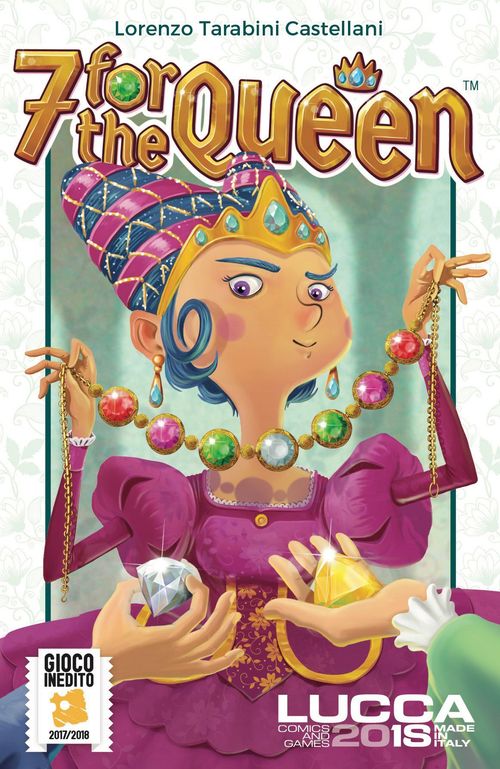
7 for the Queen
7 for the Queen Rulebook
Table of Contents
Table of Contents
Contents
- 7 Necklace cards
- A deck of 78 Precious Stone cards (Ruby, Emerald, Diamond, Topaz, Sapphire, Amethyst)
- 4 summary cards
Set Up
- Lay the Necklace cards in a row in the middle of the playing area.
- Shuffle the deck of Precious Stones and place it, face down, above the Necklace cards, forming the draw deck.
- Turn over the top 5 cards from the deck and put them face up near the deck. This is called the "display".
- Each player draws 7 cards (keep your cards hidden from the other players).
- Each player takes a summary card.
- The player who has most recently seen the Crown Jewels will be the starting player (or you can draw lots).
Example: Set up for 3 players. (The example shows the three players' hands, the Necklace cards, the display and the draw deck laid out on the table.)
The Goal of the Game
The Necklace cards show which Precious Stones the Queen wants in her new necklace at that moment. When a player plays a card with the Queen's demand symbol (a necklace icon), all players check their hands to see if they have the winning combination — that is, if they have all of the Precious Stones that the Queen currently wants. If any player has a winning combination, they win the game!
At the start of the game, the Necklace cards do not show any Precious Stones yet, because nobody has recommended any to the Queen. In this case, the Queen will be happy with any 7 stones, as long as they are all the same. As the game progresses, the players will recommend specific gems by playing Precious Stones on the Necklace cards, convincing the Queen that she wants a mix of stones which may vary from turn to turn. The player who can satisfy the Queen's current request when she demands to see her new necklace will be the winner!
The Game
The game is played in turns in clockwise order. The starting player takes the first turn.
On your turn, you must choose either to:
- Draw one card or
- Play one card
1. Draw One Card
Take any one card from the display or the top card from the draw deck and add it to your hand. If you take a card from the display, replace it immediately with the top card from the deck. There is no limit to the number of cards you can hold in your hand (however, note that in the case of a tie, victory goes to the player who has the fewest cards in their hand).
2. Play One Card
Choose any one card from your hand and play it on any empty Necklace card. Then, carry out the action shown on the card you just played: see Card Actions.
Important: If all of the Necklace cards are already occupied by Precious Stones, you may play your card on any Necklace card. The Precious Stone that was already on that card is discarded.
Example: Emma plays an Emerald with the symbol to the right, on the fifth Necklace card, which is empty (1). Then, she performs the card's action (which allows her to ask another player for any Precious Stone) (2). Then her turn ends.
Card Actions
-
Ask another player for the Precious Stone of your choice. That player must give you one card of that type, if they have any. If they have none, they have to show their hand to prove it. Example: Emma tells Sarah: "Give me a Ruby!" Sarah, who holds three Rubies in her hand, passes one of them to Emma.
-
Discard one Precious Stone from any other Necklace card. Example: Emma plays a Ruby on a Necklace card and discards the Emerald from a different card.
-
Draw one card from the display or from the deck. If you take a card from the display, replace it immediately.
-
The other players must each discard one card, or you must discard up to 3 cards. The Queen demands to see her new necklace! Check if any player has a winning combination (see The End of the Game). If no player has a winning combination, the game continues.
The Queen's Request
The combination of Precious Stones requested by the Queen (called the "winning combination") is the one shown on the Necklace cards. This combination will change every time a card is played. The order of the cards is not important.
The winning combination is always made up of exactly seven Precious Stones, even if some of the Necklace cards are empty. If one or more Necklace cards are empty, the Queen will accept any Precious Stone for those settings, but you must use the same Precious Stone for all of the empty Necklace cards (this can be the same as a Precious Stone already included in the combination).
Example: The Necklace cards show 1 Emerald, 1 Ruby, 2 Sapphires, 3 empty cards. Thus, the Queen's necklace must include 1 Emerald, 1 Ruby, 2 Sapphires, and 3 more identical Precious Stones (e.g., 3 Diamonds, or 3 Sapphires—in addition to the 2 already requested for a total of 5 Sapphires—or 3 of any other type).
When checking for a winning combination, you do not have to have only the seven required cards: you may have more. However, if more than one player has the winning combination, the player among them with the fewest cards in hand is the winner.
Important: Even if you have the seven cards of the winning combination exactly on your turn, you must still play. Therefore, you will still have to draw one card (and cannot trigger the Queen's demand) or you will have to play one card (in which case your hand drops to 6 cards, and you no longer have a winning combination!).
The End of the Game
The game can end in either of the following cases:
-
A player plays a card with the Queen's demand symbol and at least one player has the winning combination (i.e., the combination of Precious Stones shown on the Necklace cards).
-
You draw the last card from the deck. In this case, check immediately if any player has the winning combination. If no one does, discard the Necklace card farthest to the right and any Precious Stone played on it, then check if any player has a winning combination again (now you only need to match six Precious Stones). If there still is no winner, discard the rightmost Necklace card and check again (five Precious Stones), and so on, until there is a winner.
In either case, if only one player has the winning combination requested by the Queen, they win the game! If multiple players have the winning combination, the winner among them is the player with the fewest cards in their hand.
Example: Sarah has just played an Amethyst with the Queen's demand symbol, on the fifth Necklace card. All players check to see if they have the winning combination: 1 Ruby, 1 Diamond, 1 Sapphire, 1 Emerald, 1 Amethyst, and a pair of identical stones.
- Emma has 4 cards in her hand, so she does not have a winning combination.
- Sarah has 8 cards in her hand: the winning combination plus 1 additional Ruby.
- Alex has 7 cards in his hand, exactly matching the winning combination.
Alex wins!