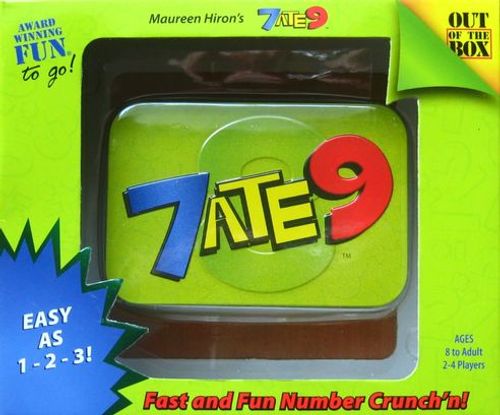
7 Ate 9
7 Ate 9 Rulebook
Table of Contents
Table of Contents
What's in the Box
- 73 7 ATE 9 Cards Each card has a yellow number, 1–10, and a plus or minus number, 1, 2, or 3. The colors of the cards correspond to the plus or minus numbers: ±1 is green, ±2 is blue, and ±3 is red.
- Rule Sheet
- Travel Tin
Ages 8 to Adult. 2–4 Players.
The Object of 7 ATE 9
Be the first person to play all of his or her 7 ATE 9 Cards.
Setting Up
- Shuffle the cards.
- Place the top card, face up, in the center of the table to create the "center pile" upon which all cards will be played.
- Deal the remaining cards, face down, to all players so that each player has an equal number of cards. Each player stacks his or her cards into a personal draw pile.
Playing the Game
-
To start the game, the dealer says "GO."
-
Each player quickly draws cards from the top of his or her draw pile to form a hand. Players may look at the cards in their hands and may play them immediately as they are drawn. There is no limit to how many cards may be held in a hand, but the cards need to be drawn one at a time.
-
Players race to play cards from their hands onto the center pile. The card on the top of the center pile determines which cards may be played next. The ± number is added to, and subtracted from, the yellow number on that same card. The resulting two numbers (one from addition and one from subtraction) indicate which cards may be played next. Any card with either of those two numbers as its yellow number may be played onto the center pile.
For example, if the card on the center pile has a yellow number 5 and a ± number of 1, any card with a yellow number 4 (5-1=4) or 6 (5+1=6) may be played.
- There are no turns—a card may be played as soon as a player determines that the card has one of the two required yellow numbers.
- When playing a card, the player must call out the yellow number on that card.
- As cards are played, players may freely refill their hands from their own draw piles.
- A player may play one card directly after another but may not play two or more cards at one time.
- If two or more players each attempt to play a card at the same time, the first card placed on the center pile takes precedence, no matter who called out the yellow number first. The other player(s) must take back their card(s).
- Play may go "around the corner." See Playing Around the Corner, below.
- The top card is constantly changing so it is almost always possible to play. But, if no one can play and each player has drawn all of the cards from his or her draw pile, play stops and all players lay their cards face down on the table. The dealer takes the bottom card from the center pile and places it on top of the center pile. The dealer says "GO," players pick up their hands, and play resumes.
-
Play continues until one player has played all of the cards from his or her hand and draw pile, except one. That player's last card may be played regardless of the yellow number on that card. The card is played face down on the center pile to end the game.
Playing Around the Corner
Sometimes the total number after adding or subtracting the ± number is either greater than 10 or less than 1. In both cases players may "play around the corner."
Greater than 10
If the total of the yellow number and the ± number is greater than 10, simply subtract 10 from that number. The resulting number becomes one of the yellow numbers that may be played next.
For example, if the card on the center pile has a yellow number 9 and a ± number of 3, either a card with a yellow number 6 (9-3=6) or a yellow number 2 (9+3=12, 12-10=2) may be played.
Less than 1
If the total of the yellow number and the ± number is less than 1, simply add 10 to that number. The resulting number becomes one of the yellow numbers that may be played next.
For example, if the card on the center pile has a yellow number 1 and a ± number of 2, either a card with a yellow number 3 (1+2=3) or a yellow number 9 (1-2=-1, -1+10=9) may be played.
Winning the Game
The first player to play all of his or her cards wins 7 ATE 9!