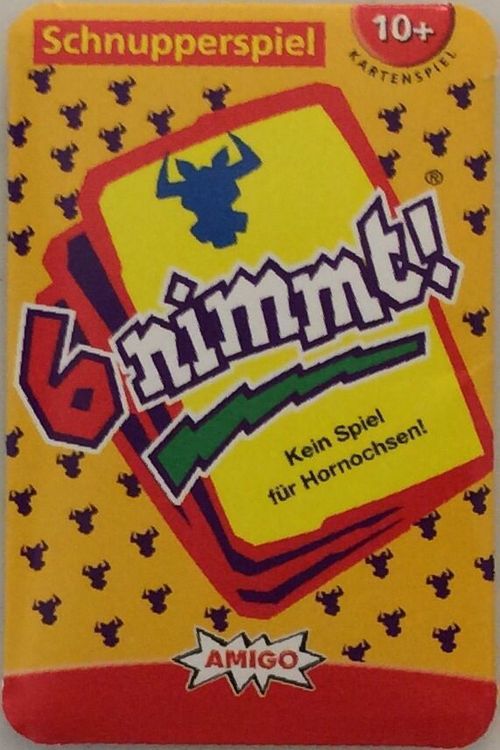
6 nimmt! Schnupperspiel
6 nimmt! Schnupperspiel Rulebook
Table of Contents
Table of Contents
Game Idea
Your goal is to take no cards. Every card you have to take brings you one minus point for each bull head (Hornochse) on it! The winner is whoever has the fewest minus points after several rounds.
Setup
Shuffle all the cards and deal ten cards to each player's hand. One of you receives the score pad and pen for writing down the points.
Forming Four Rows
From the remaining cards, lay four cards face up one below the other in the middle of the table. Each card forms the start of a row, which, including this first card, may contain at most five cards. Set all remaining cards aside. They are needed again only in the next round.
Figure 1 shows the four rows at the start of the game.
Course of Play
1. Playing a Card
Everyone chooses a card from their hand and lays it face down in front of them on the table. Only when the last player also has a card in front of them do you all turn the cards face up.
The player who played the lowest card is first to place it onto one of the four rows, then the second-lowest card goes onto a row, and so on, until the highest card of this round has also been placed onto a row. You always place cards next to each other (in a row).
Then you repeat this procedure until, after ten rounds, you have played all ten cards.
How Are the Cards Placed?
Each played card fits only one row. The following rules apply:
Rule 1: "Ascending number sequence" The cards of a row must always form an ascending number sequence.
Rule 2: "Lowest difference" You always place a card onto the row whose last card has the lowest difference to the new card.
Example: As Figure 1 shows, the first cards of the four rows have the following numbers: 12, 37, 43 and 58. In the first round you played these cards: 14, 15, 44 and 61. The 14 is the lowest card. It is placed onto a row first. According to Rule 1 you can only place it on the first row, behind the 12, and likewise the 15. According to Rule 1 the 44 could go onto the first, second or third row. According to Rule 2 "Lowest difference", however, you must place it onto the third row. The 61 you place onto the fourth row according to Rule 2.
Figure 2 shows the four rows after the 1st round.
2. Taking a Row
As long as you can place a played card onto a row, everything is fine. But what happens with a row that is full, or with a card that fits no row? In both cases you must take a row because of your played card.
Rule 3: "Full row" A row with five cards is full. If you place a sixth card onto a full row, you must take all five cards of that row. Your played card then becomes the new first card of that row.
Example: In the second round you play these cards: 21, 26, 30 and 36. The 21 and 26 go onto the first row, which is now full. You played the 30 and must likewise place your card onto the first row. Because this row is full, you must take the five cards of this row. Your 30 is now the new first card of the first row. The 36 must also go onto this row, behind the 30.
Figure 3 shows the four rows after the 2nd round.
Rule 4: "Low card" If you play a card whose number is so low that it cannot be placed ascending at the end of any row, you must take all the cards of a row of your choice. Your "low" card then becomes the new first card of that row.
Example: In the third round you play these cards: 3, 9, 68 and 83. Your "low" card 3 cannot be placed ascending onto any row. Therefore you must take a row of your choice. You choose the second row and take the 37. Your 3 is the new first card of the second row. Your fellow player with the 9 was lucky, because he can now place his 9 onto the 3. The cards 68 and 83 you place one after the other onto the fourth row.
Figure 4 shows the four rows after the 3rd round.
Tip: If you have to take a row because of a "low" card, you should as a rule take the row with the fewest bull heads.
Bull Heads = Minus Points
On each card, at the top and bottom between the numbers, at least one bull head is shown. Every bull head is a minus point!
All cards with:
- Numbers ending in five (5, 15, 25, etc.) have two bull heads,
- Multiples of ten (10, 20, 30, etc.) have three bull heads,
- Doubled numbers (11, 22, 33, etc.) have five bull heads.
The number 55 is both a doubled number and a number ending in five, so this card has seven bull heads.
Bull Head Pile
If you have to take a row, place the cards face down in front of you in your bull head pile (Hornochsenstapel). Note: Cards that have been taken do not go back into your hand.
End of a Round
A round ends when you have all played out your hand cards. Everyone now takes their bull head pile and counts the bull heads (= minus points) on their cards. The minus points are noted for each player on the pad and a new round begins.
Playing Tips
Two examples should show you how you can set a "trap" for yourself or for each other.
1st example: You play the card 45 because you think you can place it onto the third row behind the 41. But here you are mistaken, because you must place it behind the 42 on the fourth row. According to Rule 2 the lowest difference is there. Since this is the sixth card, you must take the fourth row!
(Figure 5: card layout for the 1st example.)
2nd example: You play the card 62 and believe you are making a good move because you can place it onto the first row. But this does not work. In the same round one of your fellow players plays the 29 and takes the first row ("low" card). Now you must place your card onto the fourth row and take this row!
(Figure 6: card layout for the 2nd example.)
End of the Game
Play as many rounds until one of you has collected 66 minus points or more. The winner is then the one with the fewest minus points. If several players have the fewest minus points, there are several winners.
Of course you can also agree on a different number of points or a number of rounds.