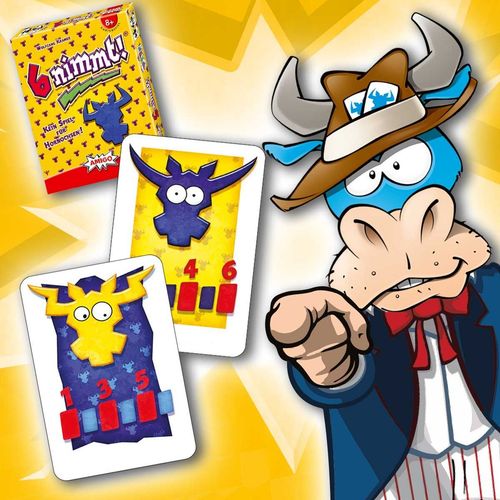
6 nimmt!: Even/Odd
6 nimmt!: Even/Odd Rulebook
Table of Contents
Table of Contents
Setup
Set up the game as usual by placing four cards in the middle of the table face up to start the four rows. Then, put the action card down to the left of the lowest card on the table. If this card's number is even, turn the "Even" side up. If it's odd, turn the action card's "Odd" side up.
Playing the Game
As usual, play one card each from your hands, reveal them simultaneously and take turns adding your cards to the matching rows.
Make sure you follow these additional rules:
a) Placing a Card – Even/Odd
You can only play odd or even cards in the row marked by the action card, matching the side it's showing.
b) Taking a Row – Moving the Action Card
When you take any row, you move the action card. First, you take the row, as usual, and place your card on the grid as the new first card of a row.
Then, you move the action card:
- You must remove the action card from its current row and put it next to one of the three other rows. The row you move it to may be the one you've just taken and restarted with your card.
- Place the action card next to the row whose last (i.e. right-most) card is the lowest.
- Turn the action card so that its odd or even side shows, depending on whether the last card of the row is odd or even, as described under "Setup" above.
Note: The action card doesn't count towards the limit of cards in a row. You still only have to take a row when you've played the 6th number card in it.
Example
Example: David has played a 90, and now he must place it in a row. According to rule 1, "Ascending Order", and rule 2, "Lowest Difference", he would have to place it next to the 85 in the fourth row. However, the action card says "Odd", so he must place his 90 next to the 52 in the second row, instead. This completes the row and David must take the five cards already in the row. His newly played 90 becomes the new first card of the second row. Next, he moves the action card. The other three rows have these last cards: 31, 90 and 92. 31 is the lowest number, so the action card must go next to the first row. As 31 is an odd number, the action card continues to show its "Odd" side.
The sheet's diagram of this example (with its ✔ and ✘ marks) is not reproduced here; the text above is the rule.