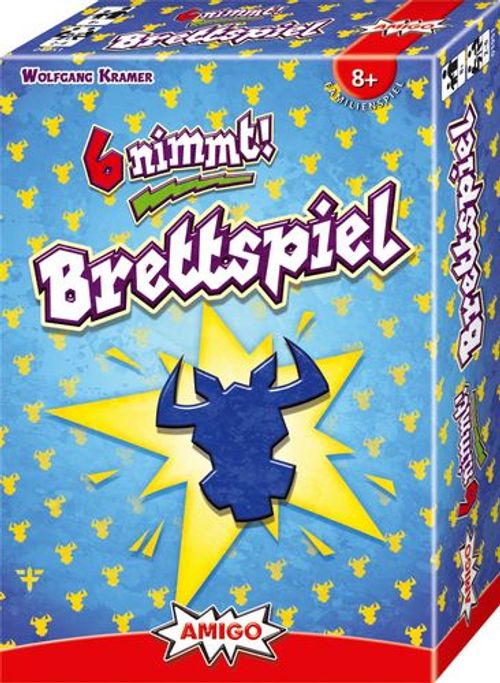
6 nimmt! Brettspiel
6 nimmt! Brettspiel Rulebook
Table of Contents
Table of Contents
Basic Game
Setup
- Place the game board, blue-ox side up, in the middle of the table.
- Each of you takes a scoring marker of your choice and places it on space "0" of the score track.
- Each of you takes the screen matching the color of your scoring marker and sets it up in front of you.
- Shuffle all the tiles. Deal each player twelve tiles face down, and place them face up behind your screen.
- Place one random tile, face up, on the first space of each of the top four rows of the game board.
- With two or three players, place the remaining tiles face down next to the game board as a supply. With four, five, or six players, return them to the game box.
- Put all other material back in the game box. It is not needed for this version.
How to Play
You play several rounds. Each round always consists of the following two steps:
- Play a tile
- Attach a tile
1. Play a Tile
All of you simultaneously choose a tile from behind your screen and place it face down in front of your screen.
2. Attach a Tile
All of you reveal your played tiles at the same time and attach them to the four active rows on the game board (always from left to right). The player with the lowest tile goes first. The other players follow in ascending order, until the player with the highest tile has also attached theirs.
Note: A row counts as active as long as at least one tile lies in that row. There are always four active rows.
Every tile always fits at the end of exactly one active row. Three rules apply:
Rule 1: Ascending Number Sequence — Your tile must always have a higher value than the last tile of the row.
Rule 2: Lowest Difference — Among the possible rows under Rule 1, you must attach your tile to the row whose last tile has the smallest difference to your played tile.
Rule 3: Exception "Number Too Low" — If your tile is so low that Rule 1 does not allow you to attach it ascending to any row, you must attach the tile to the row whose last tile has the highest value.
Example: First, Basti attaches the 57. Ascending, it fits the first, third, and fourth rows. Among these rows, the smallest difference is between the 56 and the 57. So Basti must attach the 57 to the fourth row. In the same way, Mella then attaches the 60, and Steffen the 93.
Example: First, Basti attaches the 1. It is so low that it does not fit ascending to any row. So it must be attached to the row whose last tile has the highest value, which is the second row. Then Steffen attaches the 18, and finally Mella attaches the 19.
The Special Spaces
Whenever you place a tile on a special space, you immediately trigger the pictured effect. There are the following special spaces:
Take Row: You receive as many minus points as all tiles — except your played one — show oxen in that row. Then put these tiles back in the game box and open a new active row with your played tile. To do this, place it on the first space of the next free row below the current row. If there is no free row below the current row, place the tile on the first space of the topmost free row.
Note: A row counts as free when no tile lies in that row.
Example: Steffen has played the 41 and must attach it to the first row. This triggers the "Take Row" special space. He receives 8 minus points, puts the 15, 18, and 19 back in the game box, and puts the 41 in the next free row.
Score Points: Whenever you score plus or minus points, move your scoring marker forward or back the corresponding number of spaces on the score track.
Important: You can never have more than 44 minus or plus points. Excess points are forfeited. Note: The clovers on the score track only matter when you play with the luck cards.
Green Ox / Red Ox: You receive as many plus (green) or minus (red) points as your tile shows oxen. If two oxen are pictured on the space, you receive double the number of plus or minus points.
+X / −X: You receive the number of plus or minus points shown on the special space.
Special Row "Play Two Tiles": If this row is active and at least one of the spaces with the double-tile symbol is still visible, all players must play two tiles instead of one during the "Play a Tile" phase. The spaces with the double-tile symbol do not trigger an effect when you place a tile on them.
Important: In the "Attach a Tile" phase, you begin as usual with the lowest tile, then attach the second-lowest tile, and so on. This means everyone takes two turns during this phase.
Game End
With two or three players: Once you have all played and attached your tiles, you immediately receive twelve new tiles from the supply and continue playing as normal. Once you have also played these twelve tiles, the game ends.
With four, five, or six players: Once you have all played and attached your tiles, the game ends.
The player with the most points wins. In case of a tie, there are multiple winners.
Basic Game with Luck Cards
The rules of the basic game apply. The following rules are added:
During setup, sort the luck cards by their fronts and place them as two face-up luck-card piles next to the game board.
Whenever you score minus points, you receive a luck card to your hand for each clover that you move onto or past with your scoring marker — take it in any combination from the two piles. If a pile is empty, you cannot take the corresponding card.
Every time you attach a tile, you may play a luck card immediately beforehand. Played luck cards are placed face up back on the matching pile.
The two luck cards have the following functions:
5 Plus Points: The space onto which you place your tile becomes, one time only, the special space "5 Plus Points." So you score 5 plus points and ignore any other effect of that space. You may not play this luck card if you place your tile on the last space of a row.
Example: Mella plays the "5 Plus Points" luck card before attaching the 23 to the space with the two red oxen. This gives her 5 plus points instead of 10 minus points.
Positive Oxen: You may play this luck card when you place your tile on the last space of a row. Instead of scoring all tiles in that row as minus points, you score any two tiles of your choice as plus points and immediately offset those plus points against the minus points of the other tiles.
Example: Basti plays the "Positive Oxen" luck card before attaching the 25. This lets him score the oxen of two tiles as plus points. He chooses the 83 and the 23. Instead of 17 minus points, he receives 3 plus points.
Pro Version
The rules of the basic game apply throughout. All changes are described below.
Setup
- Place the game board, red-ox side up, in the middle of the table.
- Set the stop signs ready next to the game board.
- Shuffle the action cards and deal each player two of them face down to their hand. Place the remaining action cards as a face-down action-card pile next to the game board. Leave room next to it for a discard pile.
- As in the basic game, each player receives a scoring marker, a screen, and twelve tiles.
- With two or three players, place one tile as usual on the first spaces of the top four rows. With four, five, or six players, place these four tiles on the first spaces of the bottom four rows instead.
- Regardless of player count, place the remaining tiles face down next to the game board as a supply.
- Put all other material back in the game box. It is not needed.
How to Play
Play proceeds exactly as in the basic game. However, new special spaces and action cards are added.
The New Special Spaces
Take Row (Tiles): Place all tiles from the row — except your played one — behind your screen. You do not receive minus points for them (yet)! Open a new row with your played tile. To do this, place it on the first space of any other free row. This triggers the effect of that first space.
Take Row (Ox): This special space works as in the basic game. However, you do not place your played tile in the next free row, but on the first space of any other free row of your choice. This triggers the effect of that first space.
Draw Tile: Draw a tile from the supply and place it behind your screen.
Draw Action Card: Draw an action card from the action-card pile and take it to your hand. If the action-card pile is used up, shuffle all the cards from the discard pile and set them up as a new action-card pile.
The Action Cards
Every time you must attach a tile, you may play any number of action cards immediately beforehand. Played action cards go on the discard pile.
There are the following action cards:
Stop!: Place a stop sign at the end of any active row (this does not trigger a special space). None of you may attach a tile to a row with a stop sign. As soon as a player takes a row, put all stop signs back next to the game board. Important: You may not play this action card if two stop signs already lie on the game board.
Example: Steffen plays the "Stop!" card before attaching the 67. This means Steffen attaches his tile to the first row instead of the second.
Tile Swap: Put your played tile back behind your screen. Play a new tile instead. Attach this new tile immediately, even if other players have already played tiles with lower values.
Example: Mella plays the "Tile Swap" card before attaching her tile. This lets her take the 4 back behind her screen and play a 22 instead. She attaches the 22 immediately, even though Basti's 20 is lower.
Skip: Place your tile not on the next free space of the matching row, but on the one after that. This means you skip one space. This space remains free and is not filled later (exception: the "Move to the Front" card).
Important: You may not play this card to skip the last space of a row.
Example: Basti plays the "Skip" card before attaching the 57. This skips the "7 Minus Points" space, and he places his tile on the space after that.
Move to the Front: You may place your tile at the front of any row, as long as your tile is lower than the first tile of that row. Starting from the first space of the row, shift all tiles one position to the right up to the next free space (possibly a skipped space). Then place your tile on the space that has become free.
Important: Your attached tile does not trigger a special space in this case. Instead, the tile that is shifted onto a free space by moving the row triggers that special space.
Example: Steffen plays the "Move to the Front" card before attaching the 10. This shifts the 12, 15, 18, 19, and 22 each one position to the right, and he places the 10 on the space that became free. The 22 triggers the space with the two green oxen, giving Steffen 6 plus points.
Attach Ascending: You may place your tile at the end of any row, as long as the number sequence remains ascending (Rule 1: Ascending Number Sequence). "Rule 2: Lowest Difference" does not apply to this tile.
Example: Mella plays the "Attach Ascending" card before attaching the 69. This lets her attach the 69 to the first, second, or fourth row. She chooses the fourth row.
One More Tile: Immediately play another tile. Then attach all your played tiles one after another (starting with the lowest), even if other players have already played tiles with lower values. Before each tile, you may play further action cards as usual. Note that each action card only ever applies to one tile.
Game End
The game ends (regardless of the number of players) as soon as at least one player has no tiles left behind their screen at the end of a round.
Anyone who still has tiles behind their screen receives one minus point for each ox pictured on them.
Anyone who still has action cards in hand receives 1 plus point for each action card.
The player with the most points wins. In case of a tie, there are multiple winners.
Pro Version with Luck Cards
The rules of the pro version apply. The luck cards work as in the basic game. Only the following rule is added:
If you use the "Positive Oxen" luck card on the "Take Row (Tiles)" space, you first score plus points for two tiles of your choice equal to the oxen pictured on them, and then place all tiles — except your played one — behind your screen. Then, as usual, you open any other free row with your played tile.