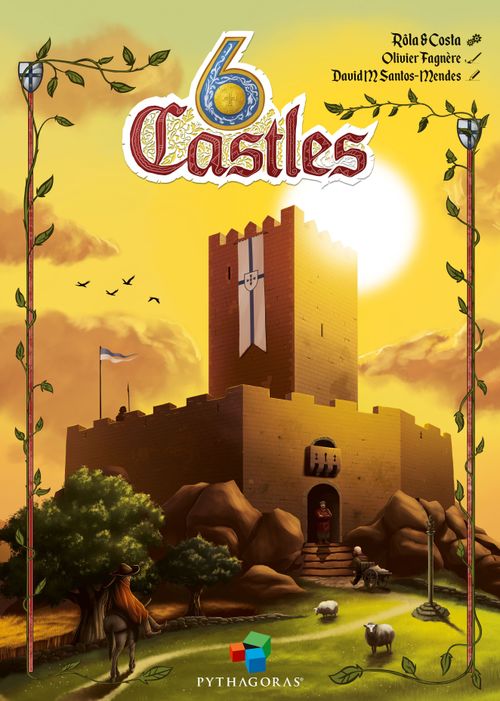
6 Castles
6 Castles Rulebook
Table of Contents
Table of Contents
Components
- 20 workers (5 per colour)
- 20 discs (5 per colour)
- 8 cylinders (2 per colour)
- 4 player aids (two for each version: advanced/family)
- 25 half-coins
- 40 gold coins
- 1 game board (religion score track, landscape score track, construction score track)
- 6 castle tiles (name, goods that may be sold (any one for Idanha Castle), charter date, final scoring sequence)
- 40 land tiles
- 1 initial land tile (double sided)
- 17 charter cards (hereafter referred to as contracts)
- 22 exploration tiles
- 1 rule book
Land tiles
Land tiles may feature 3 different terrain types:
- A) Agricultural: chestnut, linen, meat, wheat, olive oil.
- B) Landscape: pasture, bush, lake, barren, forest, crag. Crag is a special land type (see crag tiles placement rules).
- C) Construction: stone cross, chapel, military camp, house, roman milestone.
Each land tile also shows paths.
Contracts
Each contract shows a terrain type, an end game bonus, and victory points. The contract shows whether it is scored for the landscape scorer or the construction scorer.
Setup
- Place the game board with the chosen game version face up.
- 2a. Each player picks a colour and gets: 5 workers, 5 discs and 2 cylinders. 2b. Each player places 1 cylinder on the first space of the religion score track.
- Shuffle the 6 castle tiles and form a pile (next to the board). Only the top tile will remain visible at all times.
- Use 10 land tiles per player and shuffle them all. Each player gets 2 land tiles. The remaining are placed face down, next to the board, forming the draw pile.
- Shuffle the 22 exploration tiles. Each player gets 4 of them. Take another 6 tiles to form a pile next to the board. Put aside the remaining tiles, which will not be used in the game.
- 6a. Place the castle contract card, face up, next to the board. 6b. Shuffle the 16 remaining contracts. Each player gets 2, chooses one of them (keeping it secretly) and places the other (face up), next to the castle contract.
- 7a. Place the gold coins and half-coins next to the board. 7b. Draw the starting player, who gets a number of half-coins equal to the player count. The following player, clockwise, gets one less half-coin and so forth. 7c. The starting player places the initial land tile in the center of the table, choosing which side faces up. 7d. Each player picks a starting exploration tile, from the 4 received (as per number 5 above), and places 1 cylinder on the leftmost terrain.
The area for land tile placement is the centre of the table.
Family version
- 2a. Players get one less worker and one less disc.
- 6a. Contracts are not used.
- 7b. All players get one gold coin and no half-coins.
- 7d. Players immediately set their full exploration track (with the face with more agricultural terrains facing up).
Suggested setup
- Use 8, 10 or 12 land tiles per player, after removing from the game some terrain tiles as indicated below (do not remove tiles with stone crosses or chapels).
| Players | Land tiles to exclude | Land tiles per player |
|---|---|---|
| 4 | 0 | 8 |
| 3 | 5 | 10 |
| 2 | 10 | 12 |
Overview
In 6 Castles you are a noble assisting the King of Portugal in the defense and population of the kingdom. You occupy new lands, and cultivate them to get richer. With the profit from the sales you sponsor the King and the clergy to socially ascend.
To win the game you should obtain more victory points than your opponents. There are 4 different ways of scoring points: landscapes and constructions, wealth, religion, and charter cards (contracts).
The game is played in 10 rounds (family version: 8, 10 or 12 rounds). In each turn, starting with the initial player and proceeding clockwise, players carry out their actions, in the following order:
- First: place a land tile in the territory;
- Second: carry out disc actions (A) or worker actions (B);
- Third: draw a land tile from the draw pile.
First: place a land tile
Place a land tile (from your hand) in the territory (mandatory action). The land tile must be placed so as to extend an existing path, by connecting its path with one or more in the neighbouring tiles. The player may rotate this tile, but not those already placed. Once added to the territory, new hills are formed (areas surrounded by paths and, eventually, by tiles borders).
Example 1: Alice places tile 1 forming 4 new hills in the territory: a hill with 3 terrains, a hill with 2 terrains, and two hills with 1 terrain.
Exception: land tiles with crag
A tile with a crag must be placed, if at all possible, so that the crag is next to one already in the territory. A new castle is established whenever a hill with one or more crags is closed (see example 2 for an exception).
Example 2: Trevor places tile 1. As this closes hill B, the Penha Garcia castle is established. Even though hill A is closed, a castle is not established, since all castles must be at least 2 terrains apart.
- It is possible that not all castles are established during the course of a game.
- Existing workers on a hill where a castle is established are placed on top of the castle tile.
Crag bonus
The player who adds a crag tile to the territory gets an immediate bonus, as depicted on the tile: receive a half-coin; move the cylinder on the exploration track 1 space forward; move 1 space forward on the religion score track; or receive a new exploration tile.
Second: disc actions (A) or worker actions (B)
The player carries out one single action type, either disc actions (A) or worker actions (B), in the indicated order. Family version: players do not carry out actions A.2.2 and B.2.2.
A) (All actions are optional)
- A.2) Mark terrains on the exploration track;
- A.2.1) Sell goods to the castle;
- A.2.2) Score landscapes.
B) (All actions are optional)
- B.2) Move workers across the territory;
- B.2.1) Move forward on the religion score track;
- B.2.2) Score constructions.
A.2) Mark terrains on the exploration track
The player marks one or more terrains from a hill, by moving the cylinder (from space to space) or by placing discs on the exploration track.
- The cylinder may only be moved to the next space if the depicted terrain in that space is present on the hill chosen by the player.
- Only the terrains behind and beneath the cylinder, or beneath a disc, belong to the player.
- Players place their exploration tiles in a way as to form a continuous single line. It is possible to add a new tile to the right of the last one. It is also possible to replace a tile in the existing line, provided that the cylinder is on a tile to the left. In this case, if you are displacing a tile with a disc on it, return the disc to the supply.
- Whenever the cylinder catches up a disc on the exploration track, these are returned to the player supply.
- When a half-coin is depicted on the space after the cylinder, the player may pay that cost, at any time, to move forward.
Example 3: Juliet places tile 1, forming 4 new hills. She chooses to mark hill 4 terrains. She then moves the cylinder forward (two spaces) to mark the (a) pasture and (b) barren. As she wishes also to mark terrain (c) chestnut, she places a disc from her supply.
A.2.1) Sell goods to the castle
The player sells (to a castle) the goods farmed in their exploration track. The profit of each sale is found by multiplying the number of goods in his property by the number of houses, chapels or military camps on the first line of terrains surrounding the castle plus 1 (for the castle tile).
Example 4: Juliet has 3 chestnuts and there are four buildings (3 houses + 1 military camp), for a gain of 12 half-coins. She blocks the castle chestnut market with a disc, that may not be used again.
The disc used to block the market may come from the player supply or from the exploration track (mandatory if it is placed over the product being sold).
A.2.2) Score landscapes
A player may use a disc to block a landscape on the score track, whenever the number of such terrains in the exploration track is equal to or greater than the corresponding victory points.
Example 5: Robert blocks the lake landscape (3 victory points), as there are 3 such landscapes in his exploration track. The disc may not be used again.
- The disc used to block a landscape may come from the player supply or from the exploration track (mandatory, if it is placed over the landscape being scored).
- All the players may get the 4 victory points for the uppermost space on the score track (for any landscape type). All the other landscapes are immediately blocked once a disc is placed.
B.2) Move workers across the territory
The player may place, over the tile added to the territory, a worker from their supply. The movement allowance equals the total number of their workers in the territory. Movement may be discretionary allocated to one or more workers, including the last one placed. Each movement is from a crossroad to another in one of the neighbouring tiles.
Once a worker movement ends, it is laid down on a terrain of a hill next to the crossroad, at the player's choice. If there are workers from other players in that hill, the player in turn pays a gold coin to each of such players.
Players may carry out action B.2, even when not placing a new worker on the territory.
Example 6: Alice plays tile 1 and adds worker 2. She can now make up to 2 movements, and chooses to move workers 1 and 2, one movement each.
B.2.1) Move forward on the religion score track
The player moves forward on the religion score track a number of spaces equal to the total of chapels and stone crosses present in the hills where their workers are.
Example 7: Upon ending the movement (in example 6) Alice moves forward 3 spaces on the religion score track: there are 2 stone crosses on worker 2's hill and a chapel on worker 1's hill.
B.2.2) Score constructions
A player may use a worker to block a construction whenever the number of such terrains, in the hills where their workers are, is greater or equal to the corresponding number of victory points.
Example 8: Trevor places tile 1 and adds worker 2. He may make 2 movements but chooses to do just one, moving worker 2. Now he blocks roman milestones (3 victory points) because he has workers in hills with such construction (worker 2 = 1 roman milestone; worker 1 = 2 roman milestones). The worker placed on the score track may not be used again.
- The worker used to block a construction may come from the player supply or from the territory (and even from a castle).
- All the players may get the 5 victory points for the uppermost space (for any construction type). All the other constructions are immediately blocked once a worker is placed.
Third: draw a land tile
The player draws a new tile from the draw pile. Such action does not take place in the last 2 rounds of the game.
End of the game and final scoring
The game ends after the player to the right of the starting player places his last land tile in the territory and carries out the actions. Then the players add up their points in the following order.
Charter cards (contracts)
The players reveal their hidden contracts, placing them next to those already visible from the beginning. Each contract and the corresponding victory points are awarded to the player having the majority concerned:
- contracts featuring discs (majority of agricultural or landscape terrains of the depicted type on the exploration track);
- contracts featuring workers (majority of construction of the depicted type on hills occupied by their workers);
- contract featuring a castle (majority of discs and workers on castle tiles).
In case of a tie the contract is not awarded. Some contracts also award a bonus (half-coins or 1 forward movement on the religion score track).
Landscape and constructions
The players add the landscape (discs) and construction (workers) scores of these tracks.
Religion
The players add their scores of this track.
Wealth
The players count their gold coins (5 half-coins = 1 gold coin = 1 victory point).
The player with more victory points is the winner. In case of a tie the winner is the player with more spare half-coins. If the tie persists, the tied players share the victory!
Historical Note
Portugal became independent from the kingdom of Léon and Castile in the XII century. The first King of Portugal, D. Afonso Henriques, was able to keep the independence, even with scarce soldiers and resources, in a constant fight against his cousin, Alfons VII of Léon and Castile, and against the Almohads, which by then ruled over a large extent of the Iberian Peninsula. The kings who succeeded him granted charters, established villages and built castles in order to create defensive lines close to the border. This game drew inspiration from one of such defensive lines and from 6 borderline castles on the municipalities of Idanha-a-Nova, Penamacor and Sabugal.
The «mealhas» (half-coins): at the very beginning of the nation, Portuguese currency was coined in a metal so poor that it could be broken by simple hand strength. Due to this fact, broken coins were of less value, but were useful for giving change. This is how «mealhas» came to be, and how some word derivatives were created: «amealhar» (to save), «mealheiro» (piggy bank) ...