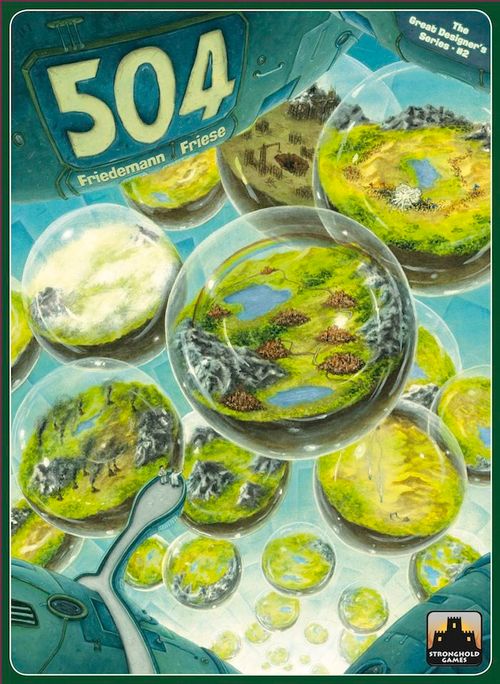
504
504 Rulebook
Table of Contents
Table of Contents
- The Game Components
- The First Game: "The World of Traveling Pioneers with a Bias for Individualism" ("World 123")
- The General Game Rules for 504
- The Introduction to The Book of Worlds
- Module 1: Pick Up & Deliver
- Module 2: Race
- Module 3: Privileges
- Module 4: Military
- Module 5: Exploration
- Module 6: Roads
- Module 7: Majorities
- Module 8: Production
- Module 9: Shares
- Glossary 1: The Maps
- Glossary 2: The Complete Turn Overview
- Glossary 3: The Overview for The Privileges of Module 3
- The Ludosophers
The Game Components
Each numbered component below is referenced throughout this rulebook and in the Book of Worlds by its number, so the players can look it up on this overview.
- 61 map tiles (11 water, 10 cities, 10 grasslands, 9 forests, 8 fields, 7 mountains, 6 deserts) — needed in 100% of all games
- 48 goods (11 cattle, 10 wood, 10 fish, 9 wheat, 8 ore) — needed in 41.7% of all games
- 30 covering tokens — needed in 22.2% of all games
- 10 city cards — needed in 22.2% of all games
- 1 price token — needed in 33.3% of all games
- 1 starting player card — needed in 53.8% of all games
- Playing money (30 each of $1, $5, $10, $50) — needed in 100% of all games
- 66 privileges (2 each per type) — needed in 33.3% of all games, certain cards only in 2.8% of all games
- 5 headquarters (1 each in four player colors, 1 in orange for the fifth stock company) — needed for the players in 100% of all games, for the fifth stock company in 22.2% of all games
- 5 transport trolleys (1 each in four player colors, 1 in orange for the fifth stock company) — needed for the players in 33.3% of all games, for the fifth stock company in 5.6% of all games
- 5 cargo hold cards — needed for the players in 33.3% of all games, for the fifth stock company in 5.6% of all games
- 10 movement point tokens (5 each of "3/4", "5/7") — needed for the players in 33.3% of all games, for the fifth stock company in 5.6% of all games
- 135 settlements (30 each in four player colors, 15x in orange for the fifth stock company) — needed for the players in 100% of all games, for the fifth stock company in 22.2% of all games
- 135 residents (30 each in four player colors, 15x orange for the fifth stock company) — needed for the players in 95.2% of all games, for the fifth stock company in 19.8% of all games
- 1 share value board/goods price board — needed in 41.7% of all games
- 100 victory point tokens (10x 10 VP, 20x 5 VP, 25x 2 VP, 45x 1 VP) — needed in 38.9% of all games
The First Game: "The World of Traveling Pioneers with a Bias for Individualism" ("World 123")
If you are ready to jump into your first game, we will explain all the necessary game rules for "World 123". This is the suggested starting game and will expose you to the first three game modules, enabling you to explore one of the 504 different worlds. To begin your first game, open the Book of Worlds so you have modules 1, 2 and 3 from top to bottom.
If you would prefer to learn more about the overall game design, skip ahead to the General Game Rules for 504.
Travelling traders are respected people in this world, so each tribe hires one for their prosperity. Thus, the traders let their transport trolleys drive across paths and roads. A trader always has an eye on the places which have demand for a certain type of goods or on the best time to upgrade their transport trolleys. The traders earn their prestige by delivering the most goods and can achieve additional rewards if they also manage to deliver all different types of goods. Additionally, the tribes love cities as only there can they make big money. Who arrives at cities and settles on land first, of course, earns more money than slower tribes. The tribes also use this knowledge to get even higher payments at cities they reach later.
Furthermore, the tribes try to diverge from the others with privileges, so they gain personal advantages. As they envy the other tribes, the prices for privileges most often remain stable. As soon as somebody passes on buying another privilege, the other tribes will get some very nice presents.
Game Components
You need the following game components for this game:
- 1 61 map tiles, 2 40 goods (8 each of all 5 types), 3 30 covering tokens, 4 10 city cards, 5 1 price token, 6 1 starting player card, 7 playing money, 33 1 overview tile
- 8 18 privileges: 2 each of the cards I (2), I (5), I (8), I (11), II (5), II (7), II (9), II (12), III (1)
- For each player: 9 1 headquarters, 10 1 transport trolley, 11 1 cargo hold card, 12 2 movement tokens (1 each of "3/4", "5/7"), 13 20 settlements, 14 9 residents
Game Preparation
The game is played on the map shown in the Book of Worlds. Place the cities and water tiles on the matching spaces. Pay attention to matching the cities with the numbered spaces and place them with their goods side face up. Shuffle the remaining tiles and randomly fill up all white spaces row by row from top to bottom, with one exception: The two remaining water tiles may never connect one of the separate water tiles with the big lake.
Place a stack of 4 goods on each city, matching the small circle.
Prepare the stack with privileges. With 4 players use all 18 cards. With 3 players, first take 1 card of each type of privilege, shuffle them and randomly remove 4 cards from the game, without looking at them. Then, add the other cards to the remaining 5 privileges. With 2 players use 1 card of each type. Shuffle the privileges separated by card backs I, II, III and place them in a single stack, so that the cards with back I are on top, the cards with back III are at the bottom.
Place the price token next to the map. Draw 1 privilege per player (For 2 players draw a total of 3 privileges) and place them in a face-up row to the right of the price token, so that the price for each privilege is $20.
Place the 10 city cards face up next to the map.
A player takes charge of the bank and prepares the playing money next to the map. Each player gets $80 as starting money.
Choose a starting player who keeps the starting player card in front of him for the entire game as a reminder.
In reverse player order starting with the last player, each player chooses a city as his capital and places his headquarters on that tile. Each player must choose a city with a different goods type on offer. Additionally, the players place their 9 residents on the 9 cities, which they did not choose as their own capitals.
Example: Rachel chooses the city "7" with ore and places one of her settlements on the matching city card. Tanja chooses the city "3" with wood and Paul the city "10" with fish. As starting player, Camille chooses her starting city last and may only choose between the cities offering cattle or wheat (the cities "1", "4", "6" or "9").
According to the chosen capitals, each player places 1 settlement onto the city card with the same number.
Example: Camille and Rachel start in different capitals. Thus, they mark different city cards with their settlements.
Each player places the cargo hold card with 1 cargo hold face up in front of himself and places the two movement point tiles as a stack next to this card, so the tile with 3 movement points (MP) is on top. He places his transport trolley on his capital and directly takes 1 good from there. He loads that good into his transport trolley by placing it on the cargo hold in front of himself. Now you can start the game!
How to Play
Beginning with the starting player, you play several rounds in clockwise order. In each round each player takes one turn. During his turn, the player plays the following 3 phases one after the other, before the next player begins his turn.
1. Purchase
First, the player may buy 1 privilege.
At the start of this phase, if there are fewer privileges in the row of cards than the number of players, the player draws 1 new privilege and places it to the right of the row of cards (2 players: If less than 3 privileges are in the row of cards, the player draws 1 new privilege). The price of each newly drawn privilege is always $20. If the player draws a privilege showing a higher back than the privileges in the row of cards, the player places the price token to the right of the cards with a lower back and the price for all these privileges drops to $0.
Now the player may buy 1 privilege. He either pays $20 to the bank or takes a cost-free privilege for free.
If he passes and does not take 1 privilege, he places the price token on the right of the row of cards and the price drops for all privileges to $0 (Thus, the other players get cost-free privileges!). The player may only buy each type of privilege once. He may use his privileges immediately after purchase. Please check the "Overview for The Privileges of Module 3" glossary for all details of these privileges.
Afterwards, the player may buy 1 upgrade for his transport trolley. He may choose between a bigger storage space with 2 cargo holds or the next higher amount of movement points (MP), which he can use in all of his turns. He pays the price to the bank.
| Upgrade | Price |
|---|---|
| 4, 5, or 7 MP | each $50 |
| 2 cargo holds | $80 |
Example: Camille wants to move her transport trolley faster, so she buys the upgrade for 4 movement points for $50 on her first turn.
2. Transport Trolley
In this phase, the player moves his transport trolley on the map from tile to tile. It can move across all land tiles and cities, but never moves onto water! The goal is to deliver the goods to a city which has demand for these types of good.
The player may transport 1 good of any type per cargo hold (at game preparation he already loaded 1 good from his capital). If his transport trolley has 2 cargo holds, he may transport two identical or two different good types. The player may load and unload his transport trolley any number of times during this phase. If he unloads goods on a land tile or a city, which has no demand for these goods, they remain there until any player loads them again onto his transport trolley.
At the start of the game, the transport trolley begins with 3 MP. For the movement of the transport trolley, the player needs 1 MP from tile to tile; except for the movement from any tile onto a mountain tile which requires 2 MP. The player may buy additional MP for his transport trolley, so he can move it immediately forward. He may buy more than 5 MP, and each additional MP costs $10 more than the previous MP. He pays the price to the bank. The player cannot save MP for his next turn.
| Additional MP | 1 | 2 | 3 | 4 | 5 |
|---|---|---|---|---|---|
| Total price | $20 | $50 | $90 | $140 | $200 |
While moving his transport trolley on the map, the player has two options to increase his income, which he receives in the 3rd phase.
When the player moves his transport trolley on any tile (on a city, too), he may place 1 settlement on that tile. All players may have 1 settlement on the same tile, but only the player placing his settlement on an empty tile gets additional income in this world. This is a voluntary action. Because of the limited number of his settlements the player may pass on this action!
The first time the player reaches a city with his transport trolley, he places his resident from there on top of the matching city card. This is an obligatory action!
If the player moves his transport trolley to a city, which has demand for the loaded good in his cargo hold, he may deliver the good to this city. The player places the delivered good face up in front of him and covers the matching space on the city with a covering token. Thus, the players commonly may deliver each demanded good one-time only to a certain city; they need to arrive faster at the cities than their opponents! If the player has two different loaded goods in his bigger cargo hold, and the city demands both, he may deliver them both and covers both matching spaces in that city.
After delivering goods, the player may directly load one (or two) goods from that city, as long as there is supply left.
If the player has enough MP to move his transport trolley to several cities (possibly the same city several times), he may deliver goods to all these cities!
3. Income
In this phase, the player gets his income.
The player always gets $20 base income for his capital.
Additionally, he gets one-time only money for his settlements which he placed on an empty tile during this turn, depending on the type of terrain: he gets $5 for grassland, forest, and field, and $10 for mountain and city.
Furthermore, the player gets one-time only money for his residents, which he newly placed on city cards during this turn: for his overall first resident he gets $10, for his overall second resident he gets $20 and so on. Finally, he moves all new residents to the bottom of the matching city cards.
Example: During his turn, Paul placed first settlements on 1 field, 1 forest and the city "5", additionally he also arrived at city "1", where Camille already placed a settlement earlier in the game. Paul placed his residents accordingly on the two city cards. He gets $90: $20 (base income for the capital) + $20 (first settlement on field, forest and city "5") + $50 (for his overall second and third resident on the city cards). Finally he moves both residents to the bottom of the city cards.
Game End
At the end of a round, after all players take their turns, the players check if they commonly delivered at least 23 goods. If yes, the game ends immediately. In this world, this may already happen after 4 or 5 rounds, so the players need to hurry! Otherwise, the starting player starts a new round.
Final Scoring
The players get victory points (VP) for their delivered goods and for certain privileges.
First, the player checks for each of his delivered types of goods, how many of them he delivered.
| Number of goods of the same type | 1 | 2 | 3 | 4 | 5+ |
|---|---|---|---|---|---|
| Victory points | 5 VP | 9 VP | 12 VP | 14 VP | 15 VP |
Additionally, the player gets 2 VP for each set containing all 5 different types of goods.
The privileges I (11) and II (9) also give 2 VP or 3 VP.
Example: Camille delivered a total of 3 wheat, 2 cattle, 2 wood, 1 fish and 1 ore. She also has a privilege for 3 VP. She gets 45 victory points = 12 (wheat) + 9 (cattle) + 9 (wood) + 5 (fish) + 5 (ore) + 2 (for 1 set containing all 5 goods) + 3 (for the privilege).
The player with the most VP wins the game! In case of a tie, the concerned player having more goods (1 or 2) in the cargo holds of his transport trolley wins the game. If there is still a tie, the concerned player with the highest income on the last game round wins the game.
A Hint for the First Game
The privilege giving 2 victory points (card I (11)) may show up during the first game round. This privilege is helpful for the final scoring, but during the first game round it is not a good value for $20. At the start of the game, simply keep your hands off of this card!
The General Game Rules for 504
Basically, we can explain each of the 504 games in a few pages. However, we do not want and cannot write a rules booklet of more than 1000 pages, so we only explained the starting game for "World 123" in this manner.
But all games in 504 use the same basic framework of general rules, which we explain to you here. Afterwards, we show you details for the Book of Worlds and how to use that to create all possible 504 worlds.
Even if you are a little bit impatient and already played the starting game of "World 123", you must read these general rules and the details for the Book of Worlds! Afterwards, you may directly play "World 456" and read the necessary details in the sections covering the involved modules 4, 5 and 6.
Game Preparation
(1) To play one of the 504 games, the players use the enclosed 9 module cards: Shuffle all 9 cards and place them in three rows of three cards one below the other. The top card shows the module on TOP I, the middle card shows the module on TOP II and the bottommost card shows the module on TOP III. The players commonly decide, which combination they like to play. Of course, they also can directly decide on any of the 504 combinations.
Each time we refer to modules in this rules booklet or the Book of Worlds, we use colored boxes with the number of the module and sometimes with an allocation to TOP I, II or III, such as 1., 4.II, 9.I.
(2) Most of the worlds use active residents. Only a few worlds (in 7.3% of all games) the players play without active residents (in short: "games without residents") and instead each player travels around the world only with a single transport trolley.
For this reason, most of these General Rules are for games with residents. If the players choose a game without residents, most of these rules are dropped.
(3) All worlds use a map. As we will explain in the Introduction to the Book of Worlds, the players always find the correct map for their game in the Book of Worlds and build that map with the map tiles. Please check Glossary 1 for all possible maps. A few modules restrict the choice for the capitals of the players. The players find these restrictions also in the Book of Worlds.
(4) In all worlds, the players always get their personal headquarters, which they use to mark their capital on the map.
(5) In all worlds, the players use the playing money, so they should choose one of the players to take care of the bank during a game.
(6.a) In all worlds with residents, depending on the number of players, each player gets a certain number of residents and settlements.
| 2 | 3 | 4 | 9.I | 9.II 5 stock companies | |
|---|---|---|---|---|---|
| residents | 30 | 25 | 20 | — | 15 |
| settlements | 30 | 25 | 20 | — | 15 |
(6.b) In all worlds without residents, the players use settlements to mark certain tiles or cards. For these games, the players get the following number of settlements, independent of the number of players (in games with the module "Race", the players also use residents for a better overview, but then the residents only stand passively as markers on the tiles and cards).
| 2 | 3 | 4 | 9.I | 9.II 5 stock companies | |
|---|---|---|---|---|---|
| settlements | 20 | 20 | 20 | — | 15 |
(7) All further game components, which the players use to play for each of the modules, are noted in the Book of Worlds and are always different from world to world.
Playing the Game
(8) The players play the games either in a round-based player order, which is newly determined from round to round (priorities I-III), or in a clockwise player order (priority IV). If the players start in different capitals, these priorities also determine the requirements for how the players choose their capitals. Respectively, the module on TOP I takes precedence over a module on TOP II. Exceptions to these rules are restrictions starting with "except".
(9) In most games, the players play the same number of turns. At the end of a round, after all players took their turns, the players check the requirement for the game end. Only the modules "Military" and "Majorities" have a requirement for the game end, which triggers directly after a player's turn.
(10) During a round, the players execute all phases in order. As shown in Glossary 2 for the detailed overview for the phases, the games only use some of the phases. The players execute phases 1, 2, 4 and 5 together. In phase 3, each player takes his turn, but again executes all parts of this phase in order (purchase, residents and so on).
(11) All the player's residents and settlements (including his headquarters) are considered his population. He uses his residents for actions, and his settlements to mark tiles where he can place new residents for replenishments.
(12) In all games without the module "Military", all tribes live peacefully with each other on all land tiles and cities. The player may move his residents on all land tiles and cities and place settlements on all these tiles, independent of other players' tribes. The player ignores the other players' tribes for his actions, only his residents and settlements are important.
(13) After the player places his headquarters and settlements on tiles, they stay there for the remainder of the game. The player only moves his residents on the map.
(14) During a whole game, the player can only have a restricted number of residents at any time on a tile: on his capital, next to his headquarters he may have up to 9 residents (maximum 9); on all other tiles (cities and land tiles) next to his settlement he may have up to 7 residents (maximum 7).
(15) The player's residents either stand upright (and are considered as "active") or lay flat on the tiles (and are considered as "exhausted"). After the player finishes with the actions of his residents in Phase 3 D: Residents, all his residents lay exhausted on the land tiles and cities. Only on his next turn does he place them upright again at the end of Phase 3 C: Purchase, so they are active again and ready for new actions.
(16) In a few modules, the players build factories, roads or plants. The players own these things after building them, so they mark the buildings with their settlements and place roads in their player colors. If a player loses the control over these things by force or voluntarily, the buildings are considered ownerless, the roads are neutral. The next player taking his turn in player order may take possession of these things during his turn, if he fulfills the requirements.
Phase 3 C: Purchase
(17) The player may buy new residents and pays $10 for each resident purchased to the bank.
(18) The player places the newly bought residents upright on the map on tiles with his settlements and exhausted residents. On his capital, he always can place any number of residents up to a total of 9 residents. On all other tiles, he may only double the number of his already existing population (the settlement and possibly exhausted residents) up to the maximum of 7 residents: If he only has 1 settlement on a tile, he may only place 1 new resident next to that settlement. If he has 1 settlement and 2 exhausted residents on a tile, he may place up to 3 new residents on that tile. The player always ignores the population of the other players!
Example: On his forest with 1 settlement and 1 exhausted resident, Paul may place up to 2 new residents. On his grassland with 1 settlement and 4 exhausted residents he may place up to 3 new residents, then he reaches the allowed maximum for that tile. On his capital with the headquarters and 3 exhausted residents, he may place up to 6 new residents before reaching the allowed maximum.
(19) After buying all new residents and placing them on the map on the desired tiles, the player places all his exhausted residents on all tiles upright again. All his residents on the map are active and ready for action in the following Phase 3 D: Residents.
Phase 3 D: Residents
(20) The player can use each of his active residents for 1 action, before that resident is exhausted. Thus, for tracking purposes, all active residents stand upright; all exhausted residents lay flat after their action.
(21) As an action, the player can move his resident 1 step to an adjacent tile before that resident exhausts. The residents can move across all land tiles and cities, but never move onto water! If the player moves that resident on a tile without 1 of his settlements for the first time, he exchanges that resident for 1 of his settlements. He places the resident back into his storage and instead places 1 settlement on that tile.
(22) The different modules offer more actions for the residents: among others are building plants, exploring unknown tiles or building roads.
(23) After the player finished all desired actions and still has some unused active residents, he simply exhausts these residents on the tiles they are standing. Thus, during Phase 3 C: Purchase of his next turn the player does not mix up the newly placed residents with the old residents already on the map since former turns.
Phase 3 H: Income
(24) In all games, the players get a base income of $20. As a reminder, we linked that base income with the capital, so all modules always refer to "$20 base income for the capital".
Additional Game Rules
(25) If the special game rules of the different modules contradict these general game rules, the special game rules take precedence.
(26) The players are NOT allowed to trade goods, money or other things between each other. Each plays by himself. In games with the module "Shares", all players owning shares of the same stock company may give hints or warnings to the president of that stock company, so they may commonly control the fate of that stock company. Players without shares of that company are not allowed to do this! In the end, the president makes all final decisions for his stock company!
(27) In games with the module "Privileges", each player gets his own privileges, giving him certain advantages. If the effects of these privileges contradict the rules of this rules booklet, the privileges take precedence.
A hint for the privilege giving 2 victory points (card I (11)): This privilege may show up during the first game round. This privilege is helpful for the final scoring, but during the first game round it is not a good value for $20. At the start of the game, simply keep your hands off of this card!
(28) The players may place their personal money in a single stack and do not need to give information about the real amount which they own. In games with the module "Shares", all money in the company assets is common knowledge, even for your private stock companies on TOP III!
(28) In 504, each game is a new gameplay experience for the players. We noticed that it is best to allow all players to take back turns (or part of their turns) before the next player starts his own turn. This really helps to concentrate on learning all the new details and removes the fear of making mistakes without being able to correct them afterwards. Especially in modules 2 and 8 when the residents are in a hurry, during the first games it is difficult for the players to understand how many residents they need on which part of the map so they can reach certain goals. Just keep calm and correct your actions during your turn!
On the next pages we explain all the details on how to use the Book of Worlds. Afterwards, the extensive rules follow for all nine modules, the building blocks of 504, and the glossaries, giving the players an overview for the different maps, the complete phases of a turn, and all details of the privileges for module 3.
The players can read these sections as needed in relation to the Book of Worlds.
This rules booklet is designed to explain the whole game system in full detail. In the future, experienced players should only need the Book of Worlds to play each of the 504 games.
The Introduction to The Book of Worlds
The heart and soul for all 504 worlds!
Besides all the necessary game components, The Book of Worlds is the key element to explain all 504 games.
Each time you open this book to three page sections of three different modules, you find all the special rules for the respective game. After reviewing the details of "World 123", open The Book of Worlds to the pages of this world so we may explain to you everything you need to know about this book as it relates to the recommended first game!
In 504, a lot of things are staggered by priorities, so often you need to check for the most important bits. For identification we use roman numbers (I, II, III, and so on), with the lowest number always matching the highest (most important) priority.
1. Determining the game map
You are always playing on one of five possible maps. To find the correct map, check here for the lowest number (the highest priority): that is the wanted map for this world. In Glossary 1: The Maps you find detailed pictures of the five possible maps.
Example: in "World 123" you play on map 3 (priority III) as demanded by module 1 on TOP I, as both modules on TOP II and TOP III have a lower priority IV.
2. Determining the player order
You either play a whole game in clockwise player order, or in separate game rounds, where you always determine a new player order after finishing that round.
If you start in different capitals, this is the section describing, in which order you choose them.
Example: in "World 123" you play in clockwise player order. You choose the capitals in reverse player order, starting with the last player (priority IV).
Additionally, here you learn if everybody starts in their own capital, or if you all start in a common capital.
Example: Each player starts in his own capital, with each offering a different type of goods.
3. Determining the starting money
Depending on the chosen world, you always need to check on the amount of starting money for each player. In many games, you all start with the same amount of money, in other games the amount depends on the player order, giving the starting player less money than all following players.
Example: in "World 123" everybody gets $80. Because of module 1, everybody gets $60 (priority IV), and because of module 3 you always get an additional $20.
4. Games with and without residents
On the Book of Worlds page, on several modules you find a fat black line. If this line is NOT on all three chosen modules, you always play with residents!
If you play with module 1 AND this line proceeds on all three chosen modules, you play without residents. Instead, you only move around the map with your transport trolley! (In module 2 you still get some residents for tracking, so these residents help to give you a better overview.)
All special game rules for games without residents always start with a special symbol.
Example: in "World 123" you play without residents, as the black line proceeds on all three modules AND you play with module 1!
5. Special game components
Apart from the base game components like the game board, you always need special game components for each module. The numeration in front of each component helps to identify the game components on the overview of "The Game Components".
Example: in "World 123" you need among other things for module 1 the 10 transport trolleys, for module 2 the 4 city cards, and for module 3 the 8 privileges!
6. Game preparation
You find all necessary information about preparing the special game components for this world in this box.
Example: in "World 123" among other things you place all city tiles with the goods side face up and place stacks of goods on top of them. Additionally, you place the city cards next to the game board and mark your chosen capitals with settlements on these cards. Furthermore, you must prepare the correct mixture of privileges, to get the biggest advantages in this world!
7. The story of this world
Each world has its own story, which gives you an idea of the tribes and their laws and rules. Additionally each world has its own name.
Example: the "World 123" is "The World of Traveling Pioneers with a Bias for Individualism".
8. Tables and examples
To give you the most neatly arranged game rules, we placed necessary tables (for prices, victory points and so on) and examples (for determining your income or your final victory points and so on) on the right side of this book in this section.
Example: in "World 123" you find all tables with prices for upgrades, for additional movement points of the transport trolley, the victory points and a detailed example for determining your income in these sections.
The Introduction to The Book of Worlds - the right page
9. The game rules of the modules
On this page you find all the necessary game rules for the chosen modules.
Each page shows only the relevant phases for the module in the correct order. So when preparing the game you need to check if more than one of the chosen modules mentions rules for the same phase (9.a).
In certain module combinations you need to follow additions or changes to the stated rules. These paragraphs always start with a colored box with the number of the module and sometimes a position of the module (see items 10-13 below), or the "without residents" symbol, and the texts are on a light grey background (9.b).
You may ignore such a paragraph, if its color and number do not match with the modules you choose to play during your game (9.c).
Example: in "World 123" both module 1 and module 2 have game rules regarding your transport trolley (9.a). Additionally, in this combination you must follow the exceptions for the game without residents and the special addition of module 2.II (Race), which is in effect with module 1.I (Pick Up & Deliver) (9.b). You can ignore the additions for modules 4 or 8 in this world (9.c).
10. TOP I, TOP II or TOP III
In each game you choose three different modules and open the corresponding three pages. Depending on the position of the module, either on top, in the middle or on bottom, its influence on the game changes, as explained in the next three items.
11. TOP I: Game end and victory condition
The topmost module always defines the game end and victory point conditions (or at least how you get the main part of these victory points).
Example: module 1 (Pick Up & Deliver) ends at the end of the turn, after you delivered a combined total of at least 23 goods to the cities. Then, you get victory points for these delivered goods.
12. TOP II: Income
The middle module always defines, how you will get your income.
Example: in module 2 (Race) you earn your money by building settlements before the other players and by visiting as many different cities as possible.
13. TOP III: "For additional flavor"
The bottommost module adds variety and always gives you new challenges in all your games.
Example: in module 3 (Privileges) you get different abilities for your transport trolley, so it moves even faster.
Each combination offers a different game!
Each of the 504 combinations gives you a new challenge.
After you have played "World 123" and learned all the general rules and the structure of the Book of Worlds, you will find all the details for the nine modules on the following pages.
Instead of reading these pages all at once, we suggest you play "World 456" ("The World of Combative Explorers with Connections") and "World 789" ("The World of the Mightiest Businessmen via External Financing") and only read the necessary chapters for the appropriate modules one by one. Thus you learn details for each of the nine modules and get a good overview of what to expect in 504.
To play each module once on each of the three positions, you only need to try 9 games ... and afterwards another 495 surprising game experiences await you. Promise!
Module 1: Pick Up & Deliver
Introduction
In the module "Pick Up & Deliver", each player owns his own transport trolley. With the help of this transport trolley, the players try to satisfy the demand of the cities for goods and carry their residents across the map, so they get to interesting tiles before their opponents. This module is the requirement for all games which can be played without residents.
Without Residents: Only if the players choose this module as one of the three possible positions will they find the "Without Residents" box in the Book of Worlds.
Game Components
The players need the following game components for this game:
- 2 48 goods, 3 30 covering tokens, 33 1 overview tile
- TOP II: 15 1 goods price board
- For each player: 10 1 transport trolley, 11 1 cargo hold card, 12 2 movement tokens
- In games without residents: 13 20 settlements (2, 3, 4 players) or 13 15 settlements (for 5 stock companies)
Game Preparation
Preparing Personal Game Components
Each player gets 1 transport trolley with 1 cargo hold card and 2 movement point cards.
If no other module demands a higher priority, the game is played in a clockwise player order (priority IV). The players choose a starting player who places the starting player card in front of him for the entire game as a reminder.
Each player gets the following starting money from the bank:
- TOP I & TOP II: Each player gets $60 (priority V).
- TOP III: 2 players: The starting player gets $60, the second player $80. 3, 4 players: Beginning with the starting player, each player gets $60, $70, $80 and $90 in order (priority VI).
In games without residents, the players also get a number of settlements as mentioned above. We explain the usage of these settlements in the affected modules.
TOP III: In games without residents, the transport trolleys do not have a cargo hold.
Preparing the map
TOP I & TOP II: If no other module demands a higher priority, the players use map 3 (priority III).
ALWAYS display cities with their goods side atop. Place 4 goods onto each city, matching the small circular symbol.
-
- In games with the module "Exploration", lay out the cities in a numerical ascending stack, lowest numbered city on top, city "10" on bottom. Each time you explore a new city during the game, place 4 goods, matching the small circular symbol.
-
- In games with the module "Production", the cities remain empty and do not offer any goods. Place all goods in a common supply next to the map.
In reverse order beginning with the last player, each player chooses a capital, which offers a different type of goods and places his headquarters there (priority IV).
TOP III: If no other module demands a higher priority, the players use map 5 (priority IV). All players start in the common capital "1" in the center of the map and place all their headquarters there.
Example: If no other module demands a higher priority, the players use map 5 (priority IV). The cities have no demand for goods, so they are ALWAYS placed with the empty side face up.
Without Residents
All players start in the common capital "1" in the center of the map and place all their headquarters there.
Preparing the Transport Trolley
The players place their transport trolleys on their respective capitals, place the cargo hold card of their transport trolley with 1 cargo hold face up in front of them and both movement point tiles in a small stack with 3 movement points (MP) on top.
TOP I & TOP II: Additionally, each player immediately takes 1 good from his capital and loads it in his transport trolley by placing it onto the cargo hold in front of himself.
-
- In games with the module "Production", the players do not take goods.
Preparing the General Game Components
TOP I & TOP II: Place the covering tokens and the overview tile next to the map.
TOP II: Place the goods price board next to the map and place 1 good of each type on the space "20", so all goods start with the same price of $20.
Playing the Game
If no other module demands a higher priority, the players play several rounds in a clockwise player order. During a round, each player takes one turn and performs the following steps of Phase 3 one after the other, before the next player takes his turn.
Phase 3 C: Purchase
During this phase the player may buy exactly 1 upgrade per turn for his transport trolley, before buying his new residents. He may either buy a bigger cargo hold or more movement points (MP). He pays the price to the bank, see below for the table and on the overview tile.
TOP III: In games without residents, the players must pay $50 for the upgrade for more movement points (MP).
| Prices for the upgrades of the transport trolley | TOP I & TOP II | TOP III |
|---|---|---|
| 4, 5, 7 movement points (MP) | each $50 | each $30 (or each $50 without residents) |
| 2 cargo holds | $80 | $40 |
Example: Camille wants to move her transport trolley faster, so she buys the upgrade for 4 movement points in her first turn.
Phase 3 E: Transport Trolley
During this phase the player moves his transport trolley on the map from tile to tile. It can move across all land tiles and cities, but never moves onto water! One of his goals is to deliver the goods to a city which has demand for this type of good. Another is the transport of his residents so they can reach the interesting tiles of the map faster.
The player may transport 1 good of any type OR up to 2 of his exhausted residents per cargo hold. If the transport trolley has 2 cargo holds, this applies for both cargo holds, so he can transport any combination of 2 identical or 2 different goods, up to 4 exhausted residents, or up to 2 residents in one cargo hold and a good in the other. He may load and unload his transport trolley at any time during this phase and any number of times; this does NOT stop its movement.
The player needs 1 movement point (MP) to move his transport trolley from tile to tile; except for the movement from any tile onto a mountain tile which requires 2 MP.
TOP I & TOP II: The goal of the player is to deliver the goods to a city which has demand for this type of good. Each city only takes 1 good for each listed goods type; thus, the players need to arrive faster at the cities than their opponents! If the player loaded two different goods in his bigger cargo hold, and the city demands both, he may deliver them both and covers both matching spaces in that city.
After delivering goods, the player may directly load one (or two) goods from that city, as long as there is supply left. If the player has enough MP to move his transport trolley to several cities (possibly the same city several times), he may deliver goods to all these cities!
TOP I: The player places the delivered goods face up in front of himself and covers the matching spaces on the cities with covering tokens.
TOP II: The player places the goods face up below the goods price board in the order he delivered them during his turn and covers the matching spaces on the cities with covering tokens. If the player delivers 2 goods to the same city, he decides in which order he places them below the goods price board.
If the player unloads goods on a land tile or a city which has no demand for these goods, the goods remain there until any player loads them again onto his transport trolley. The transport trolley with loaded residents may move through tiles without settlements of that player, which are empty or have opposing settlements and residents. However, if the player unloads residents on a tile without 1 of his settlements, 1 resident turns into 1 settlement.
In games without residents, the player may buy additional MP as needed for his transport trolley. He pays the price to the bank, see below in the following table and on the overview tile. The player may buy more than 5 additional MP, and each further MP always costs $10 more than the previous MP. The player cannot save MP for his next turn.
| Additional MP | +1 | +2 | +3 | +4 | +5 |
|---|---|---|---|---|---|
| Total Price | $20 | $50 | $90 | $140 | $200 |
-
- In games with the module "Military", the player may move his transport trolley on all tiles, even on opposing tiles. He gets 1 additional MP, if the transport trolley starts the movement on one of his tiles. If the transport trolley moves onto opposing tiles for the first time during this phase, he needs 1 additional MP for each opponent (if it starts on an opposing tile or continues to move onto more tiles of the same opponent, no further additional MPs are needed).
With 8.I / 8.II: The cities are neutral and no player controls them. Each player may move onto a city for 1 MP.
Example: Paul starts the movement of his transport trolley on one of his grasslands, so he gets 1 additional MP and together with his upgrade has a total of 5 MP. He moves the transport trolley onto Camille's forest (for a total of 2 MP), then onto Rachel's grassland (again for 2 MP) and finally onto Camille's city. Paul needs only 1 MP for this last move, as he already spent 1 additional MP for entering Camille's tiles during this turn.
If the transport trolley moves onto an opposing tile with loaded residents, the player must unload them for the fight. The player cannot load exhausted residents on an opposing tile. With module 2: After the transport trolley finishes its movement, a fight follows immediately.
-
- In games with the module "Roads", the player needs 0.5 MP per road when moving his transport trolley on his roads. If the player only has 0.5 MP left but cannot move his transport trolley across one of his roads, he must stop the movement.
-
- In games with the module "Production", each plant produces one-time only 1 good directly after the player builds it. The player places that good, for the moment, on top of the plant. Only the owner may transport the goods placed on the plants! With 8.I / 8.II: Additionally, the player must transport the goods to his trading houses and follow their limited delivery quantities!
Phase 3 H: Income
TOP II: During this phase the player gets his income.
The player always gets $20 base income for the capital. Additionally, he gets one-time only money for each good delivered in Phase 3 E. The player balances accounts separately for each good.
The player gets the price for the 1st good according to the goods price board and adjusts all prices: the price for the delivered good drops 3 spaces, the prices for all other goods each rise 1 space. Then, the player gets the price for the 2nd good etc.! The price for a type of goods cannot drop below the first "$10" space and cannot rise above $140. Finally, the player places all delivered goods into the general storage.
Example: Paul delivered 1 cattle and 1 wheat to two cities. He gets an income of $110. In addition to the base income of $20, first, he gets $40 for the cattle. He drops that price to $10 and raises the prices of the other goods to $50. Then, he gets $50 for the wheat and drops that price to $20. He raises the price for cattle to $20 and the price for the other goods to $60.
-
- In games with the module "Military", the player must pay $1 for each full $10 of this sale to the owner of the city, or in case of a free city to the bank, if he delivers goods to a city without 1 of his settlements.
Example: Paul delivers 1 wood to Camille's city. He gets an income of $50 for this sale, so he must pay $5 to Camille.
Game End
TOP I: At the end of a round, after all players took their turns, the players check if they commonly delivered at least 23 goods. If yes, the game ends immediately. Otherwise, the starting player starts a new round.
Final Scoring
TOP I: The players now get victory points (VP) for their delivered goods.
First, the player checks for each of his delivered types of goods, how many of them he delivered.
| Number of goods of the same type | 1 | 2 | 3 | 4 | 5+ |
|---|---|---|---|---|---|
| Victory points | 5 VP | 9 VP | 12 VP | 14 VP | 15 VP |
Additionally, the player gets 2 VP for each set containing all 5 different types of goods.
Example: Camille delivered a total of 3 wheat, 2 cattle, 2 wood, 1 fish and 1 ore. She gets 42 victory points = 12 (wheat) + 9 (cattle) + 9 (wood) + 5 (fish) + 5 (ore) + 2 (for 1 set containing all 5 goods).
The player with the most VP wins the game! In case of a tie, the tied player having more goods (1 or 2) in the cargo holds of his transport trolley wins the game. If there is still a tie, the tied player with the highest income on the last game round wins the game.
Module 2: Race
Introduction
In the module "Race", everything is about speed and about being first at a certain place or being first to own something. This is the module of nomadic tribes who do not care so much about leaving something behind. You only care about where you will be soon. The residents are in a hurry. Thus, it is a race from city to city, from goal to goal.
Game Components
The players need the following game components for this game:
- TOP I & TOP II: 4 10 city cards
- In games without residents, to mark cities/city cards each player/stock company gets 14 10 residents (TOP I) or 9 residents (TOP II).
- TOP III: Depending on the mid-term scorings: 16 victory point tokens in a total amount of 20 to 52, 17 1 majority board, 18 30 marking tokens
Game Preparation
Preparing the map
If no other module demands a higher priority, the players use map 5 (priority IV). All players start in the common capital "1" in the center of the map and place all their headquarters there.
Preparing the General Game Components
TOP I & TOP II: Place the 10 city cards face up next to the map. The players use them to mark the cities which their tribe already reached during the game.
TOP III: Depending on the module of TOP I the players try to fulfill certain goals. For a better overview when playing certain modules, the players place the majority board with marking tokens for each player next to the map and place the necessary victory point tokens on the board. When playing other modules, the players sometimes use their special game components as a reminder for the victory point tokens.
Preparing Personal Game Components
If no other module demands a higher priority, the game is played in a clockwise player order (priority IV). The players choose a starting player who places the starting player card in front of him for the entire game as a reminder.
Each player gets the following starting money from the bank:
- 2 players: The starting player gets $60, the second player $80.
- 3, 4 players: Beginning with the starting player each player gets $60, $70, $80 and $90 in player order (priority VI).
TOP I: To mark the chosen capitals, place 1 resident of each player onto the matching city cards.
In games without residents, the players place their remaining 9 residents on the 9 cities, which they did not choose as their own capitals.
Example: In a game without residents, Camille and Rachel start in different capitals. Thus, they both mark a different city card with their residents.
TOP II: To mark the chosen capitals, place 1 settlement of each player onto the matching city cards.
In games without residents, thus you only have 19 settlements left (2, 3, 4 players) or 14 settlements (5 stock companies) for the game. Additionally, the players place their 9 residents on the 9 cities which they did not choose as their own capitals.
Playing the Game
If no other module demands a higher priority, the players play several rounds in a clockwise player order. During a round, each player takes one turn and performs the following steps of Phase 3 one after the other, before the next player takes his turn.
Phase 3 A: Capital
In games without residents skip this Phase 3 A!
At the start of his turn, the player may change his capital by exchanging his headquarters with 1 of his own settlements in any other city. By doing this, the player may use the higher maximum of residents he can place on his capital in Phase 3 C, to faster settle in more distant areas of the map.
If the player does not have enough residents to buy in Phase 3 C or enough settlements to settle a tile in Phase 3 D/3 E/3 G in his storage, he may take back the missing pieces from the game map without substitution and place them directly back on the map. If he takes back 1 settlement, he must take back all residents on the same tile.
Phase 3 D: Residents
In this phase, the player moves his residents from tile to tile to reach the different cities as fast as possible. If he arrives in a new city, he marks this on the matching city cards.
While moving, the residents are in a hurry. Thus, they remain active if the player moves them onto tiles with at least 1 of his exhausted residents. As long as this requirement is fulfilled, the resident may move through several tiles. He only exhausts if he moves onto a tile without another of the player's exhausted residents or if the player uses him for another action.
TOP I: The first time the player reaches 1 city and exchanges 1 resident for 1 settlement, he places that resident directly on the matching city card.
TOP II: The first time the player reaches 1 city and exchanges 1 resident for 1 settlement, he places that resident directly on top of the matching city card. Because of the rising number of residents on the city cards, the players can only use a declining number of residents on the map.
IMPORTANT: The players must reach the cities once during the game. They do not need to stay there until the end of the game, but may remove their settlements from these cities during the game, or are forced to remove them because of war!
-
- In games with the module "Military", the player reaches an opposing city the first time if he moves 1 of his residents on this city. In that case he places 1 additional resident from his storage on the matching city card (moving on the city is important, not the outcome of the following fight!).
Phase 3 E: Transport Trolley
-
- This phase is ONLY played in games with the module "Pick Up & Deliver"! The player moves his transport trolley on the map from tile to tile.
TOP I: In games without residents, the player reaches cities with his transport trolley. In that case he moves his resident from that city to the matching city card.
TOP II:
-
- In games with the module "Pick Up & Deliver", the player reaches a city only with his transport trolley. In that case he places 1 resident from his storage on top of the matching city card. Of course, the player may move residents onto the city so they can settle there. This is simply not tracked on the city cards.
In games without residents, the player instead moves his resident from the city to the matching city card when he reaches the city with his transport trolley.
Additionally, the player may place 1 settlement on a tile when he moves there with his transport trolley to get an additional income in Phase 3 H. (This is a voluntary action. Because of the limited number of his settlements the player may pass on this action!)
TOP III: In games without residents, the player may place 1 settlement on a tile to fulfill certain mid-term scorings when he moves there with his transport trolley. He counts the matching type of terrain on the majority board (This is a voluntary action. Because of the limited number of his settlements the player may pass on this action!).
Mid-Term Scorings
TOP III: Depending on the module of TOP I there are mid-term scoring goals, which the players race to fulfill. Due to the limited availability of mid term goals defined for each module, there is a predetermined number of times each of these goals can be scored. The table below lists the number of scoring opportunities followed by the VP points available. The first player fulfilling these goals before they run out, receives the available victory point tokens.
- 5x / 5 VP. Reward to the first player delivering one of the good types a second time. (Place 5 goods with 5 VP next to the map.)
- 2x / 10 VP. Reward to the first player having at least 1 factory in 3 cities, once for the player having 3 factories in 1 city. (Place factories with each 10 VP next to the map.)
- Each 1x / 3 VP, 4 VP, 5 VP ... In ascending order, reward to the player conquering the next free city. (Place VP next to each city space of the majority board.)
- 6x / 5 VP. Reward to the first player exploring one of the 6 terrain types (no water) a third time. (Place 5 VP below each terrain column of the majority board.)
- 6x / 5 VP. Reward to the first player connecting one of the 6 terrain types (no water) with his roads a third time. (Place 5 VP below each terrain column of the majority board.)
- Each 1x / 10 VP, 20 VP. Reward 10 VP to the first player controlling each terrain type (no water) once, reward 20 VP to the first player controlling each terrain type twice. (Place 10 VP/20 VP next to the first two rows of the majority board.)
- 5x / 5 VP. Reward to the first player owning 3 plants of one of the good types. (Place 1 good of each type with 5 VP next to the map.)
- Use the mid-term scoring of the module on TOP II. The stock company does not get VP, instead it gets an income of $10 for each VP.
Phase 3 H: Income
TOP II: During this phase the player gets his income.
The player always gets $20 base income for the capital.
Additionally, the player gets one-time only money for each settlement which he placed on an empty tile during this turn, depending on the type of terrain: He gets $5 for grassland, forest, field and mountain, and $10 for city.
Furthermore, the player gets one-time only money for each resident which he newly placed on the city cards during this turn: For the overall 1st resident $10, for the overall 2nd resident $20 etc. Afterwards, he moves the new residents to the bottom of the matching city cards so he does not mix them up with residents which he places in later rounds on the city cards (the player one-time only gets money for each of these residents)
Example: During his turn Paul placed first settlements on 1 field, 1 forest and city "5", additionally 1 settlement on city "1", where Rachel already placed her settlement. He placed 1 resident each on top of both city cards. Now, he gets $90: $20 (base income for his capital) + $20 (1st settlements on field, forest and on city "5") + $50 (for his overall 2nd and 3rd resident on the city cards). Afterwards, he moves both residents to the bottom of the city cards.
-
- / 4. / 7.I In games with the modules "Pick Up & Deliver", or with the module "Majorities" on TOP I, if a player removes his settlement and then there is no settlement left on the tile, the next player placing the first settlement on that tile again gets one-time only $5 (one-time only $10 for city and mountain). In games with the module "Military", this rule is in effect when a player conquers a tile from another player.
Game End
TOP I: At the end of a round, after all players took their turns, the players check depending on the number of players, if at least 1 player placed residents on 9 (2), 8 (3) or 7 (4) city cards. (9.II at least 1 stock company placed 6 residents on city cards). If yes, the game ends immediately. Otherwise, the starting player starts a new round.
-
- In games with the module "Military", depending on the number of players the game ends at the end of the round, after at least 1 player placed residents on 7 (2), 6 (3) or 5 (4) city cards. (9.II at least 1 stock company placed residents on 4 city cards).
In games without residents, the game always ends at the end of the turn after at least 1 player placed 9 residents on city cards.
Final Scoring
TOP I: The player gets victory points (VP) for the cities he reached during the game. Depending on the number of his residents on the city cards he gets the following VP. In the table, the X stands for the number of cities, which trigger the game end depending on the number of players.
| Number of city cards with residents | X - 3 and less | X-2 | X-1 | X | X + 1 and more |
|---|---|---|---|---|---|
| Victory points (VP) | 22 VP | 26 VP | 32 VP | 40 VP | 50 VP |
In games without residents, the player gets 1 additional VP for each movement point of his transport trolley he used to move out of the last reached city.
Example: In a game with 3 players, Camille triggers the game end as she placed 8 of her residents on city cards. She gets 40 VP. Paul only has 7 residents on city cards. Thus, Paul gets 32 VP.
In a game without residents, Anne moved her transport trolley another 3 MP out of the last reached city. She gets an additional 3 VP.
The player with the most VP wins the game! In case of a tie, the tied player with the most residents and settlements on the map wins the game. In games without residents, the player gets additional VP for the remaining movement points of his transport trolley! The player with the most VP wins the game. In case of a tie, all tied players win the game!
Module 3: Privileges
Introduction
In the module "Privileges", everything revolves around small improvements which the players buy so others cannot own them. Depending on the other two modules, the players improve the options step by step.
In this industrial oriented world, cities are most important, as players try to build their factories there. Sadly, a modern economy also needs a working tax system, so the high-income players will pay the highest taxes.
Game Components
The players need the following game components for this game:
- 8 66 privileges, 5 1 price token, 16 100 victory point tokens, 19 30 factories, 20 3 player order cards
Game Preparation
Preparing Personal Game Components
TOP I & TOP II: This game is played in a round-based player order, so depending on the number of players place the matching player order cards next to the map. Place 1 resident per player next to these cards, so the players have one resident less for playing the game (priority I and II).
TOP II: 7.I In games with the module "Majorities" on TOP I instead place the scoring cards next to the map and place 1 resident per player next to these cards.
TOP III: If no other module demands a higher priority, the game is played in a clockwise player order (priority IV). The players choose a starting player who places the starting player card in front of him for the entire game as a reminder.
Each player gets the following starting money from the bank:
- TOP I & TOP II: Each player gets $90 (priority II).
- TOP III: Each player ALWAYS gets an additional $20 for his starting money, which is determined by the other two modules.
Preparing the map
TOP I & TOP III: If no other module demands a higher priority, the players use map 5 (priority IV). All players start in the common capital "1" in the center of the map and place all their headquarters there.
TOP I: If another module demands the priority I or II, the players each choose a different capital in Phase 1 of the first round depending on the starting bid from high to low (priority I). 9.II In games with the module "Shares" on TOP II instead the players choose the capital during the share round (SR).
TOP II: If no other module demands a higher priority, the players use map 3 (priority III). The players each choose a different capital in Phase 1 of the first round depending on the starting bid from high to low (priority II).
Preparing the Privileges
Depending on the 3 modules, compile the appropriate privileges into a deck. At the bottom of the cards, the players find the details and when to use a certain privilege. Please check Glossary 3 for a detailed list of all privileges.
- 4 or 5 stock companies: Take 2 cards of each type of privilege.
- 3 players: First take 1 card of each type of privilege, shuffle them and remove half of them from the game (rounded down). Then, add 1 card of each type to the remaining half.
- 2 players: Take 1 card of each type of privilege.
Shuffle the privileges separated by card backs I, II, III and place them in a single stack, so that the cards with the back I are on top, the cards with the back III are at the bottom.
Place the price token next to the map. Draw 1 privilege per player and place them in a face-up row to the right of the price token, so that the price for each privilege is $20.
TOP III: 2 players: Draw 3 privileges and place them in a face up row next to the price token.
Example: In a game with 4 players place 4 cards face up next to the price token, so their price is $20.
Preparing the General Game Components
TOP I & TOP II: Place 20 factories next to the map.
TOP I: Place also the victory point tokens next to the map.
Playing the Game
TOP I & TOP II: The players play the game in a round-based player order, and determine the new player order at the start of each round. Then, they play the phases Phase 1 and Phase 2 together. In Phase 3 they take their turn and each player finishes the steps of that phase before the next player starts his turn.
TOP III: If no other module demands a higher priority, the players play several rounds in a clockwise player order. During a round, each player takes one turn and performs the following steps of Phase 3 one after the other, before the next player takes his turn.
Phase 1: Player Order
TOP I & TOP II: At game start, all players bid with their starting money to choose the player order of the first game round and their capitals on the map. Each player takes the desired amount of money in his fist and on a count of three all show their bids simultaneously. A bid of $0 is valid. Starting with the highest bidder all players pay their bid to the bank and choose an available space in the player order. Additionally, they choose a capital and place their headquarters on that tile. In case of a tie, randomly draw lots for the order of choice (the losers get $2 for each lost draw).
Example: Paul has the highest bid. He chooses the first position in the player order and places his headquarters on his capital. Camille and Rachel have the same bid, so they need to draw lots. Rachel wins and chooses her position in the player order and her capital. Camille gets $2 as compensation before choosing next.
Starting with the 2nd round, determine the player order according to the income of the former round, from high to low (in case of a tie reverse the player order of the former round for the tied players).
According to the new player order, the players must pay taxes for their last income: The 1st player pays 20%, the last pays 0%, all other players pay 10% of their last income. To simplify this process, the first player pays $2 taxes for each full $10 of his income, the other players pay $1 taxes for each full $10 of their incomes. Because of higher taxes, the 1st player may get a lower income compared to the 2nd player.
Example: Camille gets an income of $68. Thus, she must pay $12 in taxes for the full $60 of her income.
TOP I: 9.II In games with the module "Shares" on TOP II, the stock company order for the 1st business round (BR) is determined in reverse order of establishment. If stock companies are only established in later share rounds (SR), they are first in stock company order in the next BR!
Phase 2: Privileges
TOP I & TOP II: During this phase the players get the desired privileges in auctions. Beginning with the 2nd game round, if there are still unsold privileges from the former round at the start of this phase, place the price token to the right of these privileges. The starting bid for these privileges drops to $0. Draw new privileges and place them to the right of the price token, until you either draw 1 new privilege per player or if there are the following number of privileges in the row of cards depending on the number of players. The minimum bid for these new privileges is $20.
| Number of players/stock companies | 2 | 3 | 4 | 5 stock companies |
|---|---|---|---|---|
| Maximum number of privileges | 4 | 5 | 6 | 7 |
All privileges are now auctioned from left to right, one at a time. Beginning with the 1st player, all players bid clockwise in sitting order around the table, until there is a highest bid. If a player passes, he may only bid again for the next privilege. The highest bidder pays the amount to the bank and places the privilege face up in front of him. If the starting bid of the privilege was $0 and all players pass again, remove that privilege from the game!
The player may buy any number of privileges in each round, but he can only buy each type of privilege once. He may use his privileges immediately after purchase.
Phase 3 C: Purchase
TOP III: At the start of this phase, the player may buy one of the desired privileges.
If there are fewer privileges in the row of cards than the number of players at the start of this phase, the player draws 1 privilege and places it to the right of the row of cards (2 players: If less than 3 privileges are in the row of cards, the player draws 1 privilege). The price of a newly drawn privilege is always $20. If the player draws a privilege with a higher back than the cards already in the row of cards, the player places the price token to the right of them and the price for all the privileges with the lower back drops to $0.
Now the player may buy 1 privilege. He either pays $20 to the bank or takes one of the privileges for $0.
If he does not take 1 privilege, he places the price token to the right side of the privileges and the price drops for all privileges to $0 (the following players get free choices).
The player may only buy each type of privilege once. He may use his privileges immediately after purchase. Please check Glossary 3 for the details of all privileges.
Example: At the start of this phase, Rachel draws a new privilege. Afterwards she takes one of the privileges for $0.
Phase 3 E: Transport Trolley
-
- This phase is ONLY played in games with the module "Pick Up & Deliver"! The player moves his transport trolley on the map from tile to tile.
TOP I & TOP II: In games without residents, the player may place 1 settlement on a city when he moves there with his transport trolley (This is a voluntary action. Because of the limited number of his settlements the player may pass on this action!).
Phase 3 F: Factories
TOP I & TOP II: Each round, the player may buy at max 1 factory on each city, if he has 1 settlement there and pays the matching costs. The first factory costs $20, the second factory always $30 (independent on the player who built the first factory), the third accordingly $40, see below for the table. On a city, the players in common may build a total of 3 factories. The player marks his factory with his settlement. If he owns several factories in the same city, he stacks them below his settlement.
| First | Second | Third | Fourth (only with 4. and 9.I) | Fifth (only with 4. and 9.I) | Sixth (only with 9.II) | |
|---|---|---|---|---|---|---|
| Cost | $0 | $10 | $20 | $30 | $40 | $50 |
TOP I: The player immediately gets 5 victory points (VP) for building the factory.
Example: Paul builds two more factories in the cities with his settlements. He pays a total of $60. $20 for the first factory on the city "4" and $40 for the third factory on city "1".
-
- / 7.I In games with the module "Race", and the module "Majorities" on TOP I, the factories are considered ownerless, if the former owner removes his settlement from the tile. The next player having a settlement on that tile during his turn may take possession of these factories.
Phase 3 H: Income
During this phase the player gets his income.
TOP I: The players place their income for now to one side, which they get by the module on TOP II, until they pay taxes in the next Phase 1.
TOP II: The player gets $20 base income for his capital, plus $15 for each of his factories. All players place their income for now to one side, until they pay taxes in the next Phase 1.
Example: Camille already owns 5 factories. Thus, she gets an income of $95: $20 (base income for the capital) + $75 (for 5 factories).
Game End
TOP I: At the end of a round, after all players took their turns, the players check if a total of at least 20 factories stand in the cities. If yes, the game ends immediately. Otherwise, the starting player starts a new round.
Final Scoring
TOP I: The players get victory points (VP) during the game for building factories and getting certain privileges.
Example: At the end of the game, Camille built a total of 7 factories and received 35 VP for them. Additionally, she owns 2 privileges, giving her an additional 2 VP and 5 VP. She has a total of 42 VP.
The player with the most VP wins the game! In case of a tie, the tied player with most money wins the game.
Module 4: Military
Introduction
In the module "Military", the players fight. There is no peaceful coexistence between their tribes, instead the motto is "You or me". Following this spirit, each player tries to build the biggest empire.
It is really helpful, that mountains and cities are easily defendable, but sadly the opponents attack much faster coming across the flat fields and grasslands. The players need to stay focused so they do not lose track of the ultimate game objectives, if the module "Military" only has a secondary role in your games.
Game Components
The players need the following game components for this game:
- 21 3 dice, 22 8 militia, 23 8 barracks
- TOP I & TOP II: 33 1 overview tile
Game Preparation
Preparing Personal Game Components
If no other module demands a higher priority, the game is played in a clockwise player order (priority IV). The players choose a starting player, who places the starting player card in front of him for the entire game as a reminder.
Each player gets the following starting money from the bank:
- TOP I: Each player gets $80 (priority IV).
- TOP II & TOP III: Each player gets $60 (priority V).
Preparing the map
Except for games with module "Exploration", the players always play with map 2 (priority II).
In reverse order beginning with the last player, each player chooses a different capital at the edge of the map and places his headquarters there (priority IV). Depending on the number of players, choose the following capitals:
- 2 players: Capitals are across from each other.
- 3 players: Capitals are equidistant from each other, so there is always a free city between two capitals.
- 4 players: Both unselected capitals are across from each other.
- 9.I / 9.II In games with the module "Shares", the stock companies may choose any capitals at the edge of the map.
Place 1 barrack and 1 militia on all free cities, which are not chosen as capitals.
-
- In games with the module "Exploration", place 1 barrack and 1 militia on all free cities which the players explore during the game.
- 8.I / 8.II In games with the module "Production" on TOP I & TOP II, place only 1 barrack on all free cities. These barracks are considered trading houses.
Preparing the General Game Components
TOP I & TOP II: Place the dice and overview tile next to the map.
Playing the Game
If no other module demands a higher priority, the players play several rounds in a clockwise player order. During a round, each player takes one turn and performs the following steps of Phase 3 one after the other, before the next player takes his turn.
Phase 3 D: Residents
In this phase, the player moves his residents from tile to tile, to conquer as many tiles as possible. Only one player can place 1 settlement on each tile, so the player must frequently attack his opponents.
The fights are resolved in two different ways. On TOP I and TOP II, the player prepares all battles in this phase and resolves them later in a separate phase. On TOP III, the player immediately fights and follows a much easier fight sequence.
Apply the following to all fights: All residents and settlements (including the headquarters in the capital) count as armies. The player attacks opponents with his residents, but defends his tiles with all his armies he has there. The free cities do not surrender without a fight and each defends itself with its barracks and militia.
The fight for the capital:
TOP I: If the capital is attacked, the headquarters defends itself last and counts as 3 armies.
TOP II & TOP III: The capital of another player cannot be attacked.
-
- / 9.I / 9.II In games with the module "Race", and the module "Shares" on TOP I or TOP II, the players may attack opposing capitals. If the capital is attacked, the headquarters defends itself last and counts as 3 armies. Only for TOP III: For this fight, the attacker must move 3 residents all at once on the capital. He removes his residents together with the capital of the opponent, see below.
The armies go to war:
TOP I & TOP II: The player attacks an opponent by moving his residents onto one of his tiles to attack that player's settlement and possibly present residents. These residents are exhausted and cannot leave the tile for now. The player will resolve all fights on tiles in Phase 3 G: Fight, when he attacks an opponent.
-
- In games with the module "Race", the player does not wait for Phase 3 G. Instead, he resolves all fights immediately, after moving all requested residents onto an opposing tile (and these residents are exhausted). The fight follows the exact same fight sequence as written below in Phase 3 G. If at least 1 defending army survives the attack, the attacker cannot attack this tile again in the same round. The player may move additional active residents onto neutralized or conquered tiles. If the capital of the defender is neutralized or conquered, the defender immediately chooses a new capital by replacing his settlement on one of his cities with his headquarters.
TOP I: If the defender does not control another city, the game ends, see below Game End.
TOP II: If the defender only controls the capital (and possibly additional land tiles), his capital cannot be attacked (Exception 9.I, see below in Phase 3 G).
The armies fight immediately:
TOP III: As soon as the player moves a resident onto an opposing tile, a fight follows immediately. The player removes his resident and 1 army of the defender on that tile. This process is repeated if necessary, until the player removes the settlement of the defender and thus neutralizes the tile.
Example: Paul attacks Camille on a field and moves 3 armies one by one on the field. With the first army he removes Camille's resident, with the second he removes Camille's settlement and neutralizes the field. His third army moves onto the neutral field and settles there. Paul exchanges that resident with 1 settlement and conquers the field.
-
- In games with the module "Race", the defender immediately chooses a new capital by replacing his settlement on one of his cities with his headquarters, if the attacker neutralizes the capital of the defender. If the defender only controls the capital (and possibly additional land tiles), his capital cannot be attacked (Exception 9, see below in this section of the rules).
-
- In games with the module "Privileges", the attacker destroys 1 existing factory in a defending city, if he neutralizes that city. If the attacker later conquers the city with 1 additional resident, he gets the remaining factories there and places them below his settlement.
-
- In games with the module "Production", there are no fights in cities, so any number of players may have their own trading houses there. If the player conquers a land tile, he also conquers the existing plant. If the land tile is neutralized, the plant remains ownerless for now.
-
- In games with the module "Shares", the attacking stock company conquers all other tiles of the defender by exchanging the armies with its own, if it conquers an opposing capital by immediately moving 1 additional active resident onto the neutralized city. If the attacker only neutralizes the capital, the defender loses all of his tiles without the attacker conquering them. Afterwards, the players lose all shares of the defeated stock company without compensation. The stock company starts anew and may be established again by the players in the next share round (SR) (With 1.I: In games with the module "Transport" on TOP I, place all delivered goods of that company separately next to the map, as they still count for the game end!)
Phase 3 G: Fight
TOP I & TOP II: During this phase, the player fights on opposing tiles with his armies.
-
- In games with the module "Race", the players ignore this Phase 3 G, as all fights immediately happen in the appropriate phase. However, the players must regard the special rules for 3. / 8. / 9.!
The player resolves all fights on tiles, where he attacks an opponent. If he attacks on several tiles, he decides in which order he resolves these fights.
The player follows this fight sequence:
- The attacker rolls 1 die for each attacking army (with more than 3 attacking armies, he needs to roll the dice several times). For each hit he removes 1 defending army (excess hits are forfeited).
- Only if the defender suffers losses, he rolls 1 die for each of his removed armies (with more than 3 attacking armies, he needs to roll the dice several times). For each hit he removes 1 attacking army (excess hits are forfeited).
- If the attacker removes all defending armies and at least 1 of his attacking armies survives, the attacker conquers the tile and exchanges 1 resident into 1 settlement. If at least 1 defending army survives, the attacker retreats all surviving armies into any adjacent areas under his control, where he has no actual fights. His armies are still exhausted and he can only use them again in his next turn.
The following dice results are possible: each combat die has six faces bearing hit symbols. Rolled for an attack, its faces score either 0 hits, 1 hit, or 2 hits. Rolled for defense, the same die is read more conservatively: its faces score either 0 hits or 1 hit (the faces worth 2 hits on an attack roll are only worth 1 hit on defense).
The attacker gets advantages and disadvantage, depending on which type of terrain he attacks the opponent. If the attacker attacks an opponent on ...
- ... mountain or city: -1 for each single die roll of the attacker.
- ... field or grassland: +1 for each single die roll of the attacker.
The result of a modified dice roll cannot be less than 0 and not rise higher than 6.
The player beats an opposing headquarters only with 3 hits. If the attacker only scores 1 or 2 hits, he loses the fight and the headquarters remains on the tile. Depending on the number of suffered hits, the defender also gets 1-3 dice rolls, even if the headquarters survives the attack.
Example: Paul attacks Camille on a grassland with 3 armies. He rolls 3 dice and gets a result. Thanks to the attacking bonus on grassland, Paul raises each of his dice rolls by +1 and scores a total of 3 hits. Paul removes both of Camille's armies, the excess hit is forfeited. Because of the 2 suffered losses, Camille now rolls 2 dice. She gets a result and scores only 1 hit. She removes 1 attacking army. Paul conquers the grassland and exchanges 1 resident with 1 settlement. His remaining resident is exhausted and stays on the tile.
- 3.I / 3.II In games with the module "Privileges" on TOP I or TOP II, the attacker destroys 1 existing factory in a defending city, if he neutralizes that city. If the attacker conquers the city, he gets the remaining factories there.
- 8.I / 8.II In games with the module "Production" on TOP I or TOP II, there are no fights in cities, so any number of players may have their own trading houses there. If the player conquers a land tile, he also conquers the existing plant. If the land tile is neutralized, the plant remains abandoned for now.
TOP II: 9.I In games with the module "Shares" on TOP I, the attacking stock company conquers all other tiles of the defender and exchanges the armies with its own, if it conquers the capital of the defender. (With 2.III: If the attacking stock company neutralizes the last capital of the defender, it may conquer that capital immediately after the fight by moving 1 additional active resident onto the neutralized city). If it only neutralizes the opposing capital, the defender loses all of his tiles without the attacker conquering them. Afterwards, the players lose all shares of the defeated stock company without substitution. The stock company starts anew and may be established again by the players in the next share round (SR).
Phase 3 H: Income
TOP II: During this phase the player gets his income.
The player gets $20 base income for the capital, plus $5 for each additional own tile. Additionally he gets a bonus income for different types of land tiles (no city tiles).
| Number of different types of land tiles | 1 | 2 | 3 | 4 | 5 |
|---|---|---|---|---|---|
| Bonus income | $0 | $5 | $10 | $20 | $30 |
Example: In addition to her capital, Camille additionally controls 2 wood, 3 grasslands, 1 mountain and 2 city tiles. She gets an income of $70 = $20 (base income for the capital) + $40 (8 additional tiles) + $10 (3 different types of land tiles).
Game End
TOP I: The game ends immediately after the end of the active player's turn, if the active player ...
-
... in Phase 3 C buys all his residents from his storage or
-
... in Phase 3 D places his last settlement from his storage on the map or
-
... in Phase 3 G neutralizes or conquers the capital of another player. If the attacker conquers the capital, he also conquers all other tiles of the defender and exchanges the armies with his own. If he neutralizes the capital, the defender loses all of his tiles without the attacker conquering them.
-
- In games with the module "Race", the game only ends if the active player neutralizes or conquers the last capital of another player in Phase 3 D. As long as the defender still has another city, he simply changes his capital and the game continues with the next player's turn.
-
8.II In games with the module "Production", only the first two requirements for the game end are active, as there are no fights on cities.
Final Scoring
TOP I: The players get the following victory points (VP): 3 VP for each own land tile, 5 VP for each own city.
The player with most VP wins the game! In case of a tie, the tied player with more armies on the map wins the game.
Module 5: Exploration
Introduction
In the module "Exploration", the players only know a small part of the whole world. They must move their explorers into the unknown to exploit virgin territory.
The players should also remember to immediately settle on the newly discovered territory, so their tribes easily can spread out on the map. Often the player who settles the land discovered first by his opponents receives a big advantage.
Game Components
The players need the following game components for this game:
- 24 6 explorer tiles, 21 1 die
- TOP I: 16 100 victory point tokens
- TOP II: 25 30 income tokens
Game Preparation
Preparing Personal Game Components
If no other module demands a higher priority, the game is played in a clockwise player order (priority IV). The players choose a starting player, who places the starting player card in front of him for the entire game as a reminder.
Each player gets the following starting money from the bank:
- 2 players: The starting player gets $60, the second player $80.
- 3, 4 players: Beginning with the starting player, each player gets $60, $70, $80 and $90 in player order (priority VI).
Preparing the map
This module always defines the map (priority I). Place all map tiles in separate stacks in a row as follows: city, water, grassland, forest, field, mountain, and desert. Sort the cities in a numerical ascending stack, lowest numbered city on top, city "10" on bottom.
-
- In games with the module "Pick Up & Deliver", each time you explore a new city during the game, place 4 goods, matching the small circular symbol.
-
- In games with the module "Military", place 1 barrack and 1 militia on all free cities, which the players explore during the game.
The players use map 1 in the following cases:
TOP I & TOP III: The players use map 1, if another module demands priority II/III.
TOP II: The players always use map 1.
In reverse order beginning with the last player, each player chooses a different capital and places his headquarters there (priority IV). The players cannot choose the central city! 9.I / 9.II In games with the module "Shares" on TOP I & TOP II, the players play on the map for 4 players. The stock companies can choose all 5 cities as capitals.
The players use map 4 in the following cases:
TOP I & TOP III: The players use map 4, if another module demands priority IV.
All players start in the common capital "1" in the center of the map and place all their headquarters there.
Preparing the General Game Components
Place the 6 explorer tiles and 3 dice next to the map.
TOP I: Also place the victory point tokens next to the map.
TOP II: Also place the income tokens next to the map.
Playing the Game
If no other module demands a higher priority, the players play several rounds in a clockwise player order. During a round, each player takes one turn and performs the following steps of Phase 3 one after the other, before the next player takes his turn.
Phase 3 D: Residents
In this phase, the player sends his residents as explorers into an unknown world, to explore as much of the virgin territory as possible.
TOP I: The player may explore an adjacent unknown space with 1 active resident. He places that resident back into his storage (except if it explores water, instead it is placed exhausted on the starting tile).
TOP II: The player may explore an adjacent unknown space with 1 active resident. Afterwards, the resident is exhausted on the starting tile.
-
- In games with the module "Race", the player may explore any number of adjacent unknown spaces with 1 active resident. He places that resident back into his storage (except if it explores only water, instead it is placed exhausted on the starting tile).
-
- In games with the module "Military", the player may explore an adjacent unknown space with 1 active resident. He places that resident back into his storage (except if it explores water, instead it is placed exhausted on the starting tile).
TOP III: The player may explore any number of adjacent unknown spaces with 1 active resident. He places that resident back into his storage (except if it explores only water, instead it is placed exhausted on the starting tile).
The main rule for exploring: Adjacent to cities the players never find new cities and next to water players never find new water!
The explorer tiles represent the probability to find a certain type of terrain. Each explorer tile next to a stack of map tiles raises the probability by 1/6 to find one tile of this stack.
After choosing the adjacent destination space, the player places the explorer tiles next to the following stacks, until he placed all 6 tiles. While placing the tiles, their printed numbers are not relevant!
- City: Place a number of explorer tiles next to the city stack matching the number of tiles between the destination space and the closest city. The players only count existing land tiles between the destination space and the city.
- Water: Place a number of explorer tiles next to the water stack matching the number of tiles between the destination space and the central city. The players count all tiles between the destination space and the central city, including water and empty spaces (in other words: the linear distance).
- Land tiles: Place 1 explorer tile next to each stack of land tiles, in the following order: grassland, forest, field, mountain, desert.
- Remaining exploring tiles: If the players still have explorer tiles they place 1 additional explorer tile next to each stack, which already received 1 or more explorer tiles, in the following order: city, water, grassland, forest, field, mountain, desert, if necessary repeatedly. Doing so increases the probability of finding one of these map tiles.
Afterwards, the player rolls 1 die and places the corresponding map tile on the destination space.
Example: Camille wants to explore the marked destination space. The distance to the next city across land tiles is 1 tile, so she places 1 explorer tile next to the city stack. The linear distance to the central city is 2 tiles, so Camille places 2 explorer tiles next to the water stack. She places the remaining 3 explorer tiles one each next to the following stacks with land tiles. Afterwards, she rolls the dice to determine the type of terrain for her destination space.
When playing with map 1, the players may only explore unknown territory in a distance of 4 spaces around the central city. This creates a hexagonal map similar to maps 2 and 3. Thus, following the adjacency rules above for cities and water tiles, the players may not always explore all cities or water tiles. When playing with map 4, the players may explore without any restrictions regarding the distance to the central city, as long as the table is big enough.
TOP I: The players get victory points during this phase.
The player immediately gets 1 VP for each explored tile from the general storage, also if he finds water. Then, place a stack of 2 "1 VP" tokens on each explored land tile and a stack of 4 "1 VP" tokens on each explored city.
During the game, the player gets additional victory points (VP) by taking them from the appropriate tiles:
- Settlement: The player gets 1 VP for placing the first settlement on the empty tile.
- Harvest: The player gets the last VP from a land tile, only if he exhausts 1 active resident to harvest this VP on the corresponding tile (On cities, the player needs to do this for each of the last three VP tokens). The player does not get this VP if he exhausts his resident on that tile for another reason.
Example: Paul moves 2 residents onto the forest. He exchanges 1 resident for 1 settlement, the other resident exhausts after that step. As Paul placed the first settlement on the forest, he takes 1 VP from the stack on that forest. During his next turn, Paul exhausts his resident to harvest on the forest. Paul takes the last VP from the forest.
TOP II: The player takes a "$5" income token for each explored tile and for each settlement which he placed first on an empty land tile or an empty city, and places that in front of himself. These income tokens raise the income of the player in Phase 3 H. The income tiles have different printed values on front and back, so the player can exchange the "$5" for "$10" or "$20" as needed, to keep a better overview.
Example: During her turn, Camille explores 1 forest and 1 city. Additionally, she places the first settlement onto the forest. She takes 3 "$5" income tokens and places them next to her other income tokens, which she already collected in former turns.
-
- / 4. / 7.I In games with the module "Race", or with the module "Majorities" on TOP I, if a player removes his settlement and then there is no settlement left on the tile, the next player placing the first settlement on that tile again also takes a "$5" income token. In games with the module "Military" this rule is in effect, when a player conquers a tile from another player.
TOP II: The following additions are also in effect. 3.I In games with the module "Privileges" on TOP I, the player may move any number of his active residents from adjacent tiles onto the just explored tile without exhausting them in this way.
- 4.I In games with the module "Military" on TOP I, the player discovers or receives the following things depending on the terrain: desert: empty; grassland or forest: 1 own settlement; field: 1 own settlement + 1 own exhausted resident; mountain: 1 militia (the player who defeats the militia on that mountain in a fight, gets one-time only an income of $20); city: 1 barrack and 1 militia (this is the general rule for games with the module "Military").
Phase 3 E: Transport Trolley
-
- This phase is ONLY played in games with the module "Pick Up & Deliver"! The player moves his transport trolley on the map from tile to tile.
TOP II & TOP III: In games without residents, the transport trolley may explore new tiles. It must move onto the newly explored tile for 1 movement point (MP), it needs 2 MP for moving onto each mountain. If the player explores 1 water tile, he needs 1 MP but the transport trolley must remain on the starting tile. If the player explores 1 mountain tile with his last MP and does not buy an additional MP, the transport trolley must remain on the starting tile, too. Additionally for TOP II: The player may place 1 settlement on a tile when he arrives there with his transport trolley, see below for Income (This is a voluntary action. Because of the limited number of his settlements the player may pass on this action!).
Phase 3 H: Income
TOP II: During this phase the player gets his income.
The player gets $20 base income for the capital. Additionally the player gets income for his collected income tiles.
Example: During the first few rounds, Rachel explored 8 tiles and placed settlements first onto 6 tiles. Thus, she gets an income of $90 = $20 (base income for the capital) + $40 (8 explored tiles) + $30 (6 first settlements).
Game End
TOP I: At the end of a round, after all players have taken their turns, the players check if 7 or less map tiles are still unexplored. If yes, the game ends immediately. Otherwise the starting player starts a new round.
Final Scoring
TOP I: The players score victory points (VP) during the game for exploring, settling and harvesting tiles.
The player with the most VP wins the game! In case of a tie, the tied player with the most residents (not settlements) on the map wins the game.
Note
In 504 there exist 36 worlds, where the different land types possess no differences with the exception of cities and water tiles. The module "Exploration" is affected the most, so in 24 out of the 168 games including exploration, it is not important which type of terrain the players explore. They simply search for the cities and are sometimes thwarted by water.
Module 6: Roads
Introduction
In the module "Roads", everything is focused on connections. The players build their respective road networks from the capital into the world, to guarantee a good supply of resources for their cities.
Only those who build a big network of roads while connecting to a balanced mixture of all terrains will win in this world. A very positive side effect of building roads is the increase of mobility. Thus, the tribes of the players will move faster on their roads than fellow opponents.
Game Components
The players need the following game components for this game:
- 26 90 roads, 33 1 overview tile
- TOP I & TOP II: 17 1 majority board, 18 30 marking tokens
Game Preparation
Preparing Personal Game Components
If no other module demands a higher priority, the game is played in a clockwise player order (priority IV). The players choose a starting player, who places the starting player card in front of him for the entire game as a reminder.
Each player gets the following starting money from the bank:
- 2 players: The starting player gets $60, the second player $80.
- 3, 4 players: Beginning with the starting player, each player gets $60, $70, $80 and $90 in player order (priority VI).
2, 3, 4 players: Each player gets 19 roads in his color. 9.I / 9.II In games with the module "Shares" on TOP I or TOP II, the 5 stock companies each get 14 roads in their color.
-
- In games with the module "Military", the players use the grey backside of the roads to build neutral roads. Independent of the number of players, and also for 5 stock companies, place a common storage of 40 roads next to the map.
Preparing the map
If no other module demands a higher priority, the players use map 5 (priority IV). All players start in the common capital "1" in the center of the map and place all their headquarters there.
Preparing the General Game Components
TOP I: Place the majority board with the column for deserts next to the game map and place the marking tokens for each player below this board.
TOP II: Place the majority board without the column for deserts next to the game map and place the marking tokens for each player below this board.
Playing the Game
If no other module demands a higher priority, the players play several rounds in a clockwise player order. During a round, each player takes one turn and performs the following steps of Phase 3 one after the other, before the next player takes his turn.
Phase 3 D: Residents
In this phase, the player moves his residents from tile to tile to build roads between these tiles.
The player may move his active residents any distance along his roads without exhausting them in this way. These residents only exhaust, if the player moves them onto a tile without one of his roads, or if he uses them for another action (in this module of course mostly for building the roads).
TOP I & TOP II: The player must build his roads in a connected network. His first road must start in his capital; afterwards, the network may branch out in any direction. If the player has 1 settlement each on two adjacent tiles, he may connect both tiles with 1 of his roads. He needs a number of active residents depending on the more expensive terrain, see in the following table. He places 1 of the used residents back into his storage and places 1 road across the edge between both tiles. The other residents are exhausted and remain on their respective tiles. They are available again in the next round.
TOP III: The player may build his roads on any tiles. They do not need to start in his capital and do not need to be connected. The players use the same building rules as written above, EXCEPT all used residents are exhausted; the players do not place them back into their storage!
Example: Rachel wants to build a road from the forest to the grassland. She has a settlement on each of the tiles and also has enough active residents there. Normally she needs 2 residents for building the road, because of the more expensive forest. But there is already a road from Paul between both tiles, so Rachel needs a total of 3 residents. She places 1 resident back into her storage; the other two residents exhaust and remain on their tiles. Rachel places a road across the edge of both tiles.
If there are already one or more roads built by opponents between two tiles where the player wants to build a road, he needs 1 additional active resident for each of these opposing roads, who also exhausts.
The player counts the tiles on the majority board as follows, which he connects with his roads:
TOP I & TOP II: Directly after building a road, the player counts all the new tiles he connected on the majority board (including his capital, TOP II: no deserts). This way, each tile may be counted by multiple players!
Example: After Paul connected the grassland with one of his roads, he counts it on the majority table.
TOP II: Each city has demand for the different types of terrain, so the player's goal is to connect one each of the terrain types for each of the cities he connects with his roads, see below for Income.
-
- / 7.I In games with the module "Race", and with the module "Majorities" on TOP I, the player's roads to a tile turn neutral if the player removes 1 settlement from the map. The first player who again owns 1 settlement each on both these tiles exchanges the neutral road with one of his own roads, if it is connected to his other roads and if he does not own a road there. With TOP I and TOP II the first player subtracts that tile on the majority board, the new owner counts it on the majority board!
-
- In games with the module "Military", the players build neutral roads, so there is always only 1 road between 2 tiles. The player may move his active residents any distance along roads on his own tiles without exhausting them in this way. 4.I / 4.II If the module "Military" is on TOP I & TOP II, the player must build his roads so they are connected via roads solely across his own tiles with his capital. If the player moves 1 or more residents onto an opposing tile, he may build 1 road onto that tile, too (even though he has no settlement there and must fight in Phase 3 G).
Example: Rachel attacks Paul's settlement with 1 of her residents on the grassland. To advance the supplies with her residents, she builds a neutral road from the forest onto the grassland and needs 2 residents. Rachel places 1 resident back into her storage, the other remains exhausted on the forest.
TOP I: The player only counts a land tile on the majority board if he connects that land tile the first time with one of his roads. Multiple players may count each city, if they control that city AND connect it via roads solely across their own tiles with their own capital. Each player always counts his capital when he builds his first road!
TOP II: The player counts all the tiles under his control on the majority board when he connects them with roads (inclusive his capital, but no deserts). If the player loses the control over a tile, he immediately subtracts all tiles on the majority board which now are not connected anymore via roads solely across his tiles to his capital.
-
- In games with the module "Majorities", the players use the side of the majority board including the column for deserts, so they also count deserts. This does not change anything for this module, but the module "Majorities" gives the players victory points (VP) for deserts.
Phase 3 E: Transport Trolley
-
- This phase is ONLY played in games with the module "Pick Up & Deliver"! The player moves his transport trolley on the map from tile to tile.
- 1.III If the module "Pick Up & Deliver" is on TOP III, once per turn and following the building rules for roads, the player may build 1 road for free from the tile with his transport trolley, if he has 1 settlement located on both affected tiles.
Phase 3 H: Income
TOP II: During this phase, the player gets his income. For an easy overview he can check the majority board.
The player gets $20 base income for the capital and $10 for each additional city which he connected with his roads.
Additionally, each of his connected cities has demand for the different types of land, so each of the connected cities gives the player money for 1 land tile of each type (except deserts): he gets $5 for grassland, field & forest, and $10 for mountain, see below for an extensive example.
Furthermore, the player gets a bonus of $10 for each complete set of terrain containing 1 city, 1 grassland, 1 field, 1 forest, 1 mountain (no desert).
Example: So far, Camille connected 2 cities and 1 grassland, 2 forests and 2 fields, plus 1 mountain. She gets a total income of $75: $20 (base income for the capital) + $10 (1 additional city) + $25 (1 grassland, 2 forests, 2 fields) + $10 (1 mountain) + $10 (1 set). The third forest does not give her income in the moment, as until now she only connected 2 cities.
Game End
TOP I: At the end of a round, after all players took their turns, the players check depending on the number of players, if at least 1 player connects 7 (2), 6 (3) or 5 (4) cities to his roads. (9.II at least 1 stock company connects 4 cities to its roads). If yes, the game ends immediately. Otherwise the starting player starts a new round.
-
- In games with the module "Military", the game ends at the end of the round, after the players commonly build at least 40 neutral roads.
Final Scoring
TOP I: The players get victory points (VP) for each of their tiles as listed on the majority table: 3 VP, 2 VP or 1 VP depending on their rank in the majority for that terrain type.
Additionally, the player gets 3 VP for each set consisting of 1 city, 1 grassland, 1 field, 1 forest, 1 mountain (no desert).
Example: Camille connected a total of 5 cities, 4 grasslands, 2 forests, 4 mountains and 3 deserts. She scores a total of 58 VP: 27 (5 cities, 4 mountains) + 22 (4 grasslands, 2 forests, 5 fields) + 3 (3 deserts) + 6 (2 sets of all terrain types excluding desert).
The player with the most VP wins the game! In case of a tie, the tied player with the most residents on tiles with his roads wins.
-
- In games with the module "Military", in case of a tie, the tied player with the most residents on tiles with neutral roads wins.
Module 7: Majorities
Introduction
In the module "Majorities", the players do not care about what or how much they own. They solely care about having more than their opponents. Thus, the players settle on all tiles and try to increase their empires. Sadly, these empires also shrink again after scorings, forcing the players to reorganize, so their empires rise again like a phoenix from the ashes.
But they need to take care of their limited amounts of residents and settlements. If these run out during the game, the players may not be able to secure the important majorities and may lose a sure win in the end.
Game Components
The players need the following game components for this game:
- 17 1 majority board, 18 30 marking tokens
- TOP I: 27 4 starting cards, 28 17 scoring cards
Game Preparation
Preparing Personal Game Components
TOP I: This game is played in a round-based player order, so depending on the number of players place the matching starting and scoring cards next to the map.
2, 3, 4 players: Place the 2 starting cards next to the map. Then shuffle the corresponding scoring cards separated by their backs of I, II, III and place them in 3 face down rows next to the starting cards (priority I).
Example: In a game with 4 players place a total of 18 cards next to the map, both starting cards and 16 scoring cards.
9.II In games with the module "Shares" on TOP II, possibly not all 5 stock companies are always active. Thus, the players take the following cards for each business round (BR): 1st & 2nd BR: Choose the starting card matching the number of active stock companies. 3rd BR: Take the scoring cards with back I. Shuffle the card "1st scoring" with a number of blank cards, so there is a face down card for each active stock company. 4th & 5th BR: Accordingly use the scoring cards with the back II or III.
Place 1 resident of each player next to these cards, so the players all have 1 less resident for playing the game.
TOP II & TOP III: If no other module demands a higher priority, the game is played in a clockwise player order (priority IV). The players choose a starting player, who places the starting player card in front of him for the entire game as a reminder.
Each player gets the following starting money from the bank:
- 2 players: The starting player gets $60, the second player $80.
- 3, 4 players: Beginning with the starting player, each player gets $60, $70, $80 and $90 in player order (for TOP I & TOP III: priority VI, for TOP II: priority III).
Preparing the map
TOP I & TOP III: If no other module demands a higher priority, the players use map 5 (priority IV). All players start in the common capital "1" in the center of the map and place all their headquarters there.
TOP I: If the players need to start in different capitals, after determining the random player order in Phase 1, they choose the capitals in reverse player order (priority I). 9.II In games with the module "Shares" on TOP II, instead the players choose the capital during the share round (SR).
TOP II: If no other module demands a higher priority, the players use map 3 (priority III). In reverse order beginning with the last player, each player chooses a different capital and places his headquarters there (priority IV).
Preparing the General Game Components
Place the majority board with the column for deserts next to the game map and place the marking tokens for each player below this board.
Playing the Game
TOP I: The players play the game in a round-based player order, and determine the new player order at the start of each round. Then, they play Phase 1 together. In Phase 3, they take their turn and each player finishes the steps of that phase before the next player starts his turn.
TOP II & TOP III: If no other module demands a higher priority, the players play several rounds in a clockwise player order. During a round, each player takes one turn and performs the following steps of Phase 3 one after the other, before the next player takes his turn.
Phase 1: Player Order
TOP I: At the start of the game, the player order is randomly determined and 1 resident of each player is placed on the spaces of the first starting card.
Each time, after all players took one turn, the player order is newly determined. In the second round, mark the new player order by placing the residents on the spaces of the 2nd starting card and starting with the third round place them separately on the face down scoring cards. As long as the players do not have victory points (VP), simply reverse the player order of the former turn. As soon as the players have VP, the new player order is determined according to VP from few to most. The player with fewest VP is new starting player, the player with most VP is last. In case of a tie, reverse the player order of all concerned players of the former turn.
Example: In a game with 4 players, the player order for the 1st round is randomly determined. At the start of the 2nd round, the players reverse the player order, as none of them received any victory points. At the start of the 3rd round, they place the residents separately on the scoring cards. The player order is reversed again, as none of the players still has any victory points. One of these face down cards will be the 1st scoring!
3.II In games with the module "Privileges" on TOP II, starting with the 2nd round the income is taxed according to the money, but the player order according to VP. In case of a tie for highest income, the player must pay 20% whose turn is earlier in player order. In case of a tie for lowest income, the player pays no taxes whose turn is later in player order. Note: Starting with the first game round, the players may get victory points from certain privileges. This affects the player order of the following game rounds.
9.II In games with the module "Shares" on TOP II, the stock company order for the first business round (BR) is determined in reverse order of establishment. If stock companies are only established in later share rounds (SR), they are first in stock company order in the next BR, if necessary in reverse order of establishment!
Phase 3 D: Residents
In this phase, the player moves his residents from tile to tile to settle on as many tiles as possible.
TOP I & TOP III: Each time the player places 1 settlement on a tile, he counts the matching type of terrain on the majority board (including his capital).
-
- In games with the module "Military", the player also counts a tile on the majority board if the player conquers that tile of another player, while the other player subtracts it.
- 6.I / 6.II In games with the module "Roads", on TOP I or TOP III, the player counts the majorities as follows: TOP I: The player counts the tiles, as described in module 6.II (including his capital AND deserts). TOP III: The player counts the tiles, as described in 6.I and in 6.II (including his capital, 6.I AND deserts).
TOP II: The majorities are determined by the module on TOP I. Each time the player fulfills the requirement mentioned below in the table, he counts the matching terrain on the majority board.
-
- / 2. / 3. / 4. / 5. / 9.: The player counts a tile when he places 1 settlement on that tile (including his capital). Exception 8.III: If the module "Production" is on TOP III, the majority is determined by this module.
- 6.: The player counts the tiles as described in 6.I (including his capital).
- 8.: The player counts a land tile if he builds the plant (if he builds a "fish"-plant, he counts the original terrain). Additionally, he counts a city if he builds his trading house there (including his capital).
-
- In games with the module "Military", the player also counts a tile on the majority board if the player conquers that tile of another player, while the other player subtracts it.
Phase 3 E: Transport Trolley
-
- This phase is ONLY played in games with the module "Pick Up & Deliver"! The player moves his transport trolley on the map from tile to tile.
TOP III: In games without residents, the player may place 1 settlement on 1 tile when he arrives there with his transport trolley. He counts the matching type of terrain on the majority board (This is a voluntary action. Because of the limited number of his settlements the player may pass on this action!).
Phase 3 H: Income
TOP II: During this phase the player gets his income.
The player gets $20 base income for the capital. Additionally, the player gets income for the majorities as stated on the majority board.
The player gets the number of tiles x $10 for each majority, up to the stated maximum.
| Terrain | City | Grassland | Forest | Field | Mountain | Desert |
|---|---|---|---|---|---|---|
| Maximum income | $50 | $50 | $45 | $40 | $35 | $30 |
In case of a tie, all concerned players get the calculated income in their turns up to the stated maximum.
Example: Camille (white) shares a majority for grasslands (2 tiles) with Paul (blue) and has the majority for fields (5 tiles). She gets a total of $80 = $20 (base income for the capital) + $20 (for 2 grasslands) + $40 (maximum for 4 fields). The additional field only secures her majority for the moment, but does not increase her income!
Phase 5: Scoring and Final Scoring
TOP I: In this module, the players execute 3 scorings. In each of the three rows of face down cards is one of the three scorings, so the players are in the dark about the exact timing of the scorings.
Starting with the third round, at the end of his turn the player now removes his resident from the face down scoring card and turns this card face up. If the card shows a blank result, the next player continues with his turn. If it is one of the three scorings, the game is paused for an immediate scoring!
1st and 2nd Scoring: The players get victory points (VP) for their majorities.
3rd Scoring (Final Scoring): Immediately after the third scoring is turned face up, the players execute the final scoring. The players get victory points (VP) for their majorities. All players missing their last turn first get one-time only additional 3 VP.
| Terrain | City | Grassland | Forest | Field | Mountain | Desert |
|---|---|---|---|---|---|---|
| 1st place | 10 VP | 10 VP | 9 VP | 8 VP | 7 VP | 6 VP |
| 2nd place (not for 2 players) | 6 VP | 6 VP | 5 VP | 4 VP | 3 VP | 2 VP |
In case of a tie for first place, all concerned players each get 2 VP less (this applies for 2 players, too) and 0 VP for second place. In case of a tie for second place, all concerned players get the stated VP.
Following each scoring, each player adds the VP he got in the actual scoring. Starting with the player getting the most VP, each player must execute the following steps (in case of a tie for VP use the actual turn order for concerned players): The player removes 1 of his own residents for each 3 VP (2 players) or 4 VP (3, 4 players and for 9.II) from the map. If he does not have enough residents, he now must remove 1 settlement for each missing resident, so all remaining settlements are still on connected tiles to his capital. He cannot remove the headquarters. If the player cannot remove enough residents and settlements, he does not score the VPs for these pieces. Afterwards, the player must adjust his marking tokens on the majority board.
Example: In a game with 3 players, Camille has majorities for cities, forests and a second place for mountains. She gets 22 VP. Afterwards, she must remove 5 residents from the map (1 resident for each 4 VP). As she actually only has 4 residents on the map, she removes them first and then removes one of her settlements, too. In this example, Camille can choose to remove any one of her settlements, as all remaining settlements are still connected to her capital.
Game End
TOP I: The game ends immediately after the third scoring is turned face up. The Final Scoring takes place, see above in Phase 5.
Final Scoring
TOP I: The player with the most VP from all three scorings wins the game! In case of a tie, the tied player with the most residents and settlements on the game map.
TOP III: The player gets additional victory points (VP) for majorities. In case of a tie, all players with the majority get the stated VP.
| Terrain | City | Grassland | Forest | Field | Mountain | Desert |
|---|---|---|---|---|---|---|
| VP | 6 VP | 6 VP | 5 VP | 4 VP | 3 VP | 2 VP |
Example: Camille has majorities for forests and mountains. She gets additional 8 VP.
Module 8: Production
Introduction
In the module "Production", the players are drawn to the countryside. They build farms, sawmills, fishing huts and mines, to squeeze the most out of the limited resources of the land. But they must leverage travel to benefit from selling their goods to the neighboring cities, as a single local city only consumes relatively few goods from them.
Thus, the tribes are in a hurry. Only the first can cultivate a land tile, and building the trading houses gets much more expensive the later the tribes are building them in the cities.
Game Components
The players need the following game components for this game:
- 2 48 goods, 29 40 plants, 33 1 overview tile
Game Preparation
Preparing Personal Game Components
If no other module demands a higher priority, the game is played in a clockwise player order (priority IV). The players choose a starting player, who places the starting player card in front of him for the entire game as a reminder.
Each player gets the following starting money from the bank:
- 2 players: The starting player gets $60, the second player $80.
- 3, 4 players: Beginning with the starting player, each player gets $60, $70, $80 and $90 in player order (priority VI).
Preparing the map
If no other module demands a higher priority, the players use map 5 (priority IV). Display land and water tiles with the goods side atop (deserts do not produce goods themselves and have no goods symbol)! All players start in the common capital "1" in the center of the map and place all their headquarters there.
Preparing the General Game Components
Place the goods, plants and overview tile next to the map.
TOP III: 1. The players only need the goods in games with the module "Pick Up & Deliver".
Playing the Game
If no other module demands a higher priority, the players play several rounds in a clockwise player order. During a round, each player takes one turn and performs the following steps of Phase 3 one after the other, before the next player takes his turn.
Phase 3 C: Purchase
TOP III: Starting with the second round, during this phase the player may only buy at max 2 more residents than the number of plants he owns in each turn.
Example: Rachel owns 4 plants, so she may only buy up to 6 residents.
Phase 3 D: Residents
In this phase, the player moves his residents from tile to tile to settle on as many land tiles as possible, so he can build one of the coveted plants there. Additionally, he tries to reach the different cities before his opponents, to save some money for building the trading houses.
While moving, the residents are in a hurry. Thus, they remain active if the player moves them onto tiles with at least 1 of his exhausted residents. As long as this requirement is fulfilled, the resident may move through several tiles. He only exhausts if he moves onto a tile without another of the player's exhausted residents or if the player uses him for another action.
The player tries to build plants with the help of his residents. On each land tile, the players commonly may only build a total of 1 plant. The player needs a number of active residents depending on the type of terrain. Afterwards, the used residents are exhausted and are only available again in the next round. The player marks the ownership by placing his settlement on the plant.
| Terrain | Grassland or field | Forest, or fish-plant next to water | Mountain |
|---|---|---|---|
| Residents needed | 1 | 2 | 3 |
On a land tile next to water, the player may build 1 fish-plant (also on deserts).
TOP I: The plant one-time only immediately produces 1 good. The player places that good face up in front of himself.
Example: The field with Camille's settlement is next to a water tile. Angeliika already owns a wheat-plant, so she builds a fish-plant next to the water. She exhausts 2 residents and places the plant below her settlement. Finally, Camille takes a fish and places that in front of herself.
TOP I, TOP II & TOP III:
-
- In games with the module "Pick Up & Deliver", the plant immediately produces 1 goods tile, which is placed on top of the plant for now.
-
- / 7.I In games with the module "Race" and the module "Majorities" on TOP I, the plants are considered ownerless if the former owner removes his settlement from the tile. The next player having a settlement on that tile during his turn may take possession of these plants.
TOP I & TOP II: Additionally, the player must build trading houses in the cities. If the player moves residents onto a city and exchanges 1 resident into 1 settlement, the settlement becomes his trading house. The player must pay additional money to the bank for building this trading house, see prices in the table below. If the player does not have enough money, he cannot move onto the city.
| First | Second | Third | Fourth (only with 4. and 9.I/9.II) | Fifth (only with 4. and 9.I/9.II) | Sixth (only with 4. and 9.I/9.II) | |
|---|---|---|---|---|---|---|
| Cost | $0 | $10 | $20 | $30 | $40 | $50 |
Example: Paul moves with 1 resident to city "3" and exchanges that resident into 1 settlement. He must pay $20 to the bank to declare this settlement as his trading house, as Rachel and Camille already built their trading houses in that city before Paul arrived.
-
- / 9.I / 9.II In games with the module "Military", any number of players may build trading houses on each city (there are no fights on cities). The players must take the trading houses of the militia into account, so even the first player must pay money to build his trading house! In combination with the module "Shares" on TOP I & TOP II, the costs for the fifth stock company raise up to $50!
Phase 3 E: Transport Trolley
-
- This phase is ONLY played in games with the module "Pick Up & Deliver"! The player moves his transport trolley on the map from tile to tile to transport your goods to the cities. The cities do not offer goods themselves, instead the goods lay on your plants.
TOP I & TOP II: 1. In games with the module "Pick Up & Deliver", the player must load the goods on tiles with his plants and transport them to his trading houses on the cities. If the module "Pick Up & Deliver" is on TOP I or TOP II, the player additionally must follow the demand of the cities as explained in that module. He places the delivered goods for the moment on top of the trading house and covers the matching goods symbol on the city. See below at Phase 3 H or at Final Scoring for the limited delivery quantities of trading houses!
Example: First, Paul moves his transport trolley to his plant on the grassland and loads the wheat onto his transport trolley. He moves his transport trolley to the city "4" and delivers the wheat to his trading house. He places the wheat on top of the trading house and covers the matching goods symbol on the city. Thus, both the demand of Paul's trading house for one good, and the demand for cattle of the city is satisfied.
TOP III: 1. In games with the module "Pick Up & Deliver", the player must load the goods on tiles with his plants and transports them to the cities. He must follow the demand of the cities as explained in that module. The player covers the spaces on the cities and places the delivered goods face up in front of himself.
Phase 3 H: Income
TOP II: During this phase the player gets his income.
First, the player gets 1 matching good for each of his plants from the general storage. He may sell 1 good to each of his trading houses (up to 2 goods to the headquarters in his capital).
The player gets $20 base income for the capital and additional income for selling his goods in several sets of different types, see below for the table. Afterwards, he places the sold goods back into the general storage.
The player may exchange goods in a ratio of 2:1 into different goods types, to get a higher income for the sale. In doing so, the player may exchange 2 different or 2 identical goods for 1 other good. He may store any number of goods face up in front of him for a later sale.
| Number of different types of goods | 1 | 2 | 3 | 4 | 5 |
|---|---|---|---|---|---|
| Income for each set | $10 | $25 | $45 | $70 | $100 |
Example: Paul owns 5 trading houses (including his headquarters) and thus may sell up to 6 goods to them. He already built 8 plants and now gets 8 goods (3 wheat, 2 cattle, 2 fish, 1 wood). He misses 1 ore for a complete set of 5 different goods, so he exchanges 1 wheat and 1 cattle for 1 ore. He gets $130 = $20 (base income for his capital) + $100 (set with 5 different goods) + $10 (set with 1 good). He sold the maximum number of 6 goods to his trading houses and stores the surplus wheat face up in front of him for a later sale.
-
- In games with the module "Pick Up & Deliver", the player always uses all goods already delivered to his trading houses. He may not exchange goods, but always keeps the goods after each sale!
Example: Paul already delivered 2 fish and 1 wood to his trading houses (1 fish and 1 wood to his headquarters). He gets an income of $55 = $20 (base income for his capital) + $25 (set with 2 different goods) + $10 (set with 1 cattle). Paul keeps the goods on top of his trading houses and can use them again in the next round.
-
- In games with the module "Military", the player may deliver up to 2 goods to each of his trading houses (including the headquarters in his capital).
Game End
TOP I: At the end of a round, after all players have taken their turn, players check if at least 1 player owns a certain number of trading houses and at least 5 goods. The required # of trading houses varies by the player count as follows: 8 (2 players), 7 (3 players) and 6 (4 players). (9.II at least 1 stock company owns 4 trading houses and at least 5 goods). If yes, the game ends immediately. Otherwise the starting player starts a new round.
-
- In games with the module "Military", depending on the # of players the game ends at the end of the round, after at least 1 player owns 6 (2 players), 5 (3 players) or 4 (4 players) trading houses and at least 5 goods. (9.II at least 1 stock company owns 3 trading houses and at least 5 goods).
Final Scoring
TOP I: The players get victory points (VP) for each of their trading houses and the goods which you score in these trading houses.
The player takes the goods in front of him and may score 1 good for each of his trading houses (up to 2 goods for the headquarters in his capital).
The player gets victory points (VP) for all these goods by scoring them in sets of different types, see below for the table.
Before scoring, the player may exchange goods in a ratio of 2:1 into different goods types, to get more valuable sets. In doing so, the player may exchange 2 different or 2 identical goods into 1 other good.
| Number of different types of goods | 1 | 2 | 3 | 4 | 5 |
|---|---|---|---|---|---|
| Total VP | 1 VP | 3 VP | 6 VP | 10 VP | 15 VP |
Additionally, the player gets 2 VP for each trading house (including his headquarters in the capital).
Example: Paul owns 5 trading houses (including his headquarters) and thus may score up to 6 goods. During the game he built a total of 9 plants and received 9 goods (3 wheat, 3 cattle, 2 fish, 1 wood). He misses ore for a complete set of 5 different goods, so he exchanges 1 wheat and 1 cattle for 1 ore. Afterwards he gets 26 VP = 10 (for 5 trading houses) + 15 (set with 5 different goods) + 1 (set with 1 wheat). He scored the maximum number of goods, so he does not get VP for the surplus cattle and fish.
-
- In games with the module "Pick Up & Deliver", the player scores his goods on top of the trading houses as explained above.
-
- In games with the module "Military", the player may score up to 2 goods for each of his trading houses (including the headquarters in his capital).
The player with the most VP wins the game! In case of a tie, the tied player with the most plants wins the game.
Module 9: Shares
Introduction
In the module "Shares", everything revolves around financial involvement in companies. It is not always the same player who controls the fate of a single stock company, but always the player owning the majority of shares.
Thus, it is more important for the players how a share asserts itself on the market, than how the corresponding stock company behaves in real life. The players will blow up investment bubbles, which may burst anytime.
Game Components
The players need the following game components for this game:
- 15 1 share value board, 31 5 share value tokens, 32 45 shares, 20 3 player order cards
- TOP I & TOP II: 30 5 stock company boards, 6 1 starting player card
Game Preparation
Preparing Personal Game Components
This game is ALWAYS played in a round-based player order.
TOP I & TOP II: Place the matching player order cards for 5 stock companies next to the map. Place 1 resident of each company next to these cards, so the companies have 1 less resident for playing the game. A player gets the starting player card for the share round (SR) and places it with the dark side face up in front of himself.
TOP III: Depending on the number of players place the matching player order cards next to the map. Place 1 resident of each player next to these cards, so the players have 1 less resident for playing the game.
TOP II & TOP III: 7.I In games with the module "Majorities" on TOP I, instead place the scoring cards next to the map and place 1 resident of each company next to them.
TOP I & TOP II: Depending on the number of players, the players get the following starting money (priority I).
| Players | 2 | 3 | 4 |
|---|---|---|---|
| Starting money | $300 | $200 | $150 |
TOP III: The module "Shares" on TOP III never determines the starting money. Instead, the players need to check the other two modules for the highest priority.
Preparing the General Game Components
Place the share value board together with the share value tokens of the stock companies next to the map.
1.II In games with the module "Pick Up & Deliver" on TOP II, the players use the combined share value & goods price board.
Preparing the Game Components of the Stock Companies
TOP I: Prepare the game for 5 stock companies. Place the shares with the dark side face up on the stock company boards.
TOP II: Prepare the game for 5 stock companies. Place the shares with the dark side face up into the bank (the stock companies do not own shares). Each stock company gets five times its fixed share value in cash and places that money in its company assets: green gets $200, white & purple each get $150, blue & orange each get $100.
TOP III: Each player is CEO of a small private stock company and takes the president's share as his title deed. He places the remaining 8 shares with the dark side in front of himself. Mark the share values of all players on the space "20" on the share value board, so all share values begin at $20.
Preparing the map
The module "Shares" never determines the map. Instead, the players need to check the other two modules for the highest priority.
TOP I & TOP II: Independent of the other modules, the presidents of the stock companies ALWAYS choose the capitals during the share round, after establishing the stock companies.
-
- If the players use map 1 during games with the module "Exploration", they play on the map for 4 players. The stock companies can choose all 5 cities as capitals.
Playing the Game
The Game Rules for TOP I & TOP II
The players execute two completely separate rounds:
Share Round (SR): During the SR, the players deal in shares of the 5 stock companies. This round is played in a clockwise player order, beginning with the player having the starting player card.
Business Round (BR): During the BR, the presidents execute the actions of their stock companies according to the other two modules. They determine the new company order for the following phases at the start of each BR, and each president takes his turn in that order (priority I & II).
TOP I: The players play the game in the following order of turns, until they finish 5 business rounds: SR, 1st BR, 2nd BR, SR, 3rd BR, SR, 4th BR, SR, 5th BR, game end.
TOP II: The players play the game in alternating turns: SR, BR, SR, BR, and so on, until they fulfill the game end condition of the module on TOP I.
Share Round (SR)
In clockwise order beginning with the starting player, in the share round (SR) each player may always either deal shares (in doing so a player must deal at least 1 share, thus buying 1 share and/or selling any number of shares), pass or quit.
Deal shares: During the same SR, a player may deal all types of shares, but only buy or sell the same type of shares! For a better overview, the player places all bought shares with the light side face up in front of himself. The first time he sells shares of a company during the SR, he places 1 resident of that company in front of himself.
Pass: As long as nobody quits, a player may repeatedly pass and during the same SR may later deal again shares, when it is his turn in the clockwise order.
Quit: If the player quits first in the SR, he takes the starting player card and places it with the crossed out side face up in front of himself. He will be the new starting player in the next SR. After the first player quits, the other players now either must deal shares or quit, too. The SR only ends, after all players quit.
Buying 1 share
TOP I: When the player buys 1 share, he always pays the money to the bank. The price for all shares always matches the actual share value, independent if the player buys it from the company holdings or from the bank. As long as the company still has shares in its company holdings, the player must buy these. Only afterwards he may buy shares of this company from the bank. If the player buys 1 share from the company holdings, the company gets the fixed issue price from the bank. The fixed issue prices of the companies are $40 for green, $30 for white & purple, $20 for blue & orange. A single player may only own at max 50% of the shares of a single stock company.
TOP II: The player buys all shares from the bank and always pays the actual share value for each share to the bank. A single player may only own at max 50% of the shares of a single stock company.
Establishing a Stock Company
If the player buys the first share of a stock company, he must buy the "2"-share (president's share) for twice the fixed issue price. This player is the president of that stock company. Indicating the establishment, the president marks the issue price of that stock company on the share value board (if necessary he places the share value token on top of other tokens). The issue prices are marked with small colored boxes on the share price board.
Now, the player directly chooses the capital for his stock company according to the other modules. In the business round (BR) he will make all of its actions.
As soon as another player has more shares of that stock company, at once he is the new president and exchanges 2 of his "1"-shares for the president's share!
If Stock Companies are established in later rounds, the following takes effect:
-
If all stock companies established at the start of the game started in the same capital, a new stock company may start on any city, which already has 1 settlement of at least one other company.
-
If all stock companies established at the start of the game started in different capitals, a new stock company may start in any city, which is not already marked as a capital of another Company.
-
- In games with the module "Military", the following "Puppy License" exception must be followed. An opposing stock company may only be attacked after it finishes its first BR. In other words, it is safe after establishing, as long as it only has a marked capital. If the stock company is established in a later round and the president chooses a city containing armies of another stock company as the capital, he destroys all these opposing armies and removes them from the map (Exception 8.I / 8.II: In games with the module "Production" on TOP I or TOP II, all opposing armies remain on the city, as there are no fights in cities!).
Selling any number of shares
Starting with the 2nd round, the player may sell his shares to the bank. He gets the actual share value for each sold share. Independent of the number of sold shares, the share values of the affected stock companies each drop by $10. If the president of a stock company sells shares and afterwards has less shares than another player, that player immediately is the new president and exchanges 2 of his "1"-shares for the president's share. If several players have the same number of shares, the player becomes new president, who is sitting next to the old president in clockwise direction. If none of the other players can become the new president, the president cannot sell that share. In other words, an established stock company remains established and always needs a president!
TOP I: The players can only sell at max 50% of the shares of a single stock company to the bank.
TOP II: The players can sell all "1"-shares to the bank (only the president's share must remain in the possession of a player).
The End of the SR
TOP I: The share values of the companies rise by $10 whose shares are now 100% owned by players. Flip all bought shares back to their dark sides and place all residents back to the companies' storages.
TOP II: The share values of the companies rise by $10 whose shares were bought most during this SR (the players simply compare the number of all shares, which are placed with the light side in front of them) AND the share values of the companies rise by $10 whose shares are now 100% owned by players. Thus, the share value of a stock company can rise twice by both cases. Flip all bought shares back to their dark sides and place all residents back to the companies' storages.
Business Round (BR)
Phase 1: Company Order
The turn order for the established stock companies is determined by the actual share values from high to low. In case of a tie, the turn order of the concerned companies is determined by the stack of markers from top to bottom on the share value board.
TOP I: 3.II In games with the module "Privileges" on TOP II, starting with the second round the income is taxed according to the amount, but the turn order according to the actual share value. In case of a tie regarding highest income, the company pays 20% taxes whose turn is now earlier in turn order. In case of a tie regarding the lowest income, the company pays 0% taxes, whose turn is now later in turn order.
Phase 3 H: Income
TOP I: Follow the rules regarding income of the module on TOP II. Place the income of the stock company to the side for now, separate from the company assets.
TOP II: Follow the rules regarding income of the module on TOP I (for this you sadly need to flip pages to check that module on TOP II). Place the income of the stock company to the side for now, separate from the company assets.
Phase 4: Dividends
TOP I: In turn order, the presidents decide to pay a dividend or keep the income for the company assets.
Pay a dividend: According to the owned shares, the income is divided between players, the bank and the stock company (the stock company keeps the remains). The share value of the company raises by $10.
Calculation of Dividends: The company pays $1 dividends for each full $10 income to each share ($2 to the president's share).
Example: The green company gets an income of $68. Thus, it pays $6 dividends. Camille is the only player owning 5 shares and gets $30. The company gets the remaining $38 for their company assets.
Keep the income: Place the whole income into the company assets. The share value of the stock company does not change.
Independent of paying a dividend or keeping the income, afterwards the stock company must pay maintenance costs: $3 each for all its settlements and $1 each for all its residents. If the stock company does not have enough money in the company assets, it pays all its remaining money and the president must pay the remaining maintenance costs with his money. If the president does not have enough money, he pays all his money and all excess costs are compensated.
TOP II: After all stock companies received their income, the actual share values of the 2 stock companies with the highest and second highest income rise by $10 (In case of a tie for 1st place all concerned share values rise by $10, no 2nd place. In case of a tie for 2nd place all concerned share values remain unchanged). The actual share values of all companies with the lowest income drop by $10. Mark all changes of the actual share values on the share value board in order of the former share values from high to low.
All stock companies pay a dividend by paying $1 for each full $20 income to each share ($2 to the president's share), both to players and to the bank. They keep the remaining income and place it onto the company assets.
Game End
TOP I: The game ends after the 5th BR. All companies pay a dividend for the last income and afterwards must pay the maintenance costs!
Final Scoring
TOP I: The players determine their wealth as follows: Each player counts his money and adds the actual share value of each of his owned shares to his personal money, according to the amount listed on the share value board (the president's share counts twice). The money in the company assets is ignored.
Example: At the end of the game, Rachel has $75. She owns 3 green shares with a share value of $70, and 2 blue shares with a share value of $90. Rachel has a wealth of $465.
7.III In games with the module "Majorities" on TOP III, the share value of each share rises by $1 for each VP of the stock company.
The player with the biggest wealth wins the game!
TOP II: First, the players determine the victory points (VP) of the 5 stock companies, which these get from the modules on TOP I and TOP III.
Afterwards, the companies get additional VP on top of the VPs they received during the game. The company with most VP gets first place and the most bonus VP.
| Company rank | 1st | 2nd | 3rd | 4th | 5th |
|---|---|---|---|---|---|
| Bonus VP | 5 VP | 3 VP | 2 VP | 1 VP | 0 VP |
In case of a tie, add the VP of the respective places for the tied companies and divide them (round up).
Example: The green stock company got the most victory points during the game and scored 43 VP. It gets an additional 5 VP. The blue and white stock companies both scored 38 VP. Thus, they share the 2nd place and each gets additional 3 VP = (3+2) / 2.
The players get the following victory points (VP): Each player gets VP for each of his shares equal to the number of VP which the matching stock company received on TOP I and TOP III together with the bonus VP (the president's share counts twice!).
The player with most VP wins the game!
The Game Rules for TOP III
The players play Phase 1 simultaneously. They determine the new player order for the following phases at the start of each round, and each take their turn in that order (priority III).
Phase 1: Player Order
At the start of the game, the turn order is randomly determined. Starting with the 2nd round determine the player order according to the income of the former round, from low to high. In case of a tie, simply reverse the player order of the concerned players.
Phase 3 B: Stock Dealing
The player may buy any number of shares of the other players from the bank for the actual share value if these were already sold in a former round to the bank (if their dark side is face up). The player cannot sell these shares again!
Additionally, the player may sell exactly 1 of his shares to the bank during his turn, either in this phase or one of the following phases. He places the share for now with the light side face up into the bank and gets money according to the actual share value (this money is not considered as income!). Then, the share value drops by $10. The player cannot sell his president's share! The player may conduct this sale during his complete turn to get missing money for one of his actions!
Phase 3 H: Income
The player places his income for now separately from his cash. After all players got their income, the players with the highest income raise their share values by $20. All other players raise their share values by $10. Finally, flip all shares sold to the bank during this round, so their dark sides are face up again.
Game End
First, the players determine the victory points (VP) of the 5 stock companies, which these get from the modules on TOP I and TOP II.
Afterwards, the companies get additional VP on top of the VPs they received during the game. The company with most VP gets first place and the most bonus VP.
| Players | 1st company | 2nd company | 3rd company | 4th company |
|---|---|---|---|---|
| 2 | 3 VP | 0 VP | — | — |
| 3 | 3 VP | 1 VP | 0 VP | — |
| 4 | 4 VP | 2 VP | 1 VP | 0 VP |
In case of a tie, add the VP of the respective places for the concerned companies and divide them (round up).
Example: In a game with 4 players, if 2 companies share the 2nd place, each company gets additional 2 VP = (2+1) / 2.
Final Scoring
The players get the following victory points (VP): Each player gets VP for each of his shares equal to the number of VP which the matching stock company received on TOP I and TOP II together with the bonus VP. The player does not get VP for his president's share!
The player with the most VP wins the game!
Glossary 1: The Maps
In 504 the players use five different maps, depending on the chosen world. In the first "tab" of the left side of the Book of Worlds, each module shows the requested map. These are again sorted by priority, so the players always choose the map with the highest priority (with the lowest roman number).
Set up the correct map by placing tiles row by row from top to bottom. Always place the cities, grasslands and water tiles on the matching spaces. Pay attention to matching the cities with the numbered spaces. Shuffle the remaining tiles and randomly fill up all white spaces, with the following two exceptions: The remaining two water tiles in the shuffled stack may never connect one of separate water tiles with the big lake on map 3, or may never cut off one of the three corners from the remaining tiles of map 5.
- Map 1 is a hexagonal layout that grows outward from a central city ("C"), with its size depending on the number of players (2, 3, or 4 players / 5 stock companies) — used for games with the module "Exploration".
- Map 2 is a symmetrical map with 10 numbered cities arranged around the edges, used mainly for the module "Military" (capitals at the edges, equidistant or opposite depending on player count).
- Map 3 is the map used for "World 123" and other games with the module "Pick Up & Deliver" on TOP I, with 10 numbered cities surrounding a large central lake.
- Map 4 is a large open hex grid centered on a single central city ("C"), used with the module "Exploration" when a bigger unexplored area is needed.
- Map 5 is the default map used by most modules when no other module demands a higher priority: 10 numbered cities arranged around a common central capital ("C").
Glossary 2: The Complete Turn Overview
In each world of 504 the players always play certain phases, which always are named in the Book of Worlds. Below is the complete overview of all phases, always with the matching module using this phase during a game. A special symbol shows if a phase is always played with residents; another symbol shows if a certain phase is only played without residents.
Share Round:
- 9.I / 9.II: Buying and selling of shares from all stock companies.
Game Round/Business Round
The players play the phases 1, 2, 4 and 5 in games when the players newly determine the player order at the start of each round. They play the phases 1, 2 and 4, 5 together, while each player plays all steps of the phase 3 one after the other in his turn, before the next player starts his turn.
In games played in clockwise player order, each player plays all steps of the phase 3 one after the other, before the next player starts his turn.
Phase 1: Determining the round-based player order
- 3.I / 3.II: according to income of the former round from high to low. Randomly in the 1st round. Payment of Taxes.
- 7.I: according to victory points from few to many. Randomly in the 1st round.
- 9.I / 9.II: according to share value from high to low.
- 9.III: according to income from low to high. Randomly in the 1st round.
Phase 2: Privileges
- 3.I / 3.II: Auction for all offered privileges.
Phase 3: Actions
A) Capital
- 2. (with residents): Changing the capital.
B) Stock Dealing
- 9.III: Selling own shares and buying shares of other companies.
C) Purchase (in the following order):
- 3.III: 1. Privileges.
-
- / 2.: Upgrade.
- (with residents): 3. Residents.
D) Residents (in any order, with residents):
- ALWAYS: Movement of residents.
- 4.III: Fight.
- 8.: Building a plant.
- 8.I / 8.II: Building a trading house.
- 6.: Building a road.
- 5.: Exploring of tiles.
- 5.I: Harvesting.
E) Transport Trolley:
- 1.: Movement of transport trolley.
-
- (without residents): Exploring of tiles.
F) Factories:
- 3.I / 3.II: Buying factories.
G) Fight:
- 4.I / 4.II (with residents): Fight.
H) Income:
- 3.I / 3.II / 9.: Collecting the income.
- Otherwise: Getting income.
Phase 4: Dividends
- 9.I / 9.II: The stock companies pay dividends of their income/keep the income.
Phase 5: Scoring & Final Scoring
- 7.I: Revealing of a scoring card and possibly scoring for all players.
Glossary 3: The Overview for The Privileges of Module 3
The Privileges of Step I
I (1): 4.I 4.II 5.I 8.I 8.II The player may place 1 additional new resident on each tile, but cannot exceed the limits on these tiles (on his capital he can have at max 1 headquarters and 9 residents, on all other tiles at max 1 settlement and 7 residents). (Phase 3 C: Purchase)
Example: Paul may place up to 2 new residents on a tile with 1 settlement. Without this privilege he can only place 1 new resident.
I (2): 2.I 2.II 4.II 6.II 7.II 8.II 9.I 9.II The player gets one-time only an additional income of $15 for placing a settlement on a city. (Phase 3 H: Income)
I (3): 9.I 9.II When all shares of that stock company are owned by players, the share value of that stock company is raised by $20 (instead of $10). (Share Round (SR))
I (4): 4.I 4.II The player has a better protection while defending and subtracts 1 hit of the attacker. He only rolls dice for each remaining hit of the attacker. (Phase 3 G: Fight, with module 2: Phase 3 D: Residents)
I (5): 2.II 3.II 5.II 8.II 9.I 9.II The player gets an additional income of $10. (Phase 3 H: Income)
I (6): 1.II When selling goods, the player gets an additional income of $10 for each sold good. (Phase 3 H: Income)
I (7): 9.I The stock company must pay at max maintenance costs of $20. All additional costs are compensated. (Phase 4: Dividends)
I (8): 1.I 1.II The player pays $15 less for each upgrade of his transport trolley, both for the bigger cargo hold and for more movement points. (Phase 3 C: Purchase)
I (9): 6.I 6.II The player only needs 1 resident for determining the building costs of roads connecting a forest (same number as for grassland). (Phase 3 D: Residents)
I (10): 5. After the player placed all explorer tokens accordingly next to the stacks, he may take 1 of these explorer tiles and newly place it next to another pile with 1 or more other explorer tiles. (Phase 3 D: Residents, with module 1: Phase 3 E: Transport Trolley)
Example: Rachel may take the explorer tile next to the stack of water tiles and place it next to the stack of grassland. Sadly, she cannot choose the stack of city tiles, as no explorer tiles are already next to that stack.
I (11): 9.I (Do not use this privilege with module 9.I.) The player gets 2 victory points. (With 7.I: The victory points are considered for the player order.) (Final Scoring)
I (12): 7.I 7.II The player counts this card as 1 additional field on the majority board. (Majorities)
The Privileges of Step II
II (1): 9.I The stock company may only pay 50% dividends of its income and still raises its share value by $10. The company pays $1 dividends for each full $20 income to each share ($2 to the president's share). (Phase 4: Dividends)
II (2): 3.I 3.II After determining the new player order, the player does not pay taxes. (Phase 1: Player Order)
II (3): 3.II The player always pays $20 for each factory (instead of $20, $30, $40). (Phase 3 F: Factories)
II (4): (Always use this privilege while playing with residents!) The player only pays $8 for each resident (instead of $10). (Phase 3 C: Purchase)
II (5): 1. Once each turn, the player gets 1 additional movement point (MP) for his transport trolley. (Phase 3 E: Transport Trolley)
II (6): 8.I 8.II The player may deliver 1 additional good to one of his trading houses. (Phase 3 H: Income, Game End, with module 1: Phase 3 E: Transport Trolley)
II (7): 1.I 1.II 4.I 4.II 6.I 6.II 8.I
- 1.I / 1.II: The player only needs 1 movement point (MP) to move on a mountain (same number as for grassland). (Phase 3 E: Transport Trolley)
- 4.I / 4.II: If the player attacks an opponent on a mountain, he gets the attack bonus for grassland: +1 for each of his die rolls. (Phase 3 G: Fight)
- 6.I / 6.II: The player only needs 1 resident for determining the building costs of roads connecting a mountain (same number as for grassland). (Phase 3 D: Residents)
- 8.I: The player only needs 1 resident for building 1 plant on a mountain (same number as for grassland). (Phase 3 D: Residents)
Example: Camille moves her transport trolley with her last 3 movement points onto the grassland next to city "2". With help of this privilege she finally may move her transport trolley onto that city.
II (8): 6.I 6.II The player only needs 1 resident for determining the building costs of roads connecting a city (same number as for grassland). (Phase 3 D: Residents)
II (9): 9.I (Do not use this privilege with module 9.I.) The player gets 3 victory points. (With 7.: The victory points are considered for the player order.) (Final Scoring)
II (10): 7.I 7.II The player counts this card as 1 additional forest on the majority board. (Majorities)
II (11): (Always use this privilege while playing with residents!) The player may use 1 resident for 2 actions during his turn. (Phase 3 D: Residents)
II (12): 2.II 3.II 5.II 8.II 9.I 9.II The player gets an additional income of $20. (Phase 3 H: Income)
The Privileges of Step III
III (1): 1.I 1.II The player does not spend movement points to move his transport trolley onto a city. He may still move onto a city after spending his last movement point to move the transport trolley onto an adjacent tile of that city. (Phase 3 E: Transport Trolley)
III (2): 7.I 7.II The player counts this card as 1 additional grassland on the majority board. (Majorities)
III (3): 7.I 7.II The player counts this card as 1 additional city on the majority board. (Majorities)
III (4): 4.I 4.II The player gets 1 additional die, both for attack and defense. (Phase 3 G: Fight, with module 2: Phase 3 D: Residents)
III (5): 4.II The player gets an income of $10 for each tile he controls (instead of $5). (Phase 3 H: Income)
III (6): 3.III 9.I (Do not use this privilege with modules 3.III 9.I.) The player gets 5 victory points. (With 7.I: The victory points are considered for player order.) (Final Scoring)
III (7): 3.I The player always pays $20 for each factory (instead of $20, $30, $40). (Phase 3 F: Factories)
III (8): 8.I 8.II The player does not pay for his trading houses, even if he reaches the cities as 2nd, 3rd and so on. (Phase 3 D: Residents)
III (9): 6.I 6.II Each turn, the player may build 1 legit road for free, meaning that he does not need active residents to build them. (Phase 3 D: Residents)
The Ludosophers
504 - THE LUDOSOPHERS
In a galaxy far away lived the ludosophers, highly gifted scientists adept in all areas of natural sciences, human disciplines, social sciences and cultural sciences. For ages they tried to find the basic principles of collective life for all kinds of tribes.
After long contemplation and testing, they decided to take a revolutionary path. Different tribes should deal with nine fundamental principles under experimental conditions: Trade, Race, Strive after Privileges, War, Exploration, Traffic, Ownership, Production and Financial Participation.
The Ludosophers programmed these tribes respectively with three different principles, so that the tribes would internalize them and think of them as important. They have no other option but to always follow the principles' instructions. To hone their studies, the ludosophers developed a hierarchy for these three principles, but they had no idea how the respective principles may function when several tribes encounter each other and the competition for all the world has to offer begins.
They needed another logical step: The ludosophers found a way to create 504 worlds in a giant shaft. They settled their programmed tribes on each of these worlds and let them live their commonly.
The ludosophers observed these small worlds closely. They each controlled one of the tribes following the principles and evaluated the results. Little by little, they tried other principles, or switched the hierarchy of the same three. They developed an ambition, to let their personal tribe thrive better than the tribes of their colleagues. Suddenly, it was as important to control the most prestigious civilization as it was to get meaningful results from the research...
... and they kept finding new worlds in the giant shaft which they had never seen before.
© 2015 2F-Spiele. Author: Friedemann Friese. Graphics & Design: Harald Lieske. Story: Stefan Mibs. Realization: Henning Kröpke. English Editor: Andreas Wickner, Christian Frank, "The Marburgers" represented by Nicole Lehmann and Anke Bäumker, Camille Ludwig. Proofreading: Stronghold Games LLC.