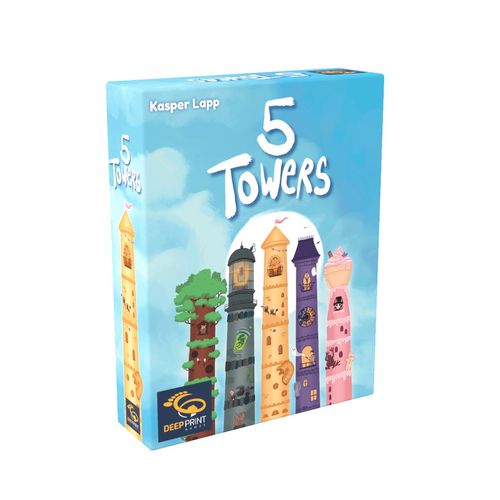
5 Towers
5 Towers Rulebook
Table of Contents
Table of Contents
Overview
A game by Kasper Lapp for 2 to 5 players, ages 7 and up.
Components: 110 cards
Don't feel like reading the rules? Watch the video explanation at fivetowers.deep-print-games.com
The Cards
Each card has a value ranging from 0 to 15 and belongs to one of the 5 types of tower:
- Candy tower (pink)
- Scary tower (purple)
- Tree tower (green/brown)
- Scrap tower (gray)
- Sand tower (yellow)
In 2- and 3-player games, there is one card of each value, from 0 to 15, for every type.
In 4- and 5-player games, there is also an extra copy of the following values for every type: 0, 2, 5, 7, 10 and 12.
The Towers
Each time you gain cards during the game (see next page), you must add them onto your towers, following these building rules:
- Each player can only have one tower of each type, and so can build a maximum of 5 towers.
- All cards in a tower must be of the same type.
- When adding a new card, you must place it onto the top half of the uppermost card of that tower (or - if it's your first card of that type - start a new tower with it). Make sure that all values within the tower remain visible.
- The values on the cards within each tower must decrease as you go up. This means you can only add a card if its value is lower than the value of the card it is placed onto. However, there are two special cards that break this rule as follows:
- Onto an 8, you can place a card of any value of the same type.
- A 9 can be placed onto a card of any value of the same type, except onto a 0 (which is the tower top).
- Once placed, the order of the cards within each tower cannot be changed.
Setup
With two or three players, remove the 30 cards with the extra-copy symbol and put them back in the box. Use only the remaining 80 cards.
With four or five players, use all 110 cards.
Shuffle the cards and place them face down as the draw deck in the middle of the table. Leave space for a discard pile and a display of 5 cards.
Choose a starting player, who will make the initial bid in the first round.
Playing the Game
The game is played over a series of rounds. At the start of each round, reveal 5 cards from the draw deck and place them face up in the display.
Then continue the round by carrying out these 3 steps in order:
- Bidding
- Building
- Clean up
1) Bidding
The starting player makes the initial bid by saying how many cards from the display they want to take, thus announcing a number from 0 to 5.
Then the bidding proceeds clockwise around the table. When it is your turn, you must either raise the current bid by announcing a higher number or pass. This continues until each player has had exactly one chance to bid or until a player made a bid of 5 (as this is the highest possible bid).
The player with the highest bid then chooses exactly as many cards from the display as they announced and puts them in their hand.
Example: Hedda is the starting player and makes a bid of 3. Peter doesn't want to or cannot raise that bid and therefore passes. Anni makes a bid of 5 and immediately takes all five cards from the display into her hand. Thus Lina, who sits to Anni's left, does not get the chance to make a bid this round as she cannot raise it beyond 5.
2) Building
Once you've made the highest bid and taken the cards into your hand, continue as follows:
a) If you like, you may now tear down the uppermost card of one of your towers. This lets you get rid of a low-valued card that is hindering your ability to build. Remove the card from its tower and place it face down beside you, forming your teardown pile. Be careful though, the more cards you have in your teardown pile at the end of the game, the more points you'll lose.
Important: Cards with a value of 0 are tower tops. These you cannot tear down. So once you've built the tower top of a certain type, you cannot take any more cards of that type (since you cannot even place a 9 onto a tower top).
b) Then, add all cards from your hand onto your towers (in any order). For details see the building rules above.
Example: Anni has taken all five cards from the display into her hand. At the moment, she has only the yellow sand tower in front of her, whose uppermost card is the 6. She tears down the 6 and is now able to add the 7 onto her sand tower as well as build all further cards from her hand.
Important: During bidding, you should consider which cards you can actually build and so only make bids you can carry out. However, if during building you notice that you are unable to add all the cards you've taken, you must cancel your entire building step. Return all cards that you've just taken to the display (and if you've torn down a card, return it to its tower as well). Then, revert to your turn of the bidding and adjust your bid accordingly or pass. Proceed with the bidding step from there.
Example: If Anni's sand tower in the example above had included the 6 and the 4, she could not have made a bid of 5, since there would have been no way for her to add the 7 onto her sand tower. So she must return all five cards to the display, adjust her bid to 4 and then Lina would get her chance to make a bid of 5 if she could.
3) Clean Up
Once the building step is finished, clean up the display by discarding any remaining cards in it face up to the discard pile.
Then start a new round in which the starting player is the player to the left of whoever just carried out the building step.
Special case: If the starting player makes an initial bid of 0 and all other players pass, the round ends immediately. Discard all cards from the display and start a new round. The starting player remains the same.
Attention: At the end of the round in which the draw deck runs out for the first time, shuffle the discard pile and form a new draw deck from it. Then continue as usual.
End of the Game
The game ends at the end of the round in which the draw deck runs out for the second time. When this happens, do not shuffle the discard pile again. This way, there may be fewer than five cards in the display for the final round. If this is the case, the highest possible bid changes accordingly. Once you've carried out the building step of the final round (or if all players have passed), the scores are worked out.
Scoring
To work out the scores, each player does the following:
A) First, gain victory points (VP) for your towers:
- Gain 1 VP for each card that is in a tower that has no tower top (has no card of value 0).
- Gain 2 VP for each card that is in a tower that does have a tower top.
- Then choose one of your towers as your main tower (preferably the one with the most cards) and gain 1 additional VP for each card in it.
B) From your resulting score, subtract VP for any cards in your teardown pile: Subtract 1 VP for your first torn down card, 2 VP for your second, 3 VP for your third, and so on.
Whoever has the most VP wins. In the case of a tie, all tied players share the victory.
Scoring example: A tower with no tower top scores 4 x 1 VP = 4 VP for its 4 cards. A tower with a tower top scores 3 x 2 VP = 6 VP for its 3 cards. If that tower with a tower top has 6 cards and is chosen as the main tower, it scores 6 x 2 VP = 12 VP, plus 6 x 1 VP = 6 VP for being the main tower. If the player has 2 cards in their teardown pile, they subtract 1 VP for the first and 2 VP for the second, for a total of -3 VP.
To tally your scores, the Deep Print Games App offers virtual scoring pads for this and many more of their games. It is available for free on the App Store and on Google Play.
Great Powers – Additional Rules (Promo)
These rules give each type of tower its own power. The rules of the base game remain in effect, but the following special rules also apply.
Overview
- Tree tower: You can discard cards from this tower to take fewer cards from the display (but you cannot take new tree cards this way).
- Scrap tower: Whenever you build a scrap card, you may also immediately add any one card from your teardown pile to its tower.
- Sand tower: You can build cards on the top OR bottom of this tower.
- Scary and Candy towers: At game end, gain 3 VP for each pair of cards of the same value that appears in both towers.
The special rules in detail:
Tree Tower
If you have a tree tower, you may bid a higher number than the number of cards you take from the display during bidding (even higher than 5). If you win the bid, you "pay" the difference between your bid and the number of cards you take by placing that many cards from the top of your tree tower face up onto the discard pile in the center of the table. Important: If you pay with tree cards, you cannot take any new tree cards from the display in the same round.
Note: Once your tree tower has a tower top, you can no longer discard tree cards to increase your bid.
Example: Your bid of 6 was the highest in the round. You take 4 cards (which are not tree cards) from the display and discard 2 cards from your tree tower (4 + 2 = 6).
Scrap Tower
Each card you add to your scrap tower immediately triggers the following effect: You may take any one card from your teardown pile and add it to its tower according to the usual building rules. This can even be the card you just tore down before building. If the card taken from the teardown pile is itself a scrap card, it immediately triggers this effect again when you add it.
Example: You win the bid and take candy-11 and scrap-15 from the display into your hand. Since your candy tower consists of 14 and 10, you first tear down the 10 and place it in your teardown pile. Then you build the candy-11 from your hand, followed by the scrap-15, which immediately allows you to take the candy-10 from your teardown pile and build it again.
Sand Tower
When building, you may add cards either to the top of your sand tower or to its bottom. You can never add cards to both ends in a single round. To add a card to the bottom, slide the new card under the lowest card so that the value remains visible.
Note: Once your sand tower has a tower top, you can no longer add cards to either end of it.
Example: Your sand tower consists of 11, 7, and 6. In the display, there are the 4, 8, and 12. You could either add the 12 and the 8 to the bottom (the special role of 8 still applies) or add the 4 to the top, but you can't add all three cards.
Scary Tower and Candy Tower
At the end of the game, score 3 additional victory points for each card in your scary tower that has a card of the same value in your candy tower. Each card can be part of only one such pair.
Example: At the end of the game, your scary tower consists of 12, 11, 7, and 3, and your candy tower consists of 14, 11, 8, 12, and 0. You receive 6 victory points for your 2 pairs (12 and 11).